Recently, the Russian Ministry of Defense announced the establishment of the “Era Military Innovation Technology Park”, which focuses on scientific research, testing and simulation of advanced weapons, military and special equipment. Coincidentally, the US military is also stepping up the development of the “Soldiers Build Intelligence System Military Training Support” project, hoping to better assist officers and soldiers in conducting military intelligence training by providing equipment, simulators and simulation modeling services. The frequently mentioned military simulation technology has attracted attention from all parties. With the rapid development of cloud computing, big data, artificial intelligence and other technologies, military simulation technology has made significant progress in equipment construction, military exercises, combat training and logistics support. At present, major military powers have recognized the huge application prospects of simulation technology in the military field and regard it as an “advanced intelligence contest” in modern warfare.
The “virtual battlefield” can also deploy troops
Once upon a time, we all “learned about war from war”. The emergence of military simulation technology has allowed us to learn about future wars from the “virtual battlefield”.
Simulation technology mainly relies on computer and other equipment platforms, and uses mathematical models to conduct scientific research, analysis, evaluation and decision-making on issues that need to be studied. Military simulation systems are simulation systems built specifically for military applications. They can conduct quantitative analysis of combat elements such as land, sea, air, space, electricity, and the Internet, the performance of weapons and equipment, and combat operations, and then accurately simulate the battlefield environment, present relevant battlefield situations, and achieve effectiveness evaluation of the combat system and command decision-making assistance.
At present, military simulation systems have become an effective means of studying future wars, designing weapons and equipment, and supporting the evaluation of tactics, and they run through the entire process of weapons and equipment development and testing. In recent years, military simulation technology has been increasingly regarded as a multiplier for improving combat effectiveness and one of the key technologies for national defense security and troop construction and development.
The United States has always listed modeling and simulation as an important key defense technology. As early as 1992, the United States announced the “Defense Modeling and Simulation Initiative” and established a special Defense Modeling and Simulation Office. The United States also specifically listed the “integrated simulation environment” as one of the seven driving technologies to maintain the US military advantage. At the same time, European countries attach great importance to the development of military simulation technology, and strive to continuously improve simulation methods in the process of developing a new generation of weapon systems, thereby improving the comprehensive effectiveness of weapon equipment construction and development.
In fact, military simulation technology has allowed people to fully learn about future wars in experiments. Before the outbreak of the Gulf War, the US Department of Defense used military simulation technology to analyze and determine the direct consequences of Iraq igniting all oil wells in Kuwait, which had a profound impact on the US military’s formulation of the Gulf War combat plan. In the integrated ballistic missile defense system project carried out by the US military, modeling and simulation methods are specifically used to conduct a preliminary assessment of the ballistic missile defense system. At the end of 2017, the US Department of Defense’s Advanced Research Projects Agency invested 12.8 million US dollars specifically for the construction of virtual simulation space battlefields. The US Army also spent 57 million US dollars to develop the Army Infantry Training System – this immersive military virtual simulation training system can provide soldiers with a more realistic battlefield combat simulation environment.
A brainstorming session to plan operations
From artillery simulation, aircraft simulation, missile simulation to today’s various types of weapon system equipment simulation and combat simulation, while simulation technology continues to meet the needs of military applications, it is also rapidly developing in the direction of virtualization, networking, intelligence, collaboration and universalization. In order to continuously improve military simulation calculation methods and improve simulation technology, people are constantly launching a “brainstorming” to plan operations.
Mathematical modeling algorithm. Mathematical model is the basis of simulation. To carry out simulation, we must first build a mathematical model of the object to be simulated. At the same time, the correctness and accuracy of the mathematical model directly affect the credibility of the simulation calculation results. In recent years, the rapid development of artificial intelligence technology has provided new ideas for mathematical modeling. Introducing artificial intelligence to build mathematical models can not only effectively improve the realism, reliability and accuracy of simulation models, but also further improve the efficiency of modeling and simulation.
Virtual reality technology. With virtual reality technology, people can interact with objects in a virtual simulation environment through related equipment, thereby creating an effect of “immersion” in the real environment. The augmented reality technology that has emerged in recent years has further increased the user’s perception of the virtual simulation system, and can superimpose virtual objects, scenes, and information generated by the military simulation system onto the real scene. The U.S. Army is currently relying on virtual reality and augmented reality technologies to develop the future overall training environment to achieve seamless, mixed immersive combat training.
Network grid technology. The realization of military simulation is inseparable from the strong support of computers, local area networks, software engineering and other technologies. The distributed interactive simulation that integrates simulation equipment or systems of different types in different locations into a whole provides a more realistic application environment for military simulation. In recent years, grid technology that can realize the rapid transmission of various types of information and resource sharing has become a research hotspot for military simulation. The US Department of Defense has begun to use the “Global Information Grid” plan to establish a military grid that communicates various information elements on the battlefield and realizes the dynamic sharing and collaborative application of various military network resources.
Winning the war before it starts
The future information warfare is an integrated war that is carried out simultaneously in multiple dimensions such as land, sea, air, space, electricity, and the Internet. Not only is the battle structure complex and the weapons and equipment diverse, but it also places higher demands on the combatants and the use of tactics. Only by building a “virtual battlefield” for future wars with the help of military simulation technology and realizing the scientific coordination of factors such as the scale of war, the course of war, war investment, the number of combatants and weapons and equipment, the targets of attack and the intensity of attack, can we be sure of victory before the war begins.
In the field of combat experiments, the U.S. military has fully reduced the losses caused by improper combat plans and action plans through a large number of computer simulation evaluations and iterative optimizations. The Russian military’s combat regulations and tactics are also “optimal battlefield solutions” obtained through scientific deduction and simulation calculation using mathematical models. Through military simulation analysis and evaluation, battlefield commanders and fighters can quickly understand the trend of war simulations and carry out effective responses according to various changes in the “virtual battlefield”, thereby effectively improving the effectiveness of combat experiments.
In the field of military training, individual soldier training can be carried out through an immersive virtual simulation training environment, which can be as close to the battlefield environment as possible and effectively improve the training effect. In recent years, the US Army has specially opened a “simulated immersion” training course in the “Advanced Course for Officers”. Through the implementation of virtual simulation military training, the organization and implementation of training are not restricted by time and weather conditions. The distributed training simulation system can even enable trainees in different locations to participate in the training together. By modeling and simulating the specific battlefield environment, tactical background and enemy forces, the military training system can also provide trainees with a more realistic battlefield perception.
In the field of equipment demonstration, the technical support of simulation systems is required throughout the life cycle of weapons and equipment development. At present, the United States has extensively adopted simulation technology in new weapon system development projects to fully support the development and testing, live-fire evaluation and combat testing of weapons and equipment. The U.S. Missile Defense Agency has further explored effective measures to deal with incoming missile threats through missile threat target modeling and simulation. The U.S. Navy simulates the operation of ship systems and crew members through mission analysis simulation software, and obtains simulation results for determining and optimizing the number of crew members. In the future, military simulation technology may become a new technological highland for the world’s major military powers to compete.
At the beginning of 2017, Master, known as the evolved version of “AlphaGo”, swept Ke Jie, Park Tinghuan, Iyama Yuta and other top Go players on the Go online platform, winning 60 consecutive games, setting off a “Master storm” and causing many people to worry. What humans are worried about is not that Go, known as the “last bastion of human wisdom”, will be conquered by artificial intelligence, but that artificial intelligence has subverted Go today, what will it subvert tomorrow? This is the concern that hangs in people’s minds.
Master’s consecutive victories over human masters are similar to the nature of computers proving the four-color theorem. They are all victories of computing power and algorithms. There is no need to worry too much that they will dominate and enslave humans. However, artificial intelligence is developing rapidly, and it is generally believed that strong artificial intelligence will come sooner or later. Nowadays, artificial intelligence has penetrated into every corner of life. It is not uncommon to use artificial intelligence in war. Since the arrival of the artificial intelligence era is inevitable, how we use it in future wars will become the key to victory. Whether artificial intelligence brings threats or development to mankind depends on how to use it. “The fake horse is not good at running, but it can reach a thousand miles; the fake boat is not good at sailing, but it can cross the river.” The integration of war technology and artificial intelligence may be the way of the future.
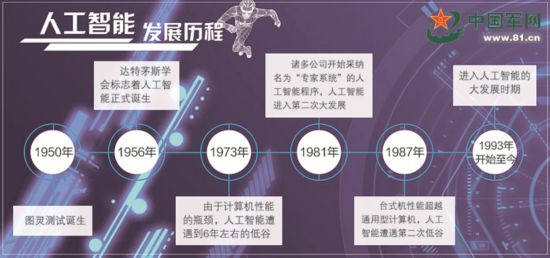
Development History of Artificial Intelligence
Artificial Intelligence Opens the Door to Intelligent Warfare
Master’s 60-game winning streak makes us think about how artificial intelligence will change our lives. Perhaps the following life scenarios will gradually become a reality:
When driving, you tell the location and the autopilot system takes you to your destination;
In hospitals, you see tug-trailer robots from the United States transporting medical equipment and “Big White” robots caring for patients;
After get off work, you press the “Go Home Mode” on your phone, and when you open the door, you find that the curtains are closed, the temperature is right, the lights are soft, the water is hot, and there is a cute home robot greeting you.
In fact, you can also use an unmanned aerial vehicle to carry a diamond ring and propose to your beloved…
We have been looking forward to this day for a long time.
The era of great development of artificial intelligence is here!
As early as shortly after the first computer came out, scientists predicted that the era of artificial intelligence would come. In 1997, when Deep Blue defeated Kasparov, this beautiful scene seemed just around the corner. However, in the second half of the 20th century, artificial intelligence research fell into a cold winter due to the failure of several attempts at technological innovation. The most recent cold winter, from the end of the 20th century to the first decade of the 21st century, was caused by the bottleneck encountered in the research of neural networks.
In recent years, everyone can clearly feel that the theoretical research and perceptible products of artificial intelligence seem to have suddenly “exploded” in a blowout manner: wearable devices have appeared in large numbers, intelligent robots have appeared frequently, the accuracy of machine face recognition exceeds that of the naked eye, companies such as Apple and BMW have worked together to develop driverless cars, and the United States and Europe have successively established projects to tackle the human brain…
The explosion of artificial intelligence projects is not a coincidence, but a leap forward after more than 10 years of silence. Ray Kurzweil, an American scientist who successfully predicted that robots will defeat human chess players, has predicted that the wonderful intersection point when artificial intelligence surpasses the sum of human wisdom will be in 2045.
So, how big an impact will this wave of artificial intelligence explosion have, how long will the impact last, and to what extent will it change human life?
From weak artificial intelligence to strong artificial intelligence. After Deep Blue dominated the chess field in 1997, artificial intelligence did not change the world as expected, and Deep Blue disappeared after more than 10 years of silence. Artificial intelligence has also remained at the stage of weak artificial intelligence and has not made any breakthroughs. This period of nearly 20 years has become the longest artificial intelligence winter to date. Some people joked that the greatest achievement in the field of artificial intelligence in the past 20 years is that Spielberg made the science fiction movie “Artificial Intelligence” that has captivated the world. Spielberg put all the rich fantasies of human beings about the future world into the movie world he created. Subsequently, a series of movies about artificial intelligence such as “Robot Butler”, “Super Hacker” and “Ex Machina” came into being. Artificial intelligence has begun to enter all aspects of human life. The use of artificial intelligence in industries such as medicine, education, services, manufacturing, and even in the military field has become common, which makes many military enthusiasts think about what artificial intelligence means to the military field and where it will go in the future?
“AlphaGo” only represents the latest achievements of artificial intelligence in the fields of deep learning of machines based on neural networks, high-performance computing and big data technology, and is a weak artificial intelligence. However, some military experts predict that the application of strong artificial intelligence in the future will bring about huge changes, just like the entry of big data five years ago. In the military field where competition and game are more intense, artificial intelligence has been increasingly moving towards the battlefield since the emergence of computers in the last century, promoting the advent of the era of intelligent warfare.
Artificial intelligence is taking big steps onto the battlefield
Artificial intelligence is an important branch of modern information technology. The world’s first programmable “Giant” computer was born in Britain during World War II. Its purpose was to help the British army decipher German codes. In recent years, artificial intelligence has been increasingly used on the battlefield, profoundly changing the face of war. In summary, the application of artificial intelligence in the military field is mainly reflected in the following five aspects:
Intelligent perception and information processing. The rapid development of micro-electromechanical systems, wireless sensor network technology, and cloud computing technology has further developed battlefield perception methods in the direction of intelligent perception and information fusion processing. The U.S. military, Russian military, French military, German military, etc. are all equipped with digital soldier systems with intelligent information perception and processing capabilities, such as the U.S. military’s “Night Warrior” and the Russian military’s “Warrior”. In fiscal year 2015, the U.S. Department of Defense’s Advanced Research Projects Agency added research and development projects such as the “cerebral cortex processor”. This processor simulates the structure of the human cerebral cortex to solve problems such as real-time control of high-speed moving objects. In the future, its application will greatly improve the autonomous action capabilities of robots and drones.
Intelligent command and control assists decision-making. The military of various countries develops various military information systems in order to build a powerful grid network information system and improve intelligent evaluation and decision-making assistance capabilities. The command and control automation systems of major military powers are constantly developing, pursuing stronger information and decision-making advantages than their opponents. In recent years, the US military has established a cyber command to vigorously strengthen its network attack and defense capabilities, focusing on the development of intelligent diagnostic information systems for network intrusions based on cloud computing, big data analysis and other technologies, which can automatically diagnose the source of network intrusions, the degree of damage to one’s own network and data recovery capabilities.
Unmanned military platforms. Western countries began to attach importance to the research and development and application of small drones, remote-controlled unmanned vehicles and unmanned boats during World War I. At present, the armies of more than 70 countries in the world are developing unmanned system platforms. The US military has equipped more than 7,000 drones, and more than 12,000 ground wheeled (or tracked) robots have been put into use on the battlefields of Iraq and Afghanistan. In the near future, the US military will achieve that ground robots account for one-third of its ground forces, and the carrier-based X-47B drone will account for one-third of the total number of carrier-based aircraft, further promoting the coordinated training and exercise between manned and unmanned platforms.
Bionic robots. Since the 21st century, robot technology has developed rapidly. Various bionic robots such as humanoid robots, robot fish, and robot insects have been continuously introduced and have been increasingly used in the military field. For example, the US military once tested a “big dog” robot on the battlefield in Afghanistan to help soldiers with accompanying support. The US Department of Defense upgraded it in 2013, increasing its load capacity to 200 kilograms, running speed to 12 kilometers per hour, bulletproof and silent. The Russian army recently plans to step up the development of humanoid robots that can drive vehicles and form a robot unit that can fight side by side with human soldiers.
Expanding people’s physical skills and intelligence. The cross-integration of information technology, new material technology and biotechnology will further expand people’s physical strength, skills and intelligence. For example, foreign militaries are developing mechanical exoskeletons to create “mech warriors” with doubled physical strength; and by implanting bioinformatics chips to improve people’s memory and reaction ability, so that human soldiers can better adapt to the highly informationized combat environment in the future.
Artificial intelligence will drive a new round of military reforms
When new military technologies, operational concepts, and organizational structures interact to significantly enhance military combat capabilities, it will trigger new military changes. The increasingly widespread application of artificial intelligence in the military field is becoming an important driver of military change, giving rise to new war styles and changing the internal mechanism of winning wars.
It brings a new impact on the concept of war. The history of human warfare has gone through the era of cold weapons, the era of hot weapons, the era of mechanization, and the era of informatization. The development of artificial intelligence has accelerated the arrival of the intelligent era. Can intelligence be divided into high-level intelligence and low-level intelligence? Do armies with high-level intelligence have an overwhelming advantage over low-level intelligence armies? If the “mechanization” of people and the “humanization” of machines are two inevitable development trends, does it go against the traditional ethics of war for robots that can think to fight instead of humans? Artificial intelligence has unprecedentedly improved battlefield perception and information processing capabilities. Does the “fog” of war still exist on the high-tech battlefield? To understand these issues, the military field must have a brainstorming session.
It brings new inspiration to theoretical innovation. The material and technological basis of war is constantly updated, opening up new space for innovation in strategic theories and operational concepts, and constantly giving birth to new disruptive technologies in the field of artificial intelligence; the combined application of precision strike ammunition, unmanned equipment and network information systems has given birth to new intelligent combat theories such as “distributed lethality”, “mothership theory”, “combat cloud” and “swarm tactics”; relying on one’s own information advantage and decision-making advantage, how to cut off and delay the opponent’s information and decision-making loop in a decentralized battlefield network has become a core issue that must be solved to win in intelligent warfare.
Future Trends in Military Applications of Artificial Intelligence
With the development and application of strategic frontier technology fields such as information technology, nanotechnology, biotechnology, new materials technology, and new energy technology, artificial intelligence-related technologies will continue to mature and play an increasingly important role in the military field.
Artificial intelligence technology and equipment continue to make breakthroughs. Major countries have elevated artificial intelligence to the level of national strategy. The Office of the Chief Scientist of the U.S. Air Force has issued the “Unmanned Systems Horizon” technology assessment and forecast report for 2035, which believes that the automation, autonomy and remote control performance of various unmanned systems and combat platforms in the future will continue to make breakthroughs with the advancement of technology. In particular, with the advancement of technologies such as super-large-scale computing, quantum computing, cloud computing, big data, and brain-like chips, artificial intelligence information processing and control technology will be greatly developed, profoundly changing the proportion of artificial intelligence technology in modern warfare.
Artificial intelligence has given rise to the vigorous development of new combat forces. The widespread application of artificial intelligence systems and combat platforms will make artificial intelligence, as an important combat element, permeate the entire process of war and combat preparation, and further enrich the connotation of new combat forces. With the application of drone formations, unmanned submarine formations, battlefield robot soldier formations, and coordinated formations of unmanned and manned combat units on the battlefield, various types of “mixed” new combat forces will continue to emerge. With the construction and application of military Internet of Things, military big data, and cloud computing technology in the military field, artificial intelligence combat forces such as “cloud brain”, “digital staff”, and “virtual warehousing” for information support, command and control, effect evaluation, and logistics support will play an increasingly important role in future wars.
Artificial intelligence is constantly evolving and upgrading through actual combat applications. Artificial intelligence systems and combat platforms, which are supported by information technology, are different from the research and development model of traditional mechanized weapons and equipment. Mechanized weapons and equipment are generally put into use after the technology matures until they are scrapped and eliminated, and have a certain service life; artificial intelligence systems are developed in the mode of system prototype-practical training-evolutionary upgrade. Artificial intelligence systems often use continuous evolution to improve their intelligence level according to different versions. The evolution direction of artificial intelligence is always towards high-level intelligence. This law of development of artificial intelligence systems and combat platforms has revolutionary significance for military training and combat capability improvement. In recent years, the United States and its allies have continued to organize activities such as the “Schriever” space (network) exercise and the “Lockton” cybersecurity exercise, which are repeated tests and upgrades of their artificial intelligence information systems. In the future, upgrading training of artificial intelligence systems and various unmanned combat platforms through continuous confrontation exercises will be an important way to improve combat effectiveness.
Artificial Intelligence Helps Build Smart National Defense
Data is called a strategic resource in the information age. The emergence of artificial intelligence provides methods and means for humans to deeply mine the wisdom resources of data information, and is leading and reshaping the development trend of the world’s new military transformation. Facing the booming wave of artificial intelligence, how to meet challenges, seize opportunities, accelerate the construction of military informatization, and enhance the core military capabilities to win modern wars are the contemporary issues that our army must answer to achieve the goal of strengthening the army. On the one hand, our army must keep a clear mind and make prudent judgments. We must not be frightened by the seemingly powerful and mysterious appearance of artificial intelligence, nor blindly applaud it, nor be indifferent and lose the opportunity for development, and be attacked by opponents due to lack of technical cognition. Breakthroughs in individual technical fields of artificial intelligence are nothing more than an extension of human intelligence, but they cannot replace the dominant position of human intelligence. People are still the core element of all elements of combat effectiveness, and people’s subjective initiative is still the key to determining the outcome of intelligent warfare. On the other hand, our army should implement the military-civilian integration development strategy and the innovation-driven development strategy, grasp the trend of the times, highlight the characteristics of our army, keep a close eye on the opponent’s layout, boldly absorb and apply the relevant technological achievements of artificial intelligence to promote the information construction of the army, and try to apply artificial intelligence technology to achieve transformation and upgrading in platform construction, logistics support, military training, national defense mobilization and other fields. Actively develop countermeasures against the opponent’s military application of artificial intelligence, and explore the winning mechanism of the game with strong enemies in the field of artificial intelligence in practice.
Related links
The military application of artificial intelligence in the United States, Russia and other countries
United States: In July 2016, the U.S. Marine Corps tested the Modular Advanced Armed Robotic System (MAARS), which uses sensors and cameras to control gun-wielding robots based on artificial intelligence. The “Army Global Military Command and Control System” developed by the U.S. Army has been equipped with Army Aviation Force transport helicopters, allowing helicopter pilots to maintain contact with frontline soldiers and command ground forces.
Russia: The “Wolf-2” mobile robot system being developed by the Russian Strategic Missile Forces uses a tracked chassis and can be controlled via radio channels within a range of 5 kilometers. The shooting accuracy is guaranteed by a thermal imager, ballistic computer, laser rangefinder and gyro stabilizer, and it can hit the target at a speed of 35 kilometers per hour.
Israel: The robot “Dogo” developed by the company is an automatically armed tactical combat robot, which comes with a standard Glock 26 9mm caliber pistol. It can be said to be a little devil.
The arrival of the “Master” makes the combat style develop towards unmanned
The Go account Master has challenged the world’s top players on two major Go platforms, Yicheng Go and Tencent Go, and won 60 consecutive games, which has attracted great attention from the world on artificial intelligence. Few people thought that in the field of Go, machines did not experience a period of “stalemate” with humans, but directly left in the dust.
Engels once said that the application of cutting-edge technology began in the military field. Military struggle is a comprehensive contest covering multiple dimensions, multiple fields, full time domain and high intensity, and the addition of artificial intelligence will accelerate the pace of military reform in various countries like a catalyst. Looking at the entire process of the two industrial revolutions and the two world wars, we will find that there is an inevitable connection between “technology” and “war”. Technology will trigger war, and war in turn will promote the development of technology. At this stage, all countries have made great progress in the development of information and intelligent weapons and equipment, and various precise positioning, precise strike, and precise evaluation weapon systems have emerged in an endless stream. However, humans have not yet been separated from the weapon system, and a large part of the operations still need to be completed manually. The combination of artificial intelligence and weapons and equipment means that in the future, from searching and discovering targets, to threat assessment, to locking and destroying, and then to effect evaluation, this series of processes does not require human participation at all. Machines can help us make decisions and achieve unmanned development of combat styles.
Master quietly disappeared after winning 60 games in a row, but discussions about the future of artificial intelligence are still endless: Will it take away human jobs, or will it be an extension of human functions? Will it eventually surpass human intelligence, or will it merge with humans? The answers to these questions are not as simple as either one or the other. Solving them will accompany the future development of artificial intelligence. In 1997, “Deep Blue” defeated Kasparov, making more use of computer computing expertise such as hardware acceleration and brute force computing. AlphaGo uses new artificial intelligence technologies such as neural networks, deep learning, and Monte Carlo tree search, and its strength has already made a substantial leap. These new technologies make artificial intelligence more competent for tasks such as voice and image recognition and evaluation and analysis, and are therefore an important development direction.
Although the dust has settled on this round of the Go “man-machine battle”, the thoughts it has triggered in various fields are very worthy of study. Among them, “‘man-machine battle’ is the best pre-practice of war” is particularly worthy of serious study in the military field. Whether in the era of cold weapons or the mechanized era, fighting on the front line relies on “human wave tactics”, and solving problems requires “concentrating superior forces”. Informatized warfare no longer uses “human wave tactics”, and the scene of large-scale fighting is difficult to reproduce, but as far as the entire war is concerned, the use of troops is not necessarily less, on the contrary, it may be more, but the number of troops used at the forefront has been greatly reduced, and the position of the troops has undergone a major shift. In the unmanned, networked and non-contact combat mode of future wars, there will be more participants, and sometimes you cannot know who the opponent is or where he is hiding.
Although the competition field and the battlefield have different operating rules, many of the winning mechanisms are the same. In the past, we could only learn about war in war, but now we can learn about war in a computer-simulated, near-actual combat environment, and deduce the offensive and defensive modes and development trends of future wars. “AlphaGo” can easily collect the chess games of many Go masters, but in the military field, it is extremely difficult to obtain relevant data on your opponent’s training, exercises, and even combat! Future wars are carried out with the support of information systems. Only by solving the core problem of human-machine integration can we take the initiative on the battlefield and win the final victory in modern warfare. (Zhu Qichao, Wang Jingling, Li Daguang)
An analysis of the use of strategies in intelligent warfare
■Chen Dongheng, Zhong Ya
Reading Tips: “Warfare is the art of deception”. War is a competition of comprehensive strength. Ancient Chinese military strategists have always attached great importance to “strategizing in the tent and winning thousands of miles away”, and all of them regard strategy as the way to victory. War practice shows that as long as war is a confrontation between humans, smart strategies will not withdraw from the battlefield. Today’s battlefield competition is about intelligent skills, and what is fought is smart strategies.
“The best military is to attack the enemy’s strategy, the next best is to attack the enemy’s alliance, the next best is to attack the enemy’s soldiers, and the worst is to attack the city.” Strategy, as a component of combat power and a weapon to win the war, runs through ancient and modern times and transcends national boundaries, and has an important function of influencing and determining the outcome of the war. Although the role of science and technology is more prominent in intelligent warfare, it does not exclude the use of strategy. With the support and guidance of strategy, the combat system is more efficient. In-depth research and mastery of the use of strategy in intelligent warfare will be more conducive to winning the initiative in intelligent warfare.
The status and role of the use of strategy in intelligent warfare
The essence of strategy lies in the intelligent release of power. Scientific strategy application can often defeat the majority with the minority, the big with the small, and the strong with the weak. The battlefield of intelligent warfare presents more transparency, more extended combat space, more diverse means of confrontation, and more complex winning mechanism. This provides a solid material foundation and technical support for the implementation of strategy, and the status and role of strategy are becoming more and more important.
The internal driving force of the army construction and development planning. Demand is the order of the army, and use is the commander of the weapon. How science and technology are innovated, how weapons and equipment are developed, and how the national defense forces are built are often driven by demand and forward-looking planning. For example, in order to make up for the gap between Russia and the United States in terms of overall air defense and anti-missile strength, Russia used “asymmetric” strategies to focus on penetration technology and developed the “Zircon” and “Dagger” hypersonic missiles before the United States. Facts show that the application of strategies mainly focuses on “Tao” and “Fa”. The more reasonable the design and the more scientific the application, the more it can stimulate the motivation, vitality and potential of innovation and creation, and trigger a revolution in science and technology, weapons and equipment, and military construction and combat methods. Only when intelligent warfare, scientific and technological innovation and weapons and equipment development are closely connected with the needs of scientific war strategies can they adhere to the correct direction and be better transformed into actual combat power.
A multiplier of the actual combat effectiveness of the combat system. In the combat power spectrum, strategy, as an important soft power, has the value and significance of providing scientific methodological guidance, appropriate time and opportunity selection and correct path support for the use of military hard power. For example, Iran once used the “dislocation” tactics to launch a large-scale retaliatory air strike against Israel, first using hundreds of cheap drones to attract the consumption of Israel’s expensive air defense system, and then using more advanced high-value ballistic missiles to penetrate, which improved the hit rate to a certain extent. Facts show that when facing an opponent with superior hard power, if the strategy is used properly, it can also achieve miraculous results; and the same hard power may have very different combat effectiveness when using different strategies and tactics. In intelligent warfare, although the “blade” of military hard power is faster, in order to make it more effective, it still needs to rely on more sophisticated strategic “sword skills”.
Dependent variables of hybrid warfare operations. Strategy can not only empower military hard power, but also has a strong direct combat function, and can even defeat the enemy without fighting by “soft killing”. For example, the United States once spent a lot of money to capture the leader of al-Qaeda, Osama bin Laden, but he seemed to have disappeared from the world, and technical means could not determine his exact hiding place. He was finally tracked down by targeting his messenger through strategic use. The United States’ “live broadcast” “Spear of Poseidon” operation attempted to show the strength of the US military by killing Bin Laden to shock the international community. Intelligent warfare is a hybrid warfare, which has entered a new era of global live broadcast, universal participation, and full coverage. More and more countries are adopting strategic methods to enhance their own confidence and strike the opponent’s will to resist, and the strategic “soft kill” combat function is becoming more and more apparent.
Basic mechanism of intelligent warfare strategy application
Intelligent warfare, high-level development of artificial intelligence, rapid iteration, full spectrum penetration, and high-efficiency release, make the application of strategy have more dimensional support and stronger drive, showing a unique operation mechanism.
Cluster operation of strategy application. The application of strategy is based on the underlying logic of war operation and follows the law of evolution of the subject from individual to team and then to system. From a historical perspective, the application of strategy warfare in the cold weapon era relied more on the wisdom and experience accumulation of generals. Natural factors such as geography and weather are the main grasps of strategy operation. The burning of Red Cliff and borrowing arrows from straw boats are vivid footnotes. In the mechanized era, in order to adapt to the increasingly complex composition of military branches and the needs of fast-paced operations, the “General Staff” of senior military institutions dedicated to war planning services came into being. The “General Staff” in the two world wars is a typical representative. In the information age, the use of war strategies mainly relies on the control of information, and information power has become the main support behind strategic planning. In intelligent warfare, the comprehensiveness of technology application, the systematic nature of force planning, and the platform characteristics of game confrontation are more prominent, and the internal requirements are that the subject of strategy implementation should shift to a more powerful systematic platform.
Algorithm-driven strategy application. Strategy is based on strategy. The essence of planning is calculation, calculation of the world situation, calculation of military situation, calculation of development trend, calculation of strength and weakness, calculation of winning advantage… Whether it is calculation by human brain or machine, calculation by generals or calculation by teams, calculation is always the most critical supporting factor. Generally speaking, whoever has stronger computing power, more precise algorithms, and faster calculations can grab the “calculation” machine and win the victory. In the era of intelligent calculation, artificial intelligence participates in strategic decision-making with human-machine hybrid algorithms or machine algorithms, which greatly enhances the efficiency of calculation. It is based on this that major countries have focused on breakthroughs in artificial intelligence to win the future competition. These artificial intelligences, characterized by strong computing power, have great application potential in simulating battlefield situations, simulating war processes, and assisting decision-making and command. Only by guarding against the opponent’s technical aggression, vigorously improving our computing power, and adding the wings of algorithms to traditional strategies can we be invincible in the strategic game confrontation.
Intelligent support for the use of strategies. In intelligent warfare, strategies are based on the rapid development of artificial intelligence and its extensive military applications. It is a two-way “rush” of human strategic wisdom and “technical” wisdom. Now, the generals’ ingenuity and traditional staff work have become increasingly difficult to adapt to the needs of intelligent warfare. Comprehensive intelligent command and decision-making platforms have become an important support for the implementation of strategies. The command and decision-making system of the US military has developed into a large platform that integrates four-layer structural functions, including “intelligence support, information fusion, mission coordination, autonomous decision-making, action deployment, force allocation, situation adjustment, and real-time tracking”, and has become the brain of its “decision-making center warfare”. The Russian Federation Armed Forces Combat Command Center can dispatch and monitor the training and exercises of the entire army in real time, and undertake combat command tasks in low-intensity small-scale conflicts. It can be seen that intelligent support for strategic planning and strategy implementation has gradually taken shape. Intelligent strategic confrontation has put forward higher requirements for the professional integration of strategic subjects, and promoted the deep integration of human biological intelligence and artificial intelligence, which is “human-like intelligence”.
Main ways to use strategies in intelligent warfare
In intelligent warfare, the era background, supporting conditions, and action mechanisms of strategy application have undergone profound changes. The way of implementing strategies must keep pace with the times, strive to combine traditional strategic advantages with new technologies and new forms of warfare, innovate and expand scientific paths to effectively release strategic energy, and strive to plan quickly, plan carefully, and integrate strategy and attack.
Intelligent technology integration releases energy. That is, make full use of intelligent technology to empower and release energy for strategies. Generally speaking, the effective implementation of strategies is inseparable from accurate information perception, rapid personnel mobilization, and efficient force strikes. The innovative application of artificial intelligence enables people to see farther, hear more closely, know more, and calculate faster, making the army gather and disperse more quickly, move more covertly, and release power more rapidly, which is more conducive to the generation of strategies and the achievement of effectiveness. On the one hand, with the help of the rapidity and autonomy of artificial intelligence, the enemy situation can be quickly grasped through intelligent reconnaissance, the decision-making time can be greatly shortened by using machine algorithms, and the optimal strategy can be selected with the help of simulation deduction; on the other hand, relying on artificial intelligence to release and enhance the efficiency of strategies, modern brain control technology, deep fake technology, information confusion technology, public opinion guidance technology, etc., have greatly expanded the space and means of implementing strategies.
Human-machine complementation releases energy. That is, the strengths and weaknesses of human intelligence and machine intelligence complement each other and enhance efficiency and release energy. The biggest advantage of machine intelligence over human intelligence is that it can fight continuously without being affected by biological factors such as will, emotion, psychology, and physical strength. However, the “meta-intelligence” of human intelligence and its ability to adapt to changes are not possessed by machine intelligence. The two intelligence advantages complement each other and aggregate to form a powerful hybrid intelligence, which strongly supports the use of strategies in war. On the one hand, the “machine brain” safely and efficiently makes up for the shortcomings of the human brain; on the other hand, the human brain responds to special situations on the spot. Facts show that the biggest advantage of human intelligence over machine intelligence is that it can make decisions and deal with different situations on the spot, which just makes up for the shortcomings of machine intelligence. Only by combining the two can we form the optimal solution for intelligent calculation and gather the strongest strategic application.
The platform releases energy as a whole. It is to create a modular intelligent system, an integrated intelligent decision-making command action platform that integrates strategy generation and release. Intelligent warfare, every second counts, improves the time sensitivity of target strikes. The intelligent platform comprehensively uses intelligent computing and command automation technology to efficiently process massive data and complex battlefield situations, creating a “super brain” for commanders. It has significant advantages of good functional connection, high stability, fast operation speed, and high combat efficiency. It is a new quality combat force for strategic planning. Relying on the intelligent command and control system, it can make real-time decisions, form a list of time-sensitive targets, and independently solve the combat units and strike platforms that can be summoned and struck the fastest and best. The hardware and software can accurately strike the targets, and accurate strikes on time-sensitive targets can be achieved in real-time decisions, providing more options for assisting war decision-making and command.
At present, the widespread use of unmanned equipment in the military field is accelerating the evolution of war forms towards intelligence, and unmanned combat has also developed into an important combat style of intelligent warfare. However, it should be clearly seen that unmanned combat, from technical development to combat application, cannot be separated from the role of people, and people are still the “master switch” of the entire chain of unmanned combat. Therefore, unmanned combat is essentially still manned, and more attention should be paid to the construction of manned combat in unmanned combat.
From the perspective of operational design, the mission task is assigned by the mission tasker.
Equipment is the material basis of war, but people are the initiators and controllers of war. The role of any equipment in war is given by commanders and fighters at all levels. From the overall perspective of combat design, war involves multiple fields such as politics, economy, diplomacy, culture, and multiple levels such as strategy, campaign, and tactics. Winning a war requires the support of advanced equipment and technology, and more importantly, it requires all-round control of the war situation. Unmanned equipment is suitable for undertaking persistent and high-risk tasks because of its characteristics such as long-lasting endurance, concealed action, high mobility, low cost, and its advantages such as adaptability to extreme environments and flexible use. However, when encountering extremely complex combat environments, extremely fierce confrontations, and rapid changes in fighters that require real-time comprehensive weighing and decision-making, unmanned systems still need to be human-led, implement complex command and control, and control unmanned equipment to complete designated combat tasks. Therefore, although unmanned equipment has become a development trend in modern warfare, its dependence on and obedience to people will not change. It is necessary to accurately grasp the advantages and disadvantages of unmanned equipment, increase research in unmanned command and control theory, unmanned combat knowledge system, etc., to form a rich and complete combat theory system, drive the development of unmanned equipment, promote the formation of unmanned combat systems, and play a greater role in limited combat scenarios, thereby playing a good role as a “multiplier” of combat capabilities.
From the perspective of equipment research and development, unmanned systems are designed by humans.
Humans are the designers of unmanned equipment, especially in the intelligent software that empowers unmanned equipment. It is the core of unmanned equipment’s ability to perform various tasks, and it is also the embodiment of the designer’s wisdom. Although the artificial intelligence algorithms used in many core software have a certain self-learning ability and improve the autonomy of unmanned equipment, the choice of such self-learning strategies is still set by humans according to task requirements and specific scenarios. At present, various types of drones, unmanned ships, unmanned submarines, etc. have a certain ability to “think like humans”, but they are subject to the limitations of artificial intelligence algorithms, big data, and existing computer architectures. They cannot be separated from human thinking and input points set by humans. For a long time, the role of humans will still be the decisive factor in the development of unmanned equipment and warfare. Therefore, no matter to what extent informatization and intelligence develop, intelligent systems cannot completely replace humans, and the development of unmanned equipment is still dominated by humans. Manned/unmanned collaboration, human-machine coexistence, and intelligent integration are inevitable and feasible stages in the development of intelligent warfare. We must give full play to the “machine”‘s fast speed, high precision, fatigue resistance, and structured “computing” advantages, and give full play to the “human”‘s creativity, flexibility, initiative, and unstructured “calculation” advantages, integrate machine intelligence with human intelligence, learn from each other’s strengths and weaknesses, complement each other, and produce collective wisdom.
From the perspective of combat use, there are people everywhere in the circuit
The intelligent system of unmanned equipment can fully support command and control, combat operations, combat support and other aspects, so that the combat system capabilities can be rapidly improved. However, if we look deeply into the entire unmanned system operation process, it completes the “man-unmanned platform-man” loop, and achieves the combat purpose through the complementary advantages of man and machine. Any advanced unmanned equipment requires combatants to plan tasks in advance, and operators to monitor and control online to ensure that its technical characteristics are brought into play. In other words, the beginning of the loop comes from human program design and thinking introduction. The task process requires human decision-making, control, monitoring and intervention. The completion of the task requires people to evaluate the applicability and combat effectiveness of unmanned equipment and constantly adapt to new combat needs. Therefore, people are still the dominant players in the entire combat use process. If the effectiveness of unmanned equipment is to be maximized, it is necessary to implement systematic professional training for the pioneers of manned/unmanned integrated operation-people. For new combat force talents, especially unmanned combat personnel, we should set up professional training institutions, integrate teaching resources, improve supporting teaching equipment, increase artificial intelligence courses, and improve talent retention mechanisms in accordance with the concept of diversified channels, integrated design, multi-functionality, and hierarchical training. At the same time, we will draw on advanced training concepts and methods from foreign militaries, and comprehensively use simulation, computer networks, virtual reality and other technologies to carry out practical military training to cultivate compound unmanned combat talents with solid theoretical foundation, high equipment technology level, and excellent practical operation skills.
From the perspective of innovation in tactics, capability improvement depends on people.
The development of technologies such as artificial intelligence, quantum computing, unmanned and anti-unmanned systems, and hypersonic weapons has led to new characteristics of modern warfare, such as great depth, long distance, and non-contact. Unmanned, invisible, and silent warfare have begun to emerge, and the future combat concepts and combat styles will undergo profound changes. The maturity of unmanned equipment has accelerated the development of new combat concepts such as wide-area distributed combat, cross-domain collaborative combat, and unmanned cluster combat into actual combat. The advantage of unmanned equipment is that there is no one on the front-end platform, but the limitation is that there is no one, and it is impossible to independently design and summarize new combat concepts and tactics. In fact, it is all done by people to study the essence and laws of a certain type of combat problem, extract common characteristics and abstractly summarize them, and then guide the solution of such combat problems. Specifically, the new combat concept is based on the research and judgment of combat conditions such as historical, current and future technological development, threat judgment, geopolitical situation, combat opponents, battlefield environment, etc., and all of these are the condensation and crystallization of human wisdom. Therefore, in the face of the complex and changeable future battlefield environment, in order to make unmanned equipment play the best combat effectiveness, it is inseparable from the innovation of combat concepts and tactics. Based on changes in the battlefield environment and targeting different combat styles, we should conduct forward-looking designs on force deployment, timing of use, methods of action, and support methods, scientifically predict the development trend of unmanned combat, promote the mutual development of equipment technology and changes in combat methods, and explore and form a combat capability construction path that is mutually verified, closed-feedback, and rollingly developed through “conceptual design-combat experiment-equipment research and development.”
From the perspective of technological development, unmanned technology is controlled by humans.
At present, people generally believe that unmanned and intelligent applications can be competent for various tasks as long as the technology is mature, but in fact, the operating rules of computers are still limited to the von Neumann serial computing architecture, and there has not yet been a revolutionary product combining biotechnology and artificial intelligence. For example, “AlphaGo” with deep learning capabilities can quickly generate astronomical numbers of various response plans in the game with human Go masters, and is almost invincible, but its intelligent foundation is Go with relatively simple rules; the US Department of Defense’s ground-based simulated air combat project, the air combat intelligent agent it developed defeated human ace pilots in human-machine confrontation, but it can only be achieved in the simple battlefield environment of the simulator. It can be seen that the current development of the intelligent field is to be able to perform tasks purposefully in terms of selection and decision-making, while war is a dynamic game process. The intelligent solutions used by unmanned equipment are only in the background assumption situation, and the “water has no constant shape” war mode requires soldiers to respond more flexibly. Therefore, we must attach great importance to the decisive role of people in scientific and technological progress, scientifically grasp the development trend of informationized and intelligentized warfare, clarify the ideas of technological development, and actively explore and form an unmanned equipment technology research and development system and development path suitable for the characteristics of the military in accordance with the methods and steps of overall demonstration, key research, pilot verification and promotion and application.
From the perspective of war law, war is dominated by people.
With the continuous updating and iteration of unmanned equipment technology, unmanned combat has become more and more intelligent, which has led to the relative blurring of the boundaries between peacetime and wartime, front and rear, soldiers and civilians. In the Libyan conflict, drones relied on algorithms to select targets, automatically tracked and attacked armed personnel without the control of operators. It can be predicted that if unmanned equipment develops to a certain extent in autonomous calculation, autonomous decision-making, and autonomous action, and completely autonomously selects, identifies, and attacks targets, and humans do not restrain it, it will have a profound impact on morality, law, and war ethics. In fact, there are “reasons”, “laws”, and “people” behind unmanned combat. No matter what stage unmanned combat develops to, it still belongs to the category of war and is still subject to the rules of war. Whether it is international law or humanitarian law, the focus has always been on human issues, such as restrictions on combat methods and means, treatment of prisoners of war, protection of civilians, etc. All principles, rules and systems are based on the perspective of people and are solved through people. Therefore, in order to avoid humanitarian and war ethics issues caused by unmanned combat, from a technical perspective, humans need to supervise and manage the operation of unmanned systems, guide arbitration, and handle emergencies, grant them limited “right to fire”, reserve “start-stop” intervention interfaces, and be able to take over unmanned systems at any time; from a legal perspective, establish war rules between humans and weapons, enhance humans’ ability to apply the rules of war, and always play a leading role in war.
(Author’s unit: Naval Research Institute)(Editors: Dai Xiaoling, Wan Peng)
With the rise of the global Internet and the development of emerging media, the world’s major military powers are now paying great attention to the strategic issue of cognitive space security. The recently published monograph “Brain Control: The Laws of War and National Security Strategy in the Global Media Age” focuses on the future development trend of war and the issue of national cognitive space security in the global media era. It puts forward the concept of “brain control” in cognitive space, which has attracted the attention of the military academic community. On this topic, the reporter interviewed the main author of the book, Professor Zeng Huafeng, Dean of the School of Humanities and Social Sciences of the National University of Defense Technology.
“Subjugating the enemy without fighting” is the highest realm of information warfare
Reporter: The concept of brain control is inseparable from the understanding of cognitive space. What is cognitive space and what is brain control?
Zeng Huafeng: Information warfare is the unity of material and spirit, concept and reality. It is not only the manifestation of the development of material form, but also the inevitable result of the action of spiritual factors. Information warfare has enabled human warfare to truly have three combat spaces for the first time: one is the natural space composed of land, sea, air, and space; the second is the network electromagnetic space based on physical principles, which is essentially a technical space; the third is the cognitive space composed of human spiritual and psychological activities. To win the future information warfare, we must grasp the initiative of the war, obtain the control of the war domain, and dominate the discourse of the war. Seizing the control of the brain in the cognitive space and “defeating the enemy without fighting” is the highest realm of information warfare.
Cognitive space refers to the scope and field of human cognitive activities. It is an invisible space that reflects people’s emotions, will, beliefs and values, and exists in the minds of participants in the struggle. The national cognitive space exists in the subjective world of each individual, and is composed of the superposition of the cognitive spaces of countless individuals in the whole society. National interests exist not only in physical form in natural space and technological space, but also invisibly in cognitive space. “Brain control” is to use the spiritual information carried by propaganda media, national languages, cultural products, etc. as weapons, to infiltrate, influence and even dominate the cognition, emotions and consciousness of the general public and national elites, and ultimately manipulate a country’s values, national spirit, ideology, cultural traditions, historical beliefs, etc., to prompt it to abandon its own theoretical understanding, social system and development path, and achieve the strategic goal of winning without fighting.
Reporter: At present, with the advent of the global media age, especially the development of emerging social media, the political game between major powers continues to intensify, and “cognitive domain symptoms” such as human psychological confusion, moral crisis, and loss of faith continue to emerge. What do you think are the characteristics of cognitive space confrontation?
Zeng Huafeng: I think there are three main characteristics: First, the security boundary of the national cognitive space is ambiguous. The national cognitive space is a boundless, invisible, shadowless, but not negligible space of interests and confrontation. Social public opinion and ideology are the main areas of competition in the cognitive space, and spiritual information is the main weapon. Wherever spiritual information can be spread, it can become a battlefield for cognitive space competition. Second, the information attack and defense of the national cognitive space is manipulable. The reception, processing and feedback of spiritual information are not only closely related to the function of the human brain, but also have distinct national and ethnic characteristics. At the same time, spiritual information is prone to distortion in the process of dissemination and diffusion. In the era of global media, individuals are both recipients and publishers of information. Theoretically, any individual or group can instantly spread the specific information they process and produce in the world and have an impact on specific target objects. Third, the strategic confrontation in the national cognitive space is persistent. The role of spiritual information needs to be carried out step by step, and we cannot expect to produce immediate results. For example, during the Cold War, Western countries led by the United States gradually infiltrated Western values into socialist countries such as the Soviet Union and Eastern Europe through cultural exchanges and other activities, achieving the goal of peaceful evolution. Today, Western hostile forces seek to instill and infiltrate Western “democratic” and “free” ideas and values through various academic exchanges in politics, economy, science, culture, etc., in normal information interaction activities.
The main way the West seizes national cognitive space and competes for “brain control”
Reporter: What are the main ways the West seizes national cognitive space and competes for “brain control”?
Zeng Huafeng: I think there are four main ways. The first is perception manipulation. Perception manipulation is also called consciousness manipulation. It aims to manipulate the behavior of others by influencing their psychology and spirit. It can be directed at individuals, groups, a country, or even the whole world. In his book “War and Anti-War”, Toffler summarized the tools of perception manipulation into six aspects: one is “accusation of atrocities”, including condemnation of real and false atrocities; the second is “exaggerating the interests of a battle or a war”; the third is “demonizing or dehumanizing the enemy”; the fourth is “polarization”, that is, if you don’t support us, you are against us; the fifth is “claiming to obey God’s will”, which has a strong religious color; the sixth is “super propaganda-propaganda that is enough to discredit the propaganda of the other party.”
The second is to cut off historical memory. Human thought and social ideology are always closely linked to historical memory. Whether it is the spiritual world of an individual or the cultural traditions of a country or nation, figuratively speaking, they are all concentrated pasts and treasures worth cherishing. Once the historical memory of an individual or group is cleverly cut off through some means, making them lose their spiritual home, the obstacles to the infiltration of their values and ideologies are removed, opening the door for the invasion of various erroneous and chaotic ideas.
The third is to change the thinking paradigm. A country and a nation have their own specific thinking paradigm, which is the premise for people to understand the world. Especially for the social elite, their thinking paradigm and ideological cognition play a leading role in the thoughts, values and ideological identity of the whole society. However, people’s rational thinking has weaknesses. Through manipulation, “virus programs” can be instilled into it, prompting people to deviate from obvious facts and accept fallacies and sometimes even absurd conclusions. Once this set of practices seizes the social elite group, most people will lose their ability to resist manipulation. At the end of the Cold War, the Western ideological attack on the Soviet Union was to influence the rational thinking of some Soviet economists, let them make a series of public speeches in the Soviet Union that catered to Western intentions, and covertly “persuaded” the Soviet people to abandon their own country’s social system and national culture, and to welcome the so-called “new era” of Western civilization with a “thorough”, “unconditional” and “bold” attitude.
Fourth, deconstruct symbols. Symbols are born in the historical evolution of national culture. Different nations have formed their own specific symbols in the course of their respective cultural development, such as clothing, anniversaries, monuments, rituals, and characters. With the help of empathy, a nation has some great symbols, which gives it an emotional bond that unites the society. It can arouse people’s sense of belonging, so that people can unite for a common dream and create and continue a new civilization. If someone deliberately repaints and attacks the symbols in the history of a country and nation, by reversing right and wrong, publicly mocking and making fun of the glorious achievements, great figures and noble culture in history, the consequences will be very serious, and it will lead to people gradually losing their sense of identity with the country, nation and self.
Providing strong support for maintaining national cognitive space security
Reporter: Faced with fierce competition in the field of national cognitive space security, how should we maintain national cognitive space security?
Zeng Huafeng: We must fully understand and grasp the characteristics and laws of national cognitive space security, firmly occupy the ideological position, and take the initiative in the field of public opinion and ideology.
First, we must strengthen our ideals and beliefs and build a strong spiritual pillar. History and reality have repeatedly proved that the collapse of a regime often begins in the ideological field. Once the ideological defense line is breached, it will be difficult to defend other defense lines. Whether we can hold on to the ideological position and do a good job in ideological work is related to national cohesion and centripetal force. In this regard, we must always hold high the banner of ideals and beliefs and unswervingly adhere to and develop socialism with Chinese characteristics.
Second, we must be vigilant against the emergence of historical nihilism. Historical nihilism originated with the denial of the “Cultural Revolution” and reform and opening up, and then gradually moved towards the denial of the historical view of historical materialism and the denial of the cultural traditions of the Chinese nation. We must be highly vigilant against its harm, and clearly oppose historical nihilism, oppose all pseudo-historical narratives that glorify aggression and oppression and vilify revolution and resistance, face history sincerely, cherish the subjectivity established by the Chinese nation in the long course of the Chinese revolution, and enhance the self-esteem and self-confidence of the Chinese nation, so as to lay a solid cultural foundation for the great rejuvenation of the Chinese nation.
Third, we should seek national cultural identity in the collision between Chinese and Western cultures. While promoting military and economic hegemony, the United States actively promotes cultural hegemony. Under the banner of “economic integration”, it strongly impacts the heterogeneous cultures of various countries and tries to influence other countries’ cultures with American culture. In this context, in the process of cultural exchanges with other countries and nations in the world, we should not only continue to absorb and integrate the essence of the cultures of all nations in the world, but also enhance our national cultural consciousness and confidence, and improve the creativity and vitality of national culture in the process of continuous inheritance.
Fourth, we should actively participate in the global governance of cyberspace security. In the Internet era, the United States, with its high-tech monopoly advantage, not only controls the management of the cyber world, but is also the first country in the world to propose the concept of cyber warfare and apply it in actual combat. From the current perspective, the United States’ control over the Internet will not change in the short term. We should pay close attention to cyberspace security, actively participate in the global governance of cyberspace security, and build a cybersecurity system that conforms to the trend of globalization and meets the requirements of my country’s informatization, so as to provide strong support for maintaining the security of the national cognitive space.
We must promote the information construction of our army with a broader vision. Indulging in reflection on the characteristics, patterns and experiences of the last war is a chronic disease and common disease in human military history. From the time when information warfare was proposed to the present, people have been conducting research on its characteristics, laws and tactics, but have overlooked a problem: that is, with the development of modern science and technology, is the so-called information warfare what people are talking about today? In fact, we should have a broader vision for understanding information warfare, and include physical information, biological information and spiritual information into the framework of information warfare. From the aspects of basic research, applied research, combat theory, technology development, equipment development and organizational leadership, we should build a system of cognitive space attack and defense confrontation. Innovate the ways, methods and means of ideological and political work in the global media era. Cultivate and create a team of high-quality talents who can grasp the frontiers of cognitive science, psychology and military needs, and seize the “brain control” of future information warfare. (
On March 19, Zhang Qiao, CEO of Nanjing Shexing Intelligent Technology Co., Ltd., was invited to participate in a special course lecture held by a military academy and gave an online special lecture entitled “Analysis of People and Equipment Supported by Open Source Data”.
In this course, Zhang Qiao combined the multiple products and technologies developed by Shexing Intelligence to give a detailed introduction to the overview of open source data, the current status of artificial intelligence, the problems solved by combining open source data with artificial intelligence, open source data intelligent systems, future application prospects and challenges, and other related topics. Nearly 100 teachers and students from the school participated in the course.
At the beginning of the course, Zhang Qiao used the definition of Open Source Intelligence (OSINT) in Title 50 of the United States Code, “War and Defense” as an introduction (definition: for a certain user group, with the purpose of obtaining intelligence, timely collection, analysis and distribution of intelligence from various types of public information), and explained a series of contents on open source data to teachers and students, so that everyone can fully realize the importance of open source data work.
Analysis of typical cases of open source data
With the increase in sources and application types, the amount of open source data has also increased exponentially, making it difficult to fully utilize the huge information value it implies. The application of artificial intelligence (AI) in computer vision, image recognition, natural language processing, speech processing, etc. is vividly reflected in typical cases of open source data. In view of the application cases of open source data, Zhang Qiaodi combined the intelligent scientific research capabilities of Shexing to show everyone the Galaxy Search product of open source data, which effectively assisted the analysis of people and equipment supported by open source data.
Zhang Qiao introduced the Galaxy Search Platform in detail from aspects of product architecture, problems solved and product capabilities. Among them, the Orion Star data collection platform is based on distributed data collection technology. It has collected nearly 1.4 billion multi-modal data such as text, pictures, videos, audio and hundreds of billions of sea and air target data from more than 40 countries and regions, covering more than 80 languages such as Chinese, English, Japanese, Arabic, etc. It has the characteristics of comprehensiveness, professionalism, diversity, integrity and scalability, and provides data support for intelligent analysis and application of open source information.
In the process of collecting, extracting, integrating, detecting, identifying and applying open source information, a total of 5 million+ annotated data and about 80 special algorithm models have been accumulated. Based on multimodal knowledge graphs, joint reasoning, computer vision, natural language processing and other technologies, the “intelligent transformation” from data to knowledge is realized. From the three levels of basic knowledge, static knowledge and dynamic knowledge, a knowledge system integrating knowledge generation, updating, accumulation and application is realized, which effectively realizes military scenario application services such as intelligence mining and analysis, supporting strategic situation analysis and judgment, and assisting battlefield command decision-making. Based on the intelligence element ontology model, structured intelligence elements are formed through multi-source language entity recognition of cross-language texts, key frame extraction of video data, target detection and recognition of image data, etc.; the military knowledge graph is used to realize the association, disambiguation and fusion of intelligence elements, complete the completion and verification of intelligence slots, and form more comprehensive, more accurate and more valuable fusion intelligence. Zhang Qiao combined the current military hot spots, took the character tracking case of Ukrainian intelligence personnel as an example, and the intelligence authentication case in the Russian-Ukrainian conflict, and fully demonstrated the ability of Galaxy Search in open source data extraction, character tracking, event tracking, target monitoring and other aspects.
Challenges of open source data
Finally, Zhang Qiao analyzed that open source data also faces severe challenges. In real life, we will also be confused by various false intelligence, such as artificial fabrication, distortion of facts, synthetic images, deep fakes and other technologies. An event we see may not be completely accurate or true. How to obtain effective and valuable intelligence information from massive amounts of information and effectively identify it requires the empowerment of emerging technologies, especially artificial intelligence technology, biotechnology and quantum computing, as well as their applications in foreign policy, economic competitiveness, military and intelligence operations. As a leading company in open source data analysis, Shexing Intelligence will continue to strengthen its exploration and practice in open source data, and contribute more to the cultivation of open source data professionals, independent innovation in military technology and military equipment, etc.
Starsee Intelligent Technology Co., Ltd. (Starsee) was established in September 2018. It is the first military intelligent enterprise in China. By introducing advanced artificial intelligence technology and combat concepts, the company integrates independently developed military intelligent algorithms and software on different hardware product forms to enhance the efficiency of future intelligent combat. Xinghe Search (https://xinghe.starsee.cn) is a global-oriented intelligent defense information service platform developed by Starsee Intelligent. Based on open source Internet data, it integrates open source information that runs through pan-military, globalization, full-link, multi-modal, and multi-language, and comprehensively uses artificial intelligence and big data technologies to achieve intelligent data collection, deep knowledge mining, multi-modal intelligence analysis, intelligent situational awareness, and decision-making assistance. It provides military enthusiasts, military industry practitioners, current (retired) military personnel, and other user groups on the Internet with real-time push of military dynamics, accurate recognition of target images, a one-point chain network for people/equipment, in-depth analysis and aggregation of military documents, and comprehensive retrieval of military knowledge and other functions and services.
A brief analysis of how the military implements the principle of “building for war”
■ Wang Xueping, Xu Yan, Zhu Xiaomeng
Introduction
To implement the general principle of “the Military Commission is in charge of the overall situation, the theater is responsible for war, and the military is responsible for construction”, the military forces need to accurately grasp the interactive rules of war and construction, strengthen the connection with the theater, form a work pattern with clear rights and responsibilities, positive interaction, smooth and efficient, and focus the main tasks, main responsibilities, and main energy on building and managing the troops. Always adhere to the principle of leading construction with war, building for war, managing for war, and promoting war with construction, comprehensively improve the practical level of military training, and provide high-quality combat forces for the theater.
Get the coordinates of building for war
The coordinates are the epochal orientation of building for war. Only when the orientation is clear can construction be accelerated on track. Entering the new era, the firepower intensity, maneuvering speed, striking accuracy and intelligence of weapons and equipment have greatly increased, the battlefield space has been continuously expanded, the coupling of combat actions has become closer, and the battlefield situation has changed more rapidly. Wars have gradually shown the characteristics of platform combat, system support, tactical actions, and strategic support. In particular, the use of intelligent, stealth, and unmanned combat, as well as aerospace forces, new concept weapons, and high-efficiency destructive ammunition have fundamentally changed the concept of war time and space. The war form has accelerated the evolution from mechanized informationization to informationized intelligence, and intelligent warfare has begun to emerge. The military should focus on building the combat power of informationized warfare with intelligent characteristics, rather than the combat power of mechanized warfare. When the armed forces are building for war, they must focus on information warfare with intelligent characteristics, turn their attention to intelligent military reform, fully imagine the future war form, scale, intensity, spatial region, etc., and use the concept beyond the times to lead the vision of construction forward again and again; they must deeply study the winning mechanism, scientifically judge, and build the troops needed to win the future war, so as to be targeted.
Find the target of building for war
The target is not only a beacon of construction and development, but also a scale to test combat effectiveness. Only by setting the correct target can the armed forces be targeted when building for war, and lead the innovative development of weapons and equipment, system organization and combat theory without deformation or distortion. When the armed forces are building for war, they are not fighting ordinary opponents, but strong enemies in the world military game. This requires the military to build for war, and must lock on to strong enemies, insist on focusing all their attention on defeating strong enemies, and exert their efforts in all work to defeat strong enemies. Closely aiming at world-class standards, the focus should be on firmly grasping the characteristics of future combat systems and system confrontations, exploring standardized and modular construction issues, and forming an integrated and coordinated system combat capability; centering on the requirements of all-domain combat, focusing on tackling practical issues such as rapid response, long-range delivery, and integrated support, and strengthening rapid and mobile cross-domain action capabilities. Grasp the key of balancing powerful enemies, strengthen targeted research on powerful enemies, insist on focusing on what the enemy fears, develop what can balance powerful enemies, and prepare more, strive to have a chance of winning in war, have bargaining chips, and have confidence, focus on solving bottlenecks such as the construction of new military forces, the use of high-tech equipment, and information intelligence integration, and build a world-class military in an all-round way.
Innovation and construction as the forerunner of war
Theory is the forerunner of practice, and scientific military theory is combat effectiveness. Whoever can grasp the development pulse of future wars and possess superb war design capabilities can win the initiative in war and even the final victory. The military should not build for war, but should place war research and construction in a strategic position, carry out forward-looking, targeted, and reserve-oriented innovative research, propose new concepts, seek new breakthroughs, and form innovative theories that are contemporary, leading, and unique. The military should build for war, and must focus on the current practice and future development of war, clarify the vertical evolution axis, focus on shaping the future battlefield, changing the future combat rules, and promote the reshaping of concepts and the reconstruction of systems as soon as possible; focus on cutting-edge technology fields and future intelligent war design, and make efforts to achieve major breakthroughs in new technologies and new forms of war; focus on the continuous development of new concepts such as combat thinking, action patterns, and capability requirements, and form forward-looking thinking on future combat actions. At the same time, the new theories and concepts should be systematized and concretized, and become a “roadmap” for planning and designing force system construction, weapons and equipment development, military training transformation, and combat talent training. It is necessary to form a closed loop from practice to theory and then from theory to practice, so that military theoretical research can draw rich nutrients from practice, and advanced and mature theoretical results can enter the military decision-making and practice links to achieve a benign interaction between theory and practice.
Build a hard core for war
Science and technology are the most revolutionary force. Scientific and technological innovation has always been a race with time and speed. If you don’t work hard to innovate, you will fall behind and be beaten. If you innovate slowly, you will also fall behind and be beaten. Today, scientific and technological innovation has become the core strategy for many countries and militaries to seek advantages. The armed forces must pay close attention to the leading role of science and technology in building for war, integrate the most cutting-edge and even imagined future science and technology into the overall planning of construction, guide the basic direction of construction and development, and actively explore the path of scientific and technological innovation to fight a future war with future enemies with our future army; we must implement the strategy of strengthening the military with science and technology, demand combat effectiveness from scientific and technological innovation, vigorously cultivate new scientific and technological growth points, and focus on improving the contribution rate of scientific and technological innovation to the development of the military’s combat effectiveness; we must face the world’s scientific and technological frontiers, the main battlefields of the future, and the major needs of combat, accelerate the pace of innovation, and launch one project after planning and justifying it, especially to let disruptive technologies run ahead, strive to run at an accelerated pace, and win new advantages. Obviously, talent is the key to building a hard core of “grasping construction for war”. Talent is the most difficult preparation. Whoever has more high-quality new military talents can gain or gain more opportunities to win on the future battlefield. We must accurately grasp the characteristics and laws of modern warfare and the requirements of military transformation and construction, and cultivate what talents are needed for war and give priority to what talents are most in short supply, so that the supply side of talent training can be accurately matched with the needs of the future battlefield.
Lay a solid foundation for grasping construction for war
Fight hard and train hard. The root of “war” lies in “construction”, and the foundation of “construction” lies in “training”. Military training, as a regular and central task of the troops, is not only the basic way to generate and improve combat effectiveness, but also the most direct preparation for military struggle. In the new era, the war situation is accelerating towards informationization and intelligence, the military’s missions and tasks are constantly expanding, the level of informationization and intelligence of weapons and equipment is gradually improving, and the training support conditions are gradually improving. It is urgent for the military forces to consider the interaction of multiple fields such as the war situation, combat methods, weapons and equipment, and personnel quality, and analyze the impact of many factors such as known and unknown, possible and impossible, and possible and impossible, so as to comprehensively upgrade their actual combat capabilities. To build for war, we must focus on training troops against strong enemies, practice reconnaissance, coordination, equipment, and support around the development of the real enemy situation, practice real force deployment, practice fast battlefield construction, practice real equipment data, and practice strong support; we must aim at the latest enemy situation in multiple fields such as land, sea, air, space, and cyberspace, and carry out real, difficult, rigorous, and practical full-element training in scenario re-enactment, “fight” with strong enemies, and let the troops gain real skills and strengthen their strength in real confrontation; we must pursue extreme training, constantly challenge the limits of people and equipment, so that the physiological and psychological limits of officers and soldiers, the performance limits of equipment, and the combat effectiveness limits of the combination of people and weapons can be fully unleashed. Only by using “extremely difficult and extremely difficult” training to present all shortcomings and weaknesses and overcome them can we cope with the most brutal battlefield. Some tactics and strategies trained beyond the limit are often the key move and fatal blow to defeat the enemy in actual combat.
Do a good job in coupling construction for war
The fundamental purpose of war and construction is to be able to fight and win. It is necessary to accelerate the realization of functional coupling under the new system and work together to accelerate the generation of combat power. Building an army that adapts to future combat needs is, in the final analysis, to build a force that can complete future combat tasks and has corresponding combat capabilities. Combat requirements are the concrete manifestation of such mission requirements and capabilities. Building for war should be based on the needs of fulfilling missions and tasks, and should be designed in advance according to future combat military needs. Military construction should be guided by military needs, and combat needs should be continuously refined and dynamically adjusted to promote the coupling of war and construction. By strengthening the argumentation and research of future combat requirements and doing a good job in top-level planning, we can grasp the direction and focus of military construction in general, consider the comprehensive development of military weapons and equipment and personnel quality from a strategic height and long-term development, clarify the focus, adhere to the principle of doing what we should do and not doing what we should not do, concentrate on developing strategic and key projects, give priority to emergency operations, correctly handle the primary and secondary, urgent and slow, light and heavy aspects of military construction, firmly grasp the main and key ones, and promote coordinated and complementary military construction, scientific and reasonable, standardized and orderly, and sustainable development. Scientific combat effectiveness assessment can not only scientifically and specifically understand the composition and strength of one’s own combat effectiveness, but also help to take targeted measures to promote the coupling of building for war, timely discover and correct deficiencies in construction, truly realize the scientific development of military construction, intensive and efficient, and promote the advancement of combat effectiveness construction.
Strictly grasp the test of building for war
Whether a unit is well built and whether it has the ability to win a battle, it must ultimately be tested through military practice. After a comprehensive test of military practice, it is inevitable that the problems in the construction of the unit will be exposed, thereby promoting the army to make corresponding adjustments in the content, focus, and direction of construction. Through repeated tests of military practice, new requirements and new goals are constantly put forward for the construction of the troops, thus leading the construction of the troops to a higher stage. Make good use of network simulated confrontation tests. The informatization and intelligence of network simulated confrontation make the cognition, decision-making, feedback, correction, and action of simulated confrontation more close to actual combat, and revolutionize the process of military activities, thereby producing positive effects on weapons and equipment, command and control, force organization and other fields, thereby promoting the continuous leap of the combat effectiveness of the troops, and even giving birth to new war styles and changing the mechanism of winning wars. Make good use of on-site live-fire exercises. As a pre-practice for future wars, live-fire exercises can not only effectively test the actual combat capabilities of the troops, but more importantly, they can discover some weak links in the construction of the troops, optimize and improve them in a targeted manner, and obtain the maximum combat effectiveness return. Make good use of the test of war practice. The leading role of war practice in the construction of the troops is irreplaceable. Strict war practice can truly test which aspects of the construction of the troops are suitable and which are not suitable for future wars, and then correct the deviations and mistakes in many aspects such as construction guidance, construction priorities, and construction methods, so as to prepare for winning the next war.
In today’s era, military intelligence is becoming a powerful driving force for a new round of military reforms after mechanization and informatization, profoundly affecting the future combat victory mechanism, combat rules, and combat methods, and increasingly pushing war into the era of intelligence. The impact of military intelligence on future combat is mainly reflected in four aspects.
First, “intelligence” will become the dominant factor in determining the outcome of future operations. Mechanized warfare can be seen as platform-centric warfare, where energy is the dominant force. Energy is used to achieve the mobility of combat platforms and firepower strikes on targets, to achieve the combat purpose of destroying the enemy, and to pursue the use of objects to carry energy and release energy. Informationized warfare can be seen as network-centric warfare, where information is the dominant force. Information does not replace energy, but through precise positioning of time and space, it multiplies the combat effectiveness of energy, thus becoming the dominant force in war, and pursues the use of networks to gather energy and release energy. Intelligent warfare can be seen as cognitive-centric warfare, in which the dominant force is “intelligence”. The combat space is further extended from the physical domain and information domain to the cognitive domain, social domain, and biological domain. The battlefield situation is more complex. War is a systemic confrontation across domains, and it pursues more empowerment and release of power with intelligence.
Second, intelligent unmanned equipment will become the main combat equipment in future operations. The development of intelligent technology has gradually separated people from weapons and equipment. Unmanned systems have shifted from assisting people in combat to replacing people in combat, completing many high-risk combat operations that are not suitable for people to perform. Intelligent combat has increasingly distinctive characteristics of “unmanned platforms, manned systems, unmanned combat, and manned command”. On the Syrian battlefield, the Russian military remotely controlled 10 combat robots to kill more than 70 Islamic State militants with “zero casualties” and seize the 754.5 high ground, becoming the first ground combat operation in military history with robots as the main force. It is expected that by 2025, the proportion of intelligent unmanned equipment in the Russian military’s weapons and equipment will reach more than 30%. The U.S. military predicts that by 2030, intelligent unmanned equipment will be able to perform tasks autonomously, and 60% of ground combat platforms will achieve unmanned intelligence. A large number of drones, unmanned ships/boats, and unmanned vehicles will become the main equipment for both sides on the intelligent battlefield, carrying out various traditional/untraditional military tasks and implementing self-organized and systematic operations.
Third, human-machine collaborative combat will become the main mode of action in future combat. Human-machine collaborative combat is a mode of combat in which manned and unmanned equipment joint formations implement coordinated attacks in a networked confrontation environment. Among them, human soldiers with battlefield decision-making and tactical control capabilities serve as the “command back end”, and intelligent unmanned equipment carrying guided weapons or various intelligence, reconnaissance and surveillance sensors serve as the “weapon front end”. With the support of information networks, human soldiers and intelligent unmanned equipment work closely together to complete actions such as situation perception, tactical decision-making, firepower guidance, weapon launch and damage assessment. According to the U.S. Army Research Laboratory, before 2035, human-machine collaborative combat will mainly take the form of autonomous combat with humans in the loop; before 2050, authorized autonomous or fully autonomous combat with humans outside the loop will be achieved, officially kicking off intelligent warfare dominated by machines.
Fourth, autonomous swarm combat will become an important attack style in future combat. The technical inspiration of swarm combat comes from the bionics research on bees. The division of labor within the bee colony is clear, there is a rich and interesting information exchange language between individuals, and the social behavior is rich, so the cluster is also called a “bee colony.” Swarm combat is an intelligent combat style that relies on artificial intelligence, data chain integration, cloud computing and other technical support, and launches dozens or even hundreds of drones at the same time. They form precise formations and precise division of labor, and perform multiple tasks and multi-target strikes at the same time. Compared with traditional combat, swarm combat has incomparable advantages and is a subversion of traditional combat styles and combat rules. After hundreds of simulation tests, the U.S. Navy found that even an advanced air defense system like the Aegis air defense system has difficulty in allocating firepower when dealing with drone swarm attacks, resulting in some drones being able to avoid interception and successfully launch attacks on ships. Data shows that when a swarm of 8 drones is used to attack ships, an average of 2.8 drones can avoid the Aegis interception system; when the number of drones increases to dozens, the number of drones that successfully avoid the interception system and achieve penetration is greater. These simulation tests fully prove that the effect of drone swarm operations is significant and poses a huge threat to the current defense system. At the same time, it also indicates that swarm-type autonomous operations will inevitably become an important offensive combat style on the future intelligent battlefield.
Artificial intelligence technology is an important support for improving strategic capabilities in emerging fields. In recent years, it has developed rapidly and has been widely used in the military field, constantly giving rise to new asymmetric advantages, and profoundly changing the basic form, combat methods and winning mechanisms of future wars. We should have a deep understanding of artificial intelligence as a revolutionary technological driving force, accurately recognize changes, respond to changes scientifically, and actively seek changes, strive to explore ways to win future wars, and gain the initiative in the accelerating intelligent war.
Information mechanism
Knowing yourself and the enemy will ensure victory in every battle. Quickly and effectively mastering all-round information is the primary prerequisite for winning a war. Artificial intelligence can realize intelligent perception of battlefield situations, intelligent analysis of massive data, and intelligent processing of multiple information, and can form a “transparent” advantage on the battlefield.
Autonomous implementation of battlefield perception. By embedding intelligent modules into the wartime reconnaissance system, various reconnaissance node units can realize random networking, ad hoc coordination, and organic integration, and can autonomously capture battlefield information in all directions and dimensions, build a relatively “transparent” digital battlefield environment and combat situation, and then dispel the “fog” of war and present the combat scene in a panoramic manner.
Accurately identify massive amounts of data. Relying on intelligent technologies such as precise sensing technology and analytical recognition technology, it accurately judges, analyzes, compares, and integrates diversified voice, text, pictures, videos, and other data to obtain faster, more complete, more accurate, and deeper battlefield situation results, far exceeding the speed and accuracy of human brain processing.
Efficient response to key information. Based on intelligent technology groups such as combat cloud, big data, and the Internet of Things, it can quickly discover large quantities of non-standardized and heterogeneous intelligence data, autonomously discover symptoms, identify intentions, analyze trends, find patterns, and respond to commanders’ needs for key information in real time and accurately.
Synchronous sharing of integrated situation. The intelligent control system can optimize and integrate various reconnaissance and surveillance systems distributed in different spaces and frequency domains such as land, sea, air, space and radio networks, and play an important hub role in sharing information and unified cognition, building a situation based on “one picture”, “one network” and “one chain”, so that all combat units can synchronously share the required information from different spaces, distances and frequencies in all domains and at all times, realizing intelligent sharing.
Decision-making mechanism
Those who can plan for victory before the battle have made more calculations. Scientific and accurate decision-making is a prerequisite for winning a war. Artificial intelligence can conduct dynamic battlefield simulation and deduction, quickly give feasible decisions, greatly shorten the decision-making cycle of combat planning, and form a decision-making advantage.
Intelligent strategic situation analysis. The decision-making support system that incorporates artificial intelligence technology has functions such as information collection, query management, data processing, and correlation analysis. It can effectively break through the limitations of human analysis capabilities, maximize the separation of false and true, correlation verification, and link thinking, and automatically conduct big data analysis such as enemy situation, our situation, and battlefield environment, forming comparative data on related forces and weapons, which can efficiently assist combat command and help commanders quickly make combat decisions.
Intelligent optimization of combat plans. Relying on the intelligent combat simulation system, it automatically generates multiple sets of intuitive plans and programs based on the pre-input combat missions and strike target information, comprehensively evaluates their advantages and disadvantages and potential risks, and selects the plan that is most conducive to realizing the commander’s intention for the commander to make the final decision. After receiving the combat missions and target requirements from the superior, each combat unit will further screen the battlefield target information in combination with the tasks and requirements of its own level, and independently formulate the best plan and program at its own level to maximize combat effectiveness.
Intelligent prediction of decision-making effectiveness. The intelligent decision-making auxiliary system relies on intelligent technologies such as big data, high-performance computing, and neural network algorithms to give the command and control system a more advanced “brain-like” ability, which can think more rationally about unexpected situations on the battlefield and quickly come to a relatively objective combat result.
Power control mechanism
The dominant position is to control power by taking advantage of the situation. Seizing control power is the key factor to win the war. Artificial intelligence can “transplant” part of human intelligence to weapons, making the combination of humans and weapon systems more and more close. The deep interaction between humans and machines has changed the traditional control elements, endowed new control connotations, and can help gain new control advantages.
The dominance of the domain is expanding to the high frontier. In the future, highly intelligent unmanned systems will be able to carry out a variety of combat missions even in harsh conditions such as high temperature, extreme cold, high pressure, lack of oxygen, toxicity, radiation, and in extreme environments such as extreme height, extreme distance, extreme depth, extreme micro, extreme darkness, and extreme brightness. The competition for dominance of the combat domain and combat space will extend to the high frontier, the far frontier, and the deep frontier.
The right to control information is expanding to multiple means. The traditional way to seize the right to control information is to control the channels of information acquisition, processing, and distribution by attacking the enemy’s reconnaissance and early warning system and destroying its command and control system. However, information warfare under the guidance of artificial intelligence uses information itself as “ammunition”, and the means to seize the right to control information are more diverse.
The network control power is expanding to distributed. The network information system built based on intelligent technology provides a ubiquitous network “cloud” to aggregate battlefield resources of various terminals and provide services, which can realize modular organization and automatic reorganization of combat forces. The traditional purpose of disconnecting the network and destroying the chain by striking key nodes will no longer be achieved. It is inevitable to respond to the “decentralized” battlefield with an intelligent distributed strike mode.
The power to control the brain is expanding to new dimensions. Brain-like technology and simulation technology are gradually militarized, forming new areas of competition and confrontation. The focus has shifted from focusing on confrontation in the physical and information domains to focusing more on influencing and controlling the opponent’s psychology. Technologies such as virtual reality and audio-visual synthesis can confuse the real with the fake. “Core attack” can quietly change the enemy’s command and control system algorithm. “Brain control” can directly control the enemy’s decision-making. By controlling and influencing the enemy’s psychology, thinking, and will, the goal of stopping and winning the war can be achieved at the lowest cost.
Mechanism of action
The key to victory in war is speed. Taking unexpected actions against the enemy is the key to victory in war. Artificial intelligence can improve the intelligence level of weapons and equipment, command and control systems, and action decisions, making mobile response capabilities faster and joint strike capabilities more accurate, creating a super action advantage.
The speed of action is “killed in seconds”. The intelligent combat system can see, hear, understand, learn and think, effectively shortening the “OODA” cycle. Once an “opportunity” is found, it will use intelligently controlled hypersonic weapons, kinetic weapons, laser weapons, etc. to quickly “kill” the target at a long distance.
Action style is “unmanned”. “Unmanned + intelligent” is the future development direction of weapons and equipment. Low-cost unmanned vehicles, drones, unmanned submarines and other unmanned autonomous equipment, with the support of cluster autonomous decision-making systems, can plan the task division of each unit according to combat targets, and unmanned devices can accurately dock, autonomously combine, and covertly penetrate to carry out cluster saturation attacks on the enemy.
The action space is “blurred”. In future wars, using interference means to carry out soft strikes on the enemy’s intelligent combat systems and intelligent weapons, and using intelligent weapons to delay or influence the enemy’s decision-making and psychology will become the key to victory. Most of these actions are completed unconsciously or silently, presenting a “blurred” state where the enemy and us are invisible, the boundaries between the front and the rear are unclear, and the visible and invisible are difficult to distinguish.
The action deployment is “stealth”. The intelligent command system and weapon equipment have bionic and stealth properties. As long as they are deployed in advance in possible combat areas during peacetime preparations or training exercises, they can be hidden and dormant and ready for combat. Once they are activated in time in wartime, they can launch a sudden attack on the enemy, which will help to quickly seize the initiative in the war.
System Mechanism
Five things and seven strategies determine victory or defeat. Future wars will be full-domain, full-system, full-element, full-process system confrontations, and a stable and efficient combat system is the basic support for winning the war. With the continuous expansion of the application of artificial intelligence in the military field, the combat system is becoming more and more intelligent, and the full-domain integrated combat system will produce a strong system advantage.
There are more means of “detection”. Intelligent combat clusters rely on network information systems to connect with various large sensors, electronic warfare systems and other human-machine interaction platforms, use the detection and perception equipment of each combat unit to obtain battlefield data, give play to the self-organizing characteristics of intelligent groups, strengthen real-time detection and support for joint combat systems and back-end intelligence analysis, and can achieve full-domain detection, joint early warning, and coordinated verification, forming a multi-dimensional, full-domain coverage of large-area joint detection intelligence system.
The scope of “control” is wider. The use of intelligent unmanned combat platforms can break through the logical limits of human thinking, the physiological limits of the senses, and the physical limits of existence, and replace humans to enter traditional life restricted areas such as the deep sea, space, polar regions, and strong radiation areas, and stay there for a long time to implement “unconventional warfare”, thereby further expanding the combat space and having the ability to continuously repel opponents in a wider range of fields.
The speed of “fighting” is faster. With the support of intelligent network information system, the intelligence chain, command chain and killing chain are seamlessly connected, the speed of information transmission, decision-making speed and action speed are accelerated simultaneously, and the intelligent combat units can be flexibly organized, autonomously coordinated and quickly strike. All of these make the time utilization efficiency extremely high and the battlefield response speed extremely fast.
The “evaluation” is more accurate. Using intelligent technologies such as experiential interactive learning and brain-like behavioral systems, the intelligent combat evaluation system can autonomously complete the collection, aggregation, grading and classification of multi-means action effect evaluation information, accurately perceive battlefield actions based on big data and panoramic images, dynamically identify combat processes and correct defects, predict complex battlefield changes, and make comprehensive plans and flexibly respond.
The “security” is more efficient. The widespread application of intelligent comprehensive security systems represented by equipment maintenance expert systems and intelligent sensing equipment can efficiently respond to security needs in various domains, intelligently plan security resources, and ensure that the “cloud” aggregates various battlefield resources, effectively improving the comprehensive security capabilities of the networked battlefield.