The nature of warfare is rapidly evolving towards intelligence. The intelligent transformation of the military is not merely a simple accumulation of technologies, but a systemic change supported by data, algorithms, and computing power. These three elements mutually empower and organically integrate, forming the technological foundation for generating new combat capabilities. To accelerate the intelligent development of the military, we must deeply grasp the technological logic of intelligent transformation, solidify the data foundation, activate the algorithm engine, and strengthen computing power support to provide a solid guarantee for winning future intelligent wars.
Operational data: the “digital cornerstone” of intelligent transformation
Data is the “lifeblood” of intelligence. Without the accumulation of high-quality, large-scale, and multi-dimensional operational data, the transformation of military intelligence will be like water without a source or a tree without roots. In intelligent warfare, all activities across the entire chain, including battlefield perception, command and decision-making, and combat operations, are essentially processes of data generation, flow, processing, and application. The completeness, accuracy, and timeliness of operational data directly determine the perception precision, decision-making speed, and strike accuracy of intelligent systems, and are an indispensable cornerstone for the intelligent transformation of the military field.
The core value of operational data lies in breaking through the “fog of war” and enabling a shift from experience-driven to data-driven approaches. In traditional warfare, commanders primarily rely on battlefield reconnaissance, intelligence analysis, and combat experience to make decisions. Limited by the breadth and depth of information acquisition, these decisions often carry a degree of subjectivity and limitation. However, in the era of intelligent warfare, a single reconnaissance drone can transmit 5GB of image data per second, and satellite networks constantly track tens of thousands of ground targets, resulting in a geometrical increase in the rate of battlefield data generation. This operational data, originating from multiple domains including land, sea, air, space, cyber, electronic, and psychological domains, can, after standardized processing and in-depth analysis, construct a transparent battlefield situation across all domains, providing commanders with precise decision-making support.
Building a comprehensive operational data resource system requires focusing on key aspects of the entire lifecycle governance. In the data acquisition phase, it’s essential to base data acquisition on the needs of all-domain operations, broaden data source channels, and achieve full coverage of data in both traditional and new domains. Traditional domains should focus on land, sea, and air battlefields, accurately collecting data on troop deployments, equipment performance, and terrain. New domains should extend to outer space, deep sea, polar regions, and cyberspace, prioritizing the collection of data on space target trajectories, deep-sea environmental parameters, and cyberspace situational awareness. In the data fusion and processing phase, a unified data standard system must be established to address prominent issues such as multiple values for a single data point and inconsistent formats, achieving interconnectivity between data from different sources and of different types. In the data sharing phase, a sound cross-domain sharing mechanism must be established, along with tiered and categorized sharing rules, breaking down service-specific barriers, departmental boundaries, and network isolation to build a ubiquitous, all-encompassing, and interconnected data sharing environment, maximizing the utilization of data resources.
To fully leverage the multiplier effect of combat data, the key lies in cultivating data-driven thinking and building a strong professional team. Data-driven thinking is the prerequisite for activating data value. It is essential to guide officers and soldiers to develop the habit of “thinking with data, speaking with data, managing with data, and making decisions with data,” abandoning traditional thinking patterns based on experience and intuition. In operational planning, quantitative analysis should be based on data; in training evaluation, precise measurement should be based on data standards; and in equipment development, iterative optimization should be supported by data. Simultaneously, efforts should be focused on building a professional data talent team, clarifying the responsibilities of each position, and connecting the entire process from data generation to data application. Through various means such as academic training, on-the-job experience, and specialized training, the professional skills of officers and soldiers in data collection, processing, analysis, and application should be improved, creating a composite talent team that understands both military operations and data technology, providing talent support for releasing the value of data.
Specialized Algorithms: The “Digital Engine” of Intelligent Transformation
If data is the “fuel” of intelligence, then algorithms are the “engine” that transforms fuel into power. Specialized algorithms, as the core driving force of military intelligence, are the key link in realizing the transformation of data into knowledge, knowledge into decision-making, and decision-making into combat effectiveness. In intelligent warfare, the quality of algorithms directly determines the reaction speed, decision-making accuracy, and combat effectiveness of the combat system, becoming the engine of intelligent transformation in the military field.
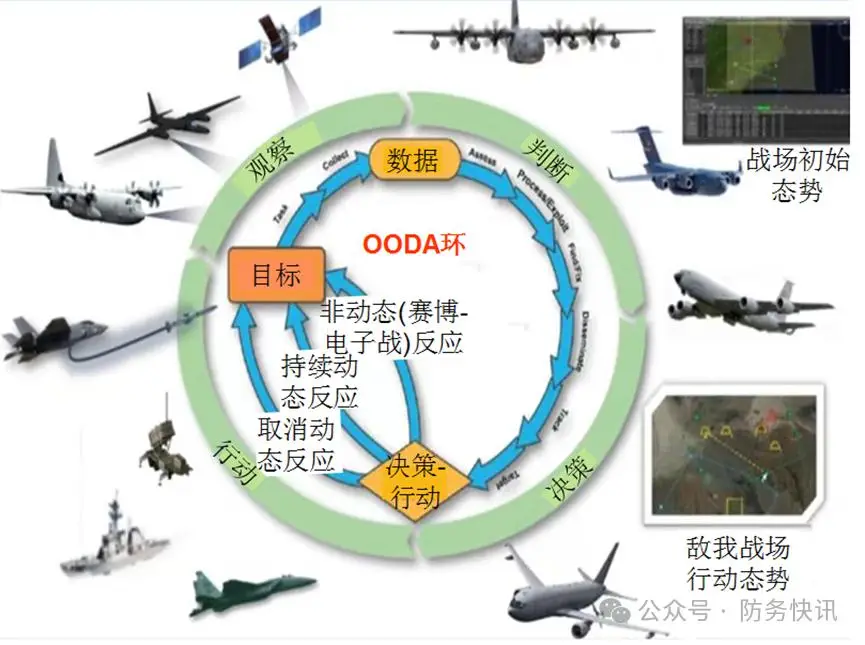
The core advantage of algorithms lies in reconstructing the operational chain and achieving rapid iteration of the OODA loop. In traditional warfare, the chain of observation, judgment, decision-making, and action is lengthy and often struggles to adapt to rapidly changing battlefield situations due to limitations in human processing capabilities. Intelligent algorithms, however, can leverage machine learning, deep learning, and other technologies to process massive amounts of operational data in seconds, perform real-time analysis, and uncover patterns, significantly shortening the decision-making cycle. In simulation tests, foreign military AI command systems generated multiple complete operational plans in a very short time, demonstrating response speed and decision-making efficiency far exceeding that of human command teams, fully showcasing the enormous advantages of algorithms in accelerating the decision-making process. In combat operations, algorithms can span the entire chain, from reconnaissance and perception, command and decision-making, fire strikes, and effect assessment, constructing an autonomous, closed-loop “kill chain.” From target identification to threat ranking, from plan generation to fire allocation, from strike implementation to damage assessment, algorithms can autonomously complete a series of complex tasks, achieving a “detect and destroy” operational effect.
Enhancing the practical application effectiveness of algorithms requires strengthening technological innovation and scenario empowerment. In terms of technological innovation, it is essential to keep pace with the development trends of artificial intelligence and accelerate the military application transformation of cutting-edge algorithms. Focusing on emerging technologies such as generative AI, neuromorphic computing, and brain-computer interfaces, we should explore pathways for the deep integration of algorithms with military needs. Regarding scenario empowerment, we must build diverse typical scenarios for algorithms based on actual combat requirements, develop specialized algorithms for target recognition, situational assessment, and virtual training, overcome bottlenecks in information processing in complex electromagnetic environments, promote the modularization and lightweight transformation of algorithms, and rapidly integrate them with command and control systems and unmanned equipment systems. This will allow algorithms to continuously iterate and optimize in specific tasks within typical scenarios, transforming algorithmic advantages into practical combat capabilities.
Strengthening algorithm security is crucial for ensuring the steady and sustainable development of intelligent transformation. While algorithms enhance combat effectiveness, they also face security risks such as tampering, deception, and misuse, potentially leading to serious consequences like “algorithmic runaway.” It is essential to establish an algorithm security review mechanism to conduct full-process security assessments of algorithm models in military intelligent systems, focusing on their reliability, transparency, and controllability to prevent algorithmic bias and logical vulnerabilities. Strengthening the research and development of algorithmic countermeasures technologies is also vital. This involves improving the anti-interference and anti-attack capabilities of our own algorithms while mastering techniques to interfere with and deceive enemy algorithms, thus gaining the initiative in algorithmic confrontation. Simultaneously, it is crucial to emphasize algorithmic ethics, clearly defining the boundaries and rules of algorithm application to ensure that algorithm development and use comply with international laws and ethical standards, avoiding any violations of war ethics.
Supercomputing Power: The “Digital Energy” for Intelligent Transformation
Computing power is the fundamental capability supporting data processing and algorithm execution, much like the “energy support” for intelligent systems. In the transformation towards military intelligence, the explosive growth of data and the increasing complexity of algorithms have placed unprecedented demands on computing power. The scale, speed, and reliability of supercomputing power directly determine the operational efficiency and combat effectiveness of military intelligent systems, becoming the driving force behind the intelligent transformation of the military field.
The core role of computing power lies in overcoming performance bottlenecks and supporting the efficient operation of complex intelligent tasks. The demand for computing power in intelligent warfare exhibits an “exponential growth” characteristic: an advanced AI command system needs to run thousands of algorithm models simultaneously when processing battlefield data across the entire domain; a swarm of drones performing collaborative combat missions requires real-time interaction and decision-making calculations involving massive amounts of data; a large-scale virtual combat training exercise needs to simulate the interactive behaviors of tens or even hundreds of thousands of combat units. The completion of these complex tasks is inseparable from powerful computing power. Without sufficient computing power, even the highest quality data cannot be processed quickly, and even the most advanced algorithms cannot operate effectively. Currently, computing power has become a crucial indicator for measuring the level of military intelligence; whoever possesses stronger computing power holds the initiative in intelligent warfare.
Building a computing power system adapted to the needs of intelligent transformation requires creating a collaborative computing power layout across the cloud, edge, and terminal. In the cloud, distributed cloud computing centers need to be constructed to build a computing power foundation that covers the entire domain and is elastically scalable. Relying on infrastructure such as big data centers and supercomputing centers, various computing resources should be integrated to form a large-scale, intensive computing power supply capability. At the edge, computing power should be deployed more readily, enhancing the autonomous computing capabilities of the battlefield. For special scenarios such as forward positions, naval vessels, and air platforms, miniaturized, low-power, and highly reliable edge computing nodes should be developed to transfer some computing tasks from the cloud to the edge. This reduces reliance on communication links and data transmission latency, and ensures that combat units can autonomously complete basic tasks such as target identification, path planning, and coordination even in extreme environments such as communication interruptions or signal blackouts, thus improving the system’s survivability. At the terminal, the built-in computing power of equipment should be strengthened to improve the intelligence level of individual combat platforms. By embedding high-performance AI chips into platforms such as drones, unmanned vehicles, and missile weapons, equipment is endowed with the ability to autonomously perceive, make decisions, and act, making it an intelligent unit with independent combat capabilities and laying the foundation for cluster collaboration and system-on-system confrontation.
Enhancing the combat readiness of computing power support requires strengthening technological innovation and security protection. In terms of technological innovation, it is crucial to keep pace with the development trends of computing power technology and accelerate the military application of new computing technologies. Focusing on cutting-edge areas such as quantum computing, photonic computing, and neuromorphic computing, we must break through the performance bottlenecks of traditional computing architectures and develop disruptive new computing power equipment. Simultaneously, we must strengthen the construction of computing power networks, building high-bandwidth, low-latency, and interference-resistant computing power transmission networks. By integrating technologies such as 5G, 6G, and satellite communication, we can ensure computing power collaboration and data interaction between the cloud, edge, and terminals, achieving seamless connection and efficient scheduling of computing power resources. In terms of security protection, we must establish a computing power security system to prevent the risks of attacks, hijacking, and misuse of computing power resources. By adopting technologies such as encrypted computing and trusted computing, we can ensure the security and privacy of data during the computing process; strengthen the physical and network protection of computing power facilities, and build a multi-layered, all-round protective barrier to ensure that the computing power system can operate stably in wartime and is not subject to enemy interference or damage.
“Order Dispatch”: Precise Targeting of New Patterns
introduction
As Lenin said, “Without understanding the times, one cannot understand war.” In recent years, the widespread application of information and intelligent technologies in the military field has promoted the deep integration of technology and tactics. Relying on intelligent network information systems, it has given rise to “order-based” precision strikes. Commanders and command organs can generate strike requirements in a formatted manner according to combat missions. The decision-making system intelligently matches strike platforms, autonomously plans action paths, and scientifically selects strike methods based on personalized requirements such as strike time, operational space, and damage indicators, thereby rapidly and accurately releasing strike effectiveness.
The operational characteristics of “order dispatch” type precision strike
As the informatization and intelligence of weapons and ammunition continue to improve, the cost of modern warfare is also constantly increasing. How to achieve the highest cost-effectiveness ratio with limited strike resources and maximize combat effectiveness has become a central issue for commanders and command organs in operational planning. “Order-based” precision strikes can provide a “feasible solution” for this.
Real-time, precise, and targeted strikes. Modern warfare places greater emphasis on structurally disrupting enemy operational systems, achieving operational objectives through the rapid and precise release of combat effectiveness. This requires commanders and command organs to seize fleeting “windows of opportunity” to strike high-value, nodal, and critical targets within an enemy’s operational system before the enemy can react. The traditional “detection-guided-strike-assessment” operational loop is time-consuming and ineffective. Therefore, “order-based” precision strikes rely on advanced intelligent network information systems, without pre-determining strike platforms. Target lists are released in real-time, and auxiliary decision-making systems rapidly assess the strike performance of various weapon platforms and the expected damage to targets. Tasks are autonomously allocated to strike platforms, rapidly linking and controlling multi-domain firepower, autonomously closing the kill chain, and conducting rapid strikes against key targets.
Multi-domain coordinated strike. The advantage of modern precision strike over traditional firepower lies in its information-based and intelligent combat system. It requires no human intervention and autonomously completes tasks such as reconnaissance, control, strike, and assessment based on a closed strike chain. This not only saves strike costs and reduces resource waste but also enables adaptive coordination based on unified operational standards. Therefore, “order-based” precision strikes require firepower forces distributed across various operational domains to establish a unified standard grid. Once a demand is issued from one point, multiple points can respond and coordinate globally, flexibly concentrating forces and firepower, using multiple means to rapidly and multi-domain convergence, and determining the strike direction, sequence, and method for each strike platform while on the move. Through system integration, time is effectively saved, enabling multi-domain precision strikes against key enemy nodes and critical parts of core targets, fully leveraging the combined power of the integrated combat effectiveness of various operational units.
The key to victory lies in swift and decisive action. Modern warfare is a “hybrid war” conducted simultaneously across multiple domains, where the interplay and confrontation of new domains and new types of forces, such as information, aerospace, and artificial intelligence, are becoming increasingly pronounced. This necessitates that both sides be able to detect and act faster than the enemy, crippling their operational systems and reducing their operational efficiency. On the one hand, it is crucial to pinpoint key nodes in the enemy’s system and launch timely and precise strikes; on the other hand, it is essential to conceal one’s own intentions and strike forces, striking swiftly and unexpectedly. “Order-based” precision strikes perfectly meet these two requirements. Supported by network information systems, they intelligently integrate firepower from various domains, achieving multi-source information perception, data interconnection, and multi-domain coordinated strikes. This enables seamless and high-speed operation of “target perception—decision and command—firepower strike—damage assessment,” resulting in a high degree of information and firepower integration and the rapid achievement of operational objectives.
The system of “order dispatch” type precision strike
”Order dispatch” precision strikes compress action time and improve strike effectiveness by building an efficient closed strike chain, enabling various fire strike platforms to better integrate into the joint fire strike system and provide rapid and accurate battlefield fire support. Its key lies in the “network” and its focus is on the “four” systems.
Multi-domain platform access network. Supported by information and intelligent technologies, an integrated information network system with satellite communication as the backbone is established. Firepower strike platforms distributed across multiple domain battlefields are integrated into the combat network to create a battlefield “cloud.” Different combat modules are distinguished, and “sub-network clouds” such as “reconnaissance, control, strike, and assessment” are established. Relying on an integrated communication network, the “sub-network clouds” are linked to the “cloud.” This can enhance the firepower strike platform’s capabilities in all domains, all times, on the move, autonomous networking, and spectrum planning, and realize network interconnection between firepower platforms, domain combat systems, and joint combat systems, as well as the interconnection and interoperability of internal strike forces.
Joint reconnaissance and sensing system. This system leverages various reconnaissance and surveillance forces within the joint operations system to achieve all-weather, multi-directional, and high-precision battlefield awareness of the operational area. This requires constructing a ubiquitous, multi-dimensional reconnaissance and sensing force system encompassing physical and logical spaces, tangible and intangible spaces. It involves widely deploying intelligent sensing devices to form an intelligence data “cloud.” Through this intelligence data “cloud,” the system analyzes the enemy situation, identifies key points in the enemy’s operational system and time-sensitive targets, updates reconnaissance information in real time, and displays target dynamics.
Intelligent Command and Decision-Making System. Relying on a new command and control system with certain intelligent control capabilities, this system constructs various planning and analysis models, expands functions such as intelligent intelligence processing, intelligent mission planning, automatic command generation, and precise action control, and expands and improves databases such as target feature database, decision-making knowledge base, and action plan database. It strengthens the system support capabilities for mission planning, action decision-making, and control during combat organization and implementation, enhances planning and decision-making and combat action control capabilities, clarifies “how to fight, where to fight, and who will fight,” and achieves precise “order dispatch.”
Distributed fire strike system. Relying on intelligent network information systems, on the one hand, it integrates multi-dimensional fire strike platforms across land, sea, air, and space, enhancing functions such as intelligent target identification and remote-controlled strike, enabling various combat modes such as remote-controlled operations, manned-unmanned collaborative operations, and flexible mobile operations; on the other hand, it can construct a low-cost fire strike platform mainly composed of low-altitude and ultra-low-altitude unmanned strike platforms such as racing drones and loitering munitions. By adding different functional combat payloads, it can closely coordinate with high-end fire strike platforms to carry out tasks such as battlefield guidance, precision strikes, and fire assessment, efficiently completing “orders”.
Autonomous Damage Assessment System. This system, built upon reconnaissance and surveillance capabilities within the joint operations system, autonomously assesses the effectiveness of attacks on targets after the firepower platform has completed its strike. It conducts real-time, dynamic, objective, and systematic analysis and evaluation of the target’s external condition and degree of functional loss, and promptly transmits relevant information back to decision-making and command centers at all levels via video images. The assessment centers then determine “how well it went” and whether the expected damage requirements were met. If not, operational actions can be adjusted in a timely manner for supplementary strikes, providing strong support for maximizing operational effectiveness.
The planning and implementation of “order dispatch” style precision strikes
The “order dispatch” style of precision strike is similar to the operation of ride-hailing services. Through a series of processes such as formatted “order” generation, intelligent target matching, and autonomous route planning, it autonomously completes the “OODA” combat cycle, making its actions more efficient, its strikes more precise, and its collaboration closer.
Real-time reporting of firepower requirements allows combat units to submit orders on demand. Reconnaissance elements distributed across different operational areas and multi-dimensional battlefield spaces are acquired through radar, optical, infrared, and technical reconnaissance methods, forming battlefield target intelligence information across a wide area and multiple sources. This information is transmitted to the battlefield information network via intelligence links, and is constantly relayed to combat units. Combat units then perform correlation processing, multi-source comparison and verification, and comprehensively compile battlefield target information to generate precise mission orders. Combat units analyze target value and connect to the decision-making platform as needed, constructing a closed-loop strike chain based on these orders, and submitting mission orders in real time, achieving dynamic optimization and precise adaptation.
The decision-making center intelligently “dispatches” fire support missions, differentiating them from actual fire strike missions. Through the battlefield information network and relying on an intelligent mission planning system, the center can automatically analyze the mission “order” information data submitted by combat units. Based on the nature, coordinates, movement status, and threat level of battlefield targets, it automatically generates mission requirements such as the type and quantity of ammunition needed for fire strike operations, the strike method, and damage indicators, forming a fire support mission “order.” By intelligently matching the optimal fire support platform and connecting link nodes as needed, the center conducts intelligent command-based “order dispatch,” delivering the orders instantly to the standby fire support platforms.
Optimal target matching is performed continuously, and firepower platforms swiftly “accept orders.” Multiple firepower platforms distributed across the battlefield respond rapidly to these orders via the battlefield information network. The platforms autonomously establish links with combat units, mutually verifying their identities before directly establishing a guided strike chain. They coordinate firepower strikes, adjusting strike methods and firing parameters in a timely manner based on target damage and battlefield target dynamics before conducting further strikes until the assigned mission is completed. Firepower platforms consistently adhere to the principle of “strike-relocate-strike-relocate,” completing strike missions and rapidly relocating to new positions, maintaining a state of constant readiness and receiving orders online in real time. After the mission concludes, the guided strike chain between the firepower platform and the combat unit is automatically terminated.
Multi-source damage information acquisition and real-time assessment by the evaluation center. Utilizing a comprehensive range of long-range, intelligent, and information-based reconnaissance methods, including satellite, radar, and drone reconnaissance, multi-domain, three-dimensional reconnaissance is conducted to acquire real-time target fire damage information, providing accurate assessments for precision fire strikes. A comprehensive assessment of damage effects is performed, quantitatively and qualitatively evaluating the strike results, distinguishing between physical, functional, and systemic damage states, and promptly feeding back to the decision-making center. Based on the damage assessment results, timely adjustment suggestions are made to modify fire strike plans, optimize operational actions, and achieve precise control of fire strikes. This facilitates commanders’ accurate control of the operational process and efficient command and control of fire strike effectiveness.
The era of intelligent warfare has begun. Intelligent command and information systems will become the “central nervous system” of future intelligent combat command and control, serving as a supporting means for intelligent combat command and control. Accelerating the construction of intelligent command and information systems is an inherent requirement for the development of military intelligence. Only by clarifying the essence of intelligent command and information system development, grasping the key points of intelligent command and information system research and development, and exploring the essentials of intelligent command and information system development can we better promote the construction and development of intelligent command and information systems and gain a competitive advantage in future intelligent warfare.
Clarify the key points of the development of intelligent command and information systems
Intelligent command and information systems are an inevitable choice in the development of warfare towards informationized and intelligent warfare, a natural outcome of the technological revolution, and a contemporary demand for the intelligent development of the military. Clarifying the key points of intelligent command and information system development helps to grasp the direction of its construction and establish long-term goals.
Promoting the intelligent evolution of warfare. In future intelligent warfare, the battlefield situation will change rapidly and the battlefield environment will be complex and harsh. In order to gain the initiative on the battlefield, “intellectual superiority” will become the new commanding height. Intelligent command and information systems are undoubtedly an important support for future combat command and operations. Their intelligent development can help promote the intelligent evolution of warfare and is an important foundation for gaining the initiative and seeking victory in intelligent warfare.
Supporting Intelligent Innovation in Combat Concepts. Future intelligent warfare requires corresponding combat command concepts, and intelligent command information systems are a crucial foundation for the practical application of these concepts, serving as the fertile ground for their innovation and development. New intelligent combat command concepts such as human-machine hybrid command formations, data-driven command activities, open development command models, and intelligent convergence command processes all rely on the support of intelligent command information systems. These systems will act as an extension of the human brain, breaking through the physiological limits of the human body and achieving the organic integration of the art of combat command and intelligent technology.
Promoting the intelligent transformation of combat methods. The widespread application of artificial intelligence technology in the military field has brought about significant changes in the mechanisms of combat victory. Intelligence has surpassed firepower and information power to become the primary factor determining the outcome of war. The development and construction of intelligent command and control information systems will promote the transformation of combat methods towards intelligence, shifting combat methods from the “combat network + precision-guided weapons” of the information age to the “intelligent Internet of Things + manned/unmanned combat platforms” of the intelligent age. Correspondingly, the basic combat style is evolving from “network-centric warfare” to “cognition-centric warfare”.
Focus on the key points of intelligent command and information system research and development
Command and information systems are a product of the information warfare era. With the rapid development of military intelligence and the research and practical application of intelligent warfare mechanisms, the intelligent upgrading and construction of command and information systems is urgently needed. Emphasis should be placed on key functional development aspects to create a completely new intelligent command and information system.
“Super-brain-based” decision-making. In future intelligent warfare, the battlefield information data is massive and complex, and commanders are easily overwhelmed by the “sea of information,” leading to confusion and affecting command and decision-making. With the emergence of intelligent decision-making technology and “cloud brains” and “digital advisors,” a new decision-making model based on the collaboration of “human brain + artificial intelligence” is quietly taking shape. Intelligent command information systems will break through the limits of human intelligence, acting as an extension of the human brain to assist commanders in their work, transforming war decision-making from purely human brain-based decision-making to super-brain-based command and decision-making combining “human brain + artificial intelligence.”
“All-dimensional” situational awareness. Future intelligent warfare will be characterized by multi-dimensional space, diverse forces, varied tactics, and accelerated pace. A comprehensive and flexible grasp of the battlefield situation will be fundamental to commanders’ decision-making. The integrated, intelligent, and dynamic presentation of the all-dimensional battlefield situation across multiple domains is an inevitable requirement for the development of command information systems. Command information systems are expanding their perception, understanding, integration, and prediction of battlefield situations, such as target identification, threat level assessment, operational action prediction, and future battle trajectory forecasting, from land, sea, air, space, electromagnetic, and cyberspace to the cognitive and social domains, achieving “all-dimensional” situational awareness.
“Intelligent connectivity” is crucial for future intelligent warfare. This will involve numerous intelligent command and control platforms and intelligent weapon platforms, connected by intelligent information and communication systems. Like the nerves and blood vessels of the human body, intelligent information and communication systems act as a link and lubricant in intelligent warfare. Therefore, it is essential to establish a comprehensive, uninterrupted intelligent information network to support the connectivity and control of intelligent equipment, enabling intelligent optimization of the network structure, intelligent reorganization to withstand network damage, and intelligent anti-interference capabilities. This will ensure intelligent collaborative operations between platforms and maximize overall combat effectiveness.
“Unmanned” Autonomous Collaboration. The extensive use of drones in recent local conflicts worldwide, playing a crucial role in determining the course of war, has attracted widespread attention. Unmanned weaponry is the material foundation of intelligent warfare, leading to disruptive combat styles such as intrusive lone-wolf operations, manned/unmanned collaborative system sabotage operations, independent operations by unmanned system formations, and drone swarm operations. While unmanned warfare is human-led, with machines granted a degree of autonomy from the backend, enabling unmanned operations on the front lines, the unmanned battlefield is constantly evolving. Disruptions to human-machine collaboration will become commonplace. Therefore, the command and control systems of unmanned intelligent equipment platforms must be more intelligent, capable of autonomous collaborative operations based on operational objectives.
“Proactive” information defense. Intelligent warfare will inevitably face diverse and multi-dimensional information attacks from powerful adversaries. The level of information security protection capabilities directly affects the outcome of the battle for “intellectual dominance” on the battlefield and is a key aspect of the construction of intelligent command information systems. Therefore, proactive measures should be taken to actively formulate and improve network protection strategies, enrich intrusion detection capabilities and authentication and identification methods, strengthen the application of advanced information security technologies, enhance the anti-interference and anti-interference capabilities of various wireless transmission methods, and build strong intelligent traceability and countermeasure capabilities to effectively curb information attacks.
Exploring the key points of intelligent command and information system development
The development of intelligent command and information systems is not merely a matter of technological innovation; it also requires further liberating our thinking and updating our concepts. To advance the development of intelligent command and information systems, we must change the traditional approach of simply adding hardware, building large networks, and collecting and storing various types of data. We must break through existing hierarchical structures, create open and service-oriented systems, and target the needs of intelligent combat command and action, exploring and researching the key aspects of intelligent command and information system development.
Innovation Concept. Guided by innovative thinking, and drawing on the development strategies of intelligent command and information systems for building a strong military, we will explore a development path with our own characteristics, tailored to actual needs. We must break away from traditional “chimney” approaches, adhere to top-level design and overall planning of the command and information system, unify interfaces, protocols, and standards, and form an open and sustainable system architecture. We must adhere to a system development approach that combines research, development, and application, formulating short-term, medium-term, and long-term development strategies to standardize the direction of system construction and development. We must adhere to iterative upgrades and optimization strategies to continuously improve the intelligence level of various subsystems, including command and control, intelligence reconnaissance, communication, information warfare, and comprehensive support, ensuring the continuous and healthy development of the intelligent command and information system.
Focusing on Key Capabilities. Concentrating on building key capabilities of intelligent command and information systems is crucial for intelligent warfare to leverage intelligence to achieve victory, and is key to gaining the “right to win” in intelligent warfare. Algorithms, computing power, and data are not only the intrinsic driving force and support for the development of artificial intelligence, but also the core capability requirements and advantages of intelligent command and information systems. The development of intelligent command and information systems must adhere to algorithmic innovation research to improve the system’s cognitive, speed, and decision-making advantages; accelerate the research and development of next-generation computers, such as quantum computers, to provide stronger computing power support for intelligent command and information systems; and deeply mine the deeper and broader information value from massive combat data resources to seek the initiative in victory.
Collective Efforts to Overcome Challenges. The construction and development of intelligent command and information systems is one of the major projects in military intelligence. It is a complex and collaborative project involving multiple fields, disciplines, departments, and units. The construction and development of intelligent command and information systems must adhere to the spirit of collective wisdom, collaborative problem-solving, and pioneering innovation. It should target strategic and forward-looking fields such as sensors, quantum information, network communication, integrated circuits, key software, big data, artificial intelligence, and blockchain. It should be driven by high-tech advancements and the demands of intelligent warfare, conducting in-depth research and exchanges across multiple fields, levels, and forms to continuously break through, innovate, and upgrade, making the functions of intelligent command and information systems more complete and intelligent.
Collaborative Development. To deeply promote the construction and development of intelligent command and information systems, it is essential to fully absorb advanced local technological achievements and integrate into the global trend of artificial intelligence innovation. Currently, artificial intelligence technology is booming worldwide, accumulating strong development momentum and technological advantages. Artificial intelligence technology has strong versatility in application, and its technological achievements have broad prospects for transformation and application, making it an important pathway to the construction and development of intelligent command and information systems. It is necessary to research and formulate general technical standards, break down barriers, overcome obstacles, and facilitate military-civilian cooperation to achieve the sharing and linkage of technological achievements. Through collaboration, it is also crucial to cultivate and shape new types of military personnel, enabling them to continuously adapt to the needs of various positions under intelligent conditions and fully leverage the effectiveness of intelligent command and information systems.
Looking back on its glorious combat history, the People’s Army has consistently adhered to the absolute leadership of the Party, proposing and implementing a comprehensive set of strategies and tactics for people’s war. These strategies and tactics are a crucial weapon for the People’s Army to defeat the strong with the weak and to conquer the enemy. Over the past 98 years, with the changing times and evolving forms of warfare, the specific content and manifestations of the strategies and tactics for people’s war have continuously evolved. To confront the challenges of information-based and intelligent warfare, we must firmly grasp the essential requirements and value orientations of the strategies and tactics for people’s war amidst the rapidly evolving global trends and practices, unifying the inherently unchanging laws of conduct with the external realities of change, and continuously innovating and developing the strategies and tactics for people’s war in the new era.
President Xi Jinping emphasized that no matter how the situation develops, the magic weapon of people’s war must never be lost. However, we must grasp the new characteristics and new requirements of people’s war in the new era, innovate its content, methods and approaches, and unleash its overall power. Currently, facing profound challenges brought about by changes in science and technology, warfare, and our adversaries, we must not only inherit and carry forward the fine traditions of people’s war, but also be sensitive to changes, actively respond to them, and proactively seek change. We must accurately grasp the inherent requirements of the strategies and tactics of people’s war in the new era, consciously update our thinking and concepts, and innovate strategic guidance, so that this magic weapon of defeating the enemy can be demonstrated on future battlefields.
Adhere to relying on the people and deeply rooted
In the long practice of revolutionary war, the people are the most profound force for victory. The people are the primary force behind the strategies and tactics of people’s war, a magic weapon for victory. People’s war has its roots deeply rooted in the people, and its confidence comes from the people. Regardless of how the times change or how the war evolves, relying closely on the people and fully mobilizing them will always be the fundamental condition and the only way to carry out people’s war. Developing the strategies and tactics of people’s war in the new era requires adhering to the mass perspective of history and the fundamental requirement that soldiers and civilians are the foundation of victory. We must integrate the traditional strategic advantages of people’s war with the mass line, broaden the sources of vitality for the strategies and tactics of people’s war, draw strategic wisdom and tactical methods from the people, and develop an intellectual advantage for people’s war in the new era. We must solidly carry out national defense education throughout the nation, continuously foster a strong sense of patriotism, inspire patriotism, strengthen awareness of potential dangers, and enhance national defense awareness. We must guide the masses to actively care about and support national defense, thereby infusing powerful spiritual strength into people’s war in the new era. We must focus on promoting high-quality population development, comprehensively improve the cultural, scientific, and innovative qualities of the entire population, accelerate the development of a modern human resource base of high quality, sufficient in volume, optimized in structure, and rationally distributed, and promote the shift of the dominant force in people’s war from quantitative to qualitative. Further improve the national defense mobilization system and mechanism, promote the establishment of a rapid response system that is connected with the national emergency response mechanism and integrated with the joint combat system, fully tap and gather the unlimited war potential contained in the people, and give full play to the resource aggregation and value-added effect.
Focus on overall planning and full-area offense and defense
In the long-term practice of revolutionary warfare, the strategies and tactics of people’s war require the comprehensive mobilization of diverse forces and resources in the political, economic, cultural, diplomatic, and military sectors, and the integrated use of various forms of struggle and methods of operation. This holistic approach compensates for local deficiencies and disadvantages, ultimately defeating powerful adversaries. Modern warfare is not only a fierce confrontation in the military sphere, but also a comprehensive struggle in the political, economic, and diplomatic spheres, exhibiting the distinct characteristics of hybrid warfare. To develop the strategies and tactics of people’s war in the new era, we must establish a broad systemic mindset, relying on the national strategic system and supported by the joint operations system, explore the implementation methods of people’s war strategies and tactics, and win the total war of people’s war in the new era. We should fully leverage the advantages of the new national system, relying on the integrated national strategic system and capabilities, efficiently aggregate superior resources across the board, fully activate the country’s national defense potential, and weave various forces and resources into a network. We should integrate and plan the subsystems of people’s war, including leadership, organization, personnel, command, technology, equipment, and support, to maximize the effectiveness of holistic linkage and systemic operation, and achieve the maximum benefits of all-round effort and multiplied energy. We must strengthen comprehensive coordination across the physical, information, and social domains, focusing on seeking breakthroughs in new domains and new qualities, and making achievements in new dimensions such as unmanned warfare, human-machine collaborative warfare, network and electronic warfare, space and deep-sea warfare, and intelligent and autonomous warfare. Military and non-military means must be coordinated, integrating various forms of struggle, including political, economic, diplomatic, public opinion, and military. Comprehensive measures must be implemented to effectively wage diplomatic offensive and defensive battles, financial and trade battles, psychological defense battles, and public opinion and legal battles. We must leverage the combined effectiveness of political offensives and armed strikes to effectively fight the political and military battles.
Strengthen active defense and take the initiative
Through the long practice of revolutionary warfare, the People’s Army has developed a comprehensive strategic philosophy of active defense, emphasizing, for example, the unity of strategic defense and offensive action in campaigns and battles, the principles of defense, self-defense, and preemptive strike, and the principle of “if no one offends me, I will not offend; if someone offends me, I will certainly offend.” Active defense is fundamentally defensive, its essence lies in activeness, and its inherent characteristic is proactiveness. Currently, profound changes have taken place in the international, national, and Party, military, and political landscapes. The strategies and tactics of people’s war in the new era generally adhere to the fundamental principle of defense and are not aimed at hegemony, aggression, or oppression of other countries. Consequently, they will win the support and endorsement of the vast majority of the Chinese people, as well as the understanding and assistance of peace-loving and justice-loving countries and peoples around the world. Developing the strategies and tactics of people’s war in the new era must adapt to the times and circumstances. We must adhere to a defensive national defense policy, implement the military strategic guidelines of the new era, excel at observing and analyzing issues from a political perspective, and be adept at considering and applying strategies from regional and global perspectives to consolidate the political foundation for victory in people’s war. We must persist in neither provoking trouble nor fearing it, strengthen the regular and diversified use of military force, firmly and flexibly carry out military struggle, and while adhering to the strategic preemptive strike, we must not give up campaign and combat offensives under favorable conditions and when necessary. We must advance steadily, make progress within stability, and be proactive within stability, effectively shape the security situation, contain crises and conflicts, and firmly grasp the initiative in the struggle.
Highlight new quality dominance and technological empowerment
In the long practice of revolutionary warfare, while emphasizing that victory in war is primarily determined by people, not objects, the People’s Army has also placed great emphasis on the research and development of advanced military technology, particularly weaponry. Comrade Mao Zedong once emphasized that without modern equipment, it would be impossible to defeat the armies of imperialism. The technological content of modern warfare has undergone a qualitative leap, with advanced technologies and new weaponry such as artificial intelligence, big data, quantum computing, unmanned aerial vehicles, and brain control being widely applied in the military. While the people remain the decisive force in determining victory in war, the manifestation of this power has undergone significant changes. Science and technology are core combat power, and People’s War will place greater emphasis on the application of scientific and technological means and rely even more heavily on the wisdom and creativity of the people. Developing the strategies and tactics of People’s War in the new era should prioritize winning information-based and intelligent warfare. We should deeply study the essential characteristics, winning mechanisms, and strategies and tactics of high-end warfare, accelerate the shift from “winning by numbers” to “winning by talent,” and from “winning by manpower” to “winning by intelligence,” effectively enhance our ability to win through scientific and technological empowerment and digital intelligence, and truly unleash the crucial role of science and technology and talent in People’s War in the new era. We will accelerate the development of high-tech industries, vigorously strengthen the construction of new forces in new domains such as ocean, space, cyberspace, artificial intelligence, and quantum technology, increase military-civilian collaboration in high-tech fields, accelerate the transformation and application of new productive forces into new combat capabilities, and promote the expansion of war potential reserves into emerging fields and the focus on new forces. We will integrate and coordinate military and civilian scientific and technological advantages, shifting the focus from traditional support and guarantee elements such as human and material resources to new support and guarantee elements such as information, technology, and intelligence. We will build information, resource, and technology pools with profound foundations and rich reserves, actively cultivate capable, strong, and professional professional support units, and continuously expand the breadth and depth of people’s participation in the war and scientific and technological support.
Emphasis on flexibility, maneuverability, innovation and checks and balances
In the long-term practice of revolutionary warfare, the strategies and tactics of People’s War are highly flexible and maneuverable. Their most essential requirement is to prioritize self-reliance, attacking the enemy without being attacked by them. Based on the actual situation of both sides, we fight the battles based on our weapons, against the enemy, and at the right time and place. We identify the enemy’s weaknesses and vulnerabilities, leverage our strengths and advantages, and defeat the enemy with our own strengths, always seizing the initiative on the battlefield. Flexible and maneuverable strategies and tactics are the magic weapon for defeating an enemy with superior equipment with inferior equipment. “You fight yours, I fight mine” is a summary and generalization of the long-term experience of China’s revolutionary war and the soul and essence of the strategies and tactics of People’s War. Developing the strategies and tactics of People’s War in the new era must grasp the methodological requirements of asymmetric checks and balances, leverage innovative operational concepts, adhere to the mechanisms of victory in modern warfare, and continuously develop practical and effective tactics to defeat the enemy. We must proceed from the actual circumstances of both sides, gaining a deep understanding of operational missions, adversaries, and the evolving operational environment. We must thoroughly grasp the concepts, elements, and methods of victory, objectively analyze and study the strengths and weaknesses, advantages and disadvantages of both sides, know the enemy and ourselves, adapt to the situation, and flexibly utilize various combat forces and methods, striving to achieve maximum results at the lowest cost. We must adhere to the principle of “attacking the enemy without being attacked by them,” capitalize on strengths and avoid weaknesses, avoid the real and attack the weak, attack where the enemy is least prepared, and attack where they must be defended. We must proactively create opportunities, flexibly maneuver the enemy, and fight wherever we are most advantageous and wherever we are most skilled. We must adhere to the principle of “using what we can to defeat what we cannot,” advancing the research and application of military theory, operational guidance, tactics, and training methods in a timely manner, innovating core operational concepts, and developing new types of combat methods. We must fight against the enemy’s tactics, targeting their weaknesses, and leveraging our military’s strengths, thus creating new winning advantages in people’s war through asymmetric checks and balances.
Emphasis on accumulating small things into big things and focusing on unity of purpose
Throughout the long practice of revolutionary warfare, our army has been at an overall disadvantage for considerable periods. Therefore, the strategies and tactics of people’s war emphasize leveraging strength against weakness locally, persisting in accumulating small victories into larger ones, and concentrating forces to wage annihilation campaigns. This has become a key strategy for the people’s army to defeat powerful foes. Compared to previous eras, modern warfare often unfolds across multiple dimensions and domains, providing greater scope for implementing this strategy of “accumulating small victories into larger ones.” Developing the strategies and tactics of people’s war in the new era requires strengthening the concept of “dispersed in appearance, yet focused in spirit; dispersed in form, yet united in strength.” This involves dynamically consolidating and uniting the numerous combat forces distributed across the multidimensional battlefield. Through the fusion of capabilities and immediate optimization, we can launch rapid localized focused-energy attacks, wide-area guerrilla harassment, and deliver annihilating and destructive strikes against key enemy locations. This not only creates a hammering effect, but also continuously wears down the enemy, gradually depriving them of the initiative on the battlefield. This highly integrated distributed warfare emphasizes the wide-area dispersion of troop deployment and the discrete distribution of capabilities. Based on the needs of achieving operational intent, objectives, and missions, it prioritizes the best operational elements, units, and forces. Through the integration of operational capabilities and the accumulation of operational impacts, it aggregates optimal operational effects, unleashes maximum operational potential, maximizes operational effectiveness, and achieves optimal operational results. This distributed warfare has evolved from “geographical dispersion” to “dynamic coupling across all domains and dimensions”: no longer limited to the physical dispersion of personnel and equipment, it extends to multi-dimensional battlefields such as cyber, electromagnetic, and cognitive. Relying on data links, artificial intelligence, and distributed command systems to achieve cross-domain collaboration, it significantly enhances battlefield survivability and multiplies strike effectiveness.
The report of the 19th National Congress of the Communist Party of China pointed out that it is necessary to “accelerate the development of military intelligence and improve joint combat capabilities and all-region combat capabilities based on network information systems”. Today’s “Liberation Army Daily” published an article pointing out that military intelligence is a new trend and new direction in the development of the military field after mechanization and informatization. We must develop intelligence on the basis of existing mechanization and informatization, and at the same time use intelligence to Traction mechanization and informatization to develop to a higher level and at a higher level. As a new combat field, cyberspace is a new field with high technological content and the most innovative vitality. Driven by military intelligence, it is ushering in a period of rapid development opportunities.
Military intelligence leads to accelerated development of cyberspace operations
■Respect the soldiers Zhou Dewang and Huang Anwei
Three major technologies support the intelligence of cyberspace weapons
Intelligence is a kind of wisdom and ability. It is the induction, cognition and application of laws by all systems with a life cycle. Intelligence is to solidify this wisdom and ability and become a state. A cyberspace weapon is a weapon used in cyberspace to carry out combat missions. Its form is dominated by software and code, and it is essentially a piece of data. The intelligence of cyberspace weapons is mainly reflected in the following three aspects:
First, intelligent vulnerability mining. Vulnerabilities are the basis for the design of cyber weapons. The ransomware that spread around the world in May this year took advantage of vulnerabilities in Microsoft’s operating system and caused a huge shock to the cybersecurity community. Vulnerabilities are expensive, ranging from tens to hundreds of thousands of dollars for a zero-day. The discovery of previous vulnerabilities mainly relied on experienced hackers, who used software tools to check and analyze the code. In the finals of the International Cybersecurity Technology Competition League held during this year’s China Internet Security Conference, participants demonstrated that intelligent robots conduct vulnerability mining on site, and then write network code through vulnerabilities to form cyber weapons, break through target systems, and seize flags. This change means that vulnerability mining has entered an era of intelligence.
Second, intelligent signal analysis and password deciphering. Signals are the carrier of network data transmission, and passwords are the last barrier to network data security. Signal analysis and password deciphering are core technologies for cyberspace operations. Breaking through signals and passwords is the basic path into cyberspace and the primary target of cyber weapon attacks. Intelligent signal analysis solves problems such as protocol analysis, modulation recognition, and individual recognition of signals through big data, cloud computing, deep learning and other technologies. Code-breaking is computational science “the crown jewel”. Through the accumulation of password data samples, intelligent code-breaking can continuously learn and find patterns, and can find the key to deciphering, thereby opening the last door of network data “safe” and solving network problems. Key links of intrusion and access.
Third, the design of an intelligent weapons platform. The U.S. military proposed the “Cyber Aircraft” project in 2009 to provide platforms such as tanks, ships, and aircraft for cyberspace operations. It can realize automatic reconnaissance, loading of cyber weapons, autonomous coordination, and autonomous attacks in cyberspace. When threatened, Self-destruction and removal of traces have certain intelligent characteristics. The weapons loaded by future “cyber aircraft” are not code compiled by software personnel, but directly based on the reconnaissance results to design intelligent cyber weapons on site in real time and achieve “ordered” development, thus greatly improving cyberspace operations. Targeted.
The intelligent trend of network-controlled weapons has become increasingly prominent
Weapons controlled by cyberspace are referred to as cyber-controlled weapons. They are weapons that connect through the network, accept cyberspace instructions, perform cross-domain tasks, and achieve combat effects in physical space. Most of the various combat weapons platforms in the future will be networked weapons platforms. In this way, the military information network is essentially the Internet of Things. Network entities such as uplink satellites, radars, and drones can detect, track, locate, and strike through the Internet. Space control, the intelligence of network-controlled weapons has flourished in battlefields such as land, sea, air, space and electricity.
In 2015, Syria used the Russian Robot Corps to defeat militants. The operation used 6 tracked robots, 4 wheeled robots, 1 automated artillery group, several drones and 1 command system. The commander dispatches drone reconnaissance through the chain of command to spot the militants, and the robots charge the militants, while accompanied by artillery and drone attack force support, delivering a fatal blow to the militants. It was only a small-scale battle, but it set the precedent for robot “group” operations.
Network-controlled intelligent weapons for sea and air battlefields are being developed and verified in large quantities. In 2014, the U.S. Navy used 13 unmanned surface boats to demonstrate and verify that unmanned boat groups intercepted enemy ships and achieved good results mainly by exchanging sensor data. When it was tested again in 2016, functions such as collaborative task allocation and tactical coordination were added, and “swarm awareness” became a distinctive feature of its intelligence.
Swarms of small and micro UAVs for aerial combat are also growing rapidly. In recent years, the U.S. Department of Defense has repeatedly tested the “Quail” micro-drone, which can drop dozens or even hundreds at a time. By improving its coordination capabilities when performing reconnaissance missions, it has made great progress in drone formation, command, control, and intelligence. Progress has been made in management and other aspects.
Space-based cyber-controlled weapons are becoming more and more “smart”. The air and space field mainly contains two types of network-controlled weapons: reconnaissance and strike. Satellites with various functions mainly perform reconnaissance missions and are typical reconnaissance sensors. With the emergence of various small and microsatellite groups, satellites have been made to exhibit new characteristics: small size, fast launch, large number, and greater intelligence. Small and microsatellite groups have greater flexibility and reliability when performing reconnaissance and communication missions, and currently the world’s satellite powers are actively developing plans for small and microsatellite groups with wider coverage.
Hypersonic strike weapons of all kinds cruised in the air and space, as if sharp swords were hanging over people’s heads. The U.S. Air Force Research Office stated that “high-speed strike weapons” will launch flight tests around 2018, and other countries are also actively developing similar weapons. The biggest features of this type of weapon are their high speed, long range, and high intelligence.
Intelligent command information system changes traditional combat command methods
Cyberspace weapons and weapons controlled by cyberspace are the “fist” of intelligent warfare, and the command information system that directs the use of these weapons is the “brain” of intelligent warfare. Cyberspace combat command information systems must keep up with intelligence simultaneously. process. At present, almost all command information systems in the world are facing the difficult problem of “intelligent lag”. In future wars, rapid decision-making and autonomous decision-making are required, which places higher requirements on intelligent auxiliary systems.
In 2007, the U.S. Department of Defense’s Advanced Research Projects Agency launched a research and development program on command and control systems ——“Project Dark Green” in order to enable computer-aided commanders to make rapid decisions and win opportunities. This is a campaign tactical-level command information system. Its research and development purpose is to embed the system into the U.S. Army brigade-level C4ISR wartime command information system to achieve intelligent command of commanders. To this day, the U.S. military has not relaxed its development of intelligent command information systems.
In cyberspace operations, the network target appears as an IP address connected to the network. The large number makes it difficult for manual operations to operate efficiently, and operations require the auxiliary support of intelligent command information systems. Currently, intelligent command information systems need to realize functions such as intelligent intelligence analysis, intelligent perception, intelligent navigation and positioning, intelligent assisted decision-making, intelligent collaboration, intelligent evaluation, and intelligent unmanned combat, especially to realize cluster combat control of unmanned network control systems, which has put forward urgent needs for intelligent command information systems and requires accelerating the research and development and application of corresponding key technologies.
To sum up, intelligent cyber weapons and cyber-controlled weapons, through intelligent information system scheduling, will form huge combat capabilities and can basically carry out all actions in the current combat style. In future wars, from the formation of command forces, to target selection, mode of action, use of tactics, etc., will all be carried out in an intelligent context. The characteristics of war “gamification” will be more significant, and the combat command method will also undergo major changes.
In the future battlefield, fighting courage requires more fighting “wisdom”
■Yang Jian and Zhao Lu
At present, the development of artificial intelligence has entered a new stage, and its penetration into various fields has begun to accelerate. As a result of this process, military competition among nations around intelligence has begun. Our army has always been a heroic and tenacious people’s army that dares to fight and win. In the future, we should continue to carry forward the glorious tradition on the battlefield. At the same time, we must more extensively master and utilize the latest scientific and technological achievements, develop more intelligent weapons and equipment, and develop more intelligent weapons and equipment. Take advantage of the opportunity to win on the battlefield.
Intelligence is a trend in the development of human society, and the war on intelligence is accelerating. It is thanks to successful innovations that go beyond the original architectural computing models, the gradual popularization of nanofabrication technologies, and breakthrough advances in the study of human brain mechanisms that the development of military intelligence has acquired a solid foundation. As a result, intelligent weapons and equipment have become increasingly prominent and are beginning to surpass and replace humans in intelligence analysis, combat response, and more. In addition, in terms of manpower requirements, comprehensive support and operating costs, intelligent weapons and equipment also have obvious advantages and are increasingly becoming the dominant force in warfare.
It has been proven that the development and application of intelligent weapons and equipment has expanded the scope of capabilities for military operations and greatly improved the combat effectiveness of the troops. On the battlefields of Afghanistan and Iraq, UAVs have taken on most of the operational support tasks of reconnaissance, intelligence, surveillance, and about one-third of the air strike tasks. In the past two years, Russia has also repeatedly used unmanned reconnaissance aircraft, combat robots and other equipment with a high degree of intelligence on the Syrian battlefield. Intelligent weapons and equipment are increasingly demonstrating important values that go beyond traditional weapons.
In future wars, the competition for intelligent combat systems will be the key to victory in master battles and peak duels. With the increasing imbalance in the development of military means supported by science and technology, whoever has the ability to implement intelligent operations first will be better able to take the initiative on the battlefield. The strong with the advantage of technological generation will try their best to The cost of war is minimized, while the weak will inevitably suffer huge losses and pay heavy prices. We must not only step up core technological innovation and weapons and equipment development, but also study and explore organizational structures, command methods and application models that adapt to the intelligent development of the military. We must also cultivate a team that can take on the responsibility of promoting the intelligent development of the military and forging intelligent combat capabilities. Talent team, give full play to the overall effectiveness of our military’s combat system, and compete with our opponents Win wars in a more “intelligent” way.
“Military academies were born and built for war”. At the opening ceremony of the 2019 military academy principals training camp, President Xi proposed a new era of military education policy, pointing out the direction for the military academies to cultivate high-quality, professional new military talents. At present, the form of war is accelerating towards informatization and intelligence. What kind of soldiers are needed to win future intelligent wars, and how military higher education can cultivate talents to adapt to intelligent wars are major issues before us.
The war form is accelerating towards intelligence
The form of war is a staged expression and state of war history that is mainly marked by the technical attributes of main battle weapons. So far, after experiencing cold weapon wars, hot weapon wars, and mechanized wars, war forms are accelerating their development towards information-based and intelligent wars. The increasingly widespread application of advanced technologies such as big data, the Internet of Things, artificial intelligence, biotechnology, and brain science in the military field is becoming an important driver of the new military revolution, giving birth to new unmanned, autonomous, and intelligent warfare forms, and changing the traditional The winning mechanism of war. In 2014, a foreign military think tank released a research report titled “War in the 20YY∶ Robot Era”, believing that a storm of military change marked by intelligent armies, autonomous equipment, and unmanned warfare is coming, and it will develop intelligent combat platforms, information systems and decision-making support systems, as well as new weapons such as directional energy, hypersonic speed, bionic, genetic, and nanometer By 2035, an intelligent combat system will be initially built, and by 2050, it will develop to an advanced stage, fully realizing intelligent or even unmanned combat platforms, information systems, and command and control. New weapons such as bionics, genes, and nanometers will enter the battlefield, and combat space will be further expanded. Expand to biological space, nanospatial space, and intelligent space.
In recent years, as people’s research on the human brain continues to deepen, brain-computer interface technology is becoming increasingly mature. In the future, the exchange of information between humans and the external world will no longer be limited to the senses. Direct information exchange between the brain and the outside world can also be achieved through chips. People and people, people and things are fully interconnected, and humans may transcend the Internet and the Internet of Things and enter the intelligent era supported by the Internet of Things. In the era of brain networking, soldiers’ brains are directly connected to combat platforms, information systems, and decision-making support systems. With the assistance of technologies such as quantum computing and cloud platforms, decisions will be made. The targets of attack will expand to human thoughts and actions, matter, energy, information and The mind is integrated. Some domestic experts believe that under the influence of artificial intelligence technology, the winning mechanism of future wars will shift from information-based warfare “information-led, system confrontation, precise strike, joint victory” to intelligent warfare “intelligent-led, autonomous confrontation, traceability Strike, cloud brain victory” transformation, following matter, energy, and information, cloud intelligence that integrates humans and machines becomes the key to determining the outcome of a war. The transformation of this “intelligent war form” is accelerating, and any hesitation may have unimaginable consequences.
However, it should be noted that man is always the most fundamental element, no matter how the war develops. The intelligent war form will promote changes in the functional role of military personnel, and will put forward higher requirements for military personnel’s ability quality. Cognitive ability may surpass knowledge and skills and become the core ability of military personnel.
Intelligent warfare requires military personnel to upgrade and reconstruct their comprehensive quality
According to the “talent growth cycle”, soldiers who are currently receiving higher education will become the main force in military combat training in more than 10 years, and will also become the first main force to meet the challenges of intelligent warfare. At present, our military’s higher education still has some shortcomings in the design of talent training goals. It does not pay enough attention to the ability to adapt to future changes in the intelligent battlefield. There is still a certain gap between talent training goals and the demand for intelligent warfare. On July 23, 2020, when President Xi inspected the Air Force Aviation University, he emphasized the need to adhere to cultivating people with moral integrity, educating people for war, strengthening military spirit education, strengthening the fighting spirit, and comprehensively laying a solid foundation for the ideological and political, military professional, scientific and cultural, and physical and psychological qualities of pilot students. Base. Implementing President Xi’s important instructions and benchmarking against the needs of future intelligent warfare, there is an urgent need to build a higher-level military talent training goal with thinking as the core, and accelerate the upgrading and reconstruction of the comprehensive quality of military personnel.
Intelligent warfare is a complex giant system that integrates multiple fields. Its intelligence-based characteristics and iterative and changeable development trends are changing the role of soldiers in war. Soldiers may gradually move from the front desk of the war to the backstage, from direct face-to-face combat to human-machine coordinated combat, and from front-line charging to back-end planning and design of the war. To be competent in functional roles such as human-machine collaboration, planning and designing wars, in addition to ideological, political and physical psychology requirements, in terms of military profession and science and culture, soldiers should focus on improving their knowledge and ability in the following five aspects: First, multi-disciplinary Integrate the knowledge structure, master the core principles of multiple intelligent war-related disciplines such as nature, military, cognitive psychology, and network intelligence, and be able to integrate knowledge across disciplines Guide military practice; the second is strong cognitive ability, with logical thinking, critical thinking, and systematic thinking abilities, and the ability to use scientific methods to analyze and infer combat problems; the third is human-machine collaboration ability, deeply grasp the characteristics and rules of intelligent warfare, and be proficient in operating Combat platforms, command and control systems, and decision-making support systems can control a variety of intelligent weapons and equipment to achieve efficient human-machine collaboration; fourth, innovative capabilities Have keen scientific and technological perception and strong creativity, and be able to grasp the forefront of science and technology, innovate combat styles, and master the laws of war development; fifth, self-growth ability, be able to accurately recognize oneself, reasonably plan military career, and freely use information means to acquire new knowledge, new technologies, new methods, constantly improve the knowledge structure, improve cognitive abilities, and better adapt to the complex and ever-changing development of military revolutions.
Find the focus of “paramilitary higher education reform”
At present, the superimposed advancement of informatization and intelligence has brought greater complexity to the talent training work of military academies. It is necessary to not only meet the needs of real-life information operations, but also lay the foundation for adapting to intelligent warfare. The following should be focused on Work.
Reconstructing the curriculum system. The curriculum system supports the formation of the talent knowledge structure. In order to “cultivate military talents that meet the needs of intelligent warfare and achieve the training goals of military major, science and culture, we should break the practice of designing curriculum systems with a single major as the background and establish a “general + direction” curriculum system”. General courses are based on existing natural science and public courses, adding courses such as mathematical logic, mathematical modeling, critical thinking, network basics, artificial intelligence, cognitive neuroscience, systems engineering, etc., and establishing a cross-field and cross-disciplinary horizontal course system, expand students’ knowledge, build the knowledge structure urgently needed for intelligent warfare, and lay a broad knowledge foundation for their lifelong growth. Direction courses are to establish a subject professional direction, set up a vertical course system of mathematical science, professional foundation, and professional positions, build a solid professional background, and cultivate students’ ability to use professional theories to solve complex combat training problems.“ The general knowledge +direction” curriculum system helps build a “T”-shaped knowledge structure to meet the needs of military talents to adapt to diverse and intelligent warfare.
Deepen classroom reform. Educational neuroscience believes that education is the reshaping of students’ brains, and classrooms are the main position for reshaping students’ neural networks. They play an irreplaceable role in the formation of high-level cognitive abilities required for intelligent warfare. Continuously deepening classroom reform is The current key task of military higher education. You have to see that a classroom with only knowledge understanding is far from a good classroom. All human behaviors, thoughts and emotions are controlled by the brain, and every knowledge, thought and emotion corresponds to the specific neural network of the brain. Therefore, classroom reform should focus on students’ learning and follow the cognitive laws of the human brain to attract and maintain attention as the starting point, establish a scientific thinking framework, and mobilize students to think proactively. Usually, the teaching method pointing to higher-order abilities has a general model —— problem-driven inspired teaching. Commonly used problem teaching methods, project teaching methods, and inquiry teaching methods all belong to this model. Therefore, the main way to promote classroom reform is to develop unknown, novel and questions and stories that students are interested in, design a thinking framework that points to logical reasoning, critical thinking, reflective ability, creative ability and learning ability, and inspire students to be guided by the framework. Actively think, supplemented by the output process of speaking and writing, and finally achieve the goal of internalizing knowledge understanding and forming high-level abilities.
Promoting comprehensive education. Modern educational theory not only regards the classroom as an important position in education, but also regards all time and space outside the classroom as an important resource for cultivating students. The time and space outside these classes not only support classroom teaching and promote the formation of intellectual abilities, but are also important places for cultivating non-intellectual abilities. Colleges and universities should make full use of these times and spaces, clarify specific training goals, and scientifically design education and training plans with a focus on going deep into the army, being close to actual combat, and highlighting practicality and creativity. Pay attention to giving full play to the management and education advantages of military academies, explore the establishment of student management models, and promote the cultivation of students’ leadership and management capabilities; continuously enrich the second classroom, build an innovation platform, create more independent practice opportunities, and enhance students’ innovative abilities; make full use of various large-scale activities, cultivate students’ competitive awareness and team collaboration capabilities; strengthen the construction of management cadre teams, improve scientific management and training capabilities, and be able to effectively guide students in time management and goal management Emotional management, psychological adjustment, habit development, etc., help students improve their self-management and independent learning abilities.
In short, education is a systematic project. The above are only three aspects that break through the shortcomings of talent training in the intelligent era. To truly solve the problem, military academies need to carry out systematic reforms in strategic planning, quality management, personnel quality, and teaching conditions. It can effectively support the achievement of talent training goals in all aspects, and this requires us to continue to explore and innovate, and continuously improve the level of running schools and educating people Efforts have been made to create a new situation in the construction and development of military academies.
System “Gathering Excellent War” It is “systematic warfare in information warfare. It does not necessarily refer to a certain combat style, but is composed of multiple combat styles and tactics” “combination boxing”, or combat style group . Emphasizes that, depending on the combat mission, combat opponent and the changing battlefield situation, any appropriate means and style of combat can be used flexibly to form combat advantages as long as it is conducive to forming comparative advantages and achieving system victory. In the specific implementation process of “system-based superior warfare”, these specific combat styles and operational tactics can not only be organized and implemented separately as part of joint all-domain operations, but also emphasize fighting “combination boxing”, using multiple strategies simultaneously, and winning as a whole.
In order to better understand its core connotation, this article lists Nine typical combat styles including overall deterrence warfare, electromagnetic disturbance warfare, network penetration warfare, and cognitive control disturbance warfare And analyze . System “Juyouzhan” ――combination boxing that flexibly uses multiple combat styles“ 1. Overall deterrence war: Emphasis on multi-domain joint deterrence; Three elements should be present in the implementation of an overall deterrent war ; Strong overall strength is central to achieving effective deterrence 2. Electromagnetic Disturbance Warfare : The key to competing for information advantage; On the combined means approach, information empowerment is achieved through “connection + sharing” ; Crack down on effective tactics for unmanned cluster operations 3. Cyber-sabotage: Soft “kill” is the main focus, combining soft and hard, focusing on breaking the net and reducing energy failure 4. Cognitive scrambling: Control the cognitive power of situational awareness and compete for information advantage; control the decision-making power of command and compete for decision-making advantage; control “brain” power and seize the advantage of brain control 5. Agile mobile warfare: High-efficiency and rapid decision-making; high-efficiency formation of a favorable combat situation; high-efficiency and instant gathering of combat forces; agile mobile warfare is an innovative development of traditional mobile warfare 6. Swarm autonomous warfare: It is conducive to forming a system advantage to suppress the enemy; it is conducive to enhancing the combat effect; it is conducive to falling into the enemy’s combat dilemma 7. Point-and-kill War: Achieving an efficient cost ratio for operations; targeting key nodes is an important option; large-scale system support is a basic condition; it is inseparable from precise intelligence support 8. Supply-breaking: The supply guarantee chain has a huge impact on the overall combat situation; the center of gravity of the attack is a key node in cutting off the enemy’s supply guarantee chain; the focus is on choosing the right time and making full use of tactics 9. System “paralysis battle:” The objectives of the operation are to make the enemy combat system run out of order; to strike the key nodes of the combat system with heavy blows; and to carry out soft strikes against the enemy combat system For learning reference only, welcome to communicate and correct! Article views do not represent the position of this body The concept of combat was first proposed as a new combat style. Innovative combat styles are a core element in the development of combat concepts. It can be said that system-gathering battle is a general term for a series of specific tactics. The following nine typical combat styles constitute the tactical system of system-gathering and superior warfare. They are: One is Overall deterrence warfare, actively organize static power display and deterrence actions in system excellence battles, and strive to defeat others without fighting or small battles; Two is Electromagnetic disturbance warfare uses various combat methods and action styles such as electronic detection, attack and defense to disrupt, prevent and destroy the enemy’s electromagnetic capabilities, actively compete for the advantages of the electromagnetic spectrum, seize the right to control information, and then win the initiative in combat; Three is In cyber attack warfare, various means such as soft strikes and hard destruction are used to defeat the enemy’s command network, intelligence network, communication network, logistics supply network, and disrupt the enemy’s command and support; Four is Cognitively Controlled Disturbance. Form a controlling advantage in the cognitive space through information attacks, public opinion attacks, and brain attacks; Five is Agile mobile warfare. Quickly adjust the deployment of troops and weapons, quickly gather capabilities on the battlefield, and seize combat opportunities; Six is Swarm autonomous warfare. Extensively use unmanned combat methods such as “bee swarms”, “wolf swarms”, and “fish swarms” to independently organize actions and distributed attacks to achieve joint human-machine victory; Seven is Pointkill. Accurately obtain intelligence, carry out multi-domain precision strikes, strive to shake the overall situation with one point, and maximize combat benefits; Eight is Supply-breaking. Organize an elite force to attack enemy logistics supplies and equipment supply supply chains, supply lines and supply bases, defeat the enemy and lose supplies and withdraw from the battle; Nine is System “paralysis battle”. A variety of means, such as breaking the net, exercising, and hitting nodes, are used to interfere with, delay, destroy, or even paralyze the effective operation of the enemy’s combat system and weaken its functions.
1. Overall deterrence Overall deterrence warfare refers to actively organizing static power display and deterrence actions in the system’s battle for excellence, and striving to defeat others without fighting or small battles. Sun Tzu said: “Subduing one’s troops without fighting is a good thing.” Deterrence and war are the two main forms of military activity. And “deterrence” is mainly the act of showing determination and will to potential opponents by showing strength or threatening to use strong strength to deter opponents from action. It can be said that the overall deterrence war in the system-based battle of excellence is an important means or tactic to achieve the goal of “stopping” human troops without fighting. Clausewitz emphasized that the first rule of strategy is to be as strong as possible, first in general, and then in key locations. Modern warfare is system-to-system confrontation. The overall deterrence war under informationized local warfare requires not only traditional deterrence methods and capabilities on land, sea, air and space, but also new deterrence methods and capabilities such as space deterrence, electromagnetic deterrence, and network deterrence. It also requires an overall deterrence that shows the overall strength of the country. Especially with the rapid development of advanced technologies such as information technology, the technological revolution, industrial revolution, and military revolution have accelerated their integration, and strategic competitiveness, social productivity, and military combat effectiveness have become more closely coupled. Winning the information war is to a greater extent a contest between the will of the country and the overall strength of the country. To contain the war, we must first act as a deterrent to our opponents in terms of overall strength.
1.1 Emphasis on multi-domain joint deterrence Means of deterrence typically include both nuclear and conventional deterrence. In the “system-based battle for excellence”, the overall deterrence war is implemented, aiming to comprehensively use conventional deterrence methods across the land, sea, air and space power grids to achieve the purpose of deterrence. Especially with the application of information network technology and space and directed energy technology in the military, space, networks, electromagnetic weapons, etc. have become new means of deterrence. Space deterrence, It mainly uses equipment such as rapid response electromagnetic orbit weapons, space-to-ground networked anti-navigation and positioning service systems, large elliptical orbit laser weapons, and high-power microwave weapons to threaten and attack the opponent’s space targets and form a deterrent against enemy space information “interference blocking”. Cyber deterrence mainly uses cyberspace situational awareness and attack equipment to threaten and attack the opponent’s military network and other critical information infrastructure to achieve deterrence against the enemy. Electromagnetic deterrence mainly uses electromagnetic spectrum combat systems to threaten and attack enemy detection, navigation, communications and other information weapons and equipment systems to achieve deafening and blinding deterrence against the enemy.
1.2 The implementation of overall deterrence should have three major elements Implementing an overall deterrent war and achieving the desired effect of deterrence usually requires three main elements: One is strength. The deterrent must have the reliable ability or strength to frighten and fear the opponent; the second is determination and will. The deterrent party must dare to use this capability when necessary; third, to transmit information clearly. The deterring party must make the ability to act and the determination clearly known to the other party accurately and effectively.
Historically, the criteria for judging deterrent strength have varied in three main ways: First, the active military force; second, the combined national strength or war potential; and third, the total number of main battle weapons and equipment. For quite a long period of history, the number of troops was deterrence, and the strength of military strength depended directly on the size of the active military, the amount of vital weapons and equipment, and non-material factors such as the morale of the army’s training organization. After the twentieth century, with the expansion of the scale of warfare, deterrence power has become less limited to the strength of the military and the quantity of vital weapons and equipment, but is determined by the nation’s war potential, which includes economic power, scientific and technological power, energy resources, and even population size, among others. The overall deterrence war in the system’s “gathering and excellence war”, the formation of its deterrence strength is mainly based on the network information system, as well as the joint global deterrence capability formed under the integration of the system.
1.3 Strong overall strength is the core of achieving effective deterrence The development of information technology and its widespread penetration and application in the military sector provide favourable conditions for building overall strength and achieving overall deterrence. System “Juyouzhan” is supported by the network information system, making full use of the permeability and connectivity of information technology, not only integrating various combat forces, combat elements, and combat units into an organic whole, realizing the military system combat advantages, but also integrating Various fields related to war and national mobilization, such as national politics, economy, diplomacy, finance, transportation, and energy, are connected and integrated into the national war mobilization system Gather all forces and resources to form an overall synergy, realize the emergence effect of system capabilities, show the overall strength advantage, and form a powerful invisible deterrent of united efforts and sharing the same hatred Create a situation that makes the enemy “powerful but unable to act ”“able to act but ineffective”, and play a role in containing and winning the war. In the “overall deterrence war”, the scope of national war mobilization will be wider, not limited to a certain direction or region, but throughout the country and even the relevant regions of the world; mobilization time will be faster, and using networks and information systems, mobilization and action information can be quickly transmitted to everyone and every node at the first time; action coordination and synergy will be more consistent, and all forces distributed in various regions can be based on the same situation Under the same order, the operation is unified at almost the same time, which greatly improves the efficiency of operational synergy; resources are more fully utilized, and various war resources based on the Internet can quickly realize the conversion between peacetime and wartime, military-civilian conversion, and achieve integrated front and rear guarantees and precise guarantees.
2. Electromagnetic Disturbance Warfare Electromagnetic disturbance warfare refers to the flexible use of electronic detection, attack and defense and other combat methods and action styles to disrupt, prevent and destroy the enemy’s electromagnetic capabilities, actively compete for the advantages of the electromagnetic spectrum, seize information control rights, and then win operational initiative.
2.1 The key to competing for information advantage Informatization local warfare is highly dependent on the electromagnetic spectrum, the Control and counter-control of electromagnetic space have become the focus of competition for information rights. Organize and carry out electromagnetic obstruction warfare, mainly to destroy the enemy’s electromagnetic spectrum and protect one’s own side from destruction. The electromagnetic spectrum is the main carrier for transmitting information. The use of electromagnetic means to disrupt the enemy’s electromagnetic spectrum will effectively reduce the enemy’s information combat capabilities and enable our own side to ensure the rapid and effective flow of information in the scenario of ownership of information rights, driving command flow, action flow, and material flow through information flow, energy flow, and then have the dominance and initiative in combat.
2.2 The basic focus is to implement electromagnetic disturbance warfare in the battle to deactivate the enemy’s combat system. It is mainly aimed at the enemy’s dependence on electromagnetic space. At the same time, in order to ensure its own effective use of electromagnetic space, it organizes various electronic reconnaissance and interference, attack, defense and support forces to attack enemy communication networks, radar networks, computer networks and command centers, communication hubs, radar stations, etc Computer network nodes, global navigation and positioning systems, space link systems such as the “Heaven and Earth Integrated Internet”, and various other frequency-using weapons and equipment carry out interference and attacks, block and destroy their communication and data transmission, and destroy the enemy’s combat system. “Connection” and “sharing” structural center of gravity provide support for seizing information control and electromagnetic control from the root, thereby weakening the enemy’s command and control capabilities Deactivating and disabling the enemy’s entire combat system.
2.3 Crack effective tactics for unmanned cluster operations “Unmanned autonomous group operations such as swarms ”“wolves ”“fishes” are important features of information-based local warfare with intelligent characteristics. The various unmanned autonomous clusters are large in number, diverse in type, and complex in characteristics, and each individual can complement each other and play a role in replacing each other. It will be very difficult to intercept and damage the entire unmanned cluster. However, from a technical point of view, for unmanned combat clusters to achieve effective synergy, each individual must share and interact with each other. Once the communication coordination between unmanned clusters is interfered with, it will be impossible to share battlefield posture and information, and will not be able to coordinate actions with each other, making it difficult to achieve the combat effectiveness it deserves. This gives the other party an opportunity to implement interception of communications and electromagnetic interference. Therefore, the implementation of electromagnetic spectrum warfare, interference and attacks on the information and communication networks of unmanned clusters, and the destruction of their information sharing and interaction will make it impossible for each individual in the unmanned cluster to achieve effective synergy and thus lose its operational capabilities.
3. Cyber-sabotage Cyber-blowout, It refers to military confrontation operations that comprehensively use technologies such as networks and computers and other effective means to control information and information networks. It is a major combat style of cyberspace operations and competition for network control. Its main combat operations are both soft-kill and hard-destroy, focusing on soft and combining soft and hard. Among them, soft kill is mainly a cyber attack, that is, it comprehensively uses blocking attacks, virus attacks and other means to block and attack enemy information networks, command systems, weapon platforms, etc., making it difficult for enemy networks, command information systems, etc. to operate effectively or even paralyze; hard destruction mainly uses precision fire strikes, high-energy microwaves, electromagnetic pulses, and anti-radiation attacks to paralyze and destroy enemy information network physical facilities Destroy enemy combat and weapons and equipment entities. The important thing is to “break the net and reduce energy failure”. Organizing a cyber attack in a “system-based battle of excellence” is to target the weaknesses of the combat opponent’s military information network, use the advantages of the system to organize various cyber attack forces, and conduct combat command networks, reconnaissance intelligence networks, communication networks and even logistics throughout the entire operation. Supply networks, etc., continue to carry out soft killing and hard destruction operations to destroy the enemy’s network system The overall function of the enemy’s combat system is reduced or even disabled. It mainly targets core targets such as the enemy’s basic information network, intelligence network, command network, and support network, and implements a series of combat operations such as network-to-electronics coordinated attacks, deception and confusion, link blocking, and takeover control, so that the enemy’s intelligent combat network system becomes incapacitated and ineffective, achieving a critical victory that paralyzes the enemy system.
4. Cognitively Controlled Disturbance Warfare Cognitive interference control war refers to interfering with, destroying or controlling the enemy’s thinking and cognition through information attacks, public opinion attacks, and brain attacks in the system optimization war, so that the enemy cannot make correct judgments and decisions, thereby controlling the enemy in cognitive space. form a controlling advantage. Cognitive domains, That is, “human thinking space and consciousness space are areas that have a critical impact on combat decision-making and judgment”. The development of information technology, especially artificial intelligence technology, and its widespread application in the military field have expanded the battle of war from physical space and information space to cognitive space, making cognitive space a completely new combat domain. With the development of information and intelligent technology and its widespread and in-depth application in the military field, the Human-machine intelligence tends to converge This has made the status of cognition in intelligent warfare more prominent, and the cognitive field has gradually become an important battlefield. The right to control cognition has become a key element of future battlefield control. Fighting for cognitive control has become an important combat style for winning information-based local warfare operations with intelligent characteristics.
4.1 Control the cognitive rights of situational awareness and compete for information advantages In the system’s “excellence battle”, information flow drives the flow of matter and energy, and information advantage determines decision-making advantage. Rapid and accurate knowledge of intelligence information and battlefield situations has an important impact on seizing command and decision-making advantages. Therefore, when organizing and implementing system-based battle gathering, we must make full use of intelligent technology and big data technology to conduct comprehensive analysis and judgment on massive intelligence information data, mine and extract the required intelligence information, and achieve more accurate and faster understanding of battlefield situations and combat environments. Cognition ensures that the enemy is discovered first and the enemy is recognized first from the source. While removing one’s own side “the fog of war”, create “the fog” for the opponent. Therefore, in order to compete for cognitive rights, we must not only control and process information before the enemy, but also take measures such as online public opinion attacks and high virtual reality chaos to actively create and spread false information, disrupt and disrupt the perception and cognition of hostile battlefield situations, maximize confusion and increase uncertainty, interfere with the opponent’s combat decisions, and delay its combat operations.
4.2 Control and command decision-making power and compete for decision-making advantages Decision strengths determine action strengths. Quick decision-making by the commander is the key to shortening “the command cycle” and achieving quick wins. The organizational system focuses on excellent combat, and the success or failure of combat operations depends largely on the speed of the commander’s decision-making. It is necessary to “use intelligent auxiliary decision-making systems, select the best combat plans, scientifically and rationally allocate combat resources, and maximize combat effectiveness; use ubiquitous intelligent networks to access required combat nodes and combat platforms at any time to build and form an integrated combat system.” Achieve decentralized deployment of power, information, and capabilities, cross-domain linkage, form advantages at locations and times required for operations, gather energy to release energy, and gather advantages to win; Implementation “core attack”, Errors or deviations in the enemy’s command decisions are caused by hacking into the other party “chip”, tampering with its programs, and command and decision system algorithms.
4.3 Control “brain” power and seize the advantage of brain control Cognitive interference control warfare in the system’s “gathering excellence war” emphasizes “attacking the heart and seizing the will”, that is, using network warfare, electromagnetic warfare and other methods to control the enemy’s human brain and consciousness cognition as well as the control system of the unmanned autonomous platform “attacking the heart Cognitive control warfare to control the brain and seize ambitions” Replace “destroy” with “control”, To achieve the goal of stopping and winning the war at the minimum cost. Attacking the heart and controlling the brain is different from traditional strategic deterrence. It places more emphasis on active attack. It is an active attack operation that mainly uses advanced information combat technology, brain control technology, etc. to attack the enemy’s decision-making leader, as well as intelligent unmanned autonomous combat platforms, auxiliary decision-making systems, etc., carry out controlled “brain” attacks, directly control and disrupt the opponent “brain”, influence and control the enemy’s decision-making, or disable it Enable stealth control of enemy combat operations. For example, “Targeting human cognitive thinking, using brain reading and brain control technology, and using mental guidance and control methods to directly carry out “inject ”“invasive” attacks on the brains of enemy personnel, interfering with, controlling or destroying the cognitive system of enemy commanders.”, deeply control it from the perspective of consciousness, thinking and psychology, seize “control intellectual power”, disrupt the enemy’s decision-making, destroy the enemy’s morale, and force the enemy to disarm.
5. Agile Mobile Warfare Agile mobile warfare refers to the efficient decision-making, efficient adjustment of troop deployment and high-efficiency real-time gathering of combat forces in systematic battle, efficient gathering of capabilities on the existing battlefield, and seizing combat opportunities. Agility is the ability to respond quickly and timely to changes in the battlefield environment. It has the characteristics of responsiveness, robustness, flexibility, elasticity, innovation and adaptability.
Table 1 Connotation of the concept of agile warfare
5.1 Efficient and fast decision-making To implement agile and mobile warfare, we must first make efficient and rapid decisions to win operational opportunities. Therefore, it is necessary to comprehensively use various means of reconnaissance, detection, perception and surveillance to obtain battlefield posture and target information in a timely manner, especially characteristic information, activity trajectories and real-time position information of time-sensitive targets, so as to ensure precise intelligence support for rapid decision-making. Efficient decision-making is also reflected in the speed of intelligence processing. It takes less time to screen effective intelligence information, formulate action plans at a faster speed according to changes in circumstances, and seize the initiative and seize the opportunity with one step ahead. High-efficiency decision-making focuses on shortening the decision-making cycle, taking the target time window as the central point, and integrating decision-making command with combat units and weapon platforms, rapid response, and overall linkage to improve combat efficiency.
5.2 High efficiency forms a favorable combat situation It is necessary to “keep abreast of changes in the battlefield situation at any time, rely on the support of information networks, and achieve dynamic reorganization of combat forces and integration during movement through cross-domain, cross-dimensional, and diversified three-dimensional maneuvers. Combat resources flow efficiently throughout the region and gather during movement to achieve mobility and excellence.”, forming a favorable battlefield situation. Agile mobile warfare relies on data fusion processing, intelligent assisted decision-making and other means to quickly form combat plans, quickly project combat forces at a high frequency according to the case, organize troops to quickly form favorable combat deployments, and realize enemy discovery, enemy decision-making, and enemy fire, first enemy assessment, change the balance of power in the shortest time and fastest speed, form combat advantages, and improve the efficiency of combat operations.
5.3 Efficient and instant gathering of combat power To organize agile mobile warfare, the key is to select the right combat force within a limited time, coordinate the entire battle situation, and form an overall synergy to ensure a fatal blow. Therefore, in response to changes in battlefield posture, especially target situations, it is necessary to draw up groups to form a joint mobile combat system formed by multi-domain combat forces, gather combat forces in real time, deploy quickly and mobilely to a favorable battlefield, and carry out real-time strikes against the enemy. For deep space, deep sea, etc. to become a new combat space, an intelligent unmanned autonomous combat platform can be organized Rapid mobility is deployed to lurk near key targets or important passages that are difficult for humans to reach due to physiological limitations, and ambush operations are carried out on standby, creating new cross-domain checks and balances.
5.4 Agile mobile warfare is an innovative development of traditional mobile warfare In the history of both ancient and modern warfare at home and abroad, there have been numerous examples of successful battles that relied on rapid covert maneuvers to achieve combat objectives. However, the combat process of information-based local warfare has been greatly compressed, the combat rhythm has accelerated rapidly, and fighter aircraft are fleeting. It has put forward higher requirements for fast mobile capture fighters. It is difficult to meet the requirements of joint operations and all-area operations under information conditions alone “fast pace, high speed”. requirements, so agile mobility must be implemented.
6. Unmanned cluster autonomous warfare Unmanned cluster autonomous warfare refers to the widespread use of unmanned combat methods such as “bees”“ wolves ”“fishes” in system optimization warfare to independently organize actions and distributed attacks to achieve joint human-machine victory. With unmanned autonomous equipment becoming the main combat force on the battlefield, defeating the enemy with unmanned autonomous equipment clusters and numerical superiority has become an important combat style in information warfare.
6.1 It is conducive to forming a system advantage to suppress the enemy Unmanned cluster independent warfare gives full play to the special advantages of unmanned combat weapons such as all-weather, unlimited, difficult to defend, and low consumption, and builds and forms large-scale unmanned combat clusters or formations such as unmanned “bee swarms”“ wolves ”“fish swarms”, and organizes independently, mutual coordination, can implement close-range and full-coverage reconnaissance, or act as bait to interfere or deceive, or cooperate with main battle weapons to implement distributed coordinated attacks Enable overall mobility and joint control of the enemy.
6.2 Conducive to enhancing combat effectiveness In “unmanned cluster autonomous operations”, different combat units within the unmanned cluster organization are responsible for different functions and different tasks, including those responsible for reconnaissance, those carrying out electromagnetic interference and fire strikes, and those playing “decoy” roles. Clusters transmit and share battlefield information through inter-group networks, perform their respective duties according to the division of labor, and collaborate in real-time, independently, and dynamically according to battlefield changes. They not only give full play to their advantages in quantity and scale, but also use information networks and intelligent integration technology to achieve integration effects, using cluster advantages to consume enemy defense detection, tracking and interception capabilities, rapidly saturating and paralyzing the enemy’s defense system.
6.3 Conducive to getting into enemy combat difficulties Unmanned cluster autonomous warfare uses a large number of autonomous unmanned combat platforms with different functions to form an unmanned combat cluster integrating reconnaissance and detection, electronic interference, cyber attacks, and fire strikes. It can carry out multi-directional and multi-directional operations against the same target or target group. Multiple, continuous attacks will make it difficult for the enemy to make effective counterattacks.
7. Pointkill Battle “Precise point-killing warfare” refers to accurately obtaining intelligence in system-based battles, implementing multi-domain precision strikes, striving to shake the overall situation with one point, and maximizing combat benefits. Informationized local warfare is an overall confrontation between systems. Implementing precise point-killing warfare and precise strikes on important nodes and key links of the enemy’s combat system will destroy the enemy’s combat system and reduce enemy combat capabilities, which will achieve twice the result with half the effort. Combat effect.
7.1 Achieve efficient combat cost ratio Achieving maximum combat effectiveness at the minimum cost is a goal pursued by both sides of the war. With the widespread application of information technology in the military field and the advent of information warfare, precision-guided weapons, intelligent kinetic energy weapons, integrated surveillance and attack drones, and laser weapons are widely equipped with troops; through the use of big data, artificial intelligence and other technologies, it has become possible to accurately calculate the required troops and weapons. These all provide material and technical conditions for achieving precision point kill warfare, achieving operational objectives at a lesser cost, and achieving operationally efficient fee ratios.
7.2 Targeting key nodes is an important option The key to precise point-killing battles is to hit the key points and nodes. If you don’t hit, it will be enough. If you hit, it will be painful. If you hit, you will win. If you hit a point, you will break the enemy’s system and shake the overall situation. The target of the strike is not limited to the enemy’s dispersed deployment of ships and aircraft, but should also be targeted at local, dynamic, time-sensitive targets or independent targets such as enemy command centers, important hubs, and even major generals and commanders, in pursuit of deterrence, shock and enemy-breaking system effects. It will also be an effective countermeasure to use precision strike fire to carry out “point-kill” strikes in response to the distributed tactic of decomposing expensive large-scale equipment functions into a large number of small platforms and implementing decentralized deployment of forces.
7.3 Large-scale system support is the basic condition The implementation of precise point-kill warfare cannot be separated from the support of a large-scale system. Focusing on achieving combat goals, the required troops and weapons are transferred from each operational domain that is dispersed and deployed. With the support of the network information system, they are dynamically integrated to form a precision strike system to achieve overall linkage and system energy gathering. Through reasonable and sufficient firepower, the target is concentrated. Strike to achieve precise use of troops and precise release of energy. To implement precise point-and-kill operations to be precise, all links within the entire combat system need to be closely connected without any mistakes. The U.S. military’s killing of bin Laden in 2011 can be said to be a typical strategic precision killing operation supported by the strategic system.
7.4 It is inseparable from precise intelligence support In precision point kill warfare, precise intelligence support is always the key to achieving operational goals. Therefore, before the war, various means should be used to collect various enemy intelligence information, especially accurate analysis and judgment of enemy targets. During combat operations, various sensors and intelligence reconnaissance methods should be used to accurately grasp enemy target changes and dynamic target situations in a timely manner, so as to provide powerful and effective intelligence support for the implementation of precise point-kill warfare. The U.S. military’s targeted killing operation against Soleimani was a typical precise point-killing battle supported by an efficient intelligence system.
8. Supply-breaking Supply chain-breaking warfare refers to organizing elite forces in a system-gathering battle to attack the enemy’s logistics supplies and equipment supply supply chain, supply lines and supply bases, defeat the enemy and lose supplies and withdraw from the battle. In response to weaknesses such as the enemy’s long logistics supply line and large equipment support stalls, the organization of elite forces to build “chain-breaking warfare” combat systems, and to carry out sustained, precise and devastating strikes against enemy logistics supplies and equipment supply chains, supply lines and supply bases, will make it unsustainable due to the loss of supplies and will have to withdraw from the battle.
8.1 The supply guarantee chain has a huge impact on the overall combat situation Logistics equipment support is an important basis for operations. The constant supply of logistical supplies and weapons and equipment ultimately determines the size of an army’s combat troops, whether they can fight, in what season, where they can fight, how far they can leave their rear bases, how long they can fight, how fast they can maneuver, and so on. In information warfare, the consumption of battlefield materials has increased exponentially. Not only has the dependence on logistics equipment support for operations not decreased, but it has become larger and larger. Moreover, the requirements for the specialization of support have also become higher and higher In particular, modern combat equipment is available in a wide variety of models and specifications, with huge volumes of mixed transport, more dispersed troop deployment and very high requirements for transport capacity, which makes bases, communication lines and transport more important than ever. The stable and efficient operation of the supply guarantee chain and continuous and uninterrupted supply guarantee are the key to operational victory and have a huge impact on the overall operational situation.
8.2 The center of gravity of the attack is a key node in cutting off the enemy’s supply guarantee chain The operational center of gravity of supply chain-breaking warfare is a key link in attacking the enemy’s supply support chain, and its continuous support capability is lost through chain-breaking. Therefore, the organization of supply chain-breaking warfare should mainly target enemy ground railway and road transport lines, maritime supply convoys, military requisitioned merchant ships and combat support ships, large and medium-sized air transport aircraft, and rear supply bases. For example, striking the enemy’s maritime supply support chain and cutting off the enemy’s fuel, ammunition, fresh water, and food supplies will make the enemy aircraft carrier battle group lose its ability to continue fighting, which in turn will even affect the outcome of a battle.
8.3 The key is to choose the right time and make full use of tactics It is crucial to organize the implementation of supply chain-breaking warfare and to choose a favorable time to strike. The timing of strikes in supply chain-breaking warfare should be organized and implemented when the enemy’s supply maneuvers are selected, so as to surprise and attack unprepared concealed tactics, carry out sudden strikes on enemy supply vehicles, ships and transport aircraft, and terminate their supply operations. Specific tactics usually include covert ambush warfare, organizing capable forces to ambush the routes and routes that enemy transportation must pass through, waiting for opportunities to carry out covert surprise attacks; stealth surprise warfare, using submarines, stealth fighters, etc. to covertly move forward to carry out attacks on enemy transportation targets, and win by surprise; long-range precision warfare, using long-range conventional surface-to-surface missile forces to attack enemy supply bases and airports Long-range precision strikes are carried out at the departure points of supplies such as docks.
9. System “paralysis battle” System destruction and paralysis war refers to the comprehensive use of various means such as breaking the network, breaking the chain, and defeating nodes in the system optimization war to interfere with, delay, destroy, or even paralyze the effective operation of the enemy’s combat system and weaken the functions of the enemy’s combat system. The essence of system destruction and paralysis warfare is to weaken the correlation and structural power between the elements of the enemy’s combat system, degrade the functions of the system, and fail to play a role in doubling capabilities.
9.1 The combat goal is to disorderly operate the enemy’s combat system In information warfare, the combat systems of both warring parties have their own internal order, and this order is the key to maintaining and supporting the operation of the combat system. The side that can maintain and navigate the internal order of the combat system will gain an advantage and, conversely, a disadvantage. Therefore, the goal of “disrupting the enemy’s winning mechanism and causing the enemy’s combat system to become disordered” should be established in system destruction and paralysis warfare. This requires that the system be fully utilized in the battle of paralysis Information technology in particular intelligent algorithms The “powerful enabling effect” can quickly adjust and reconstruct one’s own combat system, quickly generate and release powerful combat power, and implement agile and precise strikes on the enemy’s combat system, causing the enemy’s combat system to lose normal operating order and become disordered. The system functions are destroyed and the overall combat capabilities are significantly reduced.
9.2 A key node in the heavy strike combat system Systematic confrontation is a major feature of information warfare. System is an important foundation and support for system confrontation, and is also the key to effectively exerting combat effectiveness by integrating various combat forces, weapon platforms and weapon systems on the battlefield. Whether the system can be kept robust and run smoothly has a decisive influence on the achievement of war and campaign victories. In the battle to destroy and paralyze the system, the key is to focus on the enemy’s integrated combat system of land, sea, air and space power grids, breaking the network, breaking the chain, and attacking nodes. By attacking key node targets, the operating mechanism of the enemy’s combat system will be out of order, and it may even be severely damaged or destroyed. Paralysis. Therefore, the basic direction of system destruction and paralysis warfare is to select key units, key nodes, and key elements of the enemy’s combat system to carry out strikes, attack one point, destroy one part, and paralyze the whole, so as to achieve the goal of defeating the enemy.
9.3 Implement soft strikes against the enemy’s combat system When organizing and implementing system breaking and hard destruction, it simultaneously organizes soft-kill combat operations such as electronic warfare, cyber warfare, psychological warfare, and public opinion warfare, and carries out soft strikes on the information domain and cognitive domain of the enemy’s combat system. Electronic warfare uses the power of electronic warfare to carry out strong electromagnetic interference against the enemy, causing its information to malfunction and fall into the fog of war; cyber warfare uses the power of cyber attack to attack the enemy’s network information system, causing the enemy’s command and communication system and computer network to be severely damaged, causing its command to malfunction and fall into information islands or even war islands; psychological warfare and public opinion warfare, using psychological warfare and public opinion warfare methods It carries out psychological strikes and public opinion guidance against the enemy, severely damaging his will to fight and inducing his cognitive disorientation. Organizing “people’s livelihood wars” to attack the opponent’s major national economy and people’s livelihood facilities can also play a role in the enemy’s combat system “drawing fuel from the bottom of the cauldron”. In the 1999 Kosovo War, the US military did not attack the Yugoslav army, but attacked its war potential target system, causing the Yugoslav soldiers and civilians to lose their will to fight and lead to defeat.
Since the 1990s, the concepts of multi-dimensional central warfare, such as network-centric warfare, personnel-centric warfare, action-centric warfare, and decision-centric warfare, have been proposed one after another. The evolution of the concept of multi-dimensional central warfare reflects the overall goal of seeking advantages such as platform effectiveness, information empowerment, and decision-making intelligence by relying on military science and technology advantages, and also reflects the contradictory and unified relationship between people and equipment, strategy and skills, and the strange and the normal. Dialectically understanding these contradictory and unified relationships with centralized structured thinking makes it easier to grasp the essential connotation of its tactics and its methodological significance.
Strengthen the integration of the “human” dimension in the combination of people and equipment
The concepts of personnel-centric warfare and platform-centric warfare largely reflect the relationship between people and weapons and equipment. Some have specially formulated human dimension strategies, emphasizing continuous investment in the human dimension of combat effectiveness, which is the most reliable guarantee for dealing with an uncertain future. Since the beginning of the 21st century, with the rapid development of intelligent weapons and equipment, unmanned combat has emerged, and voices questioning the status and role of people have arisen one after another. It is imperative to strengthen the integration of the human dimension and enhance the synergy of the human dimension.
First, we need to enhance spiritual cohesion. Marxism believes that consciousness is the reflection of objective matter in the human mind. Tactics are the expression and summary of combat experience, and they themselves have spiritual or conscious forms. When studying tactics, we naturally need to put spiritual factors first. Some scholars believe that war is still fundamentally a contest of human will. In the information age, people’s spirits are richer and more complex, and enhancing the spiritual cohesion of the human dimension is more challenging and difficult. To enhance people’s spiritual cohesion, we need to coordinate the cultivation of collective spirit and individual spirit, maximize the satisfaction of individual spiritual needs in leading the collective spirit, realize individual spiritual pursuits in shaping the value of collective spirit, and empower people’s spirit with all available and useful information; we need to coordinate the cultivation of critical spirit and innovative spirit, adhere to the tactical epistemology of dialectical materialism, resolutely oppose idealism and mechanism in tactical cognition, and constantly inherit and innovate in criticism; we need to coordinate the cultivation of fighting spirit and scientific spirit, and promote the revolutionary spirit of facing death with courage and winning, and promote the spirit of winning by science and technology.
The second is to enhance the organizational structure. Organizations are the organs of the military, and people are the cells of the organization. The settings of military organizations in different countries have their own characteristics and commonalities. For example, the Ministry of National Defense is generally set up to distinguish between the structure of military branches, hierarchical structures and regional structures, and to distinguish between peacetime and wartime organizations. Although the purpose of construction and war is the same, the requirements for the unity of construction and the flexibility of war are different. To enhance the organizational structure and promote the consistency of war and construction, it is necessary to smooth the vertical command chain, reasonably define the command power and leadership power, command power and control power, so that the government and orders complement each other, and enhance the vertical structural strength of the organization; it is necessary to open up horizontal coordination channels, explore the establishment of normalized cross-domain (organizations, institutions, departments) coordination channels, change the simple task-based coordination model, and enhance the horizontal structural strength of the organization; it is necessary to improve the peace-war conversion mechanism, focus on the organization connection, adjustment and improvement in the change of leadership or command power of the troops, and maintain the stability and reliability of the organizational structure network.
The third is to enhance material support. The spiritual strength of people in combat can be transformed into material strength, but spiritual strength cannot be separated from the support of material strength. To enhance material support and thus realize the organic unity of material and spirit, it is necessary to ensure combat equipment, bedding, food, and medical care, build good learning venues, training facilities, and re-education channels, provide good technical services in combat regulations, physiological medicine, etc., help design diversified and personalized capacity improvement plans and career development plans, and provide strong material and technical support for the development of people’s physical fitness, skills, and intelligence, and thus comprehensively improve people’s adaptability and combat effectiveness in the uncertain battlefield environment of the future.
Deepen the practice of the “skill” dimension in the combination of combat and skills
The combination of combat skills is an important principle of tactical application. The technology includes not only the technology at the practical operation level (such as shooting technology), but also the technology at the theoretical application level (such as information technology). It can be said that tactics, technology, art and procedures together constitute its “combat methodology”. Scientific and technological development and scientific technology are important characteristics of scientific and technological development. To deepen the combination of combat skills, it is necessary to correctly grasp the relationship between technology and tactics, art and procedures, and continuously deepen the practice of the “skill” dimension.
First, promote the tacticalization of advanced technology. Technology determines tactics, which is the basic view of dialectical materialism’s tactical theory. The evolution of the concept of multi-dimensional central warfare is also an example of technology driving the development and change of tactics. Engels once pointed out: “The entire organization and combat methods of the army and the related victory or defeat… depend on the quality and quantity of the population and on technology.” However, technology-driven tactics have a “lag effect”, especially in the absence of actual combat traction. This requires actively promoting the military transformation of advanced civilian technologies and the tactical application of advanced military technologies. On the one hand, we must actively introduce advanced civilian technologies, especially accelerate the introduction and absorption of cutting-edge technologies such as deep neural networks and quantum communication computing; on the other hand, we must strengthen tactical training of advanced technology equipment, closely combine technical training with tactical training, and promote the formation of new tactics and new combat capabilities with new equipment as soon as possible.
Second, promote the technicalization of command art. “Art” is a highly subjective concept. Some Chinese and foreign scholars believe that “the art of command is rooted in the commander’s ability to implement leadership to maximize performance”, while others believe that “the art of command is the way and method for commanders to implement flexible, clever and creative command”. Chinese and foreign scholars generally regard command as an art. The main reason is that although command has objective basis and support such as combat regulations, superior orders and technical support, the more critical factor lies in the commander’s subjective initiative and creativity, which is difficult to quantify by technical means. With the development of disciplines and technologies such as cognitive psychology and cognitive neuroscience, the cognitive structure and mechanism of command will become more explicit, the mysterious veil of “command art” will gradually fade, and the technicalization of command art will become an inevitable trend. This requires continuous strengthening of technical thinking, continuous deepening of the construction of artificial intelligence-assisted command decision-making means, continuous deepening of the application of human brain decision-making mechanisms, practical use of technology to deconstruct art, and continuous promotion of the technicalization of command art.
The third is to promote the regulation of combat technology. Many scholars place technology on a position that is almost as important as tactics. This insistence on the integrated development of tactical regulation and the regulation of specialized military technology and special combat technology is an important way to promote the systematic and standardized construction of combat regulations and further achieve the integration and unification of tactics and technology at the legal level.
Seeking the advantage of the “odd” dimension in combining the odd and the regular
The odd and the even are a basic contradictory structure of tactics, with inherent identity. Without the odd, there is no even, and without the even, there is no odd; either the odd or the even, ever-changing. The choice of the odd and the even is the category of decision-centered warfare, and the application of the odd and the even is the category of action-centered warfare. In the 1990s, the theories of asymmetric warfare, non-contact warfare, and non-linear warfare were proposed. If “symmetric warfare, contact warfare, and linear warfare” are even, then “asymmetric warfare, non-contact warfare, and non-linear warfare” can be called odd. From the perspective of natural science, “symmetry, contact, and linear” are general, and “asymmetry, non-contact, and non-linear” are detailed. It is an inevitable requirement to grasp the dimension of “odd” in the combination of odd, odd, and even, and to seek the advantages of the “three nons”.
First, seek “asymmetric” advantages. “Symmetry” and “asymmetry” originally refer to the morphological characteristics of things or space. Symmetrical warfare is a battle between two troops of the same type, and asymmetric warfare is a battle between two different types of troops. The theory of asymmetric warfare requires the scientific and reasonable organization of troops, combat forces and weapon systems of different military services, deployment in a wide area, and the concentration of superior forces to deal a fatal blow to the enemy at the best combat opportunity, and then quickly redeploy the forces. Due to the limited combat power, the troops have positive asymmetric advantages and negative asymmetric disadvantages. Seeking asymmetric advantages and avoiding asymmetric disadvantages is the common expectation of the warring parties, which will lead to such a situation that the warring parties cycle back and forth between symmetry and asymmetry. Therefore, to seek “asymmetric” advantages, it is necessary to seek asymmetry in combat power, combat capability, combat command and other aspects, adhere to and carry forward “avoid the strong and attack the weak, avoid the real and attack the virtual”, “you fight yours, I fight mine”, and effectively play advantages and avoid disadvantages in asymmetry. For example, when weapons and equipment are symmetrical, strive to gain an asymmetric advantage in personnel capabilities; when forces are symmetrical, strive to gain an asymmetric advantage in command art.
The second is to seek “non-contact” advantages. “Contact” and “non-contact” are a description of the distance between different things. Contact in the military field is usually defined by the projection distance of weapons. The concept of “non-contact combat” originated from World War II and was created during the Cold War. The connotation of contact combat and non-contact combat changes with the change of the striking distance of weapons and equipment. The warring parties always seek to attack each other at a farther distance or in a wider space without being threatened. Since the 1990s, the theory of “non-contact combat” has been used in many local wars. Non-contact combat is a combat action style that implements long-range precision strikes outside the defense zone while being far away from the opponent. Non-contact combat embodies the idea of winning by technology, flexible mobility, and center of gravity strikes. With the rapid development of military science and technology, the armies of major countries in the world will have the ability to perceive and strike globally, and the connotation of “non-contact” will be further compressed to space, cognitive domain and other space fields. To this end, on the one hand, we must base ourselves on the reality of “contact combat”, learn from each other’s strengths and overcome our weaknesses in contact, and continuously accumulate advantages; on the other hand, we must expand the space for “non-contact combat”, seize the initiative and seize the opportunity in non-contact, and continuously expand our advantages.
The third is to seek “nonlinear” advantages. “Linear” and “nonlinear” usually refer to people’s thinking or behavior patterns. The movement of all things in the universe is complex and mostly nonlinear, while human cognition always tends to be simple, abstract, and linear, and has invented concepts such as logic lines, time lines, and linear mathematics. In military science, the transition from linear operations to nonlinear operations reflects the development and progress of military technology theory. Since the second half of the 20th century, nonlinear operations have been on the historical stage. Some scholars have pointed out that in linear operations, each unit mainly acts in a coordinated manner along a clear front line of its own side. The key is to maintain the relative position between its own units to enhance the safety of the units; in nonlinear operations, each unit simultaneously carries out combat operations from multiple selected bases along multiple combat lines. The key is to create specific effects at multiple decision points against the target. Linear operations mainly reflect the action-centered warfare idea, while nonlinear operations mainly reflect the target-centered warfare idea. To this end, on the one hand, we must deepen the use of linear warfare and make full use of its practical value in facilitating command, coordination and support; on the other hand, we must boldly try non-linear warfare and maximize its potential advantages of extensive mobility and full-dimensional jointness. (Yin Tao, Deng Yunsheng, Sun Dongya)
Source: China Military Network-People’s Liberation Army Daily Author: Gao Kai and Chen Liang Editor-in-charge: Zhao Leixiang
2025-01-23 06:50:x
“Order dispatch”: a new style of precision strike
■Gao Kai, Chen Liang
Lenin once said, “If you don’t understand the times, you can’t understand war.” In recent years, the widespread use of information and intelligent technology in the military field has promoted the deep integration of technology and tactics, and has given birth to “order-based” precision strikes based on intelligent network information systems. Commanders and command agencies can generate strike list requirements based on combat missions. The decision-making system can intelligently match strike platforms, autonomously plan action paths, and scientifically select strike methods based on personalized needs such as strike time, combat space, and damage indicators, thereby quickly and accurately releasing strike effectiveness.
The operational characteristics of “order-to-order” precision strikes
As the informationization and intelligence of weapons and ammunition continue to improve, the cost of modern warfare is also increasing. How to use limited strike resources to achieve the best cost-effectiveness and maximize combat effectiveness has become a central issue for commanders and command agencies in combat planning. “Order-based” precision strikes can provide a “feasible solution” for this.
Instant optimization and precise energy release. Modern warfare places more emphasis on structural strikes and destruction of the enemy’s combat system, and achieves combat objectives by quickly and accurately releasing combat effectiveness. This requires commanders and command agencies to seize the fleeting “window” of opportunity and strike high-value, nodal, and key targets in the enemy’s combat system before the enemy responds. The traditional “discovery-guidance-strike-assessment” combat loop is time-consuming and has poor combat effectiveness. Therefore, “order-dispatching” precision strikes need to rely on advanced intelligent network information systems, do not pre-determine the strike platform, and publish a list of strike targets in real time. The auxiliary decision-making system quickly evaluates the strike performance of various weapon platforms and the expected damage to the target, autonomously assigns strike platform tasks, quickly links and regulates multi-domain firepower strike forces, and autonomously closes the kill chain to quickly strike key targets.
Multi-domain energy gathering and coordinated strike. The advantage of modern combat precision strikes over previous firepower strikes lies in the information-based and intelligent combat system, which does not require human intervention and relies on a closed strike chain to autonomously complete tasks such as “detection, control, attack, and evaluation”. It can not only save the cost of strikes and reduce resource waste, but also achieve adaptive coordination based on unified combat standards. Therefore, the “order-to-order” precision strike requires the firepower strike forces distributed in various combat fields to establish a unified standard grid. As long as a demand is issued at one point, multiple points can respond and the overall linkage can be achieved. Forces and firepower can be flexibly concentrated, and multiple means and rapid multi-domain energy gathering can be used to determine the strike direction, strike order, and strike method of each strike platform on the move. Through system integration, time can be effectively saved, and multi-domain precision strikes can be carried out on key node targets and key parts of core targets of the enemy, giving full play to the overall power of the superposition and integration of the combat effectiveness of each combat unit.
The attack must break the enemy’s system and be quick and decisive. Modern warfare is a “hybrid war” implemented simultaneously in multiple fields. The interweaving influence and confrontation of new domains and new qualities such as information, aerospace, and intelligence are more obvious. This requires both sides of the war to be able to discover and act one step faster than the enemy, destroy and paralyze the enemy’s combat system, and reduce the efficiency of the enemy’s system. On the one hand, it is necessary to accurately identify the nodes of the enemy system and instantly optimize and accurately strike; on the other hand, it is necessary to conceal one’s own intentions and strike forces, and strike quickly when the enemy is unprepared. “Order dispatch” type precision strikes can well meet these two requirements. With the support of network information systems, intelligent integration of firepower strike forces in various fields can be achieved, and multi-source information perception, data cross-linking, and multi-domain coordinated strikes can be achieved. The seamless and high-speed operation of “target perception-decision-making command-firepower strike-damage assessment” is realized, and information and firepower are highly integrated to quickly achieve combat objectives.
The system composition of “order dispatch” type precision strike
The “order-based dispatch” precision strike builds an efficient closed strike chain, compresses action time, improves strike effectiveness, enables various firepower strike platforms to better integrate into the joint firepower strike system, and provides fast and accurate battlefield firepower support. The key lies in the “network” and the focus is on the “four” systems.
Multi-domain platform access network. With the support of information and intelligent technology, an integrated information network system with satellite communication as the backbone will be established, and the firepower strike platforms distributed in the multi-dimensional battlefield will be integrated into the combat network to establish a battlefield “cloud”. Different combat modules will be distinguished, and “subnet clouds” such as “detection, control, attack, and evaluation” will be established. Relying on the integrated communication network chain, the “subnet cloud” will be linked to the “cloud”, which can enhance the firepower strike platform’s full-domain, full-time, on-the-go access, autonomous networking, and spectrum planning capabilities, and realize the network interconnection of firepower platforms, domain-based combat systems, and joint combat systems, as well as the interconnection of internal strike forces.
Joint reconnaissance and perception system. Relying on various reconnaissance and surveillance forces within the joint combat system, conduct all-weather, multi-directional, and high-precision battlefield perception of the combat area. This requires the construction of a full-dimensional reconnaissance and perception force system that exists in physical and logical spaces, tangible and intangible spaces, and the deployment of intelligent perception equipment over a wide area to form an intelligence data “cloud”. Through the intelligence data “cloud”, the enemy situation is analyzed, the key points of the enemy combat system and time-sensitive targets are found, and the reconnaissance information is updated in real time to show the dynamics of the target.
Intelligent command and decision-making system. Relying on a new command and control system with certain intelligent control capabilities, various planning and analysis models are constructed to expand functions such as intelligent intelligence processing, intelligent task planning, automatic command generation, and precise action control. Databases such as the target feature library, decision-making knowledge base, and action plan library are expanded and improved to strengthen the system support capabilities for task planning, action decision-making, and control in the process of combat organization and implementation, improve planning and decision-making and combat action control capabilities, clarify “how to fight, where to fight, and who will fight”, and achieve accurate “order dispatching”.
Distributed firepower strike system. Relying on the intelligent network information system, on the one hand, it integrates land, sea, air, space and other multi-dimensional firepower strike platforms, strengthens the functions of intelligent target identification and remote control strike, and realizes various combat methods such as remote control combat of combat units, manned and unmanned coordinated combat, and flexible and mobile combat; on the other hand, it can build a low-cost firepower strike platform mainly composed of low-altitude and ultra-low-altitude unmanned strike platforms such as crossing aircraft and cruise missiles. By adding different functional combat payloads, it can work closely with high-end firepower strike platforms to implement battlefield guidance, precision strikes, firepower assessment and other tasks, and efficiently complete the “order”.
Autonomous damage assessment system. Relying on the reconnaissance and surveillance forces within the joint combat system to build a damage assessment system, after the firepower platform completes the strike, it will autonomously conduct strike effect verification on the target. It mainly conducts real-time, dynamic, objective, and systematic analysis and evaluation of the target’s appearance, degree of functional loss, etc., and promptly transmits relevant information to decision-making and command centers at all levels through video images. The evaluation center will judge “how well the strike was” and whether it meets the expected damage requirements. If it does not meet the requirements, the combat operations can be adjusted in a timely manner and supplementary strikes can be carried out to provide strong support for maximizing combat effectiveness.
Planning and implementation of “order-based” precision strikes
The “order dispatch” type of precision strike is just like the way online ride-hailing services operate. Through a series of processes such as formatted “order” generation, intelligent object matching, and autonomous path planning, it independently completes the “OODA” combat cycle. Its actions are more efficient, the strikes are more precise, and the coordination is closer.
Firepower requirements are reported in real time, and combat units “submit orders” on demand. Reconnaissance elements distributed in different combat areas and multi-dimensional battlefield spaces use radar, optical, infrared and technical reconnaissance methods to form battlefield target intelligence information through wide-area multi-source detection. This information is connected to the battlefield information network through intelligence links and is transmitted to combat units anytime and anywhere. The combat units will perform correlation processing, multi-party comparison and verification, and comprehensively compile battlefield target information to generate accurate task “orders”. The combat unit analyzes the target value and connects to the decision-making platform on demand, builds an “order”-style closed strike chain, and submits task “orders” in real time to achieve in-motion optimization and precise adaptation.
Differentiate fire strike tasks, and the decision center intelligently “dispatches orders”. Through the battlefield information network and relying on the intelligent task planning system, the decision center can automatically parse the task “order” information data submitted by the combat unit, and automatically generate the task requirements such as the type and quantity of ammunition, strike method and damage index required for the fire strike action according to the nature, coordinate position, movement status, threat level, etc. of the battlefield target, and form a fire support task “order”. Through intelligent matching of the best firepower platform, link nodes are connected as needed, and intelligent command-based “dispatching” is carried out, which is immediately delivered to the firepower platform waiting for combat.
The firepower platform can “accept orders” immediately by matching the best targets at all times. The firepower platforms distributed at multiple points in the battlefield area can respond to “accept orders” immediately through the battlefield information network. The firepower platform and the combat unit can establish a chain autonomously, and directly establish a guided strike chain after mutual “identity” verification, coordinate and cooperate with the firepower strike operation, and adjust the strike method and shooting parameters in time according to the damage to the target after the strike and the dynamics of the battlefield target, and then carry out firepower strikes again until the “dispatching” task is completed. The firepower platform always follows the principle of “strike-transfer-strike-transfer”, completes the strike task, quickly moves the position, stays in a combat state at all times, and receives “orders” online in real time. After the task is completed, the guided strike chain between the firepower platform and the combat unit will be automatically cancelled.
Acquire damage information from multiple sources, and the assessment center will “evaluate” in real time. Comprehensively use long-distance information-based intelligent reconnaissance methods such as satellite reconnaissance, radar reconnaissance, and drone reconnaissance to implement multi-domain three-dimensional reconnaissance, obtain the target’s fire damage information in real time, and provide accurate assessments for precision fire strikes. Comprehensively determine the damage effect, conduct quantitative and qualitative evaluations of the strike effect, distinguish the three damage states of the target’s physical, functional, and system, and provide timely feedback to the decision-making center. According to the damage assessment results of the strike target, timely put forward control suggestions, adjust the fire strike plan, optimize combat operations, and achieve precise control of fire strikes, so that commanders can accurately control the combat process and achieve efficient command and control of the effectiveness of fire strikes.
2023-10-24 10:21:32Source: Military High-Tech Online In July 2023, the Center for a New American Security (CNAS) released a report titled US-China Competition and Military AI: US-China Competition and Military AI, which explores how the United States can effectively manage a series of strategic risks caused by the militarization of artificial intelligence in Sino-US relations against the backdrop of intensified Sino-US competition and rapid development of artificial intelligence technology. It also conducts an in-depth analysis of the possible paths by which military artificial intelligence can intensify the strategic risks between China and the United States, the options for the United States to manage the strategic risks of military artificial intelligence, and the related measures and recommendations. The report has great reference value, so the original content is compiled as follows for readers to learn and communicate.
Five ways military AI exacerbates strategic risks between China and the United States
How will emerging military artificial intelligence exacerbate strategic risks between China and the United States? The report discusses five possible impact paths and attempts to analyze and predict this issue.
1. Reshaping the Sino-US Military Balance The report points out that in the process of militarized application of artificial intelligence, the imbalance of military strength between the competing parties caused by the unilateral improvement of military strength is most likely to aggravate the strategic risks between China and the United States. In the short term, military artificial intelligence will still be mainly used to improve the equipment maintenance, military logistics, personnel training and decision support of the military, and play an auxiliary and beneficial role, but these “behind-the-scenes” tasks, like front-line troops and weapons, constitute the basis of military strength. In addition, some emerging military artificial intelligence systems will also improve the combat capabilities of the troops. For example, the “loyal wingman” system based on human-machine collaboration can help improve the pilot’s mission, although this improvement may be incremental rather than revolutionary, and compared with fully autonomous unmanned aerial vehicles, the “loyal wingman” has limited effect on the transformation of the air combat paradigm. But there is no doubt that the military strength of the party that takes the lead in the military application of artificial intelligence will develop rapidly, and the rise and fall of this may push the military balance between China and the United States into a new stage, causing panic and concern for the lagging party.
2. Profound impact on information acquisition and strategic decision-making The report believes that military artificial intelligence may increase strategic risks in the decision-making and information fields in three main ways: first, compressing decision-making time. If artificial intelligence can help one party make decisions faster, the other party may make hasty decisions in order to keep up with the opponent’s actions. This time pressure may exacerbate tensions and even create a new crisis; second, inducing decision makers to make wrong decisions. The decision-making process of the artificial intelligence system is in a technical “black box”. If there is a lack of clear understanding of the operating mechanism and defects of the artificial intelligence system, major strategic decisions may ultimately be based on the analysis of maliciously fabricated, distorted information or other low-quality information; third, influencing the opponent’s cognition through large-scale information activities, using artificial intelligence to generate massive amounts of directional text, audio, images or videos, undermining political stability, confusing high-level decision-making, creating alliance rifts, and triggering or aggravating political crises.
3. Autonomous weapon systems First, if autonomous weapon systems provide greater military capabilities, decision makers may be more inclined to use force because they believe they have a higher chance of winning. Second, military operations using autonomous weapon systems have lower expected risks in terms of casualties, which may make leaders on both sides more likely to take action. Third, autonomous weapon technology will greatly enhance the combat capabilities of existing weapon systems, such as enabling hypersonic weapons to have the autonomy to maneuver and change their trajectories, making it more difficult for the enemy to intercept; or using machine learning to improve the predictive capabilities of air defense systems, making it possible to deploy anti-hypersonic and other high-end missile defense systems, and empowering users with greater military strength. Finally, autonomous drone swarms can theoretically provide new options for conventional counterattacks against an opponent’s nuclear arsenal. This potential capability may disrupt the strategic balance and increase the risk of strategic misjudgments.
4. Intelligence, Surveillance and Reconnaissance (ISR) Military AI has already provided new tools for completing intelligence, surveillance, and reconnaissance missions, and may play an even greater role in the future. The combination of military AI and existing technologies can greatly improve the efficiency and cost-effectiveness of completing ISR missions. For example, AI can be combined with balloons or microsatellite constellations to conduct surveillance in “near-Earth space” or enable clustering of reconnaissance drones. AI systems can also process data from a variety of sensors on a large scale to track mobile missile systems on land and even submarines in the ocean. If these capabilities become a reality, they will provide military leaders with one-way transparency that can undermine strategic stability, thereby completely undermining the survivability of the opponent’s triad nuclear forces, and greatly increase the possibility and necessity of the weaker party to take a “preemptive” strike.
5. Command, Control, and Communications (C3) AI can make cyber and electromagnetic warfare (EW) attacks more threatening and destructive. As big data inputs become increasingly important in AI training, both sides may intentionally degrade system performance by modifying or fine-tuning data sets to “poison” their opponents, which may lead to uncertainties or predictable failures in AI command, control, and communication systems that can be exploited by opponents. Another specific concern is that military AI may affect the C3 systems of nuclear weapons. Nuclear early warning systems will increasingly rely on AI technology to quickly analyze data from various sensors, but the system may misinterpret the data and generate false alarms, which may result in a brutal nuclear war that will hurt both sides.
II. Three options for the United States to manage strategic risks of military artificial intelligence
The report points out that the United States needs to take a series of measures to guard against the various potential dangers that military artificial intelligence brings to the bilateral security relations between China and the United States. These sources of risk may overlap in reality, and risk portfolio management aims to reduce a variety of different drivers of instability. The report discusses three options for managing and controlling the strategic risks of military artificial intelligence.
1. Restricting the development of China’s military AI technology The report emphasizes that one way that artificial intelligence may exacerbate the risk of escalation is that it provides a large enough military advantage for one party to convince the country that it can wage war and achieve its goals at an acceptable cost. Therefore, the United States needs to try to prevent China’s artificial intelligence technology from developing and avoid the balance of military power from tilting in favor of China. At the same time, vigorously develop the United States’ artificial intelligence capabilities so that it always stays in a leading position and forms a technological advantage deterrence. At present, the United States focuses on preventing China’s military artificial intelligence development, mainly on advanced semiconductors, an important hardware that supports artificial intelligence systems, while restricting data, algorithms and talents in a targeted manner. For example, the U.S. government’s crackdown on TikTok (the overseas version of Douyin) is partly due to concerns that Americans’ data may be used to promote China’s artificial intelligence technology. The United States will also strictly regulate the source code of artificial intelligence algorithms used for geospatial analysis, and further restrict the output or disclosure of general algorithms such as facial recognition software and large language models. In terms of talent policy, the U.S. government will take further measures to prevent Chinese students from studying artificial intelligence technology in the United States.
2. Strengthen unilateral responsibility management and responsibly control military artificial intelligence The report points out that minimizing civilian casualties should be a key design principle for military AI, and the best way to reduce the risks of military AI is to place the safety and reliability of the system on an equal footing with its lethality or efficiency, and to strictly implement testing and evaluation, verification and validation. To minimize uncertainty, China and the United States need to adopt safe design principles. The United States has formulated a series of unilateral declarative policies on the development and use of military AI. The U.S. Department of Defense’s “Artificial Intelligence Principles: Several Recommendations on the Ethics of the Department of Defense’s Artificial Intelligence Applications” requires the U.S. military to be “responsible, fair, traceable, reliable and controllable” when using AI. These core principles have been reiterated and supplemented in subsequent documents, such as the “Responsible Artificial Intelligence Practice Guide”, “Responsible Artificial Intelligence Strategy and Implementation Pathway”, and the “Autonomous Weapon System Directive” (DoD Directive 3000.09) issued in January 2023, which stipulate how to use AI and integrate it into the entire life cycle of defense projects.
3. Conduct bilateral and multilateral diplomacy to reduce strategic risks Another way to prevent dangerous power imbalances, costly arms races, or miscalculations is to engage in bilateral and multilateral diplomacy. By negotiating arms control agreements or confidence-building measures, countries can try to set boundaries for the development or use of specific military technologies and then verify compliance. China and the United States should discuss limits on risky applications of AI, such as regulating its use in nuclear command and control or offensive cyber operations. The U.S. and Chinese governments can use bilateral and multilateral channels to exchange views on the impact of AI on national security. The U.S. and Chinese militaries can also engage in dialogues in which both sides raise questions about the military capabilities of AI and its uses, and communicate on rules of engagement, operational conflicts, and other topics to fully express their respective demands and expectations. In addition to official channels, the two countries can also use 1.5-track and 2-track dialogues to enhance understanding and consensus.
III. Nine recommendations for U.S. policymakers in the report The emergence of military artificial intelligence may intensify competition between China and the United States and increase strategic risks. In order to effectively respond to this trend, the report believes that US policymakers should make efforts in nine aspects.
1. Restricting the development of artificial intelligence in relevant countries The report recommends that U.S. policymakers continue to restrict the export of semiconductor production equipment and technology, advanced chips and other terminal products to China, hindering relevant countries from advancing military artificial intelligence. In addition, it is recommended that the United States find or develop creative tools to regulate artificial intelligence and its data, algorithms, and manpower. It is also recommended that the United States clearly develop military and dual-use artificial intelligence technologies, and continuously improve its policies to ensure effectiveness, while being vigilant against policies that restrict technological development.
2. Maintaining America’s Lead in Military AI The report points out that the United States must act quickly to keep up with the development of China’s military artificial intelligence. This requires reforms in many areas, such as making “resilience” a key attribute of military systems. To succeed in this regard, not only the Department of Defense must make efforts, but also update immigration and education policies to attract, train and retain the best scientists and engineers from around the world.
3. Develop, promulgate, and implement responsible military AI norms or regulations The United States should position itself as the leading global driver of military AI technology development, operational norms, and best practices. Key U.S. priorities in the near term should include further fleshing out the operational details of norms for conducting cyber attacks (including AI) on nuclear C3 infrastructure and fulfilling the commitments of the 2022 Nuclear Posture Review (NPR). In short, U.S. actions must match its rhetoric on the responsible use of military AI.
4. Proactively engage with allies, partners, and multilateral institutions Regional and global partnerships play a vital role in achieving U.S. strategic goals. The United States should actively integrate consultations on relevant issues into its alliances and partnerships, expand the scope of discussion in the G7, NATO, AUKUS, and bilateral relations with Japan and South Korea, and actively promote and advocate the U.S. position in multilateral forums.
5. Consult with China on reducing risks and building trust related to military AI The report suggests that the United States could try to expand negotiation channels with China on military artificial intelligence, such as developing a vocabulary of military artificial intelligence terms between China and the United States to ensure that both sides have common definitions of key concepts and reduce misunderstandings caused by language and cultural barriers. The two sides can also formulate risk levels based on artificial intelligence capabilities, such as defining artificial intelligence related to logistics support as a low risk level and autonomous nuclear weapon artificial intelligence as a high risk level. Further discuss the application areas of artificial intelligence and stipulate the use of artificial intelligence in lethal weapons. Even if the negotiations between the two sides do not achieve the expected results, exploring these issues will help enhance mutual understanding.
6. Continue to seek to establish a strategic risk and crisis management mechanism between China and the United States Establishing effective diplomatic channels between China and the United States, especially maintaining contacts at the summit level, is crucial to reducing strategic risks and managing potential crises. The report recommends that the United States continue to explore the establishment of a strategic risk and crisis management mechanism between China and the United States. Even if it works intermittently, it is better than having no mechanism at all.
7. Make military AI a fundamental pillar of diplomacy with China related to nuclear weapons and strategic stability Military artificial intelligence plays an increasingly important role in the balance between nuclear capabilities and other strategic capabilities. The report recommends that the United States initiate discussions on “strategic stability” at the level of the five permanent members of the United Nations Security Council and include military artificial intelligence in the negotiations.
8. Reducing strategic risks in other areas The report believes that the United States should take measures as soon as possible to reduce strategic risks in other related areas and take unilateral actions with caution, such as postponing intercontinental ballistic missile tests when tensions escalate, especially when immediate testing is not required to ensure a safe, reliable and effective nuclear deterrence.
9. Strengthening Intelligence Collection, Analysis and Assessment The direction of the development of military artificial intelligence depends not only on itself, but also on its interaction with nuclear weapons, military infrastructure, communication capabilities and other factors. Therefore, it is urgent to deepen the understanding of the overall strategic stability related to military artificial intelligence. The report recommends that the United States instruct relevant organizations to improve or, when necessary, establish multidisciplinary offices and expert backbones to pay close attention to China’s civilian and military artificial intelligence activities, monitor and analyze intelligence related to the issue, and provide recommendations.
IV. Conclusion The military application of artificial intelligence may increase strategic risks, and countries need to work together to explore and regulate the development of artificial intelligence technology. In the face of the opportunities and challenges that artificial intelligence technology brings to human society, countries should use dialogue to dispel suspicion, replace confrontation with cooperation, and work together to promote good laws and good governance in the field of artificial intelligence, so that artificial intelligence technology can truly benefit mankind.
Text | Wen Lihao, Chen Lin (National University of Defense Technology)
現代國語:
2023年7月,新美國安全中心(CNAS)推出報告《中美關係與軍事人工智慧:美國如何在與中國的競爭中管控風險》(U.S.-China Competition and Military AI: U.S.-China Competition and Military AI),探討在中美博弈加劇和人工智慧技術迅速發展背景下,美國如何在中美關係中有效管控由人工智慧軍事化引發的一系列戰略風險,就軍事人工智慧加劇中美戰略風險的可能路徑、美國管控軍事人工智慧戰略風險的可選方案和相關措施建議展開了深入分析。報告具有較大參考價值,故將原文內容編譯如下,供讀者學習交流。