Category Archives: Chinese Artificial Intelligence

Chinese Military Development Trends & Governance Strategies of Weaponizing Artificial Intelligence

中國軍事發展趨勢與人工智能武器化治理策略

現代英語:

The weaponization of artificial intelligence (AI) is an inevitable trend in the new round of military revolution. Recent local wars have further spurred relevant countries to advance their AI weaponization strategies in order to seize the high ground in future warfare. The potential risks of AI weaponization cannot be ignored. It may intensify the arms race and disrupt the strategic balance; empower operational processes and increase conflict risks; increase accountability and collateral damage; and lower the proliferation threshold, leading to misuse and abuse. To address this, it is necessary to strengthen international strategic communication to ensure consensus and cooperation among countries on the military applications of AI; promote dialogue and coordination in the development of laws and regulations to form a unified and standardized legal framework; strengthen ethical constraints on AI to ensure that technological development conforms to ethical standards; and actively participate in global security governance cooperation to jointly maintain peace and stability in the international community.

    [Keywords] Artificial intelligence, military applications, security risks, security governance [Chinese Library Classification Number] F113 [Document Code] A

    The weaponization of artificial intelligence (AI) refers to the application of AI-related technologies, platforms, and services to the military field, making them a crucial driving force for military operations and thereby enhancing their efficiency, precision, and autonomy. With the widespread application of AI technology in the military, major powers and military leaders have increased their strategic and resource investment, accelerating research and application. The frequent regional conflicts in recent years have further stimulated the battlefield application of AI, profoundly shaping the nature of warfare and the future direction of military transformation.

    It cannot be ignored that artificial intelligence, as a rapidly developing technology, inherently carries potential risks due to its immature technology, inaccurate scenario matching, and incomplete supporting conditions. Furthermore, human misuse, abuse, or even malicious use can easily bring various risks and challenges to the military and even international security fields. To earnestly implement the global security initiatives proposed by General Secretary Xi Jinping, we must directly confront the global trend of weaponizing artificial intelligence, deeply analyze the potential security risks arising from the weaponization of AI, and consider scientifically feasible governance approaches and measures.

    Current trend of weaponization of artificial intelligence

    In recent years, the application of artificial intelligence in the military field is fundamentally reshaping the future form of warfare, changing future combat systems, and influencing the future direction of military transformation. Major military powers have regarded artificial intelligence as a disruptive key technology that will change the rules of future warfare, and have invested heavily in the research and development and application of AI weapons.

    The weaponization of artificial intelligence is an inevitable trend in military transformation.

    With the rapid development of science and technology, the necessity and urgency of military transformation are becoming increasingly prominent. Artificial intelligence, by simulating human thought processes, extends human mental and physical capabilities, enabling rapid information processing, analysis, and decision-making. It can also develop increasingly complex unmanned weapon system platforms, thereby providing unprecedented intelligent support for military operations.

    First, it provides intelligent support for military intelligence reconnaissance and analysis. Traditional intelligence reconnaissance methods are constrained by multiple factors such as manpower and time, making it difficult to effectively cope with the demands of large-scale, high-speed, and highly complex intelligence processing. The introduction of artificial intelligence (AI) technology has brought innovation and breakthroughs to the field of intelligence reconnaissance. In military infrastructure, the application of AI technology can build intelligent monitoring systems, providing high-precision, real-time intelligence perception services. In the field of intelligence reconnaissance, AI technology has the ability to process multiple “information streams” in real time, thereby greatly improving analysis efficiency. ① By using technologies such as deep learning, it is also possible to “see through the phenomena to the essence,” uncovering the deep-seated connections and causal relationships within various fragmented intelligence information, rapidly transforming massive amounts of fragmented data into usable intelligence, thereby improving the quality and efficiency of intelligence analysis.

    Secondly, it provides data support for combat command and decision-making. Artificial intelligence provides strong support for combat command and military decision-making in terms of battlefield situational awareness. Its advantage lies in its ability to perform key tasks such as data mining, data fusion, and predictive analysis. In informationized and intelligent warfare, the battlefield environment changes rapidly, and the amount of intelligence information is enormous, requiring rapid and accurate decision-making responses. Therefore, advanced computer systems have become important tools to assist commanders in managing intelligence data, assessing the enemy situation, proposing operational plans, and formulating plans and orders. For example, the US military’s ISTAR (Intelligence, Surveillance, Target Identification and Tracking) system, developed by Raytheon Technologies Corporation, encompasses intelligence gathering, surveillance, target identification, and tracking functions. It can aggregate data from diverse information sources such as satellites, ships, aircraft, and ground stations, and perform in-depth analysis and processing. This not only significantly improves the speed at which commanders acquire information but also provides data support through intelligent analysis systems, making decision-making faster, more efficient, and more accurate.

    Third, it provides crucial support for unmanned combat systems. Unmanned combat systems are a new type of weapon system capable of independently completing military missions without direct human control. They primarily consist of intelligent unmanned combat platforms, intelligent munitions, and intelligent combat command and control systems, possessing significant autonomy and intelligence. As a technological equipment leading the transformation of future warfare, unmanned combat systems have become a crucial bargaining chip in inter-state military competition. This system achieves adaptability to different battlefield environments and operational spaces by utilizing key technologies such as autonomous navigation, target recognition, and path planning. With the help of advanced algorithms such as deep learning and reinforcement learning, unmanned combat systems can independently complete navigation tasks and achieve precise target strikes. The design philosophy of this system is “unmanned platform, manned system,” essentially an intelligent extension of manned combat systems. For example, the MQM-57 Falconer unmanned aerial vehicle developed by the U.S. Defense Advanced Research Projects Agency (DARPA) employs advanced artificial intelligence technology and possesses highly autonomous target recognition and tracking capabilities.

    Fourth, it provides technical support for military logistics and equipment support. In the context of information warfare, the pace of war has accelerated, mobility has increased, and combat consumption has significantly risen. The traditional “overstocking” support model is no longer adequate to meet the rapidly changing needs of the modern battlefield. Therefore, higher demands are placed on combat troops to provide timely, location-appropriate, demand-based, and precise rapid and precise logistical support. Artificial intelligence, as a technology with spillover and cross-integration characteristics, is merging with cutting-edge technologies such as the Internet of Things, big data, and cloud computing. This has enabled AI knowledge, technology, and industry clusters to fully penetrate the military logistics field, significantly enhancing logistical equipment support capabilities.

    Major countries are actively developing military applications of artificial intelligence.

    To enhance their global competitiveness in the field of artificial intelligence, major powers such as the United States, Russia, and Japan are accelerating their strategic deployments for the military applications of AI. First, they are updating and adjusting their top-level strategic plans in the field of AI to provide clear guidance for future development. Second, in response to the needs of future warfare, they are accelerating the deep integration of AI technology with the military field, promoting the intelligent, autonomous, and unmanned development of equipment systems. Furthermore, they are actively innovating operational concepts to drive innovation in combat forces, thereby enhancing combat effectiveness and competitive advantage.

    First, strategic planning is being developed. Driven by a strategic obsession with pursuing military, political, and economic hegemony through technological dominance, the United States is accelerating its military intelligence process. In November 2023, the U.S. Department of Defense released the “Data, Analytics, and Artificial Intelligence Adoption Strategy,” aiming to expand the advanced capabilities of the entire Department of Defense system to gain a lasting military decision-making advantage. The Russian military issued what is known as “Version 3.0,” the “Russian Armaments Development Program for 2024-2033,” designed to guide weapons development over the next decade. The program emphasizes continued advancement in nuclear and conventional weapons development, with a focus on research into artificial intelligence and robotics, hypersonic weapons, and other strike weapons based on new physical principles.

    Second, the development of advanced equipment systems. Since 2005, the U.S. military has released a “Roadmap for Unmanned Systems” every few years to envision and design unmanned system platforms in various fields, including air, ground, and surface/underwater, connecting the development chain of unmanned weapons and equipment from research and development to production, testing, training, combat, and support. Currently, more than 70 countries worldwide are capable of developing unmanned system platforms, and various types of drones, unmanned vehicles, unmanned boats (vessels), and unmanned underwater vehicles are emerging rapidly. On July 15, 2024, former Chairman of the Joint Chiefs of Staff Mark Milley stated in an interview with *Defense News* that by 2039, one-third of the U.S. military force will be composed of robots. The Russian military’s Platform-M combat robot, the “Lancet” suicide drone, and the S-70 “Hunter” heavy drone have already been deployed in combat.

    Third, innovate future operational concepts. Operational concepts are forward-looking studies of future warfare styles and methods, often guiding new force organization and leapfrog development of weaponry. In recent years, the US military has proposed operational concepts such as “distributed lethality,” “multi-domain warfare,” and “mosaic warfare,” attempting to guide the direction of military transformation. Taking “mosaic warfare” as an example, this concept treats various sensors, communication networks, command and control systems, and weapon platforms as “mosaic fragments.” These “fragment” units, empowered by artificial intelligence technology, can be dynamically linked, autonomously planned, and collaboratively combined through network information systems, forming an on-demand integrated, highly flexible, and mobile lethality network. In March 2022, the US Department of Defense released the “Joint All-Domain Command and Control (JADC2) Strategic Implementation Plan,” which aims to expand multi-domain operations to an all-domain operations concept, connecting sensors from various services to a unified “Internet of Things” and using artificial intelligence algorithms to help improve operational command decisions. ③

    War and conflict have spurred the weaponization of artificial intelligence.

    In recent years, local conflicts such as the Libyan conflict, the Nagorno-Karabakh conflict, the Ukraine crisis, and the Kazakh-Israeli conflict have continued, further stimulating the development of the weaponization of artificial intelligence.

    In the Libyan conflict, both sides employed various types of drones for reconnaissance and combat missions. A report by the UN Group of Experts on Libya noted that the Turkish-made Kargu-2 drone conducted a “pursuit and long-range engagement” operation in Libya in 2020, autonomously attacking retreating enemy soldiers. This event marked the first use of a lethal autonomous weapon system in actual combat. As American scholar Zachary Callenburn stated, if anyone were to die in such an autonomous attack, it would likely be the first known instance of an AI-powered autonomous weapon being used for killing. In the 2020 Nagorno-Karabakh conflict, Azerbaijan successfully penetrated Armenian air defenses using a formation of Turkish-made TB2 “Standard” drones and Israeli-made Harop drones, gaining air superiority and the initiative. The significant success of Azerbaijani drone warfare largely stemmed from the Armenian army’s underestimation of the enemy’s capabilities and insufficient understanding of the importance and threat posed by drones in modern warfare. Secondly, from the perspective of offensive strategy, the Azerbaijani army has made bold innovations in drone warfare. They have flexibly utilized advanced equipment such as reconnaissance and strike drones and loitering munitions, which has not only improved combat efficiency but also greatly enhanced the surprise and lethality of the battles. ⑤

    During the 2022 Ukraine crisis, both Russia and Ukraine extensively used military-grade and commercial drones for reconnaissance, surveillance, artillery targeting, and strike missions. The Ukrainian army, through the use of the TB2 “Standard” drone and the US-supplied “Switchblade” series of suicide drones, conducted precision strikes and achieved high kill rates, becoming a notorious “battlefield killer.” In the Israeli-Kazakhstan conflict, the Israeli military was accused of using an artificial intelligence system called “Lavender” to identify and lock onto bombing targets in Gaza, marking as many as 37,000 Palestinians in Gaza as suspected “militants” and identifying them as targets for direct assassination. This Israeli military action drew widespread international attention and condemnation.

    Security risks arising from the weaponization of artificial intelligence

    From automated command systems to intelligent unmanned combat platforms, and then to intelligent decision-making systems in cyber defense, the application of artificial intelligence (AI) technology in the military field is becoming increasingly widespread and has become an indispensable part of modern warfare. However, with the trend of weaponizing AI, its misuse, abuse, and even malicious use will also bring significant risks and challenges to international security.

    It intensifies the arms race and disrupts the strategic balance.

    In the information and intelligent era, the disruptive potential of artificial intelligence is irresistible to major military powers, who are all focusing on the development and application of AI military capabilities, fearing that falling behind in this field will result in missing strategic opportunities. Deepening the military application of artificial intelligence can achieve “asymmetric advantages” in a lower cost and with higher efficiency.

    First, countries are vying for “first-mover advantage.” When a country achieves a technological lead in the development of intelligent weapon systems, it signifies that the country possesses more advanced artificial intelligence and related application capabilities, giving it a first-mover advantage in weapon system development, control, and contingency response. This advantage includes higher autonomy, intelligence, and adaptability, thereby increasing the country’s military strength and strategic competitive advantage. At the same time, the military advantage of a first-mover can become a security threat to competitors, leading to a competitive race among countries to advance the military application of advanced technologies. ⑦ In August 2023, U.S. Deputy Secretary of Defense Kathleen Hicks announced the “Replicator initiative,” which aims to deploy thousands of “autonomous weapon systems” in the Indo-Pacific region in less than two years. ⑧

    Secondly, the lack of transparency in the development of AI-based military equipment by various countries may exacerbate the arms race. This is mainly due to two reasons: First, AI technology is an “enabling technology” that can be used to design a variety of applications. This means that verifying the specific military applications of AI is extremely difficult, unlike nuclear weapons, where monitoring uranium, centrifuges, and weapon and delivery systems can help determine whether a country is developing or deploying nuclear weapons. The differences between semi-autonomous and fully autonomous weapon systems are primarily due to differences in computer software algorithms, making it difficult to verify treaty compliance through physical means. Second, to maintain their strategic advantage, countries often keep details of the military applications of advanced technologies secret, preventing adversaries from discerning their strategic intentions. In the current international environment, this lack of transparency not only intensifies the arms race but also sows the seeds for future escalation of conflict.

    Third, the uncertainty of national strategic intentions also exacerbates the arms race. The impact of artificial intelligence on strategic stability, nuclear deterrence, and the escalation of war largely depends on other countries’ perception of its capabilities, rather than its actual capabilities. As American scholar Thomas Schelling pointed out, international relations often feature risk competition, testing courage more than force. The relationship between major adversaries is determined by which side is ultimately willing to invest more power, or to make it appear as if it is about to invest more power.⁹ An actor’s perception of the capabilities of others, whether true or false, significantly influences the progress of the arms race. If a country vigorously develops intelligent weapon systems, competitors, uncertain of the other’s intentions, will become suspicious of the competitor’s military capabilities and the intentions behind their military development, often taking reciprocal measures, namely, developing their own military to meet their own security needs. It is this ambiguity of intention that stimulates technological accumulation, exacerbates the instability of weapons deployment, and ultimately leads to a vicious cycle.

    Empowering operational processes increases the risk of conflict.

    Empowered by big data and artificial intelligence technologies, traditional combat processes will undergo intelligent restructuring, shifting from “situational awareness—command and decision-making—offensive and defensive coordination—comprehensive support” to “intelligent situational awareness across the entire domain—human-machine integrated hybrid decision-making—manned/unmanned autonomous coordination—proactive and on-demand precise support.” However, while this intelligent restructuring of combat processes improves operational efficiency and accuracy, it also increases the risk of conflict and miscalculation.

    First, wars that break out at “machine speed” will increase the risk of hasty action. Artificial intelligence weapon systems demonstrate formidable capabilities in precision and reaction speed, making future wars likely to erupt at “machine speed.”⑩ However, excessively rapid warfare will also increase the risk of conflict. In areas that emphasize autonomy and reaction speed, such as missile defense, autonomous weapon systems, and cyberspace, faster reaction times will bring significant strategic advantages. At the same time, they will drastically reduce the time window for the defending side to react to military actions, placing commanders and decision-makers under immense “time pressure,” exacerbating the risk of “hasty action,” and increasing the possibility of unexpected escalation of the crisis.

    Second, relying on system autonomy may increase the probability of misjudgment under pressure. The U.S. Department of Defense believes that “highly autonomous artificial intelligence systems can autonomously select and execute corresponding operations based on dynamic changes in mission parameters, efficiently achieving human-preset goals. Increased autonomy not only significantly reduces reliance on human labor and improves overall operational efficiency, but is also regarded by defense planners as a key element in maintaining tactical leadership and ensuring battlefield advantage.” ⑪ However, because human commanders cannot react quickly enough, they may gradually delegate control to autonomous systems, increasing the probability of misjudgment. In March 2003, the U.S. Patriot missile system mistakenly identified a friendly Tornado fighter jet as an anti-radiation missile. Under pressure with only a few seconds to react, the commanders chose to launch the missile, resulting in the deaths of two pilots.⑫

    Third, it weakens the effectiveness of crisis termination mechanisms. During the Cold War, the US and the Soviet Union spearheaded a series of restrictive measures to curb the escalation of crises and prevent them from evolving into large-scale nuclear war. In these measures, humans played a crucial “monitoring” role, able to initiate termination measures within sufficient time to avert large-scale humanitarian catastrophes should a risk of spiraling out of control. However, with the increasing computing power of artificial intelligence systems and their deep integration with machine learning, combat responses have become more rapid, precise, and destructive, potentially weakening human intervention mechanisms for crisis termination.

    Accountability for war is difficult, and collateral damage is increased.

    Artificial intelligence weapon systems make it more difficult to define responsibility in war. In traditional warfare, weapon systems are controlled by humans, and if errors or crises occur, the human operator or the developer of the operating system bears the corresponding responsibility. Artificial intelligence technology itself weakens human agency and control, making the attribution of responsibility for technical actions unclear.

    First, there’s the “black box” problem of artificial intelligence. While AI has significant advantages in processing and analyzing data, its internal operating principles and causal logic are often difficult for humans to understand and explain. This makes it challenging for programmers to correct erroneous algorithms, a problem often referred to as the “black box” of algorithmic models. If an AI-powered weapon system poses a security threat, the “algorithm black box” could become a convenient excuse for those responsible to shirk accountability. Those seeking accountability would face generalized blame-shifting and deflection, ultimately pointing the finger at the AI ​​weapon system. In practice, the inability to understand and explain the decision-making process of AI can lead to a series of problems, such as decision-making errors, trust crises, and information misuse.

    Secondly, there is the issue of delineating human-machine responsibility in military operations. When an AI system malfunctions or makes a decision-making error, should it be treated as an independent entity and held responsible? Or should it be considered a tool, with human operators bearing all or part of the responsibility? The complexity of this responsibility delineation lies not only in the technical aspects but also in the ethical and legal ones. On the one hand, although AI systems can make autonomous decisions, their decision-making process is still limited by human-preset programs and algorithms, therefore their responsibility cannot be completely independent of humans. On the other hand, in certain situations, AI systems may exceed the pre-set limits of humans and make independent decisions; how to define their responsibility in such cases also becomes a difficult problem in the field of arms control.

    Thirdly, there is the issue of the allocation of decision-making power between humans and AI weapon systems. Depending on the level of machine autonomy, AI systems can execute tasks in three decision-making and control modes: semi-autonomous, supervised autonomy, and fully autonomous. In semi-autonomous systems, human decision-making power rests with the user; in supervised autonomy, humans supervise and intervene when necessary; in fully autonomous operations, humans do not participate in the process. As the military application of AI deepens, the role of humans in combat systems is gradually shifting from the traditional “human-in-the-loop” model to “human-on-the-loop,” evolving from direct controllers within the system to external supervisors. However, this shift also raises new questions. How to ensure that AI weapon systems adhere to human ethics and values ​​while operating independently is a major challenge currently facing the field of AI weapon development.

    Lowering the threshold for dissemination leads to misuse and abuse.

    Traditional strategic competition typically involves large-scale weapons system development and procurement, requiring substantial financial and technological support. With the maturation and diffusion of artificial intelligence (AI) technology, its accessibility and low cost make it possible for even small and medium-sized countries to develop advanced intelligent weapons systems. Currently, strategic competition in the field of military AI is primarily concentrated among major military powers such as the US and Russia. However, in the long run, the proliferation of AI technology will broaden the scope of strategic competition, posing a disruptive threat to the existing strategic balance. Once smaller countries possessing AI technology achieve relatively strong competitiveness, their willingness to confront threats from major powers may increase.

    First, artificial intelligence (AI) facilitates the development of lightweight and agile combat methods, encouraging smaller states and non-state actors to engage in small-scale, opportunistic military adventures to achieve their strategic objectives at a lower cost and with more diverse means. Second, the rapid development of AI has led to the increasing prominence of new forms of warfare such as cyber warfare and electronic warfare. In a highly competitive battlefield environment, malicious third-party actors can manipulate information to influence military planning and strategic deterrence, leading to escalation. The 2022 Ukraine crisis saw numerous instances of online disinformation used to confuse the public. Third, the widespread application of AI technology has also reduced strategic transparency. Traditional military strategies often rely on extensive intelligence gathering, analysis, and prediction; however, with the assistance of AI, operational planning and decision-making processes become more complex and unpredictable. This lack of transparency can lead to misunderstandings and misjudgments, thereby increasing the risk of conflict escalation.

    Governance Path of Artificial Intelligence Weaponization Security Risks

    To ensure the safe development of artificial intelligence and avoid the potential harm caused by its weaponization, we should strengthen international communication on governance strategies, seek consensus and cooperation among countries on the military applications of artificial intelligence, promote dialogue and coordination on laws and regulations to form a unified and standardized legal framework, strengthen ethical constraints on artificial intelligence to ensure that technological development conforms to ethical standards, and actively participate in global security governance cooperation to jointly safeguard the peace and stability of the international community.

    We attach great importance to strategic communication at the international level.

    Artificial intelligence governance is a global issue that requires concerted efforts from all countries to resolve. On the international stage, the interests of nations are intertwined yet conflicting; therefore, addressing global issues through effective communication channels is crucial for maintaining world peace and development.

    On the one hand, it is essential to accurately grasp the challenges of international governance of artificial intelligence. This involves understanding the consensus among nations on the weaponization of AI, while also closely monitoring policy differences among countries regarding the security governance of AI weaponized applications. Through consultation and cooperation, relevant initiatives should be aligned with the UN agenda to effectively prevent the misuse of AI for military purposes and promote its peaceful application.

    On the other hand, it is crucial to encourage governments to reach relevant agreements and build strategic mutual trust through official or semi-official dialogues. Compared to the “Track 1 dialogue” at the government level, “Track 1.5 dialogue” refers to dialogues involving both government officials and civilians, while “Track 2 dialogue” is a non-official dialogue conducted by academics, retired officials, and others. These two forms of dialogue offer greater flexibility and serve as important supplements and auxiliary means to official intergovernmental dialogues. Through diverse dialogue methods, officials and civilians can broadly discuss possible paths to arms control, share experiences and expertise, and avoid escalating the arms race and worsening tensions. These dialogue mechanisms will provide countries with a continuous platform for communication and cooperation, helping to enhance mutual understanding, strengthen strategic mutual trust, and jointly address the challenges posed by the militarization of artificial intelligence.

    Scientifically formulate laws and ethical guidelines for artificial intelligence.

    Artificial intelligence (AI) technology itself is neither right nor wrong, good nor evil. However, there are certainly distinctions of good and evil intentions in the design, research and development, manufacturing, use, operation, and maintenance of AI. The weaponization of AI has sparked widespread ethical concerns. Under the framework of international law, can autonomous weapon systems accurately distinguish between combatants and civilians on complex battlefields? Furthermore, if AI weapon systems cause unintended harm, how should liability be determined? Is entrusting life-or-death decision-making power to machines in accordance with ethical standards? These concerns highlight the necessity of strengthening ethical constraints on AI.

    On the one hand, it is essential to prioritize ethics and integrate the concept of “intelligent for good” from the very source of technology. In the design of AI military systems, values ​​such as human-centeredness and intelligent for good should be embedded within the system. The aim is to prevent potential indiscriminate killing and harm caused by AI at the source, control its excessive destructive power, and prevent accidental damage, thereby limiting the extent of damage caused by AI weapon systems to the smallest possible range. Currently, nearly a hundred institutions and government departments both domestically and internationally have published various AI ethics principles documents, and the academic and industrial communities have reached a consensus on basic AI ethical principles. In 2022, China’s “Position Paper on Strengthening Ethical Governance of Artificial Intelligence,” submitted to the United Nations, provided an important reference for the development of global AI ethics regulation. The document explicitly emphasizes that AI ethics regulation should be promoted through measures such as institutional construction, risk management, and collaborative governance.

    On the other hand, it is necessary to improve relevant laws and regulations and clarify the boundaries of rights and responsibilities of artificial intelligence entities. Strict technical review standards should be established to ensure the safety and reliability of AI systems. Comprehensive testing should be conducted before AI systems are deployed to ensure they do not negatively impact human life and social order. The legal responsibilities of developers, users, maintainers, and other parties throughout the entire lifecycle of AI systems should be clearly defined, and corresponding accountability mechanisms should be established.

    We will pragmatically participate in international cooperation on artificial intelligence security governance.

    The strategic risks posed by the military applications of artificial intelligence further highlight the importance of pragmatic international security cooperation. It is recommended to focus on three key areas:

    First, we should promote the formulation of guidelines for the application of artificial intelligence in the military field. Developing codes of conduct for the military application of artificial intelligence is an important responsibility of all countries in regulating its military use, and a necessary measure to promote international consensus and comply with international regulations. In 2021, the Chinese government submitted its “Position Paper on Regulating the Military Application of Artificial Intelligence” to the UN Convention on Certain Conventional Weapons Conference, and in 2023, it released the “Global Artificial Intelligence Governance Initiative,” both of which provide constructive references for improving the codes of conduct for regulating the military application of artificial intelligence.

    Second, it is essential to establish a suitable regulatory framework. The dual-use nature of artificial intelligence (AI) involves numerous stakeholders, making the role of non-state actors such as NGOs, technical communities, and technology companies increasingly prominent in the global governance of AI, thus becoming a crucial force in building a regulatory framework for the military application of AI. Technical regulatory measures that countries can adopt include: clarifying the scope of AI technology use, responsible parties, and penalties for violations; strengthening technological research and development to improve the security and controllability of the technology; and establishing regulatory mechanisms to monitor the entire process of technology research and development and application, promptly identifying and resolving problems.

    Third, we will jointly develop technologies and solutions for AI security. We encourage the inclusion of bilateral or multilateral negotiations between governments and militaries in the dialogue options for military AI applications, and promote extensive exchanges on military AI security technologies, operating procedures, and practical experience. We will also promote the sharing and reference of relevant risk management technical standards and usage norms, and continuously inject new stabilizing factors into the international security and mutual trust mechanism in the context of the militarization of AI.

    (The author is the director and researcher of the National Defense Science and Technology Strategy Research Think Tank at the National University of Defense Technology, and a doctoral supervisor; Liu Hujun, a master’s student at the School of Foreign Languages ​​of the National University of Defense Technology, also contributed to this article.)

現代國語:

朱啟超
《人民論壇》(2025年02月05日 第 02版)

【摘要】人工智能武器化是新一輪軍事變革的必然趨勢,近年來的局部戰爭衝突進一步刺激相關國家推進人工智能武器化戰略部署,搶占未來戰爭制高點。人工智能武器化的潛在風險不容忽視,將可能加劇軍備競賽,打破戰略平衡;賦能作戰流程,加大衝突風險;提升問責難度,增加附帶傷亡;降低擴散門檻,導致誤用濫用。對此,應加強國際間戰略溝通,確保各國在人工智能軍事應用上的共識與協作;推進法律法規建設的對話與協調,以形成統一規範的法律框架;加強人工智能倫理約束,確保技術發展符合道德標準;積極參與全球安全治理合作,共同維護國際社會的和平與穩定。

【關鍵詞】人工智能 軍事應用 安全風險 安全治理 【中圖分類號】F113 【文獻標識碼】A

人工智能武器化,是將人工智能相關技術、平台與服務應用到軍事領域,使其成為賦能軍事行動的重要驅動力量,進而提升軍事行動的效率、精準度和自主性。隨著人工智能技術在軍事領域的廣泛應用,各主要大國和軍事強國紛紛加大戰略與資源投入,加快研發應用步伐。近年來頻發的地區戰爭衝突也進一步刺激了人工智能的戰場運用,並深刻形塑戰爭形態以及軍事變革的未來走向。

不容忽視的是,人工智能作為一類快速發展中的技術,其本身由於內在技術的不成熟、場景匹配的不准確、支持條件的不完備,可能存在潛在風險,而由於人為的誤用、濫用甚至惡意使用,也容易給軍事領域乃至國際安全領域帶來多種風險挑戰。認真貫徹落實習近平總書記提出的全球安全倡議,必須直面世界範圍內人工智能武器化的發展趨勢,深入分析人工智能武器化應用可能帶來的安全風險,並思考科學可行的治理思路與舉措。

當前人工智能武器化的發展趨勢

近年來,人工智能在軍事領域的應用,正在從根本上重塑未來戰爭形態、改變未來作戰體系,影響軍事變革的未來走向。主要軍事大國已將人工智能視為改變未來戰爭規則的顛覆性關鍵技術,紛紛挹注大量資源,推進人工智能武器的研發與應用。

人工智能武器化是軍事變革的必然趨勢。

隨著科學技術的飛速發展,軍事變革的必要性與緊迫性愈發凸顯。人工智能通過模擬人類的思維過程,延展人類的腦力與體力,可實現信息快速處理、分析和決策,可研發日益複雜的無人化武器系統平台,從而為軍事行動提供前所未有的智能化支持。

一是為軍事情報偵察與分析提供智能支持。傳統的情報偵察方式受到人力和時間等多重因素制約,難以有效應對大規模、高速度和高複雜度的情報處理需求。人工智能技術的引入,為情報偵察領域帶來革新和突破。在軍事基礎設施中,應用人工智能技術,可構建智能監測系統,提供高精度實時的情報感知服務。在情報偵察領域,人工智能技術具備對多個“信息流”進行實時處理的能力,從而極大地提高分析效率。 ①通過使用深度學習等技術工具,還可以“透過現像看本質”,挖掘出各類碎片化情報信息中的深層脈絡與因果聯繫,將海量碎片化數據快速轉變為可以利用的情報,從而提升情報分析的質效。

二是為作戰指揮與決策提供數據支持。人工智能在戰場態勢感知方面為作戰指揮和軍事決策提供有力支持。 ②其優勢在於能夠進行數據挖掘、數據融合以及預測分析等關鍵任務。在信息化智能化戰爭中,戰場環境瞬息萬變,情報信息量龐大,要求決策響應迅速且準確。因此,先進的計算機系統就成為協助指揮人員管理情報數據、進行敵情判斷、提出作戰方案建議以及擬制計劃與命令的重要工具。以美軍為例,美國雷神技術公司(Raytheon Technologies Corporation)研製的ISTAR(情報、監視、目標識別和跟踪)系統,涵蓋了情報採集、監視、目標識別及跟踪功能,可匯聚來自衛星、艦船、飛機及地面站等多元信息源的數據,並對其進行深度分析與處理。這不僅顯著提高了指揮官獲取信息的速度,而且可藉助智能分析系統提供數據支持,使決策更加快速、高效和精準。

三是為無人作戰系統提供重要支撐。無人作戰系統是一種無需人類直接操縱,便可獨立完成軍事任務的新型武器裝備系統,主要包括智能化無人作戰平台、智能化彈藥和智能化作戰指揮控制系統等組成部分,具備顯著的自主性和智能化特徵。無人作戰系統,作為引領未來戰爭形態變革的技術裝備,已成為國家間軍事競爭的重要籌碼。該系統通過運用自主導航、目標識別、路徑規劃等關鍵技術,實現了不同戰場環境及作戰空間的適應能力。借助深度學習、強化學習等先進算法,無人作戰系統能夠獨立完成導航任務,並實現精準打擊目標。這種系統的設計理念是“平台無人,系統有人”,其本質是對有人作戰系統的智能化延伸。例如,美國國防部高級研究計劃局(DARPA)研發的“MQM-57獵鷹者”無人機,就採用了先進的人工智能技術,具備高度自主的目標識別和追踪功能。

四是為軍事後勤與裝備保障提供技術支持。在信息化戰爭的背景下,戰爭進程加快、機動性提升、作戰消耗顯著增加。傳統的“超量預儲”保障模式已無法適應現代戰場快速變化的需求,因此,對作戰部隊進行適時、適地、適需、適量的快速精確後裝保障提出了更高的要求。人工智能作為一種具有溢出帶動和交叉融合特性的技術,與物聯網、大數據、雲計算等前沿技術相互融合,使得人工智能知識群、技術群和產業群全面滲透到軍事後裝領域,顯著提升了後勤裝備保障能力。

主要國家紛紛佈局人工智能軍事應用。

為增強在人工智能領域的全球競爭力,美國、俄羅斯、日本等主要大國加緊對人工智能軍事應用的戰略佈局。首先,通過更新和調整人工智能領域的頂層戰略規劃,為未來的發展提供明確指導;其次,針對未來戰爭需求,加快人工智能技術與軍事領域的深度融合,推動裝備系統的智能化、自主化和無人化發展;此外,積極創新作戰概念,以驅動作戰力量創新,進而提升作戰效能和競爭優勢。

一是製定戰略規劃。基於技術霸權追求軍事霸權、政治霸權、經濟霸權的戰略偏執,美國正加快自身軍事智能化進程。 2023年11月,美國國防部發布《數據、分析與人工智能採用戰略》,旨在擴展整個國防部體系的先進能力,以獲得持久的軍事決策優勢。俄軍頒布被稱為“3.0版本”的《2024年至2033年俄羅斯武器裝備發展綱要》,旨在為未來10年武器裝備發展提供指導,綱要強調繼續推進核武器和常規武器建設,並重點研究人工智能和機器人技術、高超音速武器和其他基於新物理原理的打擊兵器。

二是研發先進裝備系統。美軍自2005年開始每隔幾年都會發布一版“無人系統路線圖”,以展望並設計空中、地面、水面/水下等各領域無人系統平台,貫通研發—生產—測試—訓練—作戰—保障等無人化武器裝備發展鏈路。目前,世界上已有70多個國家可以研發無人化系統平台,各種類型的無人機、無人車、無人船(艇)、無人潛航器如雨後春筍般不斷出現。 2024年7月15日,美軍參聯會前主席馬克·米利接受《美國防務新聞》採訪時稱,到2039年,三分之一的美軍部隊將由機器人組成。俄軍研發的平台-M作戰機器人、“柳葉刀”自殺式無人機和S70“獵人”重型無人機等,已投入實戰檢驗。

三是創新未來作戰概念。作戰概念是對未來戰爭樣式與作戰方式進行的前瞻性研究,往往可牽引新的作戰力量編組及武器裝備跨越發展。美軍近年來先後提出“分佈式殺傷”“多域戰”“馬賽克戰”等作戰概念,試圖引領軍事變革的發展方向。以“馬賽克戰”為例,該作戰概念將各種傳感器、通信網絡、指揮控制系統、武器平台等視為“馬賽克碎片”,這些“碎片”單元在人工智能技術賦能支持下,通過網絡信息系統可動態鏈接、自主規劃、協同組合,從而形成一個按需集成、極具彈性、靈活機動的殺傷網。 2022年3月,美國國防部發布《聯合全域指揮控制(JADC2)戰略實施計劃》,該計劃旨在將多域作戰向全域作戰概念拓展,將各軍種傳感器連接到一個統一“物聯網”中,利用人工智能算法幫助改善作戰指揮決策。 ③

戰爭衝突刺激人工智能武器化進程。

近年來,利比亞衝突、納卡衝突、烏克蘭危機、哈以沖突等局部衝突不斷,進一步刺激了人工智能武器化的發展進程。

在利比亞衝突中,交戰雙方採用多種型號無人機執行偵察和作戰任務。據聯合國利比亞問題專家小組發布的報告指出,土耳其製造的“卡古-2”(Kargu-2)無人機2020年在利比亞執行了“追捕並遠程交戰”行動,可自主攻擊撤退中的敵方士兵。這一事件標誌著致命性自主武器系統在實戰中的首次運用。如美國學者扎卡里·卡倫伯恩所述,若有人在此類自主攻擊中不幸喪生,這極有可能是歷史上首個已知的人工智能自主武器被用於殺戮的例子。在2020年納卡衝突中,阿塞拜疆運用土耳其生產的“旗手”TB2無人機編隊和以色列生產的“哈洛普”無人機成功突破了亞美尼亞防空系統,掌握了戰場製空權和主動權。 ④ 阿塞拜疆軍隊無人機作戰的顯著成效,在很大程度上源於亞美尼亞軍隊的“輕敵”心態,對無人機在現代戰爭中的重要性和威脅性認識不足。其次,從進攻策略的角度來看,阿塞拜疆軍隊在無人機戰法上進行了大膽的創新。他們靈活運用察打一體無人機和巡飛彈等先進裝備,不僅提升了作戰效率,也大大增強了戰鬥的突然性和致命性。 ⑤

在2022年爆發的烏克蘭危機中,俄羅斯和烏克蘭都廣泛使用軍用級和商用無人機執行偵察監視、火砲瞄準和打擊任務。烏克蘭軍隊通過使用“旗手”TB2無人機以及美國援助的“彈簧刀”系列自殺式無人機,實施精確打擊和高效殺傷,成為令世界矚目的“戰場殺手”。在哈以沖突中,以色列軍方被指控使用名為“薰衣草”(Lavender)的人工智能係統來識別並鎖定加沙境內的轟炸目標,曾將多達3.7萬名加沙巴勒斯坦人標記為“武裝分子”嫌疑對象,並將其認定為可直接“暗殺”的目標,以軍行動引發了國際社會廣泛關注和譴責。 ⑥

人工智能武器化帶來的​​安全風險

從自動化指揮系統到智能無人作戰平台,再到網絡防禦中的智能決策系統,人工智能技術在軍事領域的應用正變得愈發普遍,已成為現代戰爭不可或缺的一部分。然而,人工智能武器化的趨勢下,其誤用、濫用甚至惡意使用,也將給國際安全帶來不可忽視的風險挑戰。

加劇軍備競賽,打破戰略平衡。

在信息化智能化時代,人工智能所具有的顛覆性潛力讓軍事大國都難以抗拒,紛紛聚焦人工智能軍事能力的開發和運用,唯恐在這一領域落後而喪失戰略機遇。深化人工智能軍事應用,則能夠以更低成本、更高效率的方式獲得“非對稱優勢”。

一是各國紛紛搶抓“先行者優勢”。當一個國家在智能武器系統開發領域取得技術領先地位時,意味著該國具備更高級的人工智能和相關應用能力,使其在武器系統開發、控制和應急響應等方面具有先發優勢。這種優勢包括更高的自主性、智能化程度和自適應能力,從而增加了該國的軍事實力和戰略競爭優勢。與此同時,先行者的軍事優勢可能會成為競爭對手的安全威脅,導致各國在先進技術的軍事應用上呈現出你爭我趕的態勢。 ⑦ 2023年8月,美國國防部副部長凱瑟琳·希克斯宣布了“複製者計劃”(Replicator initiative),該倡議力求在不到兩年的時間內在印太地區部署數千個“自主武器系統”。 ⑧

二是各國人工智能軍備建設的不透明性可能加劇軍備競賽。這主要有兩個方面的原因:一是人工智能技術是一種可用於設計多種應用的“使能技術”,這意味著人工智能軍事應用具體情況核查難度較高,難以像核武器可以通過對鈾、離心機以及武器和運載系統的監測來判斷一個國家是否在進行核武器的開發或部署。半自主、完全自主武器系統之間的差別主要是由於計算機軟件算法不同導致的,很難通過物理核查手段來對各國的條約執行情況進行核查。二是各國為了保持己方的戰略優勢,往往對先進技術的軍事應用相關細節採取保密措施,從而使對手無法探知其戰略意圖。在當前國際環境中,這種不透明性不僅僅加劇了軍備競賽,更為未來衝突升級埋下了伏筆。

三是各國戰略意圖的不確定性也會加劇軍備競賽。人工智能對於戰略穩定、核威懾和戰爭升級的影響,很大程度上取決於他國對於其能力的感知,而非其實質能力。正如美國學者托馬斯·謝林指出,國際關係常常具有風險競爭的特徵,更多的是對勇氣而不是武力的考驗,主要對手之間的關係是由哪一方最終願意投入更大的力量,或者使之看起來即將投入更大的力量來決定的。 ⑨ 一個行為體對於他者能力的感知,無論真假,都會在很大程度上影響軍備競賽進程。如果一個國家大力發展智能武器系統,競爭對手在不確定對方意圖的情況下,會對競爭對手的軍備能力及發展軍備的意圖產生猜忌,往往採取對等措施,即通過發展軍備來滿足自身安全需求。正是這種意圖的模糊性刺激了技術積累,加劇武器部署的不穩定性,最終導致惡性循環。

賦能作戰流程,加大衝突風險。

在大數據和人工智能技術賦能下,傳統作戰流程將實現智能化再造,即由“態勢感知—指揮決策—攻防協同—綜合保障”向“全域態勢智能認知—人機一體混合決策—有人/無人自主協同—主動按需精准保障”轉變。然而,作戰流程的智能化再造雖然提高了作戰的效率和精確性,但也提升了衝突和誤判的風險。

一是以“機器速度”爆發的戰爭將增加倉促行動的風險。人工智能武器系統在精確度和反應速度上表現出強大的能力,使得未來戰爭將以“機器速度”爆發。 ⑩ 但戰爭速度過快也將升高衝突風險。在導彈防禦、自主武器系統和網絡空間等重視自主性以及反應速度的領域,更快的反應速度將帶來巨大的戰略優勢,同時也極大地壓縮了防禦方對軍事行動作出反應的時間窗口,導致作戰指揮員和決策者置身於巨大的“時間壓力”之下,加劇了“倉促行動”的風險,並增加了危機意外升級的可能性。

二是依賴系統自主性可能增加壓力下的誤判機率。美國國防部認為,“高度自主化的人工智能係統,能夠根據任務參數的動態變化,自主選擇並執行相應操作,高效實現人類預設的目標。自主性的增加不僅大幅減少了對人力的依賴,提高了整體操作效率,更被國防規劃者視為保持戰術領先、確保戰場優勢的關鍵要素。”⑪然而,由於人類指揮官無法作出足夠快的反應,可能逐漸將控制權下放給自主系統,增加誤判機率。 2003年3月,美國“愛國者”導彈系統曾錯誤地將友軍的“龍捲風”戰鬥機標記為反輻射導彈,指揮人員在只有幾秒鐘反應時間的壓力狀態下,選擇發射導彈,造成了兩名飛行員的死亡。 ⑫

三是削弱了危機終止機制的有效性。冷戰時期,美蘇主導構建了一系列限制性措施來遏制危機的升級,避免其演化為大規模的核戰爭。在這些措施中,人類扮演著至關重要的“監督者”角色,在可能出現風險失控時,能夠在充足的時間內啟動終止措施,避免大規模人道主義災難發生。但是,隨著人工智能係統運算能力的提升及其與機器學習的深度融合,作戰響應變得更為迅捷、精確和具有破壞性,人類對於危機的終止干預機制將可能被削弱。

戰爭問責困難,增加附帶傷亡。

人工智能武器系統使得戰爭責任更難界定。在傳統作戰模式下,由人類控制武器系統,一旦造成失誤或危機,人類操作員或者操作系統的研發者將承擔相應的責任。人工智能技術本身弱化了人類的能動性和控制能力,致使技術性行為的責任歸屬變得模糊不清。

一是人工智能“黑箱”問題。儘管人工智能在處理和分析數據方面有著顯著優勢,但是其內部運行規律和因果邏輯卻常常難以被人類理解和解釋,這使得程序員難以對錯誤算法進行糾偏除誤,這一問題常常被稱為算法模型的“黑箱”。一旦人工智能武器系統產生安全危害,“算法黑箱”可能成為相關責任方推卸責任的合理化藉口,追責者只能面臨泛化的卸責與推諉,並將責任矛頭指向人工智能武器系統。在實踐中,如果無法理解並解釋人工智能的決策過程,可能會引發一系列的問題,如決策失誤、信任危機、信息濫用等。

二是軍事行動中人機責任劃分問題。當人工智能係統出現故障或者決策失誤時,是否應將其視為一種獨立的實體來承擔責任?或者,是否應該將其視為一種工具,由人類操作者承擔全部或部分責任?這種責任劃分的複雜性不僅在於技術層面,更在於倫理和法律層面。一方面,人工智能係統雖然能夠自主決策,但其決策過程仍然受到人類預設的程序和算法限制,因此其責任不能完全獨立於人類。另一方面,人工智能係統在某些情況下可能會超越人類的預設範圍,作出獨立的決策,此時其責任又該如何界定,也成為軍控領域的難題。

三是人與人工智能武器系統的決策權分配問題。按照機器自主權限的不同,人工智能係統能夠以半自主、有監督式自主以及完全自主三種決策與控制方式執行任務。在半自主系統中,行動的決策權由人類掌控;在有監督式自主行動中,人類實施監督並在必要時干預;在完全自主行動中,人類不參與行動過程。隨著人工智能軍事應用程度的逐漸加深,人在作戰系統中的角色正經歷由傳統的“人在迴路內”模式逐步向“人在迴路上”轉變,人類從系統內部的直接操控者演化為系統外部的監督者。然而,這一轉變也引發了新的問題。如何確保人工智能武器系統在獨立運作時仍能遵循人類倫理和價值觀,這是當前人工智能武器研發領域面臨的重大挑戰。

降低擴散門檻,導致誤用濫用。

傳統的戰略競爭通常涉及大規模的武器系統研發和採購,需要大量資金和技術支持。人工智能技術成熟擴散後,具有易獲取且價格低廉等優勢,即便是中小國家也可能具備開發先進智能武器系統的能力。當前,軍用人工智能領域的戰略競爭主要集中在美俄等軍事大國之間。但長遠來看,人工智能技術的擴散將擴大戰略競爭的範圍,對現有的戰略平衡構成破壞性威脅。一旦掌握人工智能技術的較小規模國家擁有相對較強的競爭力,這些國家在面臨大國威脅時發起對抗的意願可能就會增強。

一是人工智能有助於發展一些輕便靈巧的作戰手段,從而鼓勵一些中小國家或者非國家行為體利用其開展小型的、機會主義的軍事冒險,以更低廉的成本和更豐富的途徑來達到其戰略目地。二是人工智能的快速發展使得網絡戰、電子戰等新型戰爭形態日益凸顯。在競爭激烈的戰場環境中,惡意的第三方行為體可以通過操縱信息來影響軍事規劃和戰略威懾,導致局勢升級。在2022年爆發的烏克蘭危機中,就有眾多網絡虛假信息傳播混淆視聽。三是人工智能技術的廣泛應用還降低了戰略透明度。傳統的軍事戰略往往依賴於大量的情報收集、分析和預測,而在人工智能技術的輔助下,作戰計劃和決策過程變得更加複雜和難以預測。這種不透明性可能導致誤解和誤判,從而增加了衝突升級的風險。

人工智能武器化安全風險的治理路徑

為確保人工智能安全發展,避免其武器化帶來的​​潛在危害,應加強國際間的治理戰略溝通,尋求各國在人工智能軍事應用方面的共識與協作;推進法律法規對話協調,以形成統一規範的法律框架;加強人工智能倫理的約束,確保技術發展符合道德標準;積極參與全球安全治理合作,共同維護國際社會的和平與穩定。

高度重視國際層面戰略溝通。

人工智能治理是一個全球性問題,需要各國通力合作,共同解決。在國際舞台上,各國利益交融與利益衝突並存,因此,通過有效的溝通渠道來處理全球性問題成為維護世界和平與發展的關鍵。

一方面,要準確把握人工智能國際治理挑戰。既要把握各國對人工智能武器化發展的共識,也要密切關注各國在人工智能武器化應用安全治理方面的政策差異,通過協商合作,使相關倡議與聯合國議程相協調,從而有效防止人工智能在軍事上的濫用,推動人工智能用於和平目的。

另一方面,推動各國政府通過官方或半官方對話,達成相關協議,建立戰略互信。相較於政府層面的“1軌對話”,“1.5軌對話”指的是政府官員與民間人士共同參與的對話,而“2軌對話”則是由學者、退休官員等進行的民間非官方形式的對話。這兩種對話形式具有更高的靈活性,是政府間官方對話的重要補充和輔助手段。通過多樣化的對話交流方式,官方和民間人士可以廣泛磋商軍備控制的可能實現路徑,分享經驗和專業知識,以避免軍備競賽的升級和緊張局勢的惡化。這些對話機制將為各國提供持續的溝通與合作平台,有助於增進相互理解、加強戰略互信,共同應對人工智能軍事化應用帶來的挑戰。

科學制定人工智能法律和倫理規約。

人工智能技術本身並無對錯善惡之分,但對於人工智能的設計、研發、製造、使用、運行以及維護確有善惡意圖之別。人工智能武器化引發了廣泛的倫理關注。國際法框架下,自主武器系統是否能夠在復雜戰場上精準區分戰鬥人員與平民?此外,若人工智能武器系統導致非預期的傷害,其責任歸屬如何界定?將關乎生死的決策權交付於機器,這一做法是否符合道德倫理標準?這些擔憂凸顯了加強人工智能倫理約束的必要性。

一方面,要堅持倫理先行,從技術源頭上融入“智能向善”的理念。在人工智能軍事系統的設計過程中,將以人為本、智能向善等價值觀內嵌於系統中。其目的是從源頭上杜絕人工智能可能引發的濫殺濫傷行為,控制其過度殺傷力,防範意外毀傷的發生,從而將人工智能武器系統所帶來的毀傷程度限制在盡可能小的範圍內。目前,國內外已有近百家機構或政府部門發佈各類人工智能倫理原則文件,學術界和產業界亦就人工智能基本倫理原則達成共識。 2022年,中國向聯合國遞交的《關於加強人工智能倫理治理的立場文件》為全球人工智能倫理監管的發展提供了重要參考。文件明確強調,應通過制度建設、風險管控、協同共治等多方面的措施來推進人工智能倫理監管。

另一方面,要完善相關法律法規,明確人工智能主體的權責邊界。制定嚴格的技術審核標準,確保人工智能係統的安全性和可靠性。在人工智能係統上線前進行全面的測試,確保其不會對人類生活和社會秩序造成負面影響。明確開發者、使用者、維護者等各方在人工智能係統全生命週期中的法律責任,以及建立相應的追責機制。

務實參與人工智能安全治理國際合作。

人工智能軍事應用所帶來的戰略風險,更加凸顯出國際安全務實合作的重要性。建議重點從三個方面著手:

一是推動制定人工智能在軍事領域的運用準則。制定人工智能軍事應用的行為準則,是各國規範人工智能軍事應用的重要責任,也是推動國際共識和遵守國際法規的必要舉措。中國政府2021年向聯合國《特定常規武器公約》大會提交了《中國關於規範人工智能軍事應用的立場文件》,2023年發布《全球人工智能治理倡議》,這些都為完善規範人工智能軍事應用的行為準則提供了建設性參考。

二是建立適用的監管框架。人工智能軍民兩用性使其涉及眾多利益攸關方,一些非國家行為體如非政府組織、技術社群、科技企業在人工智能全球治理進程中的作用將更加突出,成為人工智能軍事應用監管框架建設的重要力量。各國可採取的技術監管措施包括:明確人工智能技術的使用範圍、責任主體和違規處罰措施;加強技術研發,提高技術的安全性和可控性;建立監管機制,對技術的研發和應用進行全程監管,及時發現和解決問題。

三是共同研發人工智能安全防範技術和解決方案。鼓勵將政府間和軍隊間的雙邊或多邊談判納入軍用人工智能應用的對話選項,就軍用人工智能安全防範技術、操作規程及實踐經驗廣泛交流,推動相關風險管理技術標準和使用規範的分享借鑒,為人工智能軍事化背景下的國際安全互信機制不斷注入新的穩定因素。

(作者為國防科技大學國防科技戰略研究智庫主任、研究員,博導;國防科技大學外國語學院碩士研究生劉胡君對本文亦有貢獻)

【註釋】

①Katz B. Analytic edge: Leveraging emerging technologies to

transform intelligence analysis [R]. Washington D.C.: Center for

Strategic and International Studies, 2020.

②Paul McLeary. Pentagon’s Big AI Program, Maven, Already

Hunts Data in Middle East, Africa[N]. Breaking Defense, May 1, 2018.

③唐新華:《美國綜合威懾戰略中的技術互操作性》,《太平洋學報》, 2022年第12期,第15-25頁。

aijan’s Drones Owned the Battlefield in

Nagorno-Karabakh—and Showed Future of Warfare[N]. The

Washington Post, November 11, 2020.

⑤朱啟超、陳曦、龍坤:《無人機作戰與納卡衝突》,《中國國際戰略評論》,2020年第2期,第167-183頁。

⑥The Verge Report: Israel used AI to identify bombing targets in

Gaza [EB/OL].[2024-04-05].

artificial-intelligence-gaza-ai#:~:text.

⑦羅易煊、李彬:《軍用人工智能競爭中的先行者優勢》,《國際政治科學》, 2022第3期,第1-33頁。

⑧U.S. Department of Defense. Deputy Secretary of Defense

Kathleen Hicks Keynote Address: The Urgency to Innovate (As

Delivered) [EB/OL]. [2023-08-28]. https://www.defense.gov/News/Speeches/Speech/Article/3507156/deputy-

secretary-of-defense-kathleen-hicks-keynote-address-the-urgency-

to-innov/.

⑨[美]托馬斯·謝林著,毛瑞鵬譯:《軍備及其影響》,上海:上海人民出版社,2017年,第81頁。

⑩Rautenbach P. Keeping Humans in the Loop is Not Enough to

Make AI Safe for Nuclear Weapons[EB/OL],

enough-to-make-ai-safe-for-nuclear-weapons/,2023-02-16/2024-01-

09.

⑪Mayer M. The new killer drones: understanding the strategic

implications of next-generation unmanned combat aerial vehicles[J],

International Affairs, 2015,91(04):771.

⑫[美]保羅·沙瑞爾著,朱啟超、王姝、龍坤譯:《無人軍隊:自主武器與未來戰爭》,北京:世界知識出版社,2019年,第153-156頁。

中國原創軍事資源:https://paper.people.com.cn/rmlt/pc/content/202502/05/content_30058889349.html

STRENGTHENING THE FOUNDATION FOR CHINESE MILITARY INTELLIGENT TRANSFORMATION

加強中國軍事情報轉型的基礎

現代英語:

The nature of warfare is rapidly evolving towards intelligence. The intelligent transformation of the military is not merely a simple accumulation of technologies, but a systemic change supported by data, algorithms, and computing power. These three elements mutually empower and organically integrate, forming the technological foundation for generating new combat capabilities. To accelerate the intelligent development of the military, we must deeply grasp the technological logic of intelligent transformation, solidify the data foundation, activate the algorithm engine, and strengthen computing power support to provide a solid guarantee for winning future intelligent wars.

Operational data: the “digital cornerstone” of intelligent transformation

Data is the “lifeblood” of intelligence. Without the accumulation of high-quality, large-scale, and multi-dimensional operational data, the transformation of military intelligence will be like water without a source or a tree without roots. In intelligent warfare, all activities across the entire chain, including battlefield perception, command and decision-making, and combat operations, are essentially processes of data generation, flow, processing, and application. The completeness, accuracy, and timeliness of operational data directly determine the perception precision, decision-making speed, and strike accuracy of intelligent systems, and are an indispensable cornerstone for the intelligent transformation of the military field.

The core value of operational data lies in breaking through the “fog of war” and enabling a shift from experience-driven to data-driven approaches. In traditional warfare, commanders primarily rely on battlefield reconnaissance, intelligence analysis, and combat experience to make decisions. Limited by the breadth and depth of information acquisition, these decisions often carry a degree of subjectivity and limitation. However, in the era of intelligent warfare, a single reconnaissance drone can transmit 5GB of image data per second, and satellite networks constantly track tens of thousands of ground targets, resulting in a geometrical increase in the rate of battlefield data generation. This operational data, originating from multiple domains including land, sea, air, space, cyber, electronic, and psychological domains, can, after standardized processing and in-depth analysis, construct a transparent battlefield situation across all domains, providing commanders with precise decision-making support.

Building a comprehensive operational data resource system requires focusing on key aspects of the entire lifecycle governance. In the data acquisition phase, it’s essential to base data acquisition on the needs of all-domain operations, broaden data source channels, and achieve full coverage of data in both traditional and new domains. Traditional domains should focus on land, sea, and air battlefields, accurately collecting data on troop deployments, equipment performance, and terrain. New domains should extend to outer space, deep sea, polar regions, and cyberspace, prioritizing the collection of data on space target trajectories, deep-sea environmental parameters, and cyberspace situational awareness. In the data fusion and processing phase, a unified data standard system must be established to address prominent issues such as multiple values ​​for a single data point and inconsistent formats, achieving interconnectivity between data from different sources and of different types. In the data sharing phase, a sound cross-domain sharing mechanism must be established, along with tiered and categorized sharing rules, breaking down service-specific barriers, departmental boundaries, and network isolation to build a ubiquitous, all-encompassing, and interconnected data sharing environment, maximizing the utilization of data resources.

To fully leverage the multiplier effect of combat data, the key lies in cultivating data-driven thinking and building a strong professional team. Data-driven thinking is the prerequisite for activating data value. It is essential to guide officers and soldiers to develop the habit of “thinking with data, speaking with data, managing with data, and making decisions with data,” abandoning traditional thinking patterns based on experience and intuition. In operational planning, quantitative analysis should be based on data; in training evaluation, precise measurement should be based on data standards; and in equipment development, iterative optimization should be supported by data. Simultaneously, efforts should be focused on building a professional data talent team, clarifying the responsibilities of each position, and connecting the entire process from data generation to data application. Through various means such as academic training, on-the-job experience, and specialized training, the professional skills of officers and soldiers in data collection, processing, analysis, and application should be improved, creating a composite talent team that understands both military operations and data technology, providing talent support for releasing the value of data.

Specialized Algorithms: The “Digital Engine” of Intelligent Transformation

If data is the “fuel” of intelligence, then algorithms are the “engine” that transforms fuel into power. Specialized algorithms, as the core driving force of military intelligence, are the key link in realizing the transformation of data into knowledge, knowledge into decision-making, and decision-making into combat effectiveness. In intelligent warfare, the quality of algorithms directly determines the reaction speed, decision-making accuracy, and combat effectiveness of the combat system, becoming the engine of intelligent transformation in the military field.

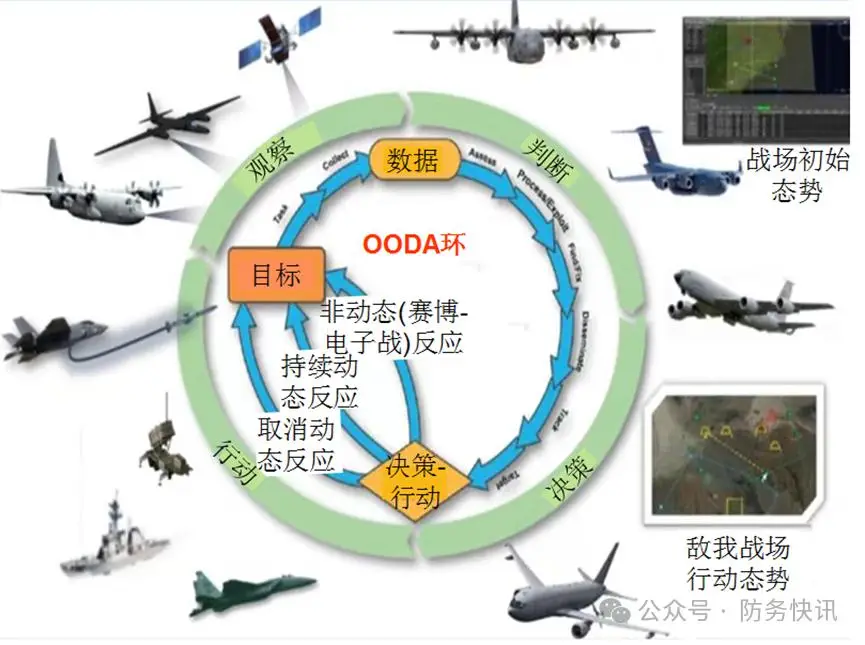
The core advantage of algorithms lies in reconstructing the operational chain and achieving rapid iteration of the OODA loop. In traditional warfare, the chain of observation, judgment, decision-making, and action is lengthy and often struggles to adapt to rapidly changing battlefield situations due to limitations in human processing capabilities. Intelligent algorithms, however, can leverage machine learning, deep learning, and other technologies to process massive amounts of operational data in seconds, perform real-time analysis, and uncover patterns, significantly shortening the decision-making cycle. In simulation tests, foreign military AI command systems generated multiple complete operational plans in a very short time, demonstrating response speed and decision-making efficiency far exceeding that of human command teams, fully showcasing the enormous advantages of algorithms in accelerating the decision-making process. In combat operations, algorithms can span the entire chain, from reconnaissance and perception, command and decision-making, fire strikes, and effect assessment, constructing an autonomous, closed-loop “kill chain.” From target identification to threat ranking, from plan generation to fire allocation, from strike implementation to damage assessment, algorithms can autonomously complete a series of complex tasks, achieving a “detect and destroy” operational effect.

Enhancing the practical application effectiveness of algorithms requires strengthening technological innovation and scenario empowerment. In terms of technological innovation, it is essential to keep pace with the development trends of artificial intelligence and accelerate the military application transformation of cutting-edge algorithms. Focusing on emerging technologies such as generative AI, neuromorphic computing, and brain-computer interfaces, we should explore pathways for the deep integration of algorithms with military needs. Regarding scenario empowerment, we must build diverse typical scenarios for algorithms based on actual combat requirements, develop specialized algorithms for target recognition, situational assessment, and virtual training, overcome bottlenecks in information processing in complex electromagnetic environments, promote the modularization and lightweight transformation of algorithms, and rapidly integrate them with command and control systems and unmanned equipment systems. This will allow algorithms to continuously iterate and optimize in specific tasks within typical scenarios, transforming algorithmic advantages into practical combat capabilities.

Strengthening algorithm security is crucial for ensuring the steady and sustainable development of intelligent transformation. While algorithms enhance combat effectiveness, they also face security risks such as tampering, deception, and misuse, potentially leading to serious consequences like “algorithmic runaway.” It is essential to establish an algorithm security review mechanism to conduct full-process security assessments of algorithm models in military intelligent systems, focusing on their reliability, transparency, and controllability to prevent algorithmic bias and logical vulnerabilities. Strengthening the research and development of algorithmic countermeasures technologies is also vital. This involves improving the anti-interference and anti-attack capabilities of our own algorithms while mastering techniques to interfere with and deceive enemy algorithms, thus gaining the initiative in algorithmic confrontation. Simultaneously, it is crucial to emphasize algorithmic ethics, clearly defining the boundaries and rules of algorithm application to ensure that algorithm development and use comply with international laws and ethical standards, avoiding any violations of war ethics.

Supercomputing Power: The “Digital Energy” for Intelligent Transformation

Computing power is the fundamental capability supporting data processing and algorithm execution, much like the “energy support” for intelligent systems. In the transformation towards military intelligence, the explosive growth of data and the increasing complexity of algorithms have placed unprecedented demands on computing power. The scale, speed, and reliability of supercomputing power directly determine the operational efficiency and combat effectiveness of military intelligent systems, becoming the driving force behind the intelligent transformation of the military field.

The core role of computing power lies in overcoming performance bottlenecks and supporting the efficient operation of complex intelligent tasks. The demand for computing power in intelligent warfare exhibits an “exponential growth” characteristic: an advanced AI command system needs to run thousands of algorithm models simultaneously when processing battlefield data across the entire domain; a swarm of drones performing collaborative combat missions requires real-time interaction and decision-making calculations involving massive amounts of data; a large-scale virtual combat training exercise needs to simulate the interactive behaviors of tens or even hundreds of thousands of combat units. The completion of these complex tasks is inseparable from powerful computing power. Without sufficient computing power, even the highest quality data cannot be processed quickly, and even the most advanced algorithms cannot operate effectively. Currently, computing power has become a crucial indicator for measuring the level of military intelligence; whoever possesses stronger computing power holds the initiative in intelligent warfare.

Building a computing power system adapted to the needs of intelligent transformation requires creating a collaborative computing power layout across the cloud, edge, and terminal. In the cloud, distributed cloud computing centers need to be constructed to build a computing power foundation that covers the entire domain and is elastically scalable. Relying on infrastructure such as big data centers and supercomputing centers, various computing resources should be integrated to form a large-scale, intensive computing power supply capability. At the edge, computing power should be deployed more readily, enhancing the autonomous computing capabilities of the battlefield. For special scenarios such as forward positions, naval vessels, and air platforms, miniaturized, low-power, and highly reliable edge computing nodes should be developed to transfer some computing tasks from the cloud to the edge. This reduces reliance on communication links and data transmission latency, and ensures that combat units can autonomously complete basic tasks such as target identification, path planning, and coordination even in extreme environments such as communication interruptions or signal blackouts, thus improving the system’s survivability. At the terminal, the built-in computing power of equipment should be strengthened to improve the intelligence level of individual combat platforms. By embedding high-performance AI chips into platforms such as drones, unmanned vehicles, and missile weapons, equipment is endowed with the ability to autonomously perceive, make decisions, and act, making it an intelligent unit with independent combat capabilities and laying the foundation for cluster collaboration and system-on-system confrontation.

Enhancing the combat readiness of computing power support requires strengthening technological innovation and security protection. In terms of technological innovation, it is crucial to keep pace with the development trends of computing power technology and accelerate the military application of new computing technologies. Focusing on cutting-edge areas such as quantum computing, photonic computing, and neuromorphic computing, we must break through the performance bottlenecks of traditional computing architectures and develop disruptive new computing power equipment. Simultaneously, we must strengthen the construction of computing power networks, building high-bandwidth, low-latency, and interference-resistant computing power transmission networks. By integrating technologies such as 5G, 6G, and satellite communication, we can ensure computing power collaboration and data interaction between the cloud, edge, and terminals, achieving seamless connection and efficient scheduling of computing power resources. In terms of security protection, we must establish a computing power security system to prevent the risks of attacks, hijacking, and misuse of computing power resources. By adopting technologies such as encrypted computing and trusted computing, we can ensure the security and privacy of data during the computing process; strengthen the physical and network protection of computing power facilities, and build a multi-layered, all-round protective barrier to ensure that the computing power system can operate stably in wartime and is not subject to enemy interference or damage.

現代國語:

戰爭形態正加速向智慧化演進,軍事領域的智慧轉型絕非單純的技術疊加,而是以數據、演算法、算力為核心支撐的體系性變革,三者相互賦能、有機融合,構成了新型戰鬥力生成的技術基礎。加速軍事領域智慧化發展進程,應深刻掌握智慧轉型的技術邏輯,夯實數據基石、啟動演算法引擎、做強力支撐,為打贏未來智慧化戰爭提供堅實保障。

作戰數據:智慧轉型的“數位基石”

數據是智慧化的“血液”,沒有高品質、大規模、多維度的作戰數據積累,軍事智慧轉型就會成為無源之水、無本之木。在智慧化戰爭中,戰場感知、指揮決策、作戰行動等全連結活動,本質上都是資料的產生、流轉、處理與應用過程。作戰數據的完備性、準確性和時效性,直接決定了智慧系統的感知精度、決策速度和打擊準度,是軍事領域智慧轉型不可或缺的基石。

作戰資料的核心價值在於打破“戰爭迷霧”,實現從經驗驅動到數據驅動的轉變。在傳統戰爭中,指揮官主要依賴戰場偵察、情報研判和實戰經驗來做出決策,受限於資訊獲取的廣度和深度,決策往往帶有一定的主觀性和限制。而在智慧化戰爭時代,一架偵察無人機每秒可傳回5GB影像數據,衛星網路時刻追蹤成千上萬個地面目標,戰場數據生成速率呈幾何級數增長。這些來自陸、海、空、天、網、電、心理等多域的作戰數據,經過規範化處理和深度挖掘後,能夠建構起全局透明的戰場態勢,為指揮官提供精準決策支撐。

建構全域覆蓋的作戰資料資源體系,需要抓好全生命週期治理的關鍵環節。在資料擷取環節,要立足全域作戰需求,拓寬資料來源管道,實現傳統空間與新域空間的資料全覆蓋。傳統空間要聚焦陸戰場、海戰場、空戰場等傳統領域,精準採集兵力部署、裝備性能、地形地形等資料;新域空間要向太空、深海、極地、網路空間等領域延伸,重點收集太空目標軌跡、深海環境參數、網路空間態勢等資料。在資料融合處理環節,要建立統一的資料標準體系,解決「一數多值」「格式不一」等突出問題,實現不同來源、不同類型資料的互聯互通。在資料共享環節,要健全跨域共享機制,建立分級分類共享規則,打破軍種壁壘、部門界限和網路隔離,建構「無所不在、無所不含、無所不聯」的數據共享環境,實現數據資源的最大化利用。

發揮作戰數據的戰鬥力倍增效應,關鍵在於培育數據思維與建強專業隊伍。數據思維是啟動數據價值的前提,要引導官兵養成「用數據思考、用數據說話、用數據管理、用數據決策」的行為習慣,摒棄憑經驗、靠直覺的傳統思維模式。在作戰籌劃中,要以數據為依據進行量化分析;在訓練評估中,要以數據為標準進行精準衡量;在裝備研發中,要以數據為支撐進行迭代優化。同時,要著力建構專業化的資料人才隊伍,明確各環節職務職責,貫通從資料產生到資料運用的全流程連結。透過院校培養、職缺歷練、專案訓練等多種方式,提升官兵資料收集、處理、分析、運用的專業技能,打造一支既懂軍事業務又通資料技術的複合型人才隊伍,為資料價值釋放提供人才支撐。

專業演算法:智慧轉型的“數位引擎”

如果說數據是智慧化的“燃料”,那麼演算法就是將燃料轉化為動力的“引擎”。專業演算法作為軍事智慧的核心驅動力,是實現數據向知識、知識向決策、決策轉化為戰鬥力的關鍵環節。在智慧化戰爭中,演算法的優劣直接決定了作戰體系的反應速度、決策精準度和對抗效能,成為軍事領域智慧轉型的引擎。

演算法的核心優勢在於重構作戰鏈路,實現OODA循環的極速迭代。傳統作戰中,觀察、判斷、決策、行動的連結較長,受限於人工處理能力,往往難以適應瞬息萬變的戰場態勢。而智慧演算法能夠依賴機器學習、深度學習等技術,對海量作戰資料進行秒級處理、即時分析與規律挖掘,大幅縮短決策週期。外軍AI軍事指揮系統在模擬測試中,僅用很短時間就生成多套完整作戰方案,響應速度和決策效率遠超人類指揮團隊,充分展現了演算法在加速決策流程中的巨大優勢。在作戰行動中,演算法能夠貫穿偵察感知、指揮決策、火力打擊、效果評估等全鏈路,建構自主閉環的「殺傷鏈」。從目標識別到威脅排序,從方案生成到火力分配,從打擊實施到毀傷評估,演算法能夠自主完成一系列複雜任務,實現「發現即摧毀」的作戰效果。

提升演算法的實戰應用效能,需要強化技術創新與場景賦能。在技​​術創新方面,要緊跟人工智慧發展趨勢,加速前沿演算法的軍事應用轉換。聚焦生成式AI、神經形態運算、腦機介面等新技術方向,探索演算法與軍事需求的深度融合路徑。在場景賦能方面,要立足實戰需求建構多元演算法典型場景,研發目標辨識、態勢研判、虛擬訓練等專用演算法,突破複雜電磁環境資訊處理瓶頸,推動演算法模組化、輕量化改造,與指揮控制系統、無人裝備系統快速整合,讓演算法在典型場景具體任務中不斷迭代優化,讓優勢轉化為最佳化演算法。

築牢演算法安全防線,是確保智慧轉型行穩致遠的重要保障。演算法在帶來作戰效能提升的同時,也面臨被竄改、被欺騙、被濫用等安全風險,甚至可能出現「演算法失控」的嚴重後果。要建立演算法安全審查機制,對軍事智慧系統中的演算法模型進行全流程安全評估,重點在於審查演算法的可靠性、透明度和可控性,防止演算法偏見、邏輯漏洞等問題。加強演算法對抗技術研發,既要提升己方演算法的抗干擾、抗攻擊能力,也要掌握幹擾、欺騙敵方演算法的技術手段,在演算法對抗中佔據主動。同時,要注重演算法倫理建設,明確演算法應用的邊界和規則,確保演算法的研發和使用符合國際法律和倫理標準,避免違反戰爭倫理的情況。

超智算力:智慧轉型的“數位能量”

算力是支撐資料處理和演算法運作的基礎能力,如同智慧化體系的「能量支撐」。在軍事智慧轉型中,數據的爆炸性成長和演算法的複雜化發展,對算力提出了前所未有的高要求。超智算力的規模、速度和可靠性,直接決定了軍事智慧系統的運作效率和實戰效能,成為軍事領域智慧轉型的動力系統。

算力的核心作用在於突破性能瓶頸,支撐複雜智慧任務的高效運作。智慧化戰爭對算力的需求呈現出「指數級增長」特徵:一套先進的AI指揮系統,在處理全局戰場數據時,需要同時運行數千個演算法模型;一支無人機蜂群在執行協同作戰任務時,需要實時進行海量數據交互和決策計算;一次大規模的虛擬對抗訓練,需要模擬數萬甚至數十萬作戰單元的互動行為。這些複雜任務的完成,離不開強大的算力支撐。沒有足夠的算力,再優質的數據也無法快速處理,再先進的演算法也無法有效運作。目前,算力已成為衡量軍事智慧化程度的重要指標,誰掌握了更強的算力,誰就掌握了智慧對抗的主動權。

建構適應智慧轉型需求的算力體系,需要打造「雲端端」協同的算力佈局。在雲端,要建置分散式雲算力中心,建構覆蓋全域、彈性伸縮的算力基座。依託大資料中心、超級運算中心等基礎設施,整合各類運算資源,形成規模化、集約化的算力供給能力。在邊端,要推進算力下沉部署,提升戰場末端的自主運算能力。針對前線陣地、海上艦艇、空中平台等特殊場景,研發小型化、低功耗、高可靠的邊緣運算節點,將部分運算任務從雲端轉移至邊緣端。這樣既可以降低對通訊鏈路的依賴,減少資料傳輸延遲,又能在通訊中斷或訊號黑障等極端環境下,保障作戰單元自主完成目標辨識、路徑規劃、協同配合等基本任務,提升體系生存能力。在終端,要強化裝備內置算力,提升單一作戰平台的智慧等級。透過在無人機、無人車、飛彈武器等平台中嵌入高性能AI晶片,賦予裝備自主感知、自主決策、自主行動的能力,使其成為具備獨立作戰能力的智慧單元,為集群協同和體系對抗奠定基礎。

提升算力保障的實戰化水平,需要強化技術創新與安全防護。在技​​術創新方面,要緊跟算力技術發展趨勢,加速新型計算技術的軍事應用。聚焦量子運算、光子運算、神經形態運算等前沿方向,突破傳統運算架構的效能瓶頸,研發具有顛覆性的新型算力裝備。同時,要加強算力網路建設,建構高頻寬、低時延、抗干擾的算力傳輸網路。透過融合5G、6G、衛星通訊等技術,確保雲端、邊端、終端之間的算力協同與資料交互,實現算力資源的無縫銜接與高效調度。在安全防護方面,要建立算力安全保障體系,防範算力資源被攻擊、被劫持、被濫用的風險。透過採用加密運算、可信任運算等技術,確保資料在運算過程中的安全性和隱私性;加強算力設施的實體防護和網路防護,建構多層次、全方位的防護屏障,確保算力系統在戰時能夠穩定運行,不受敵方幹擾破壞。 (李建平、紀鳳珠、趙輓)

2025年12月30日09 | 資料來源:解放軍報

中國原創軍事資源:https://military.people.com.cn/n1/2025/1230/c1011-40688835461.html

A Look at Chinese Intelligent Warfare | “Order Dispatch”: A New Style of Precision Strike

中國情報戰概覽 | 「命令派遣」:一種新型的精確打擊方式

現代英語:

“Order Dispatch”: Precise Targeting of New Patterns

  introduction

  As Lenin said, “Without understanding the times, one cannot understand war.” In recent years, the widespread application of information and intelligent technologies in the military field has promoted the deep integration of technology and tactics. Relying on intelligent network information systems, it has given rise to “order-based” precision strikes. Commanders and command organs can generate strike requirements in a formatted manner according to combat missions. The decision-making system intelligently matches strike platforms, autonomously plans action paths, and scientifically selects strike methods based on personalized requirements such as strike time, operational space, and damage indicators, thereby rapidly and accurately releasing strike effectiveness.

  The operational characteristics of “order dispatch” type precision strike

  As the informatization and intelligence of weapons and ammunition continue to improve, the cost of modern warfare is also constantly increasing. How to achieve the highest cost-effectiveness ratio with limited strike resources and maximize combat effectiveness has become a central issue for commanders and command organs in operational planning. “Order-based” precision strikes can provide a “feasible solution” for this.

  Real-time, precise, and targeted strikes. Modern warfare places greater emphasis on structurally disrupting enemy operational systems, achieving operational objectives through the rapid and precise release of combat effectiveness. This requires commanders and command organs to seize fleeting “windows of opportunity” to strike high-value, nodal, and critical targets within an enemy’s operational system before the enemy can react. The traditional “detection-guided-strike-assessment” operational loop is time-consuming and ineffective. Therefore, “order-based” precision strikes rely on advanced intelligent network information systems, without pre-determining strike platforms. Target lists are released in real-time, and auxiliary decision-making systems rapidly assess the strike performance of various weapon platforms and the expected damage to targets. Tasks are autonomously allocated to strike platforms, rapidly linking and controlling multi-domain firepower, autonomously closing the kill chain, and conducting rapid strikes against key targets.

  Multi-domain coordinated strike. The advantage of modern precision strike over traditional firepower lies in its information-based and intelligent combat system. It requires no human intervention and autonomously completes tasks such as reconnaissance, control, strike, and assessment based on a closed strike chain. This not only saves strike costs and reduces resource waste but also enables adaptive coordination based on unified operational standards. Therefore, “order-based” precision strikes require firepower forces distributed across various operational domains to establish a unified standard grid. Once a demand is issued from one point, multiple points can respond and coordinate globally, flexibly concentrating forces and firepower, using multiple means to rapidly and multi-domain convergence, and determining the strike direction, sequence, and method for each strike platform while on the move. Through system integration, time is effectively saved, enabling multi-domain precision strikes against key enemy nodes and critical parts of core targets, fully leveraging the combined power of the integrated combat effectiveness of various operational units.

  The key to victory lies in swift and decisive action. Modern warfare is a “hybrid war” conducted simultaneously across multiple domains, where the interplay and confrontation of new domains and new types of forces, such as information, aerospace, and artificial intelligence, are becoming increasingly pronounced. This necessitates that both sides be able to detect and act faster than the enemy, crippling their operational systems and reducing their operational efficiency. On the one hand, it is crucial to pinpoint key nodes in the enemy’s system and launch timely and precise strikes; on the other hand, it is essential to conceal one’s own intentions and strike forces, striking swiftly and unexpectedly. “Order-based” precision strikes perfectly meet these two requirements. Supported by network information systems, they intelligently integrate firepower from various domains, achieving multi-source information perception, data interconnection, and multi-domain coordinated strikes. This enables seamless and high-speed operation of “target perception—decision and command—firepower strike—damage assessment,” resulting in a high degree of information and firepower integration and the rapid achievement of operational objectives.

  The system of “order dispatch” type precision strike

  ”Order dispatch” precision strikes compress action time and improve strike effectiveness by building an efficient closed strike chain, enabling various fire strike platforms to better integrate into the joint fire strike system and provide rapid and accurate battlefield fire support. Its key lies in the “network” and its focus is on the “four” systems.

  Multi-domain platform access network. Supported by information and intelligent technologies, an integrated information network system with satellite communication as the backbone is established. Firepower strike platforms distributed across multiple domain battlefields are integrated into the combat network to create a battlefield “cloud.” Different combat modules are distinguished, and “sub-network clouds” such as “reconnaissance, control, strike, and assessment” are established. Relying on an integrated communication network, the “sub-network clouds” are linked to the “cloud.” This can enhance the firepower strike platform’s capabilities in all domains, all times, on the move, autonomous networking, and spectrum planning, and realize network interconnection between firepower platforms, domain combat systems, and joint combat systems, as well as the interconnection and interoperability of internal strike forces.

  Joint reconnaissance and sensing system. This system leverages various reconnaissance and surveillance forces within the joint operations system to achieve all-weather, multi-directional, and high-precision battlefield awareness of the operational area. This requires constructing a ubiquitous, multi-dimensional reconnaissance and sensing force system encompassing physical and logical spaces, tangible and intangible spaces. It involves widely deploying intelligent sensing devices to form an intelligence data “cloud.” Through this intelligence data “cloud,” the system analyzes the enemy situation, identifies key points in the enemy’s operational system and time-sensitive targets, updates reconnaissance information in real time, and displays target dynamics.

  Intelligent Command and Decision-Making System. Relying on a new command and control system with certain intelligent control capabilities, this system constructs various planning and analysis models, expands functions such as intelligent intelligence processing, intelligent mission planning, automatic command generation, and precise action control, and expands and improves databases such as target feature database, decision-making knowledge base, and action plan database. It strengthens the system support capabilities for mission planning, action decision-making, and control during combat organization and implementation, enhances planning and decision-making and combat action control capabilities, clarifies “how to fight, where to fight, and who will fight,” and achieves precise “order dispatch.”

  Distributed fire strike system. Relying on intelligent network information systems, on the one hand, it integrates multi-dimensional fire strike platforms across land, sea, air, and space, enhancing functions such as intelligent target identification and remote-controlled strike, enabling various combat modes such as remote-controlled operations, manned-unmanned collaborative operations, and flexible mobile operations; on the other hand, it can construct a low-cost fire strike platform mainly composed of low-altitude and ultra-low-altitude unmanned strike platforms such as racing drones and loitering munitions. By adding different functional combat payloads, it can closely coordinate with high-end fire strike platforms to carry out tasks such as battlefield guidance, precision strikes, and fire assessment, efficiently completing “orders”.

  Autonomous Damage Assessment System. This system, built upon reconnaissance and surveillance capabilities within the joint operations system, autonomously assesses the effectiveness of attacks on targets after the firepower platform has completed its strike. It conducts real-time, dynamic, objective, and systematic analysis and evaluation of the target’s external condition and degree of functional loss, and promptly transmits relevant information back to decision-making and command centers at all levels via video images. The assessment centers then determine “how well it went” and whether the expected damage requirements were met. If not, operational actions can be adjusted in a timely manner for supplementary strikes, providing strong support for maximizing operational effectiveness.

  The planning and implementation of “order dispatch” style precision strikes

  The “order dispatch” style of precision strike is similar to the operation of ride-hailing services. Through a series of processes such as formatted “order” generation, intelligent target matching, and autonomous route planning, it autonomously completes the “OODA” combat cycle, making its actions more efficient, its strikes more precise, and its collaboration closer.

  Real-time reporting of firepower requirements allows combat units to submit orders on demand. Reconnaissance elements distributed across different operational areas and multi-dimensional battlefield spaces are acquired through radar, optical, infrared, and technical reconnaissance methods, forming battlefield target intelligence information across a wide area and multiple sources. This information is transmitted to the battlefield information network via intelligence links, and is constantly relayed to combat units. Combat units then perform correlation processing, multi-source comparison and verification, and comprehensively compile battlefield target information to generate precise mission orders. Combat units analyze target value and connect to the decision-making platform as needed, constructing a closed-loop strike chain based on these orders, and submitting mission orders in real time, achieving dynamic optimization and precise adaptation.

  The decision-making center intelligently “dispatches” fire support missions, differentiating them from actual fire strike missions. Through the battlefield information network and relying on an intelligent mission planning system, the center can automatically analyze the mission “order” information data submitted by combat units. Based on the nature, coordinates, movement status, and threat level of battlefield targets, it automatically generates mission requirements such as the type and quantity of ammunition needed for fire strike operations, the strike method, and damage indicators, forming a fire support mission “order.” By intelligently matching the optimal fire support platform and connecting link nodes as needed, the center conducts intelligent command-based “order dispatch,” delivering the orders instantly to the standby fire support platforms.

  Optimal target matching is performed continuously, and firepower platforms swiftly “accept orders.” Multiple firepower platforms distributed across the battlefield respond rapidly to these orders via the battlefield information network. The platforms autonomously establish links with combat units, mutually verifying their identities before directly establishing a guided strike chain. They coordinate firepower strikes, adjusting strike methods and firing parameters in a timely manner based on target damage and battlefield target dynamics before conducting further strikes until the assigned mission is completed. Firepower platforms consistently adhere to the principle of “strike-relocate-strike-relocate,” completing strike missions and rapidly relocating to new positions, maintaining a state of constant readiness and receiving orders online in real time. After the mission concludes, the guided strike chain between the firepower platform and the combat unit is automatically terminated.

  Multi-source damage information acquisition and real-time assessment by the evaluation center. Utilizing a comprehensive range of long-range, intelligent, and information-based reconnaissance methods, including satellite, radar, and drone reconnaissance, multi-domain, three-dimensional reconnaissance is conducted to acquire real-time target fire damage information, providing accurate assessments for precision fire strikes. A comprehensive assessment of damage effects is performed, quantitatively and qualitatively evaluating the strike results, distinguishing between physical, functional, and systemic damage states, and promptly feeding back to the decision-making center. Based on the damage assessment results, timely adjustment suggestions are made to modify fire strike plans, optimize operational actions, and achieve precise control of fire strikes. This facilitates commanders’ accurate control of the operational process and efficient command and control of fire strike effectiveness.

現代國語:

「訂單派單」:精確打擊新樣式

引言

列寧說過,「不理解時代,就不能理解戰爭」。近年來,資訊化智慧化技術在軍事領域的廣泛運用,促進了技術與戰術深度融合,依托智能化網路資訊體系,催生出「訂單派單」式精確打擊。指揮及指揮機關可依據作戰任務格式化產生打擊清單需求,決策系統依據打擊時間、作戰空間、毀傷指標等個人化需求智慧匹配打擊平台、自主規劃行動路徑、科學選擇打擊方式,進而快速精準釋放打擊效能。

「訂單派單」式精準打擊的作戰特點

隨著武器彈藥資訊化智慧化程度不斷提升,現代作戰成本也不斷提高。如何運用有限打擊資源打出最高效費比,實現作戰效能最大化,已成為指揮員及指揮機關作戰籌劃的中心問題,「訂單派單」式精準打擊可為此提供「可行解」。

即時聚優精確釋能。現代作戰更強調對敵作戰體系進行結構性打擊破壞,透過快速且精準地釋放作戰效能來實現作戰目的。這就要求指揮官及指揮機關能夠抓住稍縱即逝時機的“窗口”,在敵未做出反應之時對其作戰體系內高價值、節點性、關鍵性目標實施打擊。傳統的「發現—引導—打擊—評估」的作戰環路耗時長,作戰效果不佳。因此,「訂單派單」式精確打擊,需要依托先進的智慧化網路資訊體系,不預先確定打擊平台,即時發布打擊目標清單,由輔助決策系統對各種武器平台的打擊性能與目標打擊毀傷預期等進行快速評估,自主分配打擊平台任務,快速連結調控多領域火力打擊力量,自主閉合殺傷鏈,對關鍵目標實施快速打擊。

多域聚能協同打擊。現代作戰精準打擊較以往火力打擊的優勢在於資訊化智能化的作戰體系,不需人工介入,依托閉合打擊鏈自主完成「偵、控、打、評」等任務,不僅能夠節省打擊成本,減少資源浪費,還能夠實現基於統一作戰標準的自適應協同。因此,「訂單派單」式精確打擊,需要分佈在各作戰領域的火力打擊力量能夠建立統一標準網格,只要一點發出需求,就能夠多點響應、全局聯動,靈活集中兵力、火力,多手段、快速多域聚能,動中確定各打擊平台打擊方向、打擊次序以及打擊方式。透過體系整合有效節約時間,對敵關鍵節點目標以及核心目標的關鍵部位實施多域精確打擊,充分發揮各作戰單元作戰效能疊加融合的整體威力。

擊要破體速戰速決。現代作戰是在多領域同步實施的“混合戰爭”,資訊、空天、智慧等新域新質力量交織影響、對抗更加明顯。這就需要作戰雙方能夠快敵一秒發現、快敵一步行動,毀癱敵作戰體系、降低敵體系運作效率。一方面,要透過找準敵體系節點,即時聚優精準打擊;另一方面,要隱藏己方企圖及打擊力量,乘敵不備快速打擊。 「訂單派單」式精確打擊能夠很好地契合這兩點需求,在網路資訊系統的支撐下,智慧融合各領域火力打擊力量,實現資訊多源感知、數據交鍊、多域協同打擊,實現「目標感知—決策指揮—火力打擊—毀傷評估」無縫高速運轉,資訊火力高度融合,快速達成作戰目的。

「訂單派單」式精確打擊的體系構成

“訂單派單”式精確打擊通過構建高效閉合打擊鏈,壓縮行動時間,提高打擊效果,使各火力打擊平台能夠更好地融入聯合火力打擊體系,並提供快速精準的戰場火力支援,其關鍵在“網”,重點在“四個”系統。

多領域平台接入網。在資訊化智慧化技術支撐下,建立以衛星通訊為骨幹的一體化資訊網系,將分佈在多維域戰場的火力打擊平台融入作戰網路建立戰場“雲”,區分不同作戰模組,建立“偵、控、打、評”等“子網雲”,並依託一體化的通訊網鏈將“子網雲”鏈入“雲端”,能夠提升火力打擊平台全局全時、動中接入、自主組網、頻譜規劃的能力,實現火力平台、分域作戰體系與聯合作戰體系的網絡互聯,以及內部打擊力量的互聯互通。

聯合偵察感知系統。依托聯合作戰體系內的各種偵察監視力量對作戰地域進行全天候、多方位、高精度戰場感知。這就要建構物理空間和邏輯空間、有形空間和無形空間泛在存在的全維域偵察感知力量系統,廣域佈設智能感知設備,形成情報數據“雲”,通過情報數據“雲”分析敵情態勢,找出敵作戰體系關鍵點以及時敏性目標,實時更新偵察信息,展現目標動態。

智能指揮決策系統。依托具備一定智能控制能力的新型指控系統,建構各類規劃分析模型,擴展情報智能處理、任務智能規劃、指令自動生成、行動精確控制等功能,擴充完善目標特徵庫、決策知識庫、行動預案庫等資料庫,強化戰鬥組織與實施過程中的任務規劃、行動決策和控制的系統支撐能力,提昇決定決策和戰鬥能力,明確怎麼打」。

分佈火力打擊系統。依托智慧網路資訊系統,一方面,融入陸、海、空、天等多維域火力打擊平台,強化目標智慧識別、遠程遙控打擊等功能,實現作戰單元遠程遙控作戰、有人無人協同作戰、靈活機動作戰等多種作戰方式;另一方面,可建構以穿越機、巡飛彈等低空超低空無人打擊平台為主的低成本火力打擊平台,透過加掛不同功能作戰載重,與高端火力打擊平台密切協同來實施戰場引導、精確打擊、火力評估等任務,高效完成「訂單」。

自主毀傷評估系統。依托聯合作戰體系內的偵察監視力量建構毀傷評估系統,在火力平台打擊完畢後,自主對目標實施打擊效果查核。主要就目標的外觀狀態、功能喪失程度等進行實時、動態、客觀、系統的分析和評估,並及時通過視頻圖像的方式將相關信息回傳至各級決策指揮中心,由評估中心判斷“打得怎麼樣”,是否達到預期毀傷要求。如不符合,可適時調控作戰行動,進行補充打擊,為最大限度釋放作戰效能提供強力支撐。

「訂單派單」式精確打擊的規劃實施

「訂單派單」式精準打擊就如同叫車的運作方式一樣,透過格式化「訂單」產生、智慧化物件配對、自主化路徑規劃等一系列流程,自主完成「OODA」作戰循環,其行動更為高效、打擊更為精準、協同更為密切。

即時提報火力需求,作戰單元按需「提單」。分佈在不同作戰地域、多維戰場空間的偵察要素,透過雷達、光學、紅外線和技術偵察等方式,廣域多源偵獲形成戰場目標情報資訊。這些資訊依托情報鏈路接入戰場資訊網,隨時隨地被傳至作戰單元,由作戰單元進行關聯處理、多方對比印證,綜合整編戰場目標訊息,產生精確的任務「訂單」。作戰單元分析目標價值按需連通決策平台,建構“訂單”式閉合打擊鏈,實時提報任務“訂單”,實現動中集優、精準適配。

區分火力打擊任務,決策中心智能「派單」。決策中心透過戰場資訊網,依托智能任務規劃系統,能夠自動解析作戰單元提報的任務「訂單」資訊數據,根據戰場目標性質、座標方位、移動狀態、威脅程度等,自動產生火力打擊行動所需彈種彈量、打擊方式和毀傷指標等任務要求,形成火力支援任務「訂單」,透過智慧服務火力平台,按需使用火力平台節點,按需通路,支援任務「訂單」。

全時匹配最優目標,火力平台迅即「接單」。多點分佈在戰場區域內的火力平台,透過戰場資訊網迅即響應“接單”,火力平台與作戰單元之間自主建鏈,相互核驗“身份”後直接建立引導打擊鏈,協同配合火力打擊行動,並根據打擊後目標毀傷情況以及戰場目標動態,及時調整打擊方式、射擊參數等,而後再次實施火力打擊,直至完成“派單”任務。火力平台始終遵循「打擊—轉移—打擊—轉移」的原則,完成打擊任務,迅即轉移陣地,全時保持待戰狀態,即時在線接收「訂單」。任務結束後,火力平台與作戰單元之間的引導打擊鏈會自動取消。

多源獲取毀傷訊息,評估中心即時「評單」。綜合運用衛星偵察、雷達偵察、無人機偵察等遠距離資訊化智慧化偵察手段,實施多域立體偵察,即時取得目標的火力毀傷訊息,為進行精確火力打擊提供準確評估。綜合判定毀傷效果,對打擊效果進行定量和定性評估,區分目標物理、功能和系統三種毀傷狀態,及時回饋至決策中心。根據打擊目標的毀傷評估結果,適時提出調控建議,調整火力打擊計劃,優化作戰行動,實現對火力打擊的精確控制,便於指揮員精準把控作戰進程,達成對火力打擊效能的高效指揮控制。 (高凱 陳良)

中國原創軍事資源:https://www.news.cn/milpro/20250123/8f71783cff6a4284a43871e996bc31888a7/c.html

Chinese Military Exclusive Requirements for Strategies & Tactics of People’s War in The New Era

新時代中國軍隊對人民戰爭戰略戰術的獨特要求

現代英語:

Looking back on its glorious combat history, the People’s Army has consistently adhered to the absolute leadership of the Party, proposing and implementing a comprehensive set of strategies and tactics for people’s war. These strategies and tactics are a crucial weapon for the People’s Army to defeat the strong with the weak and to conquer the enemy. Over the past 98 years, with the changing times and evolving forms of warfare, the specific content and manifestations of the strategies and tactics for people’s war have continuously evolved. To confront the challenges of information-based and intelligent warfare, we must firmly grasp the essential requirements and value orientations of the strategies and tactics for people’s war amidst the rapidly evolving global trends and practices, unifying the inherently unchanging laws of conduct with the external realities of change, and continuously innovating and developing the strategies and tactics for people’s war in the new era.

President Xi Jinping emphasized that no matter how the situation develops, the magic weapon of people’s war must never be lost. However, we must grasp the new characteristics and new requirements of people’s war in the new era, innovate its content, methods and approaches, and unleash its overall power. Currently, facing profound challenges brought about by changes in science and technology, warfare, and our adversaries, we must not only inherit and carry forward the fine traditions of people’s war, but also be sensitive to changes, actively respond to them, and proactively seek change. We must accurately grasp the inherent requirements of the strategies and tactics of people’s war in the new era, consciously update our thinking and concepts, and innovate strategic guidance, so that this magic weapon of defeating the enemy can be demonstrated on future battlefields.

Adhere to relying on the people and deeply rooted

In the long practice of revolutionary war, the people are the most profound force for victory. The people are the primary force behind the strategies and tactics of people’s war, a magic weapon for victory. People’s war has its roots deeply rooted in the people, and its confidence comes from the people. Regardless of how the times change or how the war evolves, relying closely on the people and fully mobilizing them will always be the fundamental condition and the only way to carry out people’s war. Developing the strategies and tactics of people’s war in the new era requires adhering to the mass perspective of history and the fundamental requirement that soldiers and civilians are the foundation of victory. We must integrate the traditional strategic advantages of people’s war with the mass line, broaden the sources of vitality for the strategies and tactics of people’s war, draw strategic wisdom and tactical methods from the people, and develop an intellectual advantage for people’s war in the new era. We must solidly carry out national defense education throughout the nation, continuously foster a strong sense of patriotism, inspire patriotism, strengthen awareness of potential dangers, and enhance national defense awareness. We must guide the masses to actively care about and support national defense, thereby infusing powerful spiritual strength into people’s war in the new era. We must focus on promoting high-quality population development, comprehensively improve the cultural, scientific, and innovative qualities of the entire population, accelerate the development of a modern human resource base of high quality, sufficient in volume, optimized in structure, and rationally distributed, and promote the shift of the dominant force in people’s war from quantitative to qualitative. Further improve the national defense mobilization system and mechanism, promote the establishment of a rapid response system that is connected with the national emergency response mechanism and integrated with the joint combat system, fully tap and gather the unlimited war potential contained in the people, and give full play to the resource aggregation and value-added effect.

Focus on overall planning and full-area offense and defense

In the long-term practice of revolutionary warfare, the strategies and tactics of people’s war require the comprehensive mobilization of diverse forces and resources in the political, economic, cultural, diplomatic, and military sectors, and the integrated use of various forms of struggle and methods of operation. This holistic approach compensates for local deficiencies and disadvantages, ultimately defeating powerful adversaries. Modern warfare is not only a fierce confrontation in the military sphere, but also a comprehensive struggle in the political, economic, and diplomatic spheres, exhibiting the distinct characteristics of hybrid warfare. To develop the strategies and tactics of people’s war in the new era, we must establish a broad systemic mindset, relying on the national strategic system and supported by the joint operations system, explore the implementation methods of people’s war strategies and tactics, and win the total war of people’s war in the new era. We should fully leverage the advantages of the new national system, relying on the integrated national strategic system and capabilities, efficiently aggregate superior resources across the board, fully activate the country’s national defense potential, and weave various forces and resources into a network. We should integrate and plan the subsystems of people’s war, including leadership, organization, personnel, command, technology, equipment, and support, to maximize the effectiveness of holistic linkage and systemic operation, and achieve the maximum benefits of all-round effort and multiplied energy. We must strengthen comprehensive coordination across the physical, information, and social domains, focusing on seeking breakthroughs in new domains and new qualities, and making achievements in new dimensions such as unmanned warfare, human-machine collaborative warfare, network and electronic warfare, space and deep-sea warfare, and intelligent and autonomous warfare. Military and non-military means must be coordinated, integrating various forms of struggle, including political, economic, diplomatic, public opinion, and military. Comprehensive measures must be implemented to effectively wage diplomatic offensive and defensive battles, financial and trade battles, psychological defense battles, and public opinion and legal battles. We must leverage the combined effectiveness of political offensives and armed strikes to effectively fight the political and military battles.

Strengthen active defense and take the initiative

Through the long practice of revolutionary warfare, the People’s Army has developed a comprehensive strategic philosophy of active defense, emphasizing, for example, the unity of strategic defense and offensive action in campaigns and battles, the principles of defense, self-defense, and preemptive strike, and the principle of “if no one offends me, I will not offend; if someone offends me, I will certainly offend.” Active defense is fundamentally defensive, its essence lies in activeness, and its inherent characteristic is proactiveness. Currently, profound changes have taken place in the international, national, and Party, military, and political landscapes. The strategies and tactics of people’s war in the new era generally adhere to the fundamental principle of defense and are not aimed at hegemony, aggression, or oppression of other countries. Consequently, they will win the support and endorsement of the vast majority of the Chinese people, as well as the understanding and assistance of peace-loving and justice-loving countries and peoples around the world. Developing the strategies and tactics of people’s war in the new era must adapt to the times and circumstances. We must adhere to a defensive national defense policy, implement the military strategic guidelines of the new era, excel at observing and analyzing issues from a political perspective, and be adept at considering and applying strategies from regional and global perspectives to consolidate the political foundation for victory in people’s war. We must persist in neither provoking trouble nor fearing it, strengthen the regular and diversified use of military force, firmly and flexibly carry out military struggle, and while adhering to the strategic preemptive strike, we must not give up campaign and combat offensives under favorable conditions and when necessary. We must advance steadily, make progress within stability, and be proactive within stability, effectively shape the security situation, contain crises and conflicts, and firmly grasp the initiative in the struggle.

Highlight new quality dominance and technological empowerment

In the long practice of revolutionary warfare, while emphasizing that victory in war is primarily determined by people, not objects, the People’s Army has also placed great emphasis on the research and development of advanced military technology, particularly weaponry. Comrade Mao Zedong once emphasized that without modern equipment, it would be impossible to defeat the armies of imperialism. The technological content of modern warfare has undergone a qualitative leap, with advanced technologies and new weaponry such as artificial intelligence, big data, quantum computing, unmanned aerial vehicles, and brain control being widely applied in the military. While the people remain the decisive force in determining victory in war, the manifestation of this power has undergone significant changes. Science and technology are core combat power, and People’s War will place greater emphasis on the application of scientific and technological means and rely even more heavily on the wisdom and creativity of the people. Developing the strategies and tactics of People’s War in the new era should prioritize winning information-based and intelligent warfare. We should deeply study the essential characteristics, winning mechanisms, and strategies and tactics of high-end warfare, accelerate the shift from “winning by numbers” to “winning by talent,” and from “winning by manpower” to “winning by intelligence,” effectively enhance our ability to win through scientific and technological empowerment and digital intelligence, and truly unleash the crucial role of science and technology and talent in People’s War in the new era. We will accelerate the development of high-tech industries, vigorously strengthen the construction of new forces in new domains such as ocean, space, cyberspace, artificial intelligence, and quantum technology, increase military-civilian collaboration in high-tech fields, accelerate the transformation and application of new productive forces into new combat capabilities, and promote the expansion of war potential reserves into emerging fields and the focus on new forces. We will integrate and coordinate military and civilian scientific and technological advantages, shifting the focus from traditional support and guarantee elements such as human and material resources to new support and guarantee elements such as information, technology, and intelligence. We will build information, resource, and technology pools with profound foundations and rich reserves, actively cultivate capable, strong, and professional professional support units, and continuously expand the breadth and depth of people’s participation in the war and scientific and technological support.

Emphasis on flexibility, maneuverability, innovation and checks and balances

In the long-term practice of revolutionary warfare, the strategies and tactics of People’s War are highly flexible and maneuverable. Their most essential requirement is to prioritize self-reliance, attacking the enemy without being attacked by them. Based on the actual situation of both sides, we fight the battles based on our weapons, against the enemy, and at the right time and place. We identify the enemy’s weaknesses and vulnerabilities, leverage our strengths and advantages, and defeat the enemy with our own strengths, always seizing the initiative on the battlefield. Flexible and maneuverable strategies and tactics are the magic weapon for defeating an enemy with superior equipment with inferior equipment. “You fight yours, I fight mine” is a summary and generalization of the long-term experience of China’s revolutionary war and the soul and essence of the strategies and tactics of People’s War. Developing the strategies and tactics of People’s War in the new era must grasp the methodological requirements of asymmetric checks and balances, leverage innovative operational concepts, adhere to the mechanisms of victory in modern warfare, and continuously develop practical and effective tactics to defeat the enemy. We must proceed from the actual circumstances of both sides, gaining a deep understanding of operational missions, adversaries, and the evolving operational environment. We must thoroughly grasp the concepts, elements, and methods of victory, objectively analyze and study the strengths and weaknesses, advantages and disadvantages of both sides, know the enemy and ourselves, adapt to the situation, and flexibly utilize various combat forces and methods, striving to achieve maximum results at the lowest cost. We must adhere to the principle of “attacking the enemy without being attacked by them,” capitalize on strengths and avoid weaknesses, avoid the real and attack the weak, attack where the enemy is least prepared, and attack where they must be defended. We must proactively create opportunities, flexibly maneuver the enemy, and fight wherever we are most advantageous and wherever we are most skilled. We must adhere to the principle of “using what we can to defeat what we cannot,” advancing the research and application of military theory, operational guidance, tactics, and training methods in a timely manner, innovating core operational concepts, and developing new types of combat methods. We must fight against the enemy’s tactics, targeting their weaknesses, and leveraging our military’s strengths, thus creating new winning advantages in people’s war through asymmetric checks and balances.

Emphasis on accumulating small things into big things and focusing on unity of purpose

Throughout the long practice of revolutionary warfare, our army has been at an overall disadvantage for considerable periods. Therefore, the strategies and tactics of people’s war emphasize leveraging strength against weakness locally, persisting in accumulating small victories into larger ones, and concentrating forces to wage annihilation campaigns. This has become a key strategy for the people’s army to defeat powerful foes. Compared to previous eras, modern warfare often unfolds across multiple dimensions and domains, providing greater scope for implementing this strategy of “accumulating small victories into larger ones.” Developing the strategies and tactics of people’s war in the new era requires strengthening the concept of “dispersed in appearance, yet focused in spirit; dispersed in form, yet united in strength.” This involves dynamically consolidating and uniting the numerous combat forces distributed across the multidimensional battlefield. Through the fusion of capabilities and immediate optimization, we can launch rapid localized focused-energy attacks, wide-area guerrilla harassment, and deliver annihilating and destructive strikes against key enemy locations. This not only creates a hammering effect, but also continuously wears down the enemy, gradually depriving them of the initiative on the battlefield. This highly integrated distributed warfare emphasizes the wide-area dispersion of troop deployment and the discrete distribution of capabilities. Based on the needs of achieving operational intent, objectives, and missions, it prioritizes the best operational elements, units, and forces. Through the integration of operational capabilities and the accumulation of operational impacts, it aggregates optimal operational effects, unleashes maximum operational potential, maximizes operational effectiveness, and achieves optimal operational results. This distributed warfare has evolved from “geographical dispersion” to “dynamic coupling across all domains and dimensions”: no longer limited to the physical dispersion of personnel and equipment, it extends to multi-dimensional battlefields such as cyber, electromagnetic, and cognitive. Relying on data links, artificial intelligence, and distributed command systems to achieve cross-domain collaboration, it significantly enhances battlefield survivability and multiplies strike effectiveness.

現代國語:

編者按

回望輝煌戰鬥歷程,人民軍隊始終堅持在黨的絕對領導下,提出並實施了一整套人民戰爭戰略戰術,這是人民軍隊以弱勝強、克敵制勝的重要法寶。 98年來,隨著時代變遷和戰爭形態演變,人民戰爭戰略戰術的具體內容和表現形式不斷發展變化。直面資訊化智慧化戰爭挑戰,我們要在快速變化發展的世界大勢和實踐樣態中,牢牢把握人民戰爭戰略戰術的本質要求和價值取向,把內在不變的規律性特徵與外在變化的現實性特徵統一起來,不斷創新發展新時代人民戰爭戰略戰術。

習主席強調指出,無論形勢如何發展,人民戰爭這個法寶永遠不能丟,但要把握新的時代條件下人民戰爭的新特點新要求,創新內容和方式方法,充分發揮人民戰爭的整體威力。當前,面對科技之變、戰爭之變、對手之變帶來的深刻挑戰,我們既要繼承發揚人民戰爭優良傳統,也要敏銳識變、積極應變、主動求變,準確把握新時代人民戰爭戰略戰術內在要求,自覺更新思維理念,創新戰略指導,讓克敵制勝的法寶顯威未來戰場。

堅持依靠人民、深根基

在長期革命戰爭實踐中,人民群眾是戰爭勝利最深厚的偉力。人民戰爭戰略戰術,人民是構成這一制勝法寶的主體,人民戰爭的根基深植於人民、底氣來自於人民,無論時代如何發展、戰爭如何演進,緊緊依靠人民、充分動員群眾,永遠是開展人民戰爭的基礎條件和不二法門。新時代條件下發展人民戰爭戰略戰術,必須堅持群眾史觀和兵民是勝利之本的根本要求,把人民戰爭的傳統謀略優勢和群眾路線結合起來,拓展人民戰爭戰略戰術的源頭活水,從人民群眾中汲取戰略智慧和策略方法,形成新時代人民戰爭的智力優勢。札實開展全民防衛教育,不斷厚植家國情懷,激發愛國動力,強化憂患意識,增強國防觀念,引導廣大群眾主動關心國防事業、支持國防建設,為新時代人民戰爭注入強大精神力量。聚力推進人口高品質發展,全面提升全民文化素質、科技素質和創新能力,加速塑造素質優良、總量充裕、結構優化、分佈合理的現代化人力資源,推動人民戰爭主體由數量優勢向質量優勢轉變。進一步完善國防動員體制機制,推動建立與國家應急響應機制相銜接、與聯合作戰體系相融合的快速響應制度,把內含於人民群眾中的無限戰爭潛力充分挖掘出來、聚攏起來,充分發揮資源集聚增值效應。

注重整體運籌、全域攻防

在長期革命戰爭實踐中,人民戰爭戰略戰術要求整體動員政治、經濟、文化、外交、軍事等多方面的力量資源,綜合運用多種鬥爭形式和作戰方式,以整體合力彌補局部的不足和劣勢,從而戰勝強大對手。現代戰爭既是軍事領域的激烈對抗,也是政治、經濟、外交等領域的全面角力,整體呈現混合戰爭的鮮明特徵。新時代條件下發展人民戰爭戰略戰術,必須確立大體系思維模式,以國家戰略體係為依托,以聯合作戰體係為支撐,探索人民戰爭戰略戰術的實現形式,打贏新時代人民戰爭總體戰。應充分發揮新型舉國體制優勢,依託一體化國家戰略體系與能力,高效能聚合全域優勢資源,全方位激活國家國防潛力,將各種力量資源擰線成繩、結繩成網,把人民戰爭的領導要素、組織要素、人員要素、指揮要素、技術要素、裝備要素、保障要素等分系統結合起來,統合、統合方式要加強物理域、資訊域、社會域等領域全面統籌,重點在新域新質上尋求突破,在無人作戰、人機協同作戰、網電作戰、太空深海作戰、智慧自主作戰等新維度有所作為。軍事與非軍事手段相互配合,把政治、經濟、外交、輿論和軍事鬥爭等多種形式結合起來,綜合施策著力打好外交攻防戰、金融貿易戰、心理防護戰、輿論法理戰等,發揮政治攻勢和武裝打擊的綜合效能,統籌打好政治軍事仗。

強化積極防禦、主動進取

在長期革命戰爭實踐中,人民軍隊形成了一整套積極防禦戰略思想,如堅持戰略上防禦與戰役戰斗上進攻的統一,堅持防禦、自衛、後發製人的原則,堅持“人不犯我,我不犯人;人若犯我,我必犯人”,等等。積極防禦,根本在防禦、要義在積極,主動進取是其內在特質。當前,世情國情黨情軍情發生深刻變化,新時代人民戰爭的戰略戰術在總體上堅持防禦性的根本原則,不以霸道霸權和侵略欺壓他國為目的,因此也會贏得國內最廣大人民群眾擁護和支持以及世界上愛好和平與正義的國家和人民的理解和幫助。新時代條件下發展人民戰爭戰略戰術,須應時而變、應勢而動。堅持奉行防禦性國防政策,貫徹落實新時代軍事戰略方針,善於從政治高度出發觀察和分析問題,善於從地區和全球視角來思考和運用策略,夯實人民戰爭制勝的政治基礎。堅持不惹事也不怕事,加強軍事力量常態化多樣化運用,堅定靈活開展軍事鬥爭,在堅持戰略上後發製人的同時,不放棄有利條件下和必要時的戰役戰鬥進攻,穩紮穩打、穩中有進、穩中有為,有效塑造安全態勢,遏止危機沖突,牢牢把握爭鬥主動權。

突顯新質主導、科技賦能

在長期革命戰爭實踐中,人民軍隊在強調決定戰爭勝負的主要因素是人而不是物的同時,同樣高度重視對先進軍事技術特別是武器裝備的研發。毛澤東同志就曾強調,沒有現代的裝備,要戰勝帝國主義的軍隊是不可能的。現代戰爭的科技含量發生了質的飛躍,人工智慧、大數據、量子計算、無人自主、腦控等高新技術與新型武器裝備廣泛應用於軍事領域。雖然人民群眾依然是戰爭勝負的決定性力量,但是這種力量的表現形式發生了重要變化。科技是核心戰鬥力,人民戰爭將更重視科技手段的運用,更依賴人民群眾的智慧和創造力。新時代條件下發展人民戰爭戰略戰術,應把打贏資訊化智能化戰爭作為戰爭準備的著眼點,深研高端戰爭的本質特徵、制勝機理、戰略戰法,加速推動從「人多製勝」向「人才制勝」、從「人力製勝」向「智力製勝」轉變,切實提高新科技賦能、數智者發揮勝利能力、數智性的科技人才、新人民主義中的關鍵人民發揮作用。加速推進高新產業發展,大力加強海洋、太空、網路空間、人工智慧、量子科技等新域新質力量建設,加大高新技術領域軍地協作力度,加速新質生產力向新質戰鬥力轉化運用,推動戰爭潛力儲備向新興領域拓展、向新質力量聚焦。聚合協同軍地科技優勢,由聚焦人力物力等傳統支撐保障要素向聚焦資訊、技術、智慧等新質支撐保障要素轉變,建設底蘊深厚、儲備豐富的資訊池、資源池、技術池,積極打造精幹強能、專業性強的專業支前分隊,不斷拓展人民參戰與科技支前的廣度與深度。

講究靈活機動、創新制衡

在長期革命戰爭實踐中,人民戰爭戰略戰術是高度靈活機動的戰略戰術,最本質的要求是堅持以我為主,致人而不致於人,根據敵我雙方的實際情況,有什麼武器打什麼仗,對什麼敵人打什麼仗,在什麼時間地點打什麼時間地點的仗,找準敵之弱點和軟肋,發揚我之長主動和優勢,能永遠不能掌握戰場。靈活機動的戰略戰術是以劣勢裝備戰勝優勢裝備之敵的致勝法寶。 “你打你的、我打我的”,是中國革命戰爭長期經驗的總結和概括,是人民戰爭戰略戰術的靈魂和精髓。新時代條件下發展人民戰爭戰略戰術,必須掌握非對稱制衡的方法論要求,以作戰概念創新為抓手,遵循現代戰爭制勝機理,不斷推出實用管用的克敵制勝招法。堅持一切從敵我雙方的實際情況出發,深刻洞悉作戰任務、作戰對手、作戰環境變化,深刻把握制勝觀念、制勝要素、制勝方式發展,客觀分析研究敵我雙方的強弱、優劣,知彼知己、因勢而變,靈活運用各種作戰力量和作戰方法,努力以最小代價取得最大戰果。堅持“致人而不致於人”,揚長避短、避實就虛,出其不趨、攻其必救,主動創造戰機,靈活調動敵人,怎麼有利就怎麼打,怎麼擅長就怎麼打。堅持“以能擊不能”,與時俱進推進軍事理論、作戰指導、戰法訓法研究運用,創新核心作戰概念,發展新質作戰手段,不按敵人套路打、盯著敵人軟肋打、發揮我軍優長打,在非對稱制衡中創造人民戰爭新的製勝優勢。

重視積小為大、神聚力合

在長期革命戰爭實踐中,我軍在相當長的時間內都是處於全局上的劣勢地位,所以人民戰爭戰略戰術重視局部上以強對弱,堅持積小勝為大勝,集中力量打殲滅戰,這成為人民軍隊戰勝強敵的關鍵一招。相較於以往,現代戰爭作戰往往在多維多域中展開,為實施「積小勝為大勝」提供了更加廣闊空間。新時代條件下發展人民戰爭戰略戰術,要強化「貌散而神聚,形散而力合」的理念,將分佈在多維戰場的諸多作戰力量動態集中聯合起來,通過效能融合、即時聚優,實施局部快速聚能攻擊、廣域遊擊襲擾,對敵分佈的要點實施殲這種神聚力合的分散式作戰更強調兵力部署廣域分散、能力狀態離散分佈,根據實現作戰企圖、達成作戰目的、遂行作戰任務需要,優選最佳作戰要素、單元、力量,通過作戰能力融合、行動作用累積,聚合最優作戰效應,激發最大作戰潛能,實現作戰效益最大化,達成最佳作戰效果。這種分散式作戰已經從「地理空間的分散」上升為「全局全維的動態耦合」:不再局限於人員裝備在物理空間的分散,而是拓展到網絡、電磁、認知等多維戰場;依託數據鏈、人工智能和分佈式指揮系統實現跨域協同,既極大提升了戰場生存力,又倍增了打擊效能。

中國原創軍事資源:http://www.81.cn/szb_223187/szbxq/index.html?paperName=jfjb&paperDate=2025-08-01&paperNumber=07&articleid=960384888

Chinese Military Higher Education During an Era of Intelligent Warfare

智慧戰爭時代的中國軍事高等教育

現代英語:

“Military academies were born and built for war”. At the opening ceremony of the 2019 military academy principals training camp, President Xi proposed a new era of military education policy, pointing out the direction for the military academies to cultivate high-quality, professional new military talents. At present, the form of war is accelerating towards informatization and intelligence. What kind of soldiers are needed to win future intelligent wars, and how military higher education can cultivate talents to adapt to intelligent wars are major issues before us.

The war form is accelerating towards intelligence

The form of war is a staged expression and state of war history that is mainly marked by the technical attributes of main battle weapons. So far, after experiencing cold weapon wars, hot weapon wars, and mechanized wars, war forms are accelerating their development towards information-based and intelligent wars. The increasingly widespread application of advanced technologies such as big data, the Internet of Things, artificial intelligence, biotechnology, and brain science in the military field is becoming an important driver of the new military revolution, giving birth to new unmanned, autonomous, and intelligent warfare forms, and changing the traditional The winning mechanism of war. In 2014, a foreign military think tank released a research report titled “War in the 20YY∶ Robot Era”, believing that a storm of military change marked by intelligent armies, autonomous equipment, and unmanned warfare is coming, and it will develop intelligent combat platforms, information systems and decision-making support systems, as well as new weapons such as directional energy, hypersonic speed, bionic, genetic, and nanometer By 2035, an intelligent combat system will be initially built, and by 2050, it will develop to an advanced stage, fully realizing intelligent or even unmanned combat platforms, information systems, and command and control. New weapons such as bionics, genes, and nanometers will enter the battlefield, and combat space will be further expanded. Expand to biological space, nanospatial space, and intelligent space.

In recent years, as people’s research on the human brain continues to deepen, brain-computer interface technology is becoming increasingly mature. In the future, the exchange of information between humans and the external world will no longer be limited to the senses. Direct information exchange between the brain and the outside world can also be achieved through chips. People and people, people and things are fully interconnected, and humans may transcend the Internet and the Internet of Things and enter the intelligent era supported by the Internet of Things. In the era of brain networking, soldiers’ brains are directly connected to combat platforms, information systems, and decision-making support systems. With the assistance of technologies such as quantum computing and cloud platforms, decisions will be made. The targets of attack will expand to human thoughts and actions, matter, energy, information and The mind is integrated. Some domestic experts believe that under the influence of artificial intelligence technology, the winning mechanism of future wars will shift from information-based warfare “information-led, system confrontation, precise strike, joint victory” to intelligent warfare “intelligent-led, autonomous confrontation, traceability Strike, cloud brain victory” transformation, following matter, energy, and information, cloud intelligence that integrates humans and machines becomes the key to determining the outcome of a war. The transformation of this “intelligent war form” is accelerating, and any hesitation may have unimaginable consequences.

However, it should be noted that man is always the most fundamental element, no matter how the war develops. The intelligent war form will promote changes in the functional role of military personnel, and will put forward higher requirements for military personnel’s ability quality. Cognitive ability may surpass knowledge and skills and become the core ability of military personnel.

Intelligent warfare requires military personnel to upgrade and reconstruct their comprehensive quality

According to the “talent growth cycle”, soldiers who are currently receiving higher education will become the main force in military combat training in more than 10 years, and will also become the first main force to meet the challenges of intelligent warfare. At present, our military’s higher education still has some shortcomings in the design of talent training goals. It does not pay enough attention to the ability to adapt to future changes in the intelligent battlefield. There is still a certain gap between talent training goals and the demand for intelligent warfare. On July 23, 2020, when President Xi inspected the Air Force Aviation University, he emphasized the need to adhere to cultivating people with moral integrity, educating people for war, strengthening military spirit education, strengthening the fighting spirit, and comprehensively laying a solid foundation for the ideological and political, military professional, scientific and cultural, and physical and psychological qualities of pilot students. Base. Implementing President Xi’s important instructions and benchmarking against the needs of future intelligent warfare, there is an urgent need to build a higher-level military talent training goal with thinking as the core, and accelerate the upgrading and reconstruction of the comprehensive quality of military personnel.

Intelligent warfare is a complex giant system that integrates multiple fields. Its intelligence-based characteristics and iterative and changeable development trends are changing the role of soldiers in war. Soldiers may gradually move from the front desk of the war to the backstage, from direct face-to-face combat to human-machine coordinated combat, and from front-line charging to back-end planning and design of the war. To be competent in functional roles such as human-machine collaboration, planning and designing wars, in addition to ideological, political and physical psychology requirements, in terms of military profession and science and culture, soldiers should focus on improving their knowledge and ability in the following five aspects: First, multi-disciplinary Integrate the knowledge structure, master the core principles of multiple intelligent war-related disciplines such as nature, military, cognitive psychology, and network intelligence, and be able to integrate knowledge across disciplines Guide military practice; the second is strong cognitive ability, with logical thinking, critical thinking, and systematic thinking abilities, and the ability to use scientific methods to analyze and infer combat problems; the third is human-machine collaboration ability, deeply grasp the characteristics and rules of intelligent warfare, and be proficient in operating Combat platforms, command and control systems, and decision-making support systems can control a variety of intelligent weapons and equipment to achieve efficient human-machine collaboration; fourth, innovative capabilities Have keen scientific and technological perception and strong creativity, and be able to grasp the forefront of science and technology, innovate combat styles, and master the laws of war development; fifth, self-growth ability, be able to accurately recognize oneself, reasonably plan military career, and freely use information means to acquire new knowledge, new technologies, new methods, constantly improve the knowledge structure, improve cognitive abilities, and better adapt to the complex and ever-changing development of military revolutions.

Find the focus of “paramilitary higher education reform”

At present, the superimposed advancement of informatization and intelligence has brought greater complexity to the talent training work of military academies. It is necessary to not only meet the needs of real-life information operations, but also lay the foundation for adapting to intelligent warfare. The following should be focused on Work.

Reconstructing the curriculum system. The curriculum system supports the formation of the talent knowledge structure. In order to “cultivate military talents that meet the needs of intelligent warfare and achieve the training goals of military major, science and culture, we should break the practice of designing curriculum systems with a single major as the background and establish a “general + direction” curriculum system”. General courses are based on existing natural science and public courses, adding courses such as mathematical logic, mathematical modeling, critical thinking, network basics, artificial intelligence, cognitive neuroscience, systems engineering, etc., and establishing a cross-field and cross-disciplinary horizontal course system, expand students’ knowledge, build the knowledge structure urgently needed for intelligent warfare, and lay a broad knowledge foundation for their lifelong growth. Direction courses are to establish a subject professional direction, set up a vertical course system of mathematical science, professional foundation, and professional positions, build a solid professional background, and cultivate students’ ability to use professional theories to solve complex combat training problems.“ The general knowledge +direction” curriculum system helps build a “T”-shaped knowledge structure to meet the needs of military talents to adapt to diverse and intelligent warfare.

Deepen classroom reform. Educational neuroscience believes that education is the reshaping of students’ brains, and classrooms are the main position for reshaping students’ neural networks. They play an irreplaceable role in the formation of high-level cognitive abilities required for intelligent warfare. Continuously deepening classroom reform is The current key task of military higher education. You have to see that a classroom with only knowledge understanding is far from a good classroom. All human behaviors, thoughts and emotions are controlled by the brain, and every knowledge, thought and emotion corresponds to the specific neural network of the brain. Therefore, classroom reform should focus on students’ learning and follow the cognitive laws of the human brain to attract and maintain attention as the starting point, establish a scientific thinking framework, and mobilize students to think proactively. Usually, the teaching method pointing to higher-order abilities has a general model —— problem-driven inspired teaching. Commonly used problem teaching methods, project teaching methods, and inquiry teaching methods all belong to this model. Therefore, the main way to promote classroom reform is to develop unknown, novel and questions and stories that students are interested in, design a thinking framework that points to logical reasoning, critical thinking, reflective ability, creative ability and learning ability, and inspire students to be guided by the framework. Actively think, supplemented by the output process of speaking and writing, and finally achieve the goal of internalizing knowledge understanding and forming high-level abilities.

Promoting comprehensive education. Modern educational theory not only regards the classroom as an important position in education, but also regards all time and space outside the classroom as an important resource for cultivating students. The time and space outside these classes not only support classroom teaching and promote the formation of intellectual abilities, but are also important places for cultivating non-intellectual abilities. Colleges and universities should make full use of these times and spaces, clarify specific training goals, and scientifically design education and training plans with a focus on going deep into the army, being close to actual combat, and highlighting practicality and creativity. Pay attention to giving full play to the management and education advantages of military academies, explore the establishment of student management models, and promote the cultivation of students’ leadership and management capabilities; continuously enrich the second classroom, build an innovation platform, create more independent practice opportunities, and enhance students’ innovative abilities; make full use of various large-scale activities, cultivate students’ competitive awareness and team collaboration capabilities; strengthen the construction of management cadre teams, improve scientific management and training capabilities, and be able to effectively guide students in time management and goal management Emotional management, psychological adjustment, habit development, etc., help students improve their self-management and independent learning abilities.

In short, education is a systematic project. The above are only three aspects that break through the shortcomings of talent training in the intelligent era. To truly solve the problem, military academies need to carry out systematic reforms in strategic planning, quality management, personnel quality, and teaching conditions. It can effectively support the achievement of talent training goals in all aspects, and this requires us to continue to explore and innovate, and continuously improve the level of running schools and educating people Efforts have been made to create a new situation in the construction and development of military academies.

(Author’s unit: Air Force Aviation University)

現代國語:

“軍隊院校因打仗而生、為打仗而建”。在2019年全軍院校長集訓開班式上,習主席提出新時代軍事教育方針,為全軍院校培養高素質、專業化新型軍事人才指明了方向。當前,戰爭形態正加速向信息化、智能化發展,打贏未來智能化戰爭需要什麼樣的軍人,軍事高等教育如何培養適應智能化戰爭的人才等,是擺在我們面前的重大課題。

戰爭形態加速向智能化發展

戰爭形態是以主戰兵器技術屬性為主要標志的、戰爭歷史階段性的表現形式和狀態。迄今為止,戰爭形態在經歷了冷兵器戰爭、熱兵器戰爭、機械化戰爭之後,正加速向信息化、智能化戰爭發展。大數據、物聯網、人工智能、生物技術、腦科學等先進科技在軍事領域日益廣泛的應用,正成為新軍事革命的重要推手,催生新的無人化、自主化、智能化戰爭形態,改變著傳統戰爭制勝機理。2014年,外軍智庫發布名為《20YY∶機器人時代的戰爭》的研究報告,認為以智能化軍隊、自主化裝備和無人化戰爭為標志的軍事變革風暴正在來臨,其將通過發展智能化作戰平台、信息系統與決策支持系統,以及定向能、高超聲速、仿生、基因、納米等新型武器,到2035年初步建成智能化作戰體系,到2050年將發展到高級階段,全面實現作戰平台、信息系統、指揮控制智能化甚至無人化,仿生、基因、納米等新型武器走上戰場,作戰空間進一步向生物空間、納米空間、智能空間拓展。

近年來,隨著人們對人腦研究的不斷深入,腦機接口技術正日趨成熟,未來人類與外部世界的信息交換將不再局限於感官,還可以通過芯片實現大腦與外界直接的信息交流,人與人、人與物充分互聯互通,人類或將超越互聯網、物聯網,進入腦聯網支持的智能時代。腦聯網時代,軍人的大腦與作戰平台、信息系統、決策支持系統直接相聯,在量子計算和雲平台等技術輔助下開展決策,打擊的對象將拓展到人的思想和行動,物質、能量、信息與心智融為一體。國內有專家認為,在人工智能技術的作用下,未來戰爭的制勝機理將由信息化戰爭的“信息主導、體系對抗、精確打擊、聯合制勝”,向智能化戰爭的“智能主導、自主對抗、溯源打擊、雲腦制勝”轉變,繼物質、能量、信息之後,人機融合的雲智能成為決定戰爭勝負的關鍵。這一智能化戰爭形態的轉變正在加速到來,任何遲疑都可能帶來難以想象的後果。

但應該看到,無論戰爭如何發展,人始終是最根本的要素。智能化戰爭形態將促使軍人的職能作用發生變化,對軍人的能力素質將提出更高的要求,認知能力或將超越知識、技能成為軍人的核心能力。

智能化戰爭要求軍人綜合素質升級重構

根據人才成長周期,目前正在接受高等教育的軍人,10多年後將成為部隊作戰訓練主體力量,也將成為迎接智能化戰爭挑戰的第一批主力軍。當前,我軍高等教育在人才培養目標設計上尚存在一些不足,對適應未來多變的智能化戰場能力關注不夠,人才培養目標與智能化戰爭需求還有一定差距。2020年7月23日,習主席視察空軍航空大學時,強調要堅持立德樹人、為戰育人,加強軍魂教育,強化戰斗精神,全面打牢飛行學員思想政治、軍事專業、科學文化、身體心理等素質基礎。貫徹習主席重要指示,對標未來智能化戰爭需求,迫切需要構建以思維力為核心的更加高階的軍事人才培養目標,加快軍人綜合素質升級重構。

智能化戰爭是整合多個領域的復雜巨系統,其智力為本的特點和迭代多變的發展趨勢,正在改變軍人在戰爭中的角色。軍人或將逐步由戰爭前台走向幕後,由直接面對面作戰轉變為人機協同作戰,由前線沖鋒陷陣轉變為後端籌劃設計戰爭。要勝任人機協同、籌劃設計戰爭等職能作用,除思想政治和身體心理必須達到要求外,在軍事專業和科學文化方面,軍人應重點提升以下五個方面的知識能力素質:一是多學科融合的知識結構,掌握自然、軍事、認知心理、網絡智能等多個智能化戰爭相關學科領域的核心原理,能夠跨學科整合知識,指導軍事實踐;二是強大的認知能力,具有邏輯思維、審辨思維、系統思維能力,能夠運用科學方法分析推理解決作戰問題;三是人機協作能力,深刻把握智能化戰爭特點規律,熟練運用作戰平台、指揮控制系統、決策支持系統,能夠操控多樣化智能武器裝備,實現人機高效協同;四是創新能力,具有敏銳的科技感知力和強大的創造力,能夠把握科技前沿,創新作戰樣式,掌握戰爭發展規律;五是自我成長能力,能夠准確認知自我,合理規劃軍事職業生涯,自如運用信息手段獲取新知識、新技術、新方法,不斷完善知識結構,提升認知能力,較好地適應復雜多變的軍事革命發展。

找准軍事高等教育改革著力點

當前,信息化與智能化的疊加推進,給軍隊院校人才培養工作帶來更大復雜性,既要滿足現實的信息化作戰需要,同時又要為適應智能化戰爭奠定基礎,應著重抓好以下幾項工作。

重構課程體系。課程體系支撐著人才知識結構的形成。為培養滿足智能化戰爭需要的軍事人才,達成軍事專業、科學文化兩個方面的培養目標,應打破以單一專業為背景設計課程體系的做法,建立“通識+方向”的課程體系。通識課程是在現有自然科學和公共類課程基礎上,增加數理邏輯、數學建模、批判性思維、網絡基礎、人工智能、認知神經科學、系統工程等課程,建立跨領域跨學科的橫向課程體系,拓展學員的知識面,搭建智能化戰爭急需的知識結構,為其終身成長奠定廣博的知識基礎。方向課程是確立一個學科專業方向,設置數理科學、專業基礎、專業崗位的縱向課程體系,構建厚實的專業背景,培養學員運用專業理論解決復雜作戰訓練問題的能力。“通識+方向”的課程體系,有助於構建“T”形知識結構,滿足軍事人才適應多樣多變智能化戰爭的需要。

深化課堂改革。教育神經科學認為,教育是對學生大腦的重塑,而課堂是重塑學生神經網絡的主陣地,特別對於智能化戰爭所需要的高階認知能力形成具有不可替代的作用,持續深化課堂改革是軍事高等教育當前的關鍵任務。要看到,只有知識理解的課堂遠遠不是一個好課堂。人的一切行為、思想和情感全部由大腦控制,每個知識、思維和情緒都與大腦的特定神經網絡相對應,因此,課堂改革要以學生的學習為中心,遵循人腦的認知規律,以吸引和保持注意力為起點,建立科學的思維框架,調動學員主動思考。通常,指向高階能力的教學方法具有一個通用模式——問題驅動的啟發式教學,常用的問題式教學法、項目式教學法、探究式教學法都屬於這一模式。所以,推進課堂改革的主要路徑是開發未知、新奇和學生感興趣的問題和故事,設計指向邏輯推理、審辨思維、反思能力、創造能力以及學習能力的思維框架,啟發學員在框架的指引下主動思考,再輔以講出來、寫出來的輸出過程,最後達成知識理解內化和高階能力形成的目標。

推動全面育人。現代教育理論不僅把課堂作為教育的重要陣地,還把課堂之外的所有時間和空間都視作培養學生的重要資源。這些課堂以外的時間和空間不僅支撐課堂教學、促進知識能力形成,還是培育非智力能力的重要場所。院校應充分利用這些時間和空間,明確具體的培養目標,以深入部隊、貼近實戰、突出實踐性和創造性為重點,科學設計教育訓練計劃。注重發揮軍隊院校管理育人優勢,探索建立學員管理模式,促進學員領導管理能力的培養;不斷豐富第二課堂,搭建創新平台,創造更多自主實踐機會,提升學員的創新能力;充分利用各種大型活動,培養學員競爭意識和團隊協作能力;加強管理干部隊伍建設,提高科學管訓能力,能夠有效輔導學員開展時間管理、目標管理、情緒管理、心理調節、習慣養成等,幫助學員提升自我管理和自主學習能力。

總而言之,教育是一個系統工程,以上僅是突破智能化時代人才培養短板的三個方面,真正解決問題還需要軍隊院校進行系統化改革,在戰略規劃、質量管理、人員素質、教學條件等諸方面都能夠有效支撐人才培養目標的達成,而這需要我們持續不斷地探索與創新,不斷提高辦學育人水平,努力開創軍事院校建設發展新局面。

(作者單位:空軍航空大學)

來源:解放軍報 作者:唐維忠 責任編輯:王鳳 2021-05-13 10:24:xx

中國原創軍事資源:http://www.mod.gov.cn/gfbw/gfjy_index/jsyxgfs/4885203888.html?big=fan

China Advancing Digital Intelligence of Defence Mobilization – Informatization to Intelligentization

中國推進國防動員數位化智能化-從資訊化走向智慧化

現代英語:

With the accelerated evolution of the new round of scientific and technological revolution, military revolution and industrial revolution, the form of war has made great strides towards intelligence, and the field of national defense mobilization has undergone profound changes. In-depth analysis of the new characteristics of national defense mobilization in the intelligent era, exploration of intelligent national defense mobilization methods, and promotion of digital intelligence of national defense mobilization are urgent practical issues facing national defense mobilization work.

Digital intelligence technology is widely used in social production and life, and the target areas, means, training exercises, etc. of national defense mobilization have also undergone profound changes, showing many new characteristics. First, the targets of national defense mobilization have expanded from traditional fields to emerging areas of intelligence. Currently, the world’s major military powers have stepped up efforts to tap and utilize the country’s smart resources. The U.S. military has launched a flagship project for the application of artificial intelligence technology “Project Mavin”, and many U.S. private technology companies such as Parantil and Amazon have participated in research and development. It is worth noting that as the role of digital intelligence technology in seizing and maintaining multi-domain competitive advantages becomes increasingly prominent, the global battle for artificial intelligence talents is intensifying, and defense mobilization is focusing on advantageous universities and key institutions engaged in artificial intelligence research. The second is the in-depth transformation of defense mobilization methods from multi-chain decentralization to intelligent dynamic matching. Through the use of intelligent means such as large models, the docking of national defense mobilization potential will be automatically matched according to professional mobilization algorithm rules. The efficiency of the transformation of national defense mobilization potential will be greatly improved. The docking of supply and demand will be changed from “offline to online”, and the transportation of mobilization materials will be handed over. It will be quickly transported to the front through intelligent dispatch, which can be achieved “direct access from the factory to the battlefield”. Under the integration of the “intelligent charging platform”, the mobilization and command method that integrates network, information and intelligence, and integrates air, space and earth allows “command chain” and “mobilization chain” to be accurately connected, agile and efficient, and can achieve plan generation “one-click” and test evaluation “Modelization”, command control “visualization”, comprehensive management “platformization”. Third, defense mobilization training has developed in depth from simple and inefficient to digital and intellectual empowerment. By using augmented reality and virtual reality technologies to construct a practical simulation confrontation environment, it can not only enhance the sense of technology, interactivity, and fun of teaching and training, but also help enhance the practicality of training, allowing trainees to “immersive” Improve training effectiveness and speed up training progress. For example, foreign military forces use interactive virtual courses in the metaverse to help soldiers master equipment maintenance and repair skills, and use augmented reality equipment to assist in the repair of some equipment. At the same time, the training and evaluation system constructed using digital twin technology will minimize the factors of human interference, squeeze the training water, provide real and objective evaluation conclusions for the training level of trainees, and promote military training from empirical management to scientific management.

To promote the digital intelligence of national defense mobilization, we must aim to win future wars, adhere to innovation-driven and technological victory, and gather superior resources in all aspects. 1. “We must focus on gathering excellence in wisdom and building new areas and new quality forces!”. Find out the high-end digital intelligence potential of national defense mobilization, tap out high-end talents, high-tech and other new resources in new fields and new fields hidden in the public and enterprises, deepen cooperation with artificial intelligence specialized new enterprises and related scientific research institutes and universities, and update them in a timely manner Potential catalog opens up new space for high-end potential support. Focusing on the expansion of support and support objects into multi-dimensional battlefields, focusing on the joint combat system “to make up for weaknesses” and multi-dimensional space “to make up for blindness”, relying on digital and intellectual potential resources to build a strong new domain and new quality defense mobilization team to provide strong support for the joint combat system. Second, we must focus on digital intelligence empowerment and improve efficient institutional mechanisms. Improve the military demand reporting and docking mechanism, unify the military demand indicator system, build a “clearly” demand reporting catalog list for both military and civilian parties, and consolidate the data foundation for collaboration and linkage. Improve the potential information system to realize functions such as intelligent matching of demand and potential, real-time statistics of stock and consumption, and form a close collaboration model between supply and demand that is data-driven, accurately matched, and trusted to interact. Third, we must focus on intellectual and brain assistance and build a strong command and coordination platform. Open up data barriers between systems to achieve information sharing, data interaction, and intelligent office. Accelerate the construction of a national defense mobilization command platform that integrates and connects combat command systems, connects grassroots defense mobilization units, and horizontally connects different types of mobilization units, using “big data + big model + cloud platform” technology to establish a relationship between “command chain” and “implementation chain” A human-machine collaborative decision-making model that presents situations, handles needs, assists planning, and regulates actions Improving the quality and effectiveness of defence mobilization command. Fourth, we must focus on outsmarting the future and accelerating technological innovation and transformation. Improve the mechanism to support joint military-civilian scientific and technological innovation, expand participation channels for local scientific and technological enterprises, universities and institutes, and achieve two-way promotion and efficient integration of new quality productivity and new quality combat effectiveness. Improve the agile response and rapid transformation mechanism of advanced technology, accelerate the development of new combat capabilities, and enhance the victory contribution rate of digital intelligence in national defense mobilization.

現代國語:

吳子穆

隨著新一輪科技革命、軍事革命和產業革命的加速演進,戰爭形態朝向智慧化闊步邁進,國防動員領域發生深刻變化。深入研究智慧化時代防衛動員的新特點,探討智慧化國防動員辦法,推進國防動員數智化,是國防動員工作面臨的緊迫現實課題。

數智技術在社會生產生活中廣泛應用,國防動員的對象領域、手段方法、訓練演練等也隨之發生深刻改變,呈現諸多新的特點。一是國防動員對象由傳統領域向智慧新興領域深入擴展。當前,世界主要軍事強國均加強了對國家智慧資源的挖掘利用。美軍啟動了人工智慧技術應用旗艦項目“梅文計畫”,帕蘭蒂爾、亞馬遜等多家美國民間科技企業參與研發。值得注意的是,隨著數智技術對奪取並維持多域競爭優勢的作用愈發凸顯,全球人工智慧人才爭奪戰愈演愈烈,國防動員正在向優勢高校和從事人工智慧研究的重點院所聚焦。二是國防動員手段由多鏈分散向智慧動態匹配深入轉變。通過大模型等智慧化手段的運用,國防動員潛力對接將按專業的動員算法規則進行自動匹配,國防動員潛力轉化的效率將大大提升,供需對接將由“線下轉為線上”,動員物資運輸交接將通過智能化派單方式快速運抵前方,可實現“工廠直達戰場”。在智慧化指控平台整合下,網信智融合、空天地一體的動員指揮手段,讓「指揮鏈」與「動員鏈」精準銜接、敏捷高效,能夠實現預案生成「一鍵化」、試驗評估「模型化」、指揮控制「可視化」、綜合管理「平台化」。第三是國防動員訓練由簡單低效向數智孿生賦能深入發展。透過運用增強現實與虛擬現實技術,構設實戰化的模擬對抗環境,既能提升教學組訓的科技感、互動性、趣味性,也有助於增強訓練實戰性,讓參訓人員在「沉浸式」訓練中提高訓練成效,加快訓練進度。例如,外軍運用元宇宙中的互動式虛擬課程幫助士兵掌握裝備維護和修理技能,借助增強現實設備協助完成一些裝備的維修工作。同時,運用數字孿生技術所構設的訓練評鑑系統,將最大限度減少人為乾擾的因素,擠壓訓練水分,為參訓人員的訓練水準提供真實客觀的評估結論,推動軍事訓練由經驗式管理走向科學化管理。

推動防衛動員數智化,必須瞄準打贏未來戰爭,堅持創新驅動、科技制勝,凝聚各方面優勢資源。一要著眼向智聚優,建強新域新質力量。摸清國防動員高端數智潛力,把蘊藏在民眾與企業中的高端人才、高新科技等新域新質資源挖掘出來,深化與人工智慧專精特新企業及相關科研院所、高校的合作,及時更新潛力目錄,為高端潛力援戰開拓新空間。著眼支援保障對象向多維戰場拓展,聚焦為聯戰體系“補弱”、多維空間“補盲”,依托數智潛力資源編優建強新域新質國防動員隊伍,為聯合作戰體系提供有力支撐。二要著眼數智賦能,健全高效制度機制。健全軍事需求提報對接機制,統一軍事需求指標體系,構建軍地雙方都「看得明白」的需求提報目錄清單,夯實協同聯動的數據基礎。完善潛力資訊系統,實現需求與潛力智慧匹配、存量與消耗實時統計等功能,形成數據驅動、精準匹配、可信互動的供需兩端密切協作模式。三要著眼智腦輔助,建強指揮協調平台。打通系統之間的數據壁壘,實現資訊共享、數據互動、智慧辦公。加速建立上融聯合作戰指揮體系、下接基層國防動員單位、橫向貫通不同類型動員單位的國防動員指揮平台,運用「大數據+大模型+雲平台」技術,在「指揮鏈」與「落實鏈」之間建立態勢呈現、需求處理、輔助規劃、調控行動的人機協同決策模式,提升國防指揮質效。四要著眼智勝未來,加速科技創新與轉化。完善支持軍地聯合科技創新體制機制,拓展地方科技企業、大學院所參與管道,實現新質生產力與新質戰鬥力的雙向拉動、高效融合。健全先進技術敏捷響應與快速轉化機制,加速發展新質戰鬥力,提升國防動員數智化的勝戰貢獻率。

中國軍網 國防網
2025年3月20日 星期四

中國原創軍事資源:http://www.81.cn/szb_223187/szbxq/index888.html?paperName=jfjb&paperDate=2025-03-20&paperNumber=07&articleid=951582

Chinese Military Research on Conceptual System-based Superior Warfare – How to Fight in Information Warfare System Operations? Analysis of Nine Typical Combat Styles

中國軍事體系優勢作戰概念研究-資訊化作戰體系如何作戰?九種典型作戰風格分析

現代英語:

System “Gathering Excellent War” It is “systematic warfare in information warfare. It does not necessarily refer to a certain combat style, but is composed of multiple combat styles and tactics” “combination boxing”, or combat style group . Emphasizes that, depending on the combat mission, combat opponent and the changing battlefield situation, any appropriate means and style of combat can be used flexibly to form combat advantages as long as it is conducive to forming comparative advantages and achieving system victory. In the specific implementation process of “system-based superior warfare”, these specific combat styles and operational tactics can not only be organized and implemented separately as part of joint all-domain operations, but also emphasize fighting “combination boxing”, using multiple strategies simultaneously, and winning as a whole. 


       In order to better understand its core connotation, this article lists Nine typical combat styles including overall deterrence warfare, electromagnetic disturbance warfare, network penetration warfare, and cognitive control disturbance warfare And analyze .

       System “Juyouzhan” ――combination boxing that flexibly uses multiple combat styles“
        1. Overall deterrence war: Emphasis on multi-domain joint deterrence; Three elements should be present in the implementation of an overall deterrent war ; Strong overall strength is central to achieving effective deterrence
        2. Electromagnetic Disturbance Warfare : The key to competing for information advantage; On the combined means approach, information empowerment is achieved through “connection + sharing” ; Crack down on effective tactics for unmanned cluster operations
       3. Cyber-sabotage: Soft “kill” is the main focus, combining soft and hard, focusing on breaking the net and reducing energy failure
       4. Cognitive scrambling: Control the cognitive power of situational awareness and compete for information advantage; control the decision-making power of command and compete for decision-making advantage; control “brain” power and seize the advantage of brain control
       5. Agile mobile warfare: High-efficiency and rapid decision-making; high-efficiency formation of a favorable combat situation; high-efficiency and instant gathering of combat forces; agile mobile warfare is an innovative development of traditional mobile warfare
       6. Swarm autonomous warfare: It is conducive to forming a system advantage to suppress the enemy; it is conducive to enhancing the combat effect; it is conducive to falling into the enemy’s combat dilemma
       7. Point-and-kill War: Achieving an efficient cost ratio for operations; targeting key nodes is an important option; large-scale system support is a basic condition; it is inseparable from precise intelligence support
       8. Supply-breaking: The supply guarantee chain has a huge impact on the overall combat situation; the center of gravity of the attack is a key node in cutting off the enemy’s supply guarantee chain; the focus is on choosing the right time and making full use of tactics
       9. System “paralysis battle:” The objectives of the operation are to make the enemy combat system run out of order; to strike the key nodes of the combat system with heavy blows; and to carry out soft strikes against the enemy combat system

        For learning reference only, welcome to communicate and correct! Article views do not represent the position of this body
       The concept of combat was first proposed as a new combat style. Innovative combat styles are a core element in the development of combat concepts. It can be said that system-gathering battle is a general term for a series of specific tactics. The following nine typical combat styles constitute the tactical system of system-gathering and superior warfare. They are: One is Overall deterrence warfare, actively organize static power display and deterrence actions in system excellence battles, and strive to defeat others without fighting or small battles; Two is Electromagnetic disturbance warfare uses various combat methods and action styles such as electronic detection, attack and defense to disrupt, prevent and destroy the enemy’s electromagnetic capabilities, actively compete for the advantages of the electromagnetic spectrum, seize the right to control information, and then win the initiative in combat; Three is In cyber attack warfare, various means such as soft strikes and hard destruction are used to defeat the enemy’s command network, intelligence network, communication network, logistics supply network, and disrupt the enemy’s command and support; Four is Cognitively Controlled Disturbance. Form a controlling advantage in the cognitive space through information attacks, public opinion attacks, and brain attacks; Five is Agile mobile warfare. Quickly adjust the deployment of troops and weapons, quickly gather capabilities on the battlefield, and seize combat opportunities; Six is Swarm autonomous warfare. Extensively use unmanned combat methods such as “bee swarms”, “wolf swarms”, and “fish swarms” to independently organize actions and distributed attacks to achieve joint human-machine victory; Seven is Pointkill. Accurately obtain intelligence, carry out multi-domain precision strikes, strive to shake the overall situation with one point, and maximize combat benefits; Eight is Supply-breaking. Organize an elite force to attack enemy logistics supplies and equipment supply supply chains, supply lines and supply bases, defeat the enemy and lose supplies and withdraw from the battle; Nine is System “paralysis battle”. A variety of means, such as breaking the net, exercising, and hitting nodes, are used to interfere with, delay, destroy, or even paralyze the effective operation of the enemy’s combat system and weaken its functions.


       1. Overall deterrence
       Overall deterrence warfare refers to actively organizing static power display and deterrence actions in the system’s battle for excellence, and striving to defeat others without fighting or small battles. Sun Tzu said: “Subduing one’s troops without fighting is a good thing.” Deterrence and war are the two main forms of military activity. And “deterrence” is mainly the act of showing determination and will to potential opponents by showing strength or threatening to use strong strength to deter opponents from action. It can be said that the overall deterrence war in the system-based battle of excellence is an important means or tactic to achieve the goal of “stopping” human troops without fighting. Clausewitz emphasized that the first rule of strategy is to be as strong as possible, first in general, and then in key locations. Modern warfare is system-to-system confrontation. The overall deterrence war under informationized local warfare requires not only traditional deterrence methods and capabilities on land, sea, air and space, but also new deterrence methods and capabilities such as space deterrence, electromagnetic deterrence, and network deterrence. It also requires an overall deterrence that shows the overall strength of the country. Especially with the rapid development of advanced technologies such as information technology, the technological revolution, industrial revolution, and military revolution have accelerated their integration, and strategic competitiveness, social productivity, and military combat effectiveness have become more closely coupled. Winning the information war is to a greater extent a contest between the will of the country and the overall strength of the country. To contain the war, we must first act as a deterrent to our opponents in terms of overall strength.


       1.1 Emphasis on multi-domain joint deterrence
       Means of deterrence typically include both nuclear and conventional deterrence. In the “system-based battle for excellence”, the overall deterrence war is implemented, aiming to comprehensively use conventional deterrence methods across the land, sea, air and space power grids to achieve the purpose of deterrence. Especially with the application of information network technology and space and directed energy technology in the military, space, networks, electromagnetic weapons, etc. have become new means of deterrence. Space deterrence, It mainly uses equipment such as rapid response electromagnetic orbit weapons, space-to-ground networked anti-navigation and positioning service systems, large elliptical orbit laser weapons, and high-power microwave weapons to threaten and attack the opponent’s space targets and form a deterrent against enemy space information “interference blocking”. Cyber deterrence mainly uses cyberspace situational awareness and attack equipment to threaten and attack the opponent’s military network and other critical information infrastructure to achieve deterrence against the enemy. Electromagnetic deterrence mainly uses electromagnetic spectrum combat systems to threaten and attack enemy detection, navigation, communications and other information weapons and equipment systems to achieve deafening and blinding deterrence against the enemy.

1.2 The implementation of overall deterrence should have three major elements
       Implementing an overall deterrent war and achieving the desired effect of deterrence usually requires three main elements: One is strength. The deterrent must have the reliable ability or strength to frighten and fear the opponent; the second is determination and will. The deterrent party must dare to use this capability when necessary; third, to transmit information clearly. The deterring party must make the ability to act and the determination clearly known to the other party accurately and effectively.


       Historically, the criteria for judging deterrent strength have varied in three main ways: First, the active military force; second, the combined national strength or war potential; and third, the total number of main battle weapons and equipment. For quite a long period of history, the number of troops was deterrence, and the strength of military strength depended directly on the size of the active military, the amount of vital weapons and equipment, and non-material factors such as the morale of the army’s training organization. After the twentieth century, with the expansion of the scale of warfare, deterrence power has become less limited to the strength of the military and the quantity of vital weapons and equipment, but is determined by the nation’s war potential, which includes economic power, scientific and technological power, energy resources, and even population size, among others. The overall deterrence war in the system’s “gathering and excellence war”, the formation of its deterrence strength is mainly based on the network information system, as well as the joint global deterrence capability formed under the integration of the system.


       1.3 Strong overall strength is the core of achieving effective deterrence
       The development of information technology and its widespread penetration and application in the military sector provide favourable conditions for building overall strength and achieving overall deterrence. System “Juyouzhan” is supported by the network information system, making full use of the permeability and connectivity of information technology, not only integrating various combat forces, combat elements, and combat units into an organic whole, realizing the military system combat advantages, but also integrating Various fields related to war and national mobilization, such as national politics, economy, diplomacy, finance, transportation, and energy, are connected and integrated into the national war mobilization system Gather all forces and resources to form an overall synergy, realize the emergence effect of system capabilities, show the overall strength advantage, and form a powerful invisible deterrent of united efforts and sharing the same hatred Create a situation that makes the enemy “powerful but unable to act ”“able to act but ineffective”, and play a role in containing and winning the war.
       In the “overall deterrence war”, the scope of national war mobilization will be wider, not limited to a certain direction or region, but throughout the country and even the relevant regions of the world; mobilization time will be faster, and using networks and information systems, mobilization and action information can be quickly transmitted to everyone and every node at the first time; action coordination and synergy will be more consistent, and all forces distributed in various regions can be based on the same situation Under the same order, the operation is unified at almost the same time, which greatly improves the efficiency of operational synergy; resources are more fully utilized, and various war resources based on the Internet can quickly realize the conversion between peacetime and wartime, military-civilian conversion, and achieve integrated front and rear guarantees and precise guarantees.


       2. Electromagnetic Disturbance Warfare
       Electromagnetic disturbance warfare refers to the flexible use of electronic detection, attack and defense and other combat methods and action styles to disrupt, prevent and destroy the enemy’s electromagnetic capabilities, actively compete for the advantages of the electromagnetic spectrum, seize information control rights, and then win operational initiative.


       2.1 The key to competing for information advantage Informatization local warfare is highly dependent on the electromagnetic spectrum, the Control and counter-control of electromagnetic space have become the focus of competition for information rights. Organize and carry out electromagnetic obstruction warfare, mainly to destroy the enemy’s electromagnetic spectrum and protect one’s own side from destruction. The electromagnetic spectrum is the main carrier for transmitting information. The use of electromagnetic means to disrupt the enemy’s electromagnetic spectrum will effectively reduce the enemy’s information combat capabilities and enable our own side to ensure the rapid and effective flow of information in the scenario of ownership of information rights, driving command flow, action flow, and material flow through information flow, energy flow, and then have the dominance and initiative in combat.


       2.2 The basic focus is to implement electromagnetic disturbance warfare in the battle to deactivate the enemy’s combat system. It is mainly aimed at the enemy’s dependence on electromagnetic space. At the same time, in order to ensure its own effective use of electromagnetic space, it organizes various electronic reconnaissance and interference, attack, defense and support forces to attack enemy communication networks, radar networks, computer networks and command centers, communication hubs, radar stations, etc Computer network nodes, global navigation and positioning systems, space link systems such as the “Heaven and Earth Integrated Internet”, and various other frequency-using weapons and equipment carry out interference and attacks, block and destroy their communication and data transmission, and destroy the enemy’s combat system. “Connection” and “sharing” structural center of gravity provide support for seizing information control and electromagnetic control from the root, thereby weakening the enemy’s command and control capabilities Deactivating and disabling the enemy’s entire combat system.


       2.3 Crack effective tactics for unmanned cluster operations
     “Unmanned autonomous group operations such as swarms ”“wolves ”“fishes” are important features of information-based local warfare with intelligent characteristics. The various unmanned autonomous clusters are large in number, diverse in type, and complex in characteristics, and each individual can complement each other and play a role in replacing each other. It will be very difficult to intercept and damage the entire unmanned cluster. However, from a technical point of view, for unmanned combat clusters to achieve effective synergy, each individual must share and interact with each other. Once the communication coordination between unmanned clusters is interfered with, it will be impossible to share battlefield posture and information, and will not be able to coordinate actions with each other, making it difficult to achieve the combat effectiveness it deserves. This gives the other party an opportunity to implement interception of communications and electromagnetic interference. Therefore, the implementation of electromagnetic spectrum warfare, interference and attacks on the information and communication networks of unmanned clusters, and the destruction of their information sharing and interaction will make it impossible for each individual in the unmanned cluster to achieve effective synergy and thus lose its operational capabilities.


       3. Cyber-sabotage
       Cyber-blowout, It refers to military confrontation operations that comprehensively use technologies such as networks and computers and other effective means to control information and information networks. It is a major combat style of cyberspace operations and competition for network control. Its main combat operations are both soft-kill and hard-destroy, focusing on soft and combining soft and hard. Among them, soft kill is mainly a cyber attack, that is, it comprehensively uses blocking attacks, virus attacks and other means to block and attack enemy information networks, command systems, weapon platforms, etc., making it difficult for enemy networks, command information systems, etc. to operate effectively or even paralyze; hard destruction mainly uses precision fire strikes, high-energy microwaves, electromagnetic pulses, and anti-radiation attacks to paralyze and destroy enemy information network physical facilities Destroy enemy combat and weapons and equipment entities.
       The important thing is to “break the net and reduce energy failure”. Organizing a cyber attack in a “system-based battle of excellence” is to target the weaknesses of the combat opponent’s military information network, use the advantages of the system to organize various cyber attack forces, and conduct combat command networks, reconnaissance intelligence networks, communication networks and even logistics throughout the entire operation. Supply networks, etc., continue to carry out soft killing and hard destruction operations to destroy the enemy’s network system The overall function of the enemy’s combat system is reduced or even disabled. It mainly targets core targets such as the enemy’s basic information network, intelligence network, command network, and support network, and implements a series of combat operations such as network-to-electronics coordinated attacks, deception and confusion, link blocking, and takeover control, so that the enemy’s intelligent combat network system becomes incapacitated and ineffective, achieving a critical victory that paralyzes the enemy system.


      4. Cognitively Controlled Disturbance Warfare
      Cognitive interference control war refers to interfering with, destroying or controlling the enemy’s thinking and cognition through information attacks, public opinion attacks, and brain attacks in the system optimization war, so that the enemy cannot make correct judgments and decisions, thereby controlling the enemy in cognitive space. form a controlling advantage.
      Cognitive domains, That is, “human thinking space and consciousness space are areas that have a critical impact on combat decision-making and judgment”. The development of information technology, especially artificial intelligence technology, and its widespread application in the military field have expanded the battle of war from physical space and information space to cognitive space, making cognitive space a completely new combat domain. With the development of information and intelligent technology and its widespread and in-depth application in the military field, the Human-machine intelligence tends to converge This has made the status of cognition in intelligent warfare more prominent, and the cognitive field has gradually become an important battlefield. The right to control cognition has become a key element of future battlefield control. Fighting for cognitive control has become an important combat style for winning information-based local warfare operations with intelligent characteristics.


       4.1 Control the cognitive rights of situational awareness and compete for information advantages
       In the system’s “excellence battle”, information flow drives the flow of matter and energy, and information advantage determines decision-making advantage. Rapid and accurate knowledge of intelligence information and battlefield situations has an important impact on seizing command and decision-making advantages. Therefore, when organizing and implementing system-based battle gathering, we must make full use of intelligent technology and big data technology to conduct comprehensive analysis and judgment on massive intelligence information data, mine and extract the required intelligence information, and achieve more accurate and faster understanding of battlefield situations and combat environments. Cognition ensures that the enemy is discovered first and the enemy is recognized first from the source. While removing one’s own side “the fog of war”, create “the fog” for the opponent. Therefore, in order to compete for cognitive rights, we must not only control and process information before the enemy, but also take measures such as online public opinion attacks and high virtual reality chaos to actively create and spread false information, disrupt and disrupt the perception and cognition of hostile battlefield situations, maximize confusion and increase uncertainty, interfere with the opponent’s combat decisions, and delay its combat operations.


       4.2 Control and command decision-making power and compete for decision-making advantages
       Decision strengths determine action strengths. Quick decision-making by the commander is the key to shortening “the command cycle” and achieving quick wins. The organizational system focuses on excellent combat, and the success or failure of combat operations depends largely on the speed of the commander’s decision-making. It is necessary to “use intelligent auxiliary decision-making systems, select the best combat plans, scientifically and rationally allocate combat resources, and maximize combat effectiveness; use ubiquitous intelligent networks to access required combat nodes and combat platforms at any time to build and form an integrated combat system.” Achieve decentralized deployment of power, information, and capabilities, cross-domain linkage, form advantages at locations and times required for operations, gather energy to release energy, and gather advantages to win; Implementation “core attack”, Errors or deviations in the enemy’s command decisions are caused by hacking into the other party “chip”, tampering with its programs, and command and decision system algorithms.


       4.3 Control “brain” power and seize the advantage of brain control
       Cognitive interference control warfare in the system’s “gathering excellence war” emphasizes “attacking the heart and seizing the will”, that is, using network warfare, electromagnetic warfare and other methods to control the enemy’s human brain and consciousness cognition as well as the control system of the unmanned autonomous platform “attacking the heart Cognitive control warfare to control the brain and seize ambitions” Replace “destroy” with “control”, To achieve the goal of stopping and winning the war at the minimum cost. Attacking the heart and controlling the brain is different from traditional strategic deterrence. It places more emphasis on active attack. It is an active attack operation that mainly uses advanced information combat technology, brain control technology, etc. to attack the enemy’s decision-making leader, as well as intelligent unmanned autonomous combat platforms, auxiliary decision-making systems, etc., carry out controlled “brain” attacks, directly control and disrupt the opponent “brain”, influence and control the enemy’s decision-making, or disable it Enable stealth control of enemy combat operations. For example, “Targeting human cognitive thinking, using brain reading and brain control technology, and using mental guidance and control methods to directly carry out “inject ”“invasive” attacks on the brains of enemy personnel, interfering with, controlling or destroying the cognitive system of enemy commanders.”, deeply control it from the perspective of consciousness, thinking and psychology, seize “control intellectual power”, disrupt the enemy’s decision-making, destroy the enemy’s morale, and force the enemy to disarm.


      5. Agile Mobile Warfare
      Agile mobile warfare refers to the efficient decision-making, efficient adjustment of troop deployment and high-efficiency real-time gathering of combat forces in systematic battle, efficient gathering of capabilities on the existing battlefield, and seizing combat opportunities. Agility is the ability to respond quickly and timely to changes in the battlefield environment. It has the characteristics of responsiveness, robustness, flexibility, elasticity, innovation and adaptability.

Table 1 Connotation of the concept of agile warfare


      5.1 Efficient and fast decision-making
      To implement agile and mobile warfare, we must first make efficient and rapid decisions to win operational opportunities. Therefore, it is necessary to comprehensively use various means of reconnaissance, detection, perception and surveillance to obtain battlefield posture and target information in a timely manner, especially characteristic information, activity trajectories and real-time position information of time-sensitive targets, so as to ensure precise intelligence support for rapid decision-making. Efficient decision-making is also reflected in the speed of intelligence processing. It takes less time to screen effective intelligence information, formulate action plans at a faster speed according to changes in circumstances, and seize the initiative and seize the opportunity with one step ahead. High-efficiency decision-making focuses on shortening the decision-making cycle, taking the target time window as the central point, and integrating decision-making command with combat units and weapon platforms, rapid response, and overall linkage to improve combat efficiency.


      5.2 High efficiency forms a favorable combat situation
      It is necessary to “keep abreast of changes in the battlefield situation at any time, rely on the support of information networks, and achieve dynamic reorganization of combat forces and integration during movement through cross-domain, cross-dimensional, and diversified three-dimensional maneuvers. Combat resources flow efficiently throughout the region and gather during movement to achieve mobility and excellence.”, forming a favorable battlefield situation. Agile mobile warfare relies on data fusion processing, intelligent assisted decision-making and other means to quickly form combat plans, quickly project combat forces at a high frequency according to the case, organize troops to quickly form favorable combat deployments, and realize enemy discovery, enemy decision-making, and enemy fire, first enemy assessment, change the balance of power in the shortest time and fastest speed, form combat advantages, and improve the efficiency of combat operations.


      5.3 Efficient and instant gathering of combat power
      To organize agile mobile warfare, the key is to select the right combat force within a limited time, coordinate the entire battle situation, and form an overall synergy to ensure a fatal blow. Therefore, in response to changes in battlefield posture, especially target situations, it is necessary to draw up groups to form a joint mobile combat system formed by multi-domain combat forces, gather combat forces in real time, deploy quickly and mobilely to a favorable battlefield, and carry out real-time strikes against the enemy. For deep space, deep sea, etc. to become a new combat space, an intelligent unmanned autonomous combat platform can be organized Rapid mobility is deployed to lurk near key targets or important passages that are difficult for humans to reach due to physiological limitations, and ambush operations are carried out on standby, creating new cross-domain checks and balances.


      5.4 Agile mobile warfare is an innovative development of traditional mobile warfare
      In the history of both ancient and modern warfare at home and abroad, there have been numerous examples of successful battles that relied on rapid covert maneuvers to achieve combat objectives. However, the combat process of information-based local warfare has been greatly compressed, the combat rhythm has accelerated rapidly, and fighter aircraft are fleeting. It has put forward higher requirements for fast mobile capture fighters. It is difficult to meet the requirements of joint operations and all-area operations under information conditions alone “fast pace, high speed”. requirements, so agile mobility must be implemented.


       6. Unmanned cluster autonomous warfare
       Unmanned cluster autonomous warfare refers to the widespread use of unmanned combat methods such as “bees”“ wolves ”“fishes” in system optimization warfare to independently organize actions and distributed attacks to achieve joint human-machine victory. With unmanned autonomous equipment becoming the main combat force on the battlefield, defeating the enemy with unmanned autonomous equipment clusters and numerical superiority has become an important combat style in information warfare.


       6.1 It is conducive to forming a system advantage to suppress the enemy
       Unmanned cluster independent warfare gives full play to the special advantages of unmanned combat weapons such as all-weather, unlimited, difficult to defend, and low consumption, and builds and forms large-scale unmanned combat clusters or formations such as unmanned “bee swarms”“ wolves ”“fish swarms”, and organizes independently, mutual coordination, can implement close-range and full-coverage reconnaissance, or act as bait to interfere or deceive, or cooperate with main battle weapons to implement distributed coordinated attacks Enable overall mobility and joint control of the enemy.


       6.2 Conducive to enhancing combat effectiveness
       In “unmanned cluster autonomous operations”, different combat units within the unmanned cluster organization are responsible for different functions and different tasks, including those responsible for reconnaissance, those carrying out electromagnetic interference and fire strikes, and those playing “decoy” roles. Clusters transmit and share battlefield information through inter-group networks, perform their respective duties according to the division of labor, and collaborate in real-time, independently, and dynamically according to battlefield changes. They not only give full play to their advantages in quantity and scale, but also use information networks and intelligent integration technology to achieve integration effects, using cluster advantages to consume enemy defense detection, tracking and interception capabilities, rapidly saturating and paralyzing the enemy’s defense system.


       6.3 Conducive to getting into enemy combat difficulties
       Unmanned cluster autonomous warfare uses a large number of autonomous unmanned combat platforms with different functions to form an unmanned combat cluster integrating reconnaissance and detection, electronic interference, cyber attacks, and fire strikes. It can carry out multi-directional and multi-directional operations against the same target or target group. Multiple, continuous attacks will make it difficult for the enemy to make effective counterattacks.


       7. Pointkill Battle
       “Precise point-killing warfare” refers to accurately obtaining intelligence in system-based battles, implementing multi-domain precision strikes, striving to shake the overall situation with one point, and maximizing combat benefits. Informationized local warfare is an overall confrontation between systems. Implementing precise point-killing warfare and precise strikes on important nodes and key links of the enemy’s combat system will destroy the enemy’s combat system and reduce enemy combat capabilities, which will achieve twice the result with half the effort. Combat effect.


      7.1 Achieve efficient combat cost ratio
      Achieving maximum combat effectiveness at the minimum cost is a goal pursued by both sides of the war. With the widespread application of information technology in the military field and the advent of information warfare, precision-guided weapons, intelligent kinetic energy weapons, integrated surveillance and attack drones, and laser weapons are widely equipped with troops; through the use of big data, artificial intelligence and other technologies, it has become possible to accurately calculate the required troops and weapons. These all provide material and technical conditions for achieving precision point kill warfare, achieving operational objectives at a lesser cost, and achieving operationally efficient fee ratios.


       7.2 Targeting key nodes is an important option
       The key to precise point-killing battles is to hit the key points and nodes. If you don’t hit, it will be enough. If you hit, it will be painful. If you hit, you will win. If you hit a point, you will break the enemy’s system and shake the overall situation. The target of the strike is not limited to the enemy’s dispersed deployment of ships and aircraft, but should also be targeted at local, dynamic, time-sensitive targets or independent targets such as enemy command centers, important hubs, and even major generals and commanders, in pursuit of deterrence, shock and enemy-breaking system effects. It will also be an effective countermeasure to use precision strike fire to carry out “point-kill” strikes in response to the distributed tactic of decomposing expensive large-scale equipment functions into a large number of small platforms and implementing decentralized deployment of forces.


       7.3 Large-scale system support is the basic condition
       The implementation of precise point-kill warfare cannot be separated from the support of a large-scale system. Focusing on achieving combat goals, the required troops and weapons are transferred from each operational domain that is dispersed and deployed. With the support of the network information system, they are dynamically integrated to form a precision strike system to achieve overall linkage and system energy gathering. Through reasonable and sufficient firepower, the target is concentrated. Strike to achieve precise use of troops and precise release of energy. To implement precise point-and-kill operations to be precise, all links within the entire combat system need to be closely connected without any mistakes. The U.S. military’s killing of bin Laden in 2011 can be said to be a typical strategic precision killing operation supported by the strategic system.


       7.4 It is inseparable from precise intelligence support
       In precision point kill warfare, precise intelligence support is always the key to achieving operational goals. Therefore, before the war, various means should be used to collect various enemy intelligence information, especially accurate analysis and judgment of enemy targets. During combat operations, various sensors and intelligence reconnaissance methods should be used to accurately grasp enemy target changes and dynamic target situations in a timely manner, so as to provide powerful and effective intelligence support for the implementation of precise point-kill warfare. The U.S. military’s targeted killing operation against Soleimani was a typical precise point-killing battle supported by an efficient intelligence system.


       8. Supply-breaking
       Supply chain-breaking warfare refers to organizing elite forces in a system-gathering battle to attack the enemy’s logistics supplies and equipment supply supply chain, supply lines and supply bases, defeat the enemy and lose supplies and withdraw from the battle. In response to weaknesses such as the enemy’s long logistics supply line and large equipment support stalls, the organization of elite forces to build “chain-breaking warfare” combat systems, and to carry out sustained, precise and devastating strikes against enemy logistics supplies and equipment supply chains, supply lines and supply bases, will make it unsustainable due to the loss of supplies and will have to withdraw from the battle.


       8.1 The supply guarantee chain has a huge impact on the overall combat situation
       Logistics equipment support is an important basis for operations. The constant supply of logistical supplies and weapons and equipment ultimately determines the size of an army’s combat troops, whether they can fight, in what season, where they can fight, how far they can leave their rear bases, how long they can fight, how fast they can maneuver, and so on. In information warfare, the consumption of battlefield materials has increased exponentially. Not only has the dependence on logistics equipment support for operations not decreased, but it has become larger and larger. Moreover, the requirements for the specialization of support have also become higher and higher In particular, modern combat equipment is available in a wide variety of models and specifications, with huge volumes of mixed transport, more dispersed troop deployment and very high requirements for transport capacity, which makes bases, communication lines and transport more important than ever. The stable and efficient operation of the supply guarantee chain and continuous and uninterrupted supply guarantee are the key to operational victory and have a huge impact on the overall operational situation.


       8.2 The center of gravity of the attack is a key node in cutting off the enemy’s supply guarantee chain
       The operational center of gravity of supply chain-breaking warfare is a key link in attacking the enemy’s supply support chain, and its continuous support capability is lost through chain-breaking. Therefore, the organization of supply chain-breaking warfare should mainly target enemy ground railway and road transport lines, maritime supply convoys, military requisitioned merchant ships and combat support ships, large and medium-sized air transport aircraft, and rear supply bases. For example, striking the enemy’s maritime supply support chain and cutting off the enemy’s fuel, ammunition, fresh water, and food supplies will make the enemy aircraft carrier battle group lose its ability to continue fighting, which in turn will even affect the outcome of a battle.


       8.3 The key is to choose the right time and make full use of tactics
       It is crucial to organize the implementation of supply chain-breaking warfare and to choose a favorable time to strike. The timing of strikes in supply chain-breaking warfare should be organized and implemented when the enemy’s supply maneuvers are selected, so as to surprise and attack unprepared concealed tactics, carry out sudden strikes on enemy supply vehicles, ships and transport aircraft, and terminate their supply operations. Specific tactics usually include covert ambush warfare, organizing capable forces to ambush the routes and routes that enemy transportation must pass through, waiting for opportunities to carry out covert surprise attacks; stealth surprise warfare, using submarines, stealth fighters, etc. to covertly move forward to carry out attacks on enemy transportation targets, and win by surprise; long-range precision warfare, using long-range conventional surface-to-surface missile forces to attack enemy supply bases and airports Long-range precision strikes are carried out at the departure points of supplies such as docks.


       9. System “paralysis battle”
       System destruction and paralysis war refers to the comprehensive use of various means such as breaking the network, breaking the chain, and defeating nodes in the system optimization war to interfere with, delay, destroy, or even paralyze the effective operation of the enemy’s combat system and weaken the functions of the enemy’s combat system. The essence of system destruction and paralysis warfare is to weaken the correlation and structural power between the elements of the enemy’s combat system, degrade the functions of the system, and fail to play a role in doubling capabilities.


       9.1 The combat goal is to disorderly operate the enemy’s combat system
       In information warfare, the combat systems of both warring parties have their own internal order, and this order is the key to maintaining and supporting the operation of the combat system. The side that can maintain and navigate the internal order of the combat system will gain an advantage and, conversely, a disadvantage. Therefore, the goal of “disrupting the enemy’s winning mechanism and causing the enemy’s combat system to become disordered” should be established in system destruction and paralysis warfare. This requires that the system be fully utilized in the battle of paralysis Information technology in particular intelligent algorithms The “powerful enabling effect” can quickly adjust and reconstruct one’s own combat system, quickly generate and release powerful combat power, and implement agile and precise strikes on the enemy’s combat system, causing the enemy’s combat system to lose normal operating order and become disordered. The system functions are destroyed and the overall combat capabilities are significantly reduced.


       9.2 A key node in the heavy strike combat system
       Systematic confrontation is a major feature of information warfare. System is an important foundation and support for system confrontation, and is also the key to effectively exerting combat effectiveness by integrating various combat forces, weapon platforms and weapon systems on the battlefield. Whether the system can be kept robust and run smoothly has a decisive influence on the achievement of war and campaign victories. In the battle to destroy and paralyze the system, the key is to focus on the enemy’s integrated combat system of land, sea, air and space power grids, breaking the network, breaking the chain, and attacking nodes. By attacking key node targets, the operating mechanism of the enemy’s combat system will be out of order, and it may even be severely damaged or destroyed. Paralysis. Therefore, the basic direction of system destruction and paralysis warfare is to select key units, key nodes, and key elements of the enemy’s combat system to carry out strikes, attack one point, destroy one part, and paralyze the whole, so as to achieve the goal of defeating the enemy.


       9.3 Implement soft strikes against the enemy’s combat system
       When organizing and implementing system breaking and hard destruction, it simultaneously organizes soft-kill combat operations such as electronic warfare, cyber warfare, psychological warfare, and public opinion warfare, and carries out soft strikes on the information domain and cognitive domain of the enemy’s combat system. Electronic warfare uses the power of electronic warfare to carry out strong electromagnetic interference against the enemy, causing its information to malfunction and fall into the fog of war; cyber warfare uses the power of cyber attack to attack the enemy’s network information system, causing the enemy’s command and communication system and computer network to be severely damaged, causing its command to malfunction and fall into information islands or even war islands; psychological warfare and public opinion warfare, using psychological warfare and public opinion warfare methods It carries out psychological strikes and public opinion guidance against the enemy, severely damaging his will to fight and inducing his cognitive disorientation. Organizing “people’s livelihood wars” to attack the opponent’s major national economy and people’s livelihood facilities can also play a role in the enemy’s combat system “drawing fuel from the bottom of the cauldron”. In the 1999 Kosovo War, the US military did not attack the Yugoslav army, but attacked its war potential target system, causing the Yugoslav soldiers and civilians to lose their will to fight and lead to defeat. 

現代國語:

體系聚優戰是資訊化戰爭中的體係作戰,其不限定特指某一種作戰樣式,而是由多種作戰樣式和戰法組成的“組合拳”,或作戰樣式群。強調根據作戰任務、作戰對手和戰場情勢變化,只要有利於形成相對優勢、達成體系製勝,可以靈活運用任何適宜的作戰手段和样式,形成作戰優勢。在體系聚優戰具體實施過程中,這些具體作戰樣式和行動戰法既可以作為聯合全局作戰的一部分單獨組織實施,更強調打“組合拳”,多策並舉,整體制勝。
為更能理解其核心內涵,本文列舉了整體威懾戰、電磁擾阻戰、網路破擊戰、認知控擾戰等九大典型作戰樣式,並進行分析。

體系聚優戰――靈活運用多種作戰樣式的「組合拳」作者:學術plus高級觀察員 東週
本文主要內容及關鍵字
1.整體威懾戰:強調多域聯合威懾;實施整體威懾戰應具備三大要素;強大整體實力是實現有效威懾的核心
2.電磁擾阻戰:爭奪資訊優勢的關鍵;在組合手段方法上,透過「連結+共享」實現資訊賦能;破解無人集群作戰的有效戰法
3.網路破擊戰:軟殺傷為主,軟硬結合,重在破網降能失效
4.認知控擾:控制態勢感知認知權,爭奪資訊優勢;控制指揮決策權,爭奪決策優勢;控制「腦」權,奪取腦控優勢
5.敏捷機動戰:高效率快速決策;高效率形成有利作戰態勢;高效率即時聚合作戰力量;敏捷機動戰是對傳統機動作戰的創新發展
6.蜂群自主戰:有利於形成體系優勢壓制敵方;有利於增強作戰效果;有利於陷敵於作戰困境
7.精確點殺戰:實現作戰的高效費比;打關鍵節點目標是重要選項;大範圍體系支撐是基本條件;離不開精確情報保障
8.補給斷鍊戰:供應保障鏈對作戰全局影響巨大;打擊重心是斷敵供應保障鏈的關鍵節點;重在選準時機活用戰法
9.體系毀癱戰:作戰目標是使敵作戰體系運作失序;重拳打擊作戰體系的關鍵節點;對敵作戰體系實施軟打擊

僅供學習參考,歡迎交流指正!文章觀點不代表本機構立場
作戰概念首先是作為一種新的作戰樣式提出。創新作戰樣式是作戰概念開發的核心內容。可以說,體系聚優戰是一系列具體戰法的總稱。以下九大典型作戰樣式構成了體系聚優戰的戰法體系。分別為:一是整體威懾戰,在體系聚優戰中積極組織靜態威力展示和威懾行動,力爭不戰或小戰而屈人之兵;二是電磁擾阻戰,運用電子偵攻防等多種作戰手段和行動樣式,擾亂、阻止、破壞敵電磁能力的發揮,積極爭奪電磁頻譜優勢,奪取制資訊權,進而贏得作戰主動;三是網路破擊戰,運用軟打擊和硬摧毀等多種手段,破敵指揮網、情報網、通信網、後勤補給網,亂敵指揮保障;四是認知控擾。透過資訊攻擊、輿論攻擊、腦攻擊,在認知空間形成控制優勢;五是敏捷機動戰。快速調整兵力兵器部署,在即設戰場快速聚集能力,搶奪作戰先機;六是蜂群自主戰。廣泛運用「蜂群」、「狼群」、「魚群」等無人作戰手段,自主組織行動、分散式攻擊,實現人機聯合製勝;七是精確點殺戰。精準獲取情報,實施多域精確打擊,力爭打一點撼全局,實現作戰效益最大化;八是補給斷鏈戰。組織精銳力量,打敵後勤物資裝備供應補給鏈、補給線和補給基地,破敵失去補給而退出戰鬥;九是體系毀癱戰。綜合採取破網、鍛鍊、打節點等多種手段,幹擾、遲滯、破壞甚至癱瘓敵作戰體係有效運轉,削弱敵作戰系統功能。
1.整體威懾戰
整體威懾戰是指在體系聚優戰中積極組織靜態威力展示和威懾行動,力爭不戰或小戰而屈人之兵。孫子曰:「不戰而屈人之兵,善之善者也。」威懾和戰爭是軍事活動的兩種主要形式。而威懾,主要是透過展現力量或威脅使用強大實力,向潛在對手錶明決心意志,以嚇阻對手行動的行為。可以說,體系聚優戰中的整體威懾戰是實現不戰而「止」人之兵的重要手段或戰法。克勞塞維茨強調,策略的第一條規則是盡可能強大,首先是整體的強大,然後是在關鍵部位的強大。現代戰爭是體系與體系的對抗。資訊化局部戰爭下的整體威懾戰,不僅要有陸海空天傳統威懾手段和能力,也需要太空威懾、電磁威懾、網路威懾等新型威懾手段和能力,更需要有顯示國家整體實力的整體威懾。特別是隨著資訊科技等先進科技的快速發展,科技革命、產業革命、軍事革命加速融合,戰略競爭力、社會生產力和軍隊戰鬥力耦合關聯更加緊密,打贏資訊化戰爭更大程度上是國家意志和國家整體實力的較量。若要遏止戰爭,首先要從整體實力上對對手形成嚇阻。
1.1 強調多域聯合威懾
威懾手段通常包括核威懾和常規威懾。在體系聚優戰中,實施整體威懾戰,旨在綜合運用陸海空天電網全域常規威懾手段,以達成威懾目的。特別是隨著資訊網路技術及太空、定向能技術在軍事上的應用,太空、網路、電磁武器等成為新型威懾手段。太空威懾,主要以快速回應電磁軌道武器、天地網路化反導航定位服務系統、大橢圓軌道雷射武器、高功率微波武器等裝備,威脅攻擊對手空間目標,形成對敵空間訊息「幹擾阻斷」威懾。網路威懾,主要是以網路空間態勢感知和攻擊裝備,威脅攻擊對手軍事網路及其它關鍵資訊基礎設施,實現對敵威懾。電磁威懾,主要以電磁頻譜作戰系統,威脅攻擊敵探測、導航、通訊等資訊化武器裝備系統,實現對敵致聾致盲威懾。 1.2 實施整體嚇阻戰應具備三大要素
實施整體威懾戰並達成嚇阻預期效果,通常必須具備三大要素:一是實力。威嚇方必須具備令對手感到忌憚畏懼的可靠能力或力量;二是決心意志。威懾方在必要時必須敢於使用這種能力;三是明確傳遞訊息。威懾方必須將行動能力與決心準確、有效地讓對方清楚知道。
從歷史上看,判斷威懾實力的標準主要有三個面向變化:一是現役軍事力量;二是綜合國力或戰爭潛力;三是主戰武器裝備總數。在相當長一段歷史時期內,軍隊數量就是威懾,軍事實力的強弱直接取決於現役軍隊的規模、重要武器裝備的數量,以及軍隊訓練組織士氣等非物質因素。二十世紀後,隨著戰爭規模的擴大,威懾實力已不再僅限於軍隊兵力和重要武器裝備的數量,而是由國家戰爭潛力所決定,其中包括經濟實力、科技實力、能源資源,甚至人口數量,等等。體系聚優戰中的整體威懾戰,其威懾實力的形成主要基於網路資訊體系,以及在該體系融合整合下形成的聯合全局威懾能力。
1.3 強大整體實力是實現有效威懾的核心綜合分析研判,挖掘提取所需情報訊息,實現對戰場態勢、作戰環境的更精準、更快速認知,從源頭確保先敵發現、先敵認知。在消除己方「戰爭迷霧」的同時,也要為對手製造「迷霧」。因此,爭奪認知權,不僅要先敵掌握、先敵處理信息,還要採取網絡輿論攻擊、高度虛擬現實亂真等措施,積極製造、散佈虛假信息,破壞、擾亂敵對戰場態勢的感知、認知,最大限度地製造混亂、增加不確定性,幹擾對手的作戰決策,遲滯其作戰行動。
4.2 控制指揮決策權,爭奪決策優勢
決策優勢決定行動優勢。指揮者的快速決策是縮短「指揮週期」、實現快速勝利的關鍵。組織體系聚優戰,作戰行動成敗很大程度取決於指揮的決策速度。要利用智慧輔助決策系統,優選最佳作戰方案,科學合理調配作戰體系,實現力量、資訊、能力分散部署、跨域聯動,在作戰所需地點、時間形成優勢,集子聚釋能、聚變勝負實施、跨域聯動,在作戰所需地點、時間形成優勢,集子聚釋能、聚變勝負實施法實作「攻芯」,透過反義程式定義、原則性反制勝;
4.3 控制「腦」權,奪取腦控優勢
體系聚優戰中的認知控擾戰,強調“攻心奪志”,即利用網絡戰、電磁戰等方式,對敵方人腦和意識認知以及無人自主平台的控制系統實施“攻心控腦奪志”的認知控制戰,以“控制”取代“摧毀”,以最小代價實現止戰、勝戰之目的。攻心控腦與傳統的謀略威懾不同,其更強調主動攻擊,是一種主動攻擊行動,主要運用先進信息作戰技術、控腦技術等,對敵決策首腦,以及智能化無人自主作戰平台、輔助決策系統等,實施控“腦”攻擊,直接控制、擾亂對手“大腦”,影響、控制敵對決策,或使其失能,實現隱形敵作戰。如以人的認知思維為目標,利用讀腦、腦控技術,運用心智導控手段,直接對敵方人員大腦實施“注入”“侵入”式攻擊,幹擾、控製或破壞敵指揮人員認知體系,從意識、思維和心理上對其深度控制,奪取“制智權”,以亂敵決策、破敵士氣,迫敵繳械。
5.敏捷機動戰
敏捷機動戰,指在體系聚優戰中高效率決策、高效率調整兵力兵器部署和高效率即時聚合作戰力量,在既設戰場高效率聚集能力,搶奪作戰先機。敏捷是一種快速及時應對戰場環境變化的能力,具有響應性、穩健性、柔性、彈性、創新性和適應性等特徵。
表1 敏捷作戰概念內涵

5.1 高效率快速決策
實施敏捷機動戰,首先要高效率快速決策,贏得作戰先機。因此,要綜合運用各種偵察探測感知與監視手段,及時獲取戰場態勢和目標信息,特別是時敏目標的特徵信息、活動軌跡以及實時位置信息,確保為快速決策提供精準情報支持。高效率決策也體現在情報處理速度上,要用更少的時間甄別有效情報訊息,根據情況變化,以更快的速度製定行動方案,快敵一步佔據主動,奪取先機。高效率決策重在縮短決策週期,要以目標時間窗口為中心點,決策指揮與作戰單元、武器平台一體協同、快速反應、整體連動,提高作戰效率。
5.2 高效率形成有利作戰態勢
要隨時掌握戰場態勢變化,依靠資訊網支撐,透過跨域、跨維、多樣化立體機動,達成作戰力量動態重組、動中融合,作戰資源全局高效流動、動中聚集,實現機動聚優,形成有利戰場態勢。敏捷機動戰依賴資料融合處理、智慧化輔助決策等手段,快速形成作戰方案,依案高頻率快速投送作戰力量,組織部隊快速形成有利作戰部署,實現先敵發現、先敵決策、先敵開火、先敵評估,以最短時間、最快速度改變力量對比,形成作戰優勢,提高作戰行動效率。
5.3 高效率即時聚合作戰力量
組織敏捷機動戰,關鍵在於有限時間內選準作戰力量,協調整個戰局,形成整體合力,確保一擊致命。因此,要針對戰場態勢特別是目標情況變化,抽組形成由多域作戰力量形成的聯合機動作戰系統,即時聚合作戰力量,快速機動部署至有利戰場,對敵實施即時打擊。針對深空、深海等成為新的作戰空間,可組織智慧化無人自主作戰平台,快速機動部署至人類因生理所限而難以到達的重點目標或重要通道附近潛伏,待機實施伏擊作戰,形成新的跨域制衡優勢。
5.4 敏捷機動戰是對傳統機動作戰的創新發展
古今中外戰爭史上,靠著快速隱密機動達成作戰目的的成功戰例比比皆是。但資訊化局部戰爭作戰進程大幅壓縮,作戰節奏極速加快,戰機稍縱即逝,對快速機動捕捉戰機提出更高要求,僅靠「快節奏、高速度」已難以滿足資訊化條件下聯合作戰、全局作戰的要求,因而必須實施敏捷機動。
6.無人集群自主戰
無人集群自主戰,指在體系聚優戰中廣泛運用「蜂群」「狼群」「魚群」等無人作戰手段,自主組織行動、分散式攻擊,實現人機聯合製勝。隨著無人自主裝備成為戰場上的主要作戰力量,以無人自主裝備集群和數量優勢戰勝敵人,已成為資訊化戰爭中的重要作戰風格。
6.1 有利於形成體系優勢壓制敵方
無人群聚自主戰充分發揮無人作戰兵器全天候、無極限、難防禦、低消耗等特殊優勢,建構組成無人「蜂群」「狼群」「魚群」等大規模無人作戰集群或編隊,自主組織、相互協同,可實施近距離、全覆蓋偵察,或充當誘敵實施幹擾、欺騙,或配合主戰兵器實施分佈式協同攻擊,實現整體分散式協同攻擊者。
6.2 有利於增強作戰效果
在無人群聚自主作戰中,無人群集編成內的不同作戰單元分別擔負不同功能、不同任務,既有負責偵察的,也有實施電磁幹擾、火力打擊的,還有扮演「誘餌」角色的。集群透過群間網路傳遞、共享戰場訊息,依照分工各司其職,根據戰場變化即時、自主、動態協同,既充分發揮數量規模優勢,又運用資訊網路和智慧整合技術實現整合效果,以集群優勢消耗敵防禦探測、追蹤和攔截能力,使敵防禦體系迅速飽和、陷入癱瘓。
6.3 有利於陷敵於作戰困境
無人集群自主戰以大量不同功能的自主無人作戰平台混合編組,形成集偵察探測、電子乾擾、網路攻擊、火力打擊於一體的無人作戰集群,對同一目標或目標群實施多方向、多波次、持續不斷的攻擊,將使敵難以作出有效反擊。
7.精確點殺戰
精確點殺戰,是指在體系聚優戰中精準獲取情報,實施多域精確打擊,力爭打一點撼全局,實現作戰效益最大化。資訊化局部戰爭是體系與體系之間的整體對抗,實施精確點殺戰,對敵方作戰體系重要節點與關鍵環節實施精確打擊,破壞敵作戰體系,降維敵作戰能力,將形成事半功倍的作戰效果。
7.1 實現作戰的高效費比
以最小代價實現最大作戰效益是作戰雙方都在追求的目標。隨著資訊科技在軍事領域的廣泛應用及資訊化戰爭來臨,精確導引武器、智慧化動能武器、察打一體無人機以及雷射武器等廣泛裝備部隊;透過運用大數據、人工智慧等技術,精確計算所需兵力兵器已成為可能。這些都為實現精確點殺戰,以較小代價達成作戰目標,實現作戰高效費比,提供了物質和技術條件。
7.2 打關鍵節點目標是重要選項
精確點殺戰重在打關鍵、打節點,不打則已,打則必痛、打則必勝,打一點破敵體系、撼動全局。打擊的目標不僅限於敵分散部署的艦機等,還應針對敵指揮中心、重要樞紐,甚至主要將領、指揮等局部、動態、時敏目標或獨立目標實施打擊,追求威懾震撼和破敵體系效果。針對將昂貴的大型裝備功能分解到大量小型平台、實施兵力分散部署這一分佈式戰術,運用精確打擊火力對其進行「點殺」式打擊,也將是一個有效對策。
7.3 大範圍體系支撐是基本條件
實施精確點殺戰,離不開大範圍體系支撐。圍繞著實現作戰目標,從分散部署的各作戰域抽調所需兵力兵器,在網路資訊體系支撐下,動態融合形成精確打擊體系,實現整體連動、體系聚能,透過合理夠用的火力集中對目標實施打擊,達成精確用兵、精確釋能。實施精確點殺戰要做到精確,需要整個作戰體系內各環節緊密銜接,不能有絲毫差錯。 2011年美軍擊斃賓拉登作戰行動,可以說是戰略體系支撐下的一次典型的戰略精確點殺作戰行動。
7.4 離不開精確情報保障
在精確點殺戰中,精確情報保障始終是達成作戰目標的關鍵。因此,戰前應動用各種手段蒐集敵方各種情報資料信息,特別要對敵方目標作出精準分析研判。作戰行動中,應動用各種感測器和情報偵察手段,適時精準掌握敵方目標變化及動態目標狀況,為實施精確點殺戰提供有力有效的情報保障。美軍對蘇萊曼尼的定點清除行動,就是一場典型的以高效情報體系支撐的精確點殺戰。
8.補給斷鍊戰
補給斷鏈戰,是指在體系聚優戰中組織精銳力量,打敵後勤物資和裝備供應補給鏈、補給線和補給基地,破敵失去補給而退出戰鬥。針對敵後勤補給線長、裝備保障攤子大等弱點,組織精銳力量建構「斷鍊戰」作戰體系,對敵後勤物資和裝備供應補給鏈、補給線和補給基地等,實施持續、精確、毀滅性打擊,將使其因失去補給而難以為繼,不得不退出戰鬥。
8.1 供應保障鏈對作戰全局影響巨大
後勤裝備保障是作戰的重要基礎。後勤物資和武器裝備持續不斷的供應補給,最後決定一支軍隊作戰部隊的規模、能否作戰、在什麼季節作戰、在哪裡作戰、能離開後方基地多遠、能作戰多長時間、機動的速度多快,等等。在資訊化戰爭中,戰場物資消耗呈指數級上升,作戰對後勤裝備保障的依賴程度不僅沒有減小,反而越來越大,而且保障的專業化程度要求也越來越高,特別是現代化作戰裝備器材型號規格紛繁多樣,混裝運輸體積巨大,部隊部署更加分散,對運力也提出非常高的要求,這使線路、通信和運輸比以往任何時候都更加重要。供應保障鏈的穩定高效運作和持續不間斷的供應保障,是作戰制勝的關鍵,對作戰全局產生巨大影響。
8.2 打擊重心是斷敵供應保障鏈的關鍵節點
補給斷鍊戰的作戰重心是打擊敵方供應保障鏈的關鍵環節,透過斷鍊使其喪失持續保障能力。因此,組織補給斷鍊戰應主要以敵方地面鐵路公路運輸線、海上補給船隊、軍事徵用的商船和戰鬥支援艦,空中大中型運輸機,以及後方補給基地等作為打擊目標。例如打擊敵方海上供應保障鏈,斷敵燃料、彈藥、淡水、食物補給,將使敵航母戰鬥群失去持續作戰能力,進而影響一場戰役的勝負。
8.3 重在選準時機活用戰法
組織實施補給斷鍊戰,選擇有利打擊時機至關重要。補給斷鍊戰的打擊時機,應選擇敵補給機動時組織實施,以出其不意攻其不備的隱蔽戰法,對敵補給車輛、艦船和運輸機實施突然打擊,終止其補給行動。具體戰法通常有隱蔽伏擊戰,組織精幹力量埋伏在敵運輸工具必經路線和航線上,伺機實施隱密性突然打擊;隱形奇襲戰,使用潛艦、隱形戰機等隱蔽前出,對敵運輸目標實施打擊,以奇制勝;遠程精確補給
9.體系毀癱戰
體系毀癱戰,指在體系聚優戰中,綜合採取破網、斷鍊、打節點等多種手段,幹擾、遲滯、破壞甚至癱瘓敵作戰體係有效運轉,削弱敵作戰體系功能。體系毀癱戰的本質,是透過削弱敵作戰體係要素間的關聯性與結構力,使體系功能退化,無法發揮能力倍增作用。
9.1 作戰目標是使敵作戰體系運作失序
在資訊化戰爭中,交戰雙方作戰體係都有其內在秩序,而這種秩序是維繫和支撐作戰體系運作的關鍵所在。能夠維護和駕馭作戰體系內在秩序的一方將獲得優勢,反之則處於劣勢。因此,體系毀癱戰應確立亂敵制勝機制、致敵作戰體系失序此目標。這就要求在體系毀癱戰中要充分利用資訊科技特別是智慧演算法的強大賦能作用,對己方作戰體系進行快速調整和重構,迅即生成並釋放強大的作戰威力,對敵方作戰體系實施敏捷精準打擊,使敵作戰體系失去正常的運作秩序,在失序中使體系功能遭到破壞,整體作戰精準打擊,使敵作戰體系失去正常的運作秩序,在失序中使體系功能遭到破壞,整體作戰能力顯著下降。
9.2 重拳打擊作戰體系的關鍵節點
體系對抗是資訊化戰爭的一個主要特徵。體係是體系對抗的重要基礎與支撐,也是戰場上各種作戰部隊、武器平台和
資訊科技的發展及在軍事領域的廣泛滲透和應用,為建構整體實力、實現整體威懾提供了有利條件。體系聚優戰以網路資訊體系為支撐,充分利用資訊科技的滲透性和聯通性,不僅把各種作戰力量、作戰要素、作戰單元融合為一個有機整體,實現軍事上的體係作戰優勢,而且把國家政治、經濟、外交、金融、交通、能源等與戰爭和國家動員相關的各領域,都連接、匯入國家戰爭動員體系,凝聚各方面力量和資源形成整體合力,實現體系能力的湧現效應,從整體上顯示綜合實力優勢,形成眾志成城、同仇敵愾的強大無形威懾,塑造使敵「有力量但不能行動」「能行動但沒有效果」的態勢,起到遏制和打贏戰爭的作用。
在整體威懾戰中,國家戰爭動員的範圍將更加廣泛,不僅限於某一方向、區域,而是遍及全國各地,乃至世界有關地區;動員時間更加迅速,利用網絡和信息系統,動員和行動信息可在第一時間迅速傳達到每個人、每個節點;行動協調和協同更加一致,分佈在各域各地的各方力量可以基於同一態勢、根據同一命令幾乎在同一時間統一行動,極大提高行動協同效率;資源利用更加充分,基於網絡的各種戰爭資源,可以快速實現平戰轉換、軍民轉換,實現前方後方一體化保障、精確保障。
2.電磁擾阻戰
電磁擾動戰,指靈活運用電子偵攻防等多種作戰手段和行動樣式,擾亂、阻止、破壞敵電磁能力的發揮,積極爭奪電磁頻譜優勢,奪取制信息權,進而贏得作戰主動。
2.1 爭奪資訊優勢的關鍵資訊化局部戰爭高度依賴電磁頻譜,對電磁空間的控制與反控製成為爭奪制資訊權的焦點。組織實施電磁阻擾戰,主要是破壞敵方電磁頻譜,保護己方不受破壞。電磁頻譜是傳遞訊息的主要載體。使用電磁手段對敵方電磁頻譜實施阻擾破壞,將有效降低敵資訊作戰能力,並使己方在擁有製資訊權的場景下,保障資訊的快速有效流動,透過資訊流驅動指揮流、行動流、物質流、能量流,進而擁有作戰的主導權、主動權。
2.2基本著眼導航定位系統、天地一體互聯網等空間鏈路系統,及其他各種用頻武器裝備,實施幹擾、攻擊,阻斷、破壞其通信聯絡及資料傳輸,破壞敵作戰體系的「連結」與「共享」結構重心,從根源為奪取制資訊權、制電磁權提供支撐,進而削弱整個作戰控制能力,使敵軍系統失能、失效。
2.3 破解無人集群作戰的有效戰法
「蜂群」「狼群」「魚群」等無人自主集群作戰,是具有智慧化特徵的資訊化局部戰爭的重要特徵。各種無人自主集群數量龐大、類型多樣、特徵複雜,且每個個體都可以互補位置、互相替代發揮作用,攔截毀傷整個無人集群將十分困難。但從技術角度分析,無人作戰集群為實現有效協同,每個個體之間必須進行資訊共享與互動。無人集群間通訊協同一旦受到干擾,將無法分享戰場態勢與訊息,無法相互協同行動,也就很難發揮應有作戰效能。這就給對方實施通訊攔截與電磁幹擾提供了機會。因此,實施電磁頻譜戰,對無人集群的資訊通訊網路實施幹擾、攻擊,破壞其資訊共享與交互,將使無人集群中每個個體無法實現有效協同,從而失去作戰能力。
3.網路破擊戰
網路破擊戰,指綜合運用網路和電腦等技術以及其他有效手段,圍繞著資訊、資訊網路的控制權而進行的軍事對抗行動,是網路空間作戰、爭奪制網權的主要作戰樣式。其主要作戰行動既有軟殺傷也有硬摧毀,以軟為主、軟硬結合。其中,軟殺傷主要是網路攻擊,即綜合利用阻塞攻擊、病毒攻擊等手段,對敵資訊網路、指揮系統、武器平台等進行阻滯與攻擊,使敵網路、指揮資訊系統等難以有效運作甚至癱瘓;硬摧毀主要是利用精確火力打擊、高能量微波、電磁脈衝以及反輻射攻擊等手段,癱毀敵資訊資訊網路和物理設施,摧毀敵人實體武器。
重在破網降能失效。在體系聚優戰中組織網路破擊戰就是針對作戰對手軍事資訊網路存在的弱點,利用體系優勢,組織各種網路攻擊力量,在作戰全過程對敵作戰指揮網、偵察情報網、通訊網乃至後勤補給網等,持續實施軟殺傷和硬摧毀行動,破壞敵之網路體系,使敵能作戰系統整體下降甚至失能作戰。主要對敵基礎資訊網、情報網、指揮網、保障網等核心目標,實施網電協同攻擊、欺騙迷惘、連結阻塞、接管控制等一系列作戰行動,使敵智能化作戰網路體系失能失效,達成癱敵體系的關鍵性勝利。
4.認知控擾戰
認知控擾戰,是指在體系聚優戰中透過資訊攻擊、輿論攻擊、腦攻擊,幹擾、破壞或控制敵對思維認知,使敵不能做出正確判斷、決策,從而在認知空間對敵形成控制優勢。
認知域,即人的思考空間、意識空間,是對作戰決策、判斷等具有關鍵性影響的領域。資訊科技特別是人工智慧技術的發展及在軍事領域的廣泛應用,使戰爭的較量從物理空間、資訊空間擴大到認知空間,使認知空間成為一個全新的作戰域。隨著資訊化、智慧化技術發展並在軍事領域廣泛深入應用,人機智慧趨於融合,使認知在智慧化戰爭作戰中的地位更加凸顯,認知領域逐漸成為重要的戰場。制認知權成為未來戰場控制權的關鍵要素。爭奪認知控制權成為具有智慧化特徵的資訊化局部戰爭作戰制勝的重要作戰樣式。
4.1 控制態勢感知認知權,爭奪資訊優勢
體系聚優戰中,資訊流驅動物質流、能量流,資訊優勢決定決策優勢。對情報資訊與戰場態勢的快速、準確認知,對奪取指揮決策優勢有重要影響。因此,組織實施體系聚優戰,要充分利用智慧技術、大數據技術,對海量情報資訊資料進行武器系統聯為一體,有效發揮作戰效能的關鍵。體系能否保持健壯、順暢運轉,對取得戰爭和戰役勝利具有決定性影響。體系毀癱戰中,關鍵在於著眼敵方陸海空天電網整合作戰體系,破網、斷鍊、打節點,透過打關鍵節點目標,使敵方作戰體系運作機理失序,甚至遭到重創或毀癱。因此,體系毀癱戰的基本指向是選敵作戰體系的關鍵單元、關鍵節點、關鍵要素實施打擊,擊其一點、毀其一片、癱其整體,達成克敵制勝的目的。
9.3 對敵作戰體系實施軟性打擊
組織實施體系破擊戰硬摧毀時,同步組織電子戰、網路戰、心理戰、輿論戰等軟殺傷作戰行動,對敵作戰體系的資訊域、認知域實施軟打擊。電子戰,使用電子戰力量對敵實施強電磁幹擾,使其信息失靈,陷入戰爭迷霧之中;網絡戰,使用網絡進攻力量對敵網絡信息體系實施攻擊,使敵指揮通信系統和計算機網絡受到嚴重破壞,使其指揮失靈,陷入信息孤島乃至戰爭孤島;心理戰和作戰論戰,使用心理戰、輿論手段,對敵對認知,打擊其戰爭論戰,使用心理戰、輿論手段,對敵對心理打擊行為論組織民生戰,打擊對手的重大國計民生設施,同樣可以對敵作戰體係起到「釜底抽薪」作用。 1999年科索沃戰爭中,美軍沒有打擊南聯盟軍隊,而是打擊其戰爭潛力目標體系,使南聯盟軍民失去戰鬥意志走向失敗。

中國原創軍事資源:http://www.81it.com/2022/0901/13716888.html

Chinese Military Dissipation Warfare: China’s Successful Method of Intelligent Warfare

中國軍事分散戰:中國智慧化戰爭的成功之道

現代英語:

With the rapid development of intelligent technology and its widespread military application, intelligent warfare is becoming a new form of warfare after information warfare, while dissipative warfare has become a typical way of intelligent warfare. The so-called “dissipative warfare” refers to the combat method in which an intelligent warfare system achieves a comprehensive combat capability that integrates material consumption, energy release and information diffusion by enriching and integrating internally and suddenly emerging externally. Strengthening research on dissipative warfare will help us deeply reveal the winning mechanism of intelligent warfare and win the initiative in future war games.

Dissipation warfare is the inevitable result of the development of the times

Dissipative warfare is manifested in the comprehensive confrontation of physical domain, information domain and cognitive domain in the intelligent era. It is reflected in the high degree of unity in the form of political competition, economic competition, military offense and defense, cultural conflict and diplomatic checks and balances, reflecting the intelligent warfare system. The openness, complexity and emergence of.

Adapting to the requirements of the security situation in the intelligent era. Entering the era of intelligence, technologies such as wide networks, big data, large models, cloud computing, and deep learning are developing rapidly, and the connections between political groups, countries, and ethnic groups are even broader. Under the influence of multiple factors such as political pluralism, economic integration, social openness, and technological revolution, non-traditional security has emerged and become intertwined with traditional threats. Intelligent war subjects and categories have continued to expand, war time and space have continued to extend, and war and peace have followed each other like a shadow. And intertwined, the war system will further transcend local geographical restrictions, move from relatively closed to more open, and form a higher-level and larger-scale confrontation. Dissipative warfare emphasizes the comprehensive efforts of intelligent warfare systems in the physical domain, information domain and cognitive domain, and highly unifies and incorporates political competitions, economic competitions, military offensive and defensive, cultural conflicts and diplomatic checks and balances into the category of confrontation between ourselves and the enemy, adapting to the world. The requirements of the times as the security situation develops.

In line with the objective laws of the evolution of the war forms. The dissipation phenomenon of the war system has always existed since the emergence of war. However, before the emergence of intelligent war forms, due to technological constraints, it was always in a relatively low-level and simple state. War confrontation can only manifest itself in material consumption and energy. A certain form of dispersion and information diffusion. During the agricultural era, the forms of warfare were mainly represented by cold weapon warfare dominated by material elements and centered on the human body. During the industrialization era, the forms of warfare were mainly represented by thermonuclear weapons and mechanized warfare dominated by energy elements and centered on platforms. In the age of informatization, the forms of warfare are mainly characterized by information warfare dominated by information elements and centered on the network information system. Entering the era of intelligence, intelligent technology highly unifies the cognitive advantages, decision-making advantages and action advantages in the confrontation between ourselves and the enemy. In essence, it highly unifies matter, energy and information. Through intelligent empowerment, intelligent energy gathering, and Intelligent energy release has formed an intelligent war form dominated by intelligent elements and centered on intelligent algorithms The main form of expression is dissipative warfare that reflects the confrontation of complex systems of intelligent warfare.

With solid support of philosophical theoretical foundation. Social form is the matrix of war form. To explore and understand intelligent war, we must comprehensively examine the evolution of war form and the social form in which intelligent war is located based on the basic principles of historical materialism and dialectical materialism, and build a new concept of war. and contextual system. From a philosophical point of view, matter, energy and information are the three elements that make up the world. Matter embodies the existence of origin, energy embodies the existence of movement, and information embodies the existence of connection. The progressive alternation of the three dominates the evolution and operation of social forms and war forms. According to the negative principle of the negation of dialectical materialism, in the intelligent era after the information age, the elements that dominate society will take the turn of matter again after matter, energy, and information. However, this matter is formed after a highly informatized spiral. The main feature of new substances is that they have intelligent technical attributes. Thus, in essence, dissipative warfare is the highly unified nature of the intelligent element in terms of the characteristic advantages of matter, energy, and information in previous low-order war forms, and the highly unified nature of forms such as material consumption, energy release, and information diffusion prevalent in warfare, reflecting the typical characteristics of intelligent warfare.

Deeply grasp the inner essence of dissipative warfare

Dissipative warfare is based on the real world and covers the virtual world. It adapts to the rapid development of intelligent technology, the rise of non-traditional security threats, and the continuous expansion of the main body and scope of warfare, and presents many new features.

Antisynthetic game. As the intelligent war form accelerates to a higher depth and breadth, and the political, economic, cultural, diplomatic and other fields become more interconnected and influence more widely, the focus of war begins to shift from the military system to the social system, and the war stakeholders Confrontation will be reflected in various forms of comprehensive games such as political competition, economic competition, military offensive and defensive, cultural conflicts, and diplomatic checks and balances The war superiority pursued is no longer limited to the field of military confrontation. The winner of the war must adapt to the requirements of openness, complexity and emergence of the war system, and shift from the extensive consumption and use of a single substance, energy and information to the dissipation of the war system dominated by intelligent advantages, striving to win initiative and advantage in a multi-field comprehensive game.

Subjects cross-domain multivariate. The subjects of intelligent warfare are becoming increasingly general, and the potential forces of war that traditional warfare needs to mobilize will be in a state of normalized confrontation. Political forces, institutions and personnel of all kinds, together with troops and servicemen fighting on the battlefield in the traditional sense, constitute the main body of the war. Diversified war subjects will span the real and virtual domains and appear in multiple spatial domains such as land, sea, air, sky, electricity, and psychology, covering physical domains, information domains, cognitive domains, etc., and covering political, economic, cultural, diplomatic and other social domains. For example, “civilians in society can use smartphones to collect information on the military battlefield and transmit it to war stakeholders, causing the proliferation of key information about war, thereby affecting war decisions or the victory or defeat of a battle and battle”.

Enrichment. The virtual and real forces are one. Around the purpose of war, all possible real and virtual forces will be integrated with the support of intelligent technology, performing duties and acting according to regulations on parallel battlefields; with or without force. Unmanned combat forces will achieve a high degree of autonomy after going through the stages of manual operation, manual authorization, and human supervision, and can be deployed and combined with various types of manned forces on demand, effectively synergizing and coexisting in parallel under the constraints of common war rules; multi-party forces are integrated. Based on the broad contacts in various fields and the common purpose of the war system, all parties, including the party, government, military, police and civilians, closely cooperate and act in a unified manner between military operations and political, economic, diplomatic, public opinion and legal struggles to form a comprehensive combat force. In short, under the integrated planning of countries or political groups, the diverse participating forces in intelligent warfare, although physically dispersed, can focus on common war purposes to achieve logical concentration, instant enrichment, complementary advantages, and integration.

Efficacy cumulative emergence. The high-order war forms, while having new qualitative technical characteristics, still include the characteristic advantages of the low-order war forms. Dissipation warfare emphasizes continuous comprehensive confrontation in multiple domains, which includes both the consumption of ammunition, supplies, equipment and even combatants at the material level, as well as the continuous collection and release of energy levels, including through data, knowledge, algorithms at the information level. The diffusion and fusion of etc. have an unlimited impact on people’s thinking and cognition, value pursuit, moral concepts, emotional will, behavior patterns, etc. Under the normal deterrence of nuclear weapons, intelligent warfare has shown a downward trend of bleeding, but political isolation, economic blockade, cultural conflicts, diplomatic strangulation, etc. will become more severe and intense. When the role of various systems such as military, political, economic, cultural, and diplomatic systems continues to play, and the accumulation of effectiveness reaches a certain level, the war system will increase negative entropy, thereby achieving sudden changes in combat power and the emergence of system effectiveness, thereby gaining war advantages.

Fight a good dissipative war in the “select the right combat focus”

The intelligent warfare system maximizes the combat effectiveness of the system by enriching and integrating internally, suddenly emerging externally, increasing efficiency across domains, and dissipating intelligence. This is the winning mechanism contained in dissipative warfare. To win the victory in intelligent warfare, it is necessary to clarify the combat focus of dissipative warfare, identify the focus of war preparations based on the shortcomings and weaknesses of the opponent’s system.

Focusing on the openness of the system, closing off and isolating the opponent’s war system. Interrupting the exchange of material, energy and information between the adversary’s war system and the external battlefield environment, so that it lacks channels for the source of material, energy and information, and gradually moves towards isolation, closure and weakness. For example, “At the strategic level, political isolation is used to isolate the opponent’s war system, causing the system entropy to increase”. At the “campaign level”, methods such as cutting off data sources, destroying data backups, falsifying data, and tampering with information can be used to comprehensively use soft and hard means to force the war system to transform into a closed state, thereby reducing the effectiveness of the opponent’s system.

Focusing on the complexity of the system, it breaks down the adversary’s war system in different domains. The more and more closely connected the elements of an intelligent warfare system are, the less reliable the architecture will be. Using the principle that each layer in a complex system is relatively independent, strategic overall, campaign local and tactical action strategies can be formulated to achieve hierarchical and domain-based attack on the enemy’s war system. For example, “At the strategic level, the use of economic blockade greatly weakens the opponent’s war strength and development potential”. At the “campaign level”, we take advantage of the vulnerability of the combat system communication network, use network-to-electric composite attacks as the basic path and means, and use methods such as “destroying terminals, attacking elements, isolated groups, disconnecting networks, and breaking clouds” to break through the opponent’s combat system structure and promote The opponent’s war system “collapse”.

Focus on “system emergence and dismantle the system of evacuation of opponents”. Only when there are sudden changes and emergent effects in the intelligent warfare system can the system’s effectiveness be quickly formed and exerted, and the advantage of dissipative warfare be gained. It is not possible to form an emergence of advantages if only individual components or elements come into play. It is foreseeable that the current emerging technologies such as ChatGPT and more advanced intelligent technologies in the future will provide new ways of thinking to understand and discover the operating behaviors, states and laws of complex systems of war, as well as new means to explore objective laws and transform nature and society, the superior party in war confrontation will reduce the coupling degree of the opponent’s war system through a parallel confrontation method that combines virtuality and reality Achieving the purpose of dismantling the system of evacuation of enemy warfare.

現代國語:

王荣辉

2023-05-09 11:48:00

来源:中国军网-解放军报

隨著智慧化技術快速發展及在軍事上的廣泛應用,智慧化戰爭正成為資訊化戰爭後的新戰爭形態,而耗散戰則成為智慧化戰爭的典型方式。所謂耗散戰,是指智慧化戰爭體系透過對內富聚融合,對外突變湧現,達成集物質消耗、能量釋散和資訊擴散於一體的綜合戰力的作戰方式。加強耗散戰研究,有利於我們深入揭示智慧化戰爭制勝機理,贏得未來戰爭賽局主動權。
耗散戰是時代發展的必然結果
耗散戰表現在智慧化時代中物理域、資訊域和認知域的綜合對抗,體現為政治較量、經濟比拼、軍事攻防、文化衝突和外交制衡等形式的高度統一,反映了智能化戰爭體系所具有的開放性、複雜性和湧現性。
適應智慧化時代的安全情勢要求。進入智慧化時代,寬網路、大數據、大模型、雲端運算、深度學習等技術快速發展,各政治集團、國家、民族之間的聯繫更加廣泛。在政治多元、經濟交織、社會開放、技術革命等多重因素作用下,非傳統安全興起並與傳統威脅交織,智能化戰爭主體和範疇不斷拓展,戰爭時間與空間不斷外延,戰爭與和平如影相隨並交織一體,戰爭體系將進一步超越局部地域限制,從相對封閉走向更加開放,形成更高層次和更大範圍的對抗。耗散戰強調智慧化戰爭體系在物理域、資訊域和認知域的綜合發力,把政治較量、經濟比拼、軍事攻防、文化衝突和外交制衡等形式高度統一併納入敵我對抗範疇,適應了世界安全形勢發展的時代要求。
符合戰爭形態演變的客觀法則。戰爭體系的耗散現象自戰爭產生以來便始終存在,只不過在智能化戰爭形態出現之前,由於技術的製約,一直處於較為低級的、簡單的狀態,戰爭對抗僅能表現為物質消耗、能量釋散和信息擴散中的某一種形式。農業時代,戰爭形態主要表現為以物質要素為主導的、以人體為中心的冷兵器戰爭。工業化時代,戰爭形態主要表現為以能量要素為主導的、以平台為中心的熱核兵器和機械化戰爭。在資訊化時代,戰爭形態主要表現為以資訊要素為主導的、以網信體系為中心的資訊化戰爭。進入智能化時代,智能化技術將敵我對抗中的認知優勢、決策優勢和行動優勢高度統一起來,實質是將物質、能量和資訊三者高度統一,透過以智賦能、以智聚能、以智釋能,形成了以智能要素為主導的、以智能算法為中心的智能化戰爭形態,主要表現為反映智能化戰爭體系即為反映智能化複雜體系的耗散戰。
具有堅實的哲學理論基礎支撐。社會形態是戰爭形態的母體,探索和認識智能化戰爭,必須基於歷史唯物主義和辯證唯物主義的基本原理,綜合考察戰爭形態的演進和智能化戰爭所處的社會形態,構建新的戰爭概念和語境體系。從哲學角度來看,物質、能量和資訊是構成世界的三大要素,物質體現本源的存在,能量體現運動的存在,訊息則體現連結的存在,三者遞進交替主導著社會形態和戰爭形態的演進和運作。依照辯證唯物論的否定之否定原理,在資訊時代之後的智慧時代,主導社會的要素將繼物質、能量、資訊後再次輪到物質,只不過這個物質是高度資訊化後螺旋式上升後形成的新型物質,其主要特徵就是具有了智慧化技術屬性。因此,從本質上講,耗散戰是智慧要素將以前低階戰爭形態中物質、能量和資訊的特性優勢高度統一起來,將戰爭中普遍存在的物質消耗、能量釋散和資訊擴散等形式高度統一起來,反映了智能化戰爭的典型特徵。
深刻把握耗散戰的內在要義
耗散戰基於現實世界、涵蓋虛擬世界,適應了智慧化技術快速發展、非傳統安全威脅興起、戰爭主體和範疇不斷拓展的趨勢,呈現出許多新特性。
對抗綜合博弈。隨著智慧化戰爭形態加速向更高深度和廣度發展,政治、經濟、文化、外交等領域相互聯繫和影響更具廣泛性,戰爭重心開始從軍事系統向社會系統偏移,戰爭利益攸關方的對抗將體現為政治較量、經濟比拼、軍事攻防、文化衝突和外交制衡等多種形式的綜合博弈,追求的軍事優勢不再僅限於戰爭優勢。戰爭制勝方必須適應戰爭體系的開放性、複雜性和湧現性要求,從單一物質、能量和資訊的粗放式消耗和運用轉變到以智能優勢主導戰爭體系的耗散,力爭在多領域的綜合博弈中贏得主動和優勢。
主體跨域多元。智慧化戰爭的主體日益泛化,傳統戰爭需要動員的戰爭潛在力量將處於常態化對抗狀態。政治力量、各類機構和人員與傳統意義上在戰場廝殺的部隊和軍人一起構成戰爭的主體。多元化戰爭主體將跨越現實域和虛擬域,出現在陸、海、空、天、電、心理等多個空間域,涵蓋物理域、資訊域、認知域等,涵蓋政治、經濟、文化、外交等多類社會域。如社會平民可以用智慧型手機收集軍事戰場上的信息並傳遞給戰爭利益攸關方,造成對戰爭關鍵訊息的擴散,進而影響戰爭決策或一場戰役和戰鬥的勝敗。
力量一體富聚。虛實力量一體。圍繞著戰爭目的,一切可能運用的現實力量和虛擬力量將在智能化技術支撐下實現一體化,在平行戰場上按職履責、按規行動;有無力量一體。無人作戰力量將在經歷人工操作、人工授權、人為監督階段後,實現高度的自主性,並可與各類有人力量按需部署、按需組合,在共同的戰爭規則約束下有效協同、並行共生;多方力量一體。基於各領域的廣泛聯繫和戰爭體系的共同目的,黨政軍警民等各方力量將軍事行動與政治、經濟、外交、輿論、法理鬥爭密切配合、統一行動,形成綜合戰力。總之,在國家或政治集團的一體籌劃下,智慧化戰爭的多元參戰力量雖然物理分散,但能夠圍繞共同的戰爭目的,實現邏輯集中、即時富聚,優勢互補、一體聚優。
效能累積湧現。高階戰爭形態在具有新質技術特徵的同時,仍涵括低階戰爭形態的特徵優勢。耗散戰強調在多域持續進行綜合對抗,這既包括物質層面的彈藥、物資、器材甚至作戰人員的消耗,也包括能量層面的不斷匯集和釋放,更包括透過資訊層面的數據、知識、演算法等的擴散與融合,對人的思維認知、價值追求、道德觀念、情感意志、行為模式等產生不可限量的影響。在核武的常態嚇阻下,智慧化戰爭呈現出血腥味下降,但政治孤立、經濟封鎖、文化衝突、外交扼殺等將更加嚴峻激烈的局面。當軍事、政治、經濟、文化、外交等各系統角色持續發揮,效能累積達到某一程度,戰爭體係就會增加負熵,進而實現戰力突變和體系效能湧現,從而獲得戰爭優勢。
在選準作戰重心中打好耗散戰
智慧化戰爭體系透過對內富聚融合,對外突變湧現,跨域增效、以智耗散,達成體係作戰效能最大化,這是耗散戰蘊含的製勝機理。要在智慧化戰爭中贏得勝勢,必須明確耗散戰的作戰重心,針對對手體系短板弱點,找準戰爭準備的發力點。
著眼體系開放性,封閉孤立對手戰爭體系。截斷對手戰爭體系與外在戰場環境的物質、能量和資訊交流,使之缺乏物質、能量和資訊來源管道,逐漸走向孤立、封閉和虛弱狀態。如在戰略層面,採取政治孤立的方式,使對手戰爭體系處於孤立狀態,造成體系熵增。在戰役層面,可利用切斷資料來源、毀滅資料備份、資料作假、竄改資訊等方法,綜合採用軟硬手段,迫其戰爭體係向封閉狀態轉化,進而降低對方體系效能。
著眼體系複雜性,分域破擊對手戰爭體系。智慧化戰爭體係要素間連結越多、連結程度越緊密,體系結構可靠性就越低。運用複雜系統中各分層相對獨立的原理,可製訂戰略全局、戰役局部和戰術行動策略,實現對敵戰爭體系的分層分域破擊。如在戰略層面,採用經濟封鎖的方式,大大削弱對手的戰爭實力和發展潛力。在戰役層面,利用作戰系統通訊網路的脆弱性,以網電複合攻擊為基本路徑與手段,採用「毀端、擊元、孤群、斷網、破雲」等方式,破擊對方作戰系統結構,促使對方戰爭體系「坍塌」。
著眼體系湧現性,拆解疏散對手戰爭體系。智慧化戰爭體系只有出現突變和湧現效應,才能快速形成發揮體系效能,獲得耗散戰優勢。如果只是單一組分或要素發揮作用,不可能形成優勢湧現。可以預見,當前興起的ChatGPT等技術以及未來更高級的智能化技術,將提供理解和發現戰爭複雜體系運行行為、狀態和規律的全新思維方式,以及探知客觀規律、改造自然和社會的新手段,戰爭對抗優勢方將透過虛實結合、平行一體的對抗方式,降低對手戰爭體系的耦合度,達成拆解敵方戰爭體系的目的。

中國原創軍事資源:http://www.81it.com/2023/0509/14260888.html

Chinese Military’s Brief Analysis of Multi-dimensional Central Warfare

中國軍隊多維中心戰淺析

現代英語:

2023-09-27 11:58:xx

Source: Guangming Military

Since the 1990s, the concepts of multi-dimensional central warfare, such as network-centric warfare, personnel-centric warfare, action-centric warfare, and decision-centric warfare, have been proposed one after another. The evolution of the concept of multi-dimensional central warfare reflects the overall goal of seeking advantages such as platform effectiveness, information empowerment, and decision-making intelligence by relying on military science and technology advantages, and also reflects the contradictory and unified relationship between people and equipment, strategy and skills, and the strange and the normal. Dialectically understanding these contradictory and unified relationships with centralized structured thinking makes it easier to grasp the essential connotation of its tactics and its methodological significance.

Strengthen the integration of the “human” dimension in the combination of people and equipment

The concepts of personnel-centric warfare and platform-centric warfare largely reflect the relationship between people and weapons and equipment. Some have specially formulated human dimension strategies, emphasizing continuous investment in the human dimension of combat effectiveness, which is the most reliable guarantee for dealing with an uncertain future. Since the beginning of the 21st century, with the rapid development of intelligent weapons and equipment, unmanned combat has emerged, and voices questioning the status and role of people have arisen one after another. It is imperative to strengthen the integration of the human dimension and enhance the synergy of the human dimension.

First, we need to enhance spiritual cohesion. Marxism believes that consciousness is the reflection of objective matter in the human mind. Tactics are the expression and summary of combat experience, and they themselves have spiritual or conscious forms. When studying tactics, we naturally need to put spiritual factors first. Some scholars believe that war is still fundamentally a contest of human will. In the information age, people’s spirits are richer and more complex, and enhancing the spiritual cohesion of the human dimension is more challenging and difficult. To enhance people’s spiritual cohesion, we need to coordinate the cultivation of collective spirit and individual spirit, maximize the satisfaction of individual spiritual needs in leading the collective spirit, realize individual spiritual pursuits in shaping the value of collective spirit, and empower people’s spirit with all available and useful information; we need to coordinate the cultivation of critical spirit and innovative spirit, adhere to the tactical epistemology of dialectical materialism, resolutely oppose idealism and mechanism in tactical cognition, and constantly inherit and innovate in criticism; we need to coordinate the cultivation of fighting spirit and scientific spirit, and promote the revolutionary spirit of facing death with courage and winning, and promote the spirit of winning by science and technology.

The second is to enhance the organizational structure. Organizations are the organs of the military, and people are the cells of the organization. The settings of military organizations in different countries have their own characteristics and commonalities. For example, the Ministry of National Defense is generally set up to distinguish between the structure of military branches, hierarchical structures and regional structures, and to distinguish between peacetime and wartime organizations. Although the purpose of construction and war is the same, the requirements for the unity of construction and the flexibility of war are different. To enhance the organizational structure and promote the consistency of war and construction, it is necessary to smooth the vertical command chain, reasonably define the command power and leadership power, command power and control power, so that the government and orders complement each other, and enhance the vertical structural strength of the organization; it is necessary to open up horizontal coordination channels, explore the establishment of normalized cross-domain (organizations, institutions, departments) coordination channels, change the simple task-based coordination model, and enhance the horizontal structural strength of the organization; it is necessary to improve the peace-war conversion mechanism, focus on the organization connection, adjustment and improvement in the change of leadership or command power of the troops, and maintain the stability and reliability of the organizational structure network.

The third is to enhance material support. The spiritual strength of people in combat can be transformed into material strength, but spiritual strength cannot be separated from the support of material strength. To enhance material support and thus realize the organic unity of material and spirit, it is necessary to ensure combat equipment, bedding, food, and medical care, build good learning venues, training facilities, and re-education channels, provide good technical services in combat regulations, physiological medicine, etc., help design diversified and personalized capacity improvement plans and career development plans, and provide strong material and technical support for the development of people’s physical fitness, skills, and intelligence, and thus comprehensively improve people’s adaptability and combat effectiveness in the uncertain battlefield environment of the future.
             

Deepen the practice of the “skill” dimension in the combination of combat and skills

The combination of combat skills is an important principle of tactical application. The technology includes not only the technology at the practical operation level (such as shooting technology), but also the technology at the theoretical application level (such as information technology). It can be said that tactics, technology, art and procedures together constitute its “combat methodology”. Scientific and technological development and scientific technology are important characteristics of scientific and technological development. To deepen the combination of combat skills, it is necessary to correctly grasp the relationship between technology and tactics, art and procedures, and continuously deepen the practice of the “skill” dimension.

First, promote the tacticalization of advanced technology. Technology determines tactics, which is the basic view of dialectical materialism’s tactical theory. The evolution of the concept of multi-dimensional central warfare is also an example of technology driving the development and change of tactics. Engels once pointed out: “The entire organization and combat methods of the army and the related victory or defeat… depend on the quality and quantity of the population and on technology.” However, technology-driven tactics have a “lag effect”, especially in the absence of actual combat traction. This requires actively promoting the military transformation of advanced civilian technologies and the tactical application of advanced military technologies. On the one hand, we must actively introduce advanced civilian technologies, especially accelerate the introduction and absorption of cutting-edge technologies such as deep neural networks and quantum communication computing; on the other hand, we must strengthen tactical training of advanced technology equipment, closely combine technical training with tactical training, and promote the formation of new tactics and new combat capabilities with new equipment as soon as possible.

Second, promote the technicalization of command art. “Art” is a highly subjective concept. Some Chinese and foreign scholars believe that “the art of command is rooted in the commander’s ability to implement leadership to maximize performance”, while others believe that “the art of command is the way and method for commanders to implement flexible, clever and creative command”. Chinese and foreign scholars generally regard command as an art. The main reason is that although command has objective basis and support such as combat regulations, superior orders and technical support, the more critical factor lies in the commander’s subjective initiative and creativity, which is difficult to quantify by technical means. With the development of disciplines and technologies such as cognitive psychology and cognitive neuroscience, the cognitive structure and mechanism of command will become more explicit, the mysterious veil of “command art” will gradually fade, and the technicalization of command art will become an inevitable trend. This requires continuous strengthening of technical thinking, continuous deepening of the construction of artificial intelligence-assisted command decision-making means, continuous deepening of the application of human brain decision-making mechanisms, practical use of technology to deconstruct art, and continuous promotion of the technicalization of command art.

The third is to promote the regulation of combat technology. Many scholars place technology on a position that is almost as important as tactics. This insistence on the integrated development of tactical regulation and the regulation of specialized military technology and special combat technology is an important way to promote the systematic and standardized construction of combat regulations and further achieve the integration and unification of tactics and technology at the legal level.
              

Seeking the advantage of the “odd” dimension in combining the odd and the regular

The odd and the even are a basic contradictory structure of tactics, with inherent identity. Without the odd, there is no even, and without the even, there is no odd; either the odd or the even, ever-changing. The choice of the odd and the even is the category of decision-centered warfare, and the application of the odd and the even is the category of action-centered warfare. In the 1990s, the theories of asymmetric warfare, non-contact warfare, and non-linear warfare were proposed. If “symmetric warfare, contact warfare, and linear warfare” are even, then “asymmetric warfare, non-contact warfare, and non-linear warfare” can be called odd. From the perspective of natural science, “symmetry, contact, and linear” are general, and “asymmetry, non-contact, and non-linear” are detailed. It is an inevitable requirement to grasp the dimension of “odd” in the combination of odd, odd, and even, and to seek the advantages of the “three nons”.

First, seek “asymmetric” advantages. “Symmetry” and “asymmetry” originally refer to the morphological characteristics of things or space. Symmetrical warfare is a battle between two troops of the same type, and asymmetric warfare is a battle between two different types of troops. The theory of asymmetric warfare requires the scientific and reasonable organization of troops, combat forces and weapon systems of different military services, deployment in a wide area, and the concentration of superior forces to deal a fatal blow to the enemy at the best combat opportunity, and then quickly redeploy the forces. Due to the limited combat power, the troops have positive asymmetric advantages and negative asymmetric disadvantages. Seeking asymmetric advantages and avoiding asymmetric disadvantages is the common expectation of the warring parties, which will lead to such a situation that the warring parties cycle back and forth between symmetry and asymmetry. Therefore, to seek “asymmetric” advantages, it is necessary to seek asymmetry in combat power, combat capability, combat command and other aspects, adhere to and carry forward “avoid the strong and attack the weak, avoid the real and attack the virtual”, “you fight yours, I fight mine”, and effectively play advantages and avoid disadvantages in asymmetry. For example, when weapons and equipment are symmetrical, strive to gain an asymmetric advantage in personnel capabilities; when forces are symmetrical, strive to gain an asymmetric advantage in command art.

The second is to seek “non-contact” advantages. “Contact” and “non-contact” are a description of the distance between different things. Contact in the military field is usually defined by the projection distance of weapons. The concept of “non-contact combat” originated from World War II and was created during the Cold War. The connotation of contact combat and non-contact combat changes with the change of the striking distance of weapons and equipment. The warring parties always seek to attack each other at a farther distance or in a wider space without being threatened. Since the 1990s, the theory of “non-contact combat” has been used in many local wars. Non-contact combat is a combat action style that implements long-range precision strikes outside the defense zone while being far away from the opponent. Non-contact combat embodies the idea of winning by technology, flexible mobility, and center of gravity strikes. With the rapid development of military science and technology, the armies of major countries in the world will have the ability to perceive and strike globally, and the connotation of “non-contact” will be further compressed to space, cognitive domain and other space fields. To this end, on the one hand, we must base ourselves on the reality of “contact combat”, learn from each other’s strengths and overcome our weaknesses in contact, and continuously accumulate advantages; on the other hand, we must expand the space for “non-contact combat”, seize the initiative and seize the opportunity in non-contact, and continuously expand our advantages.

The third is to seek “nonlinear” advantages. “Linear” and “nonlinear” usually refer to people’s thinking or behavior patterns. The movement of all things in the universe is complex and mostly nonlinear, while human cognition always tends to be simple, abstract, and linear, and has invented concepts such as logic lines, time lines, and linear mathematics. In military science, the transition from linear operations to nonlinear operations reflects the development and progress of military technology theory. Since the second half of the 20th century, nonlinear operations have been on the historical stage. Some scholars have pointed out that in linear operations, each unit mainly acts in a coordinated manner along a clear front line of its own side. The key is to maintain the relative position between its own units to enhance the safety of the units; in nonlinear operations, each unit simultaneously carries out combat operations from multiple selected bases along multiple combat lines. The key is to create specific effects at multiple decision points against the target. Linear operations mainly reflect the action-centered warfare idea, while nonlinear operations mainly reflect the target-centered warfare idea. To this end, on the one hand, we must deepen the use of linear warfare and make full use of its practical value in facilitating command, coordination and support; on the other hand, we must boldly try non-linear warfare and maximize its potential advantages of extensive mobility and full-dimensional jointness. (Yin Tao, Deng Yunsheng, Sun Dongya)

現代國語:

2023-09-27 11:58:xx

來源:光明軍事
自1990年代以來,網路中心戰、人員中心戰、行動中心戰、決策中心戰等多維度的中心戰概念先後被提出。多維度中心戰概念的演變,反映了依靠軍事科技優勢尋求平台效能、資訊賦能、決策智能等優勢的總體目標,更反映了人與裝、謀與技、奇與正等方面的對立統一關係。以中心式結構化思維辯證地認識這些對立統一關係,更便於掌握其戰術的本質內涵及其方法論意義。
強化人裝結合中「人」維度融合
人員中心戰與平台中心戰概念很大程度上反映的是人與武器裝備的關係。有的專門制定人維度策略,強調在戰鬥力的人維度進行持續投入,對於應對不確定的未來是最可靠的保障。進入21世紀以來,隨著智慧化武器裝備的快速發展,無人作戰異軍突起,對人的地位作用的質疑聲音此起彼伏,強化人維度的融合、增強人維度的合力勢在必行。
一是增強精神凝聚力。馬克思主義認為,意識是客觀物質在人腦中的反映。戰術是戰鬥經驗的表現與概括,本身俱有精神或意識上的形態,研究戰術自然要把精神因素放在第一位。有學者認為,戰爭從根本上來說仍然是人類意志的較量。在資訊化時代,人的精神更加豐富複雜,增強人維度精神上的凝聚力,挑戰和難度更高。增強人的精神凝聚力,需要統籌培養集體精神與個體精神,在引領集體精神中最大限度滿足個體精神需求,在培塑集體精神價值中實現個體精神追求,用一切可用、有用的信息賦能人的精神;需要統籌培養批判精神與創新精神,堅持辯證唯物論的戰術知識論,堅決反對戰術認識上的唯心論和機械論,不斷在批判中繼承、在繼承中創新;需要統籌培養戰鬥精神與科學精神,既要弘揚視死如歸、敢打必勝的革命精神,又要發揚科學制勝、技術制勝的精神。


二是增強組織結構力。組織是軍隊的器官,人是組織的細胞。不同國家軍事組織的設置有其特性,也有其共通性。例如普遍設有國防部,區分軍種結構、層級結構與區域結構,區分平時編制與戰時編成。儘管建與戰在目的上是一致的,但是建的統一性與戰的彈性在要求上不盡相同。增強組織結構力進而促進戰建一致,需要暢通縱向指揮鏈路,合理界定指揮權與領導權、指揮權與控制權,做到政令相長,增強組織的縱向結構力;需要打通橫向協同管道,探索建立常態化的跨領域(組織、機構、部門)協同途徑,改變單純的任務式協同模式,增強組織的橫向結構力;需要健全平戰轉換機制,重點關注部隊領導權或指揮權變更中組織銜接、調整和健全等工作,保持組織結構網絡的穩定性、可靠性。
三是增強物質保障力。戰鬥中人的精神力量可以轉化為物質力量,但精神力量也離不開物質力量的支撐。增強物質保障力進而實現物質與精神的有機統一,需要像為決策保障情報、為槍砲保障彈藥、為車輛保障油料一樣,保障好戰鬥裝具、被裝、伙食、醫療,建設好學習場地、訓練設施和再教育渠道,提供好戰條令、生理醫學等方面技術服務,幫助設計多樣化個人化的能力提升計劃、職業發展規劃,為發展人的體能、技能和智能,進而全面提高人在未來不確定性戰場環境中的適應性和戰鬥力,提供堅強的物質和技術支撐。

深化戰技結合中「技」維度實踐
戰技結合是戰術運用的重要原則。其中的技術不僅包括實務操作層面的技術(如射擊技術),也包括理論應用層面的技術(如資訊科技)。可以認為,戰術、技術、藝術和程序共同構成了其「戰鬥方法論」。科學技術化和技術科學化是科學技術發展的重要特徵。深化戰技結合,需要正確掌握技術與戰術、藝術、程序的關係,不斷深化「技」維度實踐。


一是推動先進技術戰術化。技術決定戰術,是辯證唯物論戰術論的基本觀點。多維度中心戰概念的演變,也是技術推動戰術發展變革的例子。恩格斯曾指出:“軍隊的全部組織和作戰方式以及與之有關的勝負……,取決於居民的質與量和取決於技術。”然而,技術推動戰術具有“滯後效應”,尤其在缺少實戰牽引的情況下。這就需要主動推進先進民用技術的軍事轉化和先進軍事技術的戰術應用。一方面,要積極引進民用先進技術,尤其要加速推進深度神經網路、量子通訊運算等尖端技術的引進吸收;另一方面,要加強先進技術裝備戰術訓練,把練技術與練戰術緊密結合起來,推動新裝備盡快形成新戰術和新戰力。
二是推動指揮藝術技術化。 「藝術」是一個具有較強主體性的概念。中外學者有的認為“指揮藝術根植於指揮官實施領導以最大限度提高績效的能力”,有的認為“指揮藝術是指揮官實施靈活巧妙和富有創造性指揮的方式與方法”。中外學者普遍將指揮視為藝術,主要原因在於:指揮儘管有作戰條令、上級命令和技術保障等客觀方面的依據和支撐,但更關鍵的因素在於指揮員的主觀能動性和創造性,而這是比較難以用技術手段加以量化的。隨著認知心理學、認知神經科學等學科和技術的發展,指揮的認知結構和作用機制將更加顯性化,「指揮藝術」的神秘面紗將逐漸退去,指揮藝術技術化將會成為必然趨勢。這需要不斷強化技術思維,持續深化人工智慧輔助指揮決策手段建設,持續深化人類大腦決策機理運用,切實用技術解構藝術,不斷推動指揮藝術技術化。


三是推動戰鬥技術條令化。不少學者把技術置於與戰術近乎同等重要的地位。這種堅持戰術條令化與兵種專業技術和專門戰鬥技術條令化的融合發展,是推動戰鬥條令體系化規範化建設,進而實現戰術與技術在法規層面融合統一的重要途徑。

謀求奇正結合中「奇」維度優勢
奇與正是戰術的一種基本矛盾結構,具有內在同一性。無奇便無正,無正也無奇;或奇或正,千變萬化。奇與正的選擇是決策中心戰的範疇,奇與正的運用是行動中心戰的範疇。 1990年代,非對稱作戰、非接觸作戰、非線式作戰理論被提出。若稱「對稱作戰、接觸作戰、線式作戰」為正,則可稱「非對稱作戰、非接觸作戰、非線式作戰」為奇。從自然科學角度來看,「對稱、接觸、線式」是概述的,「非對稱、非接觸、非線式」是詳實的。把握好奇正結合中「奇」的維度,謀取「三非」優勢是必然要求。
一是謀取「非對稱」優勢。 「對稱」與「非對稱」本來是對事物或空間的形態特徵的指稱。對稱作戰是兩種相同類型部隊之間的交戰,非對稱作戰是兩種不同類型部隊之間的交戰。非對稱作戰理論要求對不同軍兵種部隊、作戰力量和武器系統進行科學合理編組,在寬廣的地域展開部署,在最佳的作戰時機集中優勢力量給敵人以致命的打擊,然後迅速重新部署力量。由於作戰力量的有限性,部隊有正面的非對稱優勢,就有負面的非對稱劣勢。謀取非對稱優勢、規避非對稱劣勢是交戰雙方的共同期望,進而造成這樣一種局面──交戰雙方在對稱與非對稱之間往復循環。因此,謀取“非對稱”優勢,要謀取作戰力量、作戰能力、作戰指揮等多方面上的非對稱,堅持和發揚“避強擊弱、避實擊虛”“你打你的,我打我的”,在非對稱中有效發揮優勢、規避劣勢。例如,在武器裝備對稱時爭取佔據人員能力上的非對稱優勢,在力量對稱時爭取佔據指揮藝術上的非對稱優勢。
二是謀取「非接觸」優勢。 「接觸」與「非接觸」是對不同事物之間距離狀態的一種描述。軍事領域的接觸通常是以武器的投射距離來界定的。 「非接觸作戰」的概念起源於二戰,產生於冷戰時期。接觸作戰與非接觸作戰的內涵是隨著武器裝備打擊距離的改變而改變的。交戰雙方也總是謀求在免受威脅的更遠距離或更廣空間攻擊對方。自1990年代以來,「非接觸作戰」理論在多場局部戰爭中被運用。非接觸作戰是在遠離對方的情況下實施防區外遠程精確打擊的作戰行動樣式。非接觸作戰體現了技術制勝、靈活機動、重心打擊的思想。隨著軍事科技的快速發展,世界主要國家軍隊將具備全球感知和全球打擊的能力,「非接觸」的內涵將進一步壓縮至太空、認知域等太空領域。為此,一方面要立足「接觸作戰」實際,在接觸中取長補短、固強補弱,不斷積蓄勝勢;另一方面要拓展「非接觸作戰」空間,在非接觸中搶抓先手、搶佔先機,不斷拓展優勢。
三是謀取「非線式」優勢。 「線式」與「非線式」通常是指人的思維或行為模式。宇宙萬物運動是複雜的,大抵是非線式的,而人類的認知總是傾向於簡單的、抽象的、線式的,並發明了邏輯線、時間線以及線性數學等概念。軍事學中,從線式作戰到非線式作戰,反映了軍事技術理論的發展進步。 20世紀下半葉起,非線作戰就登上歷史舞台。有學者指出,線式作戰中各部隊主要沿著明確的己方前沿協調一致行動,關鍵是保持己方部隊之間的相對位置,以增強部隊的安全性;非線式作戰中各部隊從選定的多個基地沿多條作戰線同時實施作戰行動,關鍵是針對目標在多個決定點製造特定效果。線式作戰體現的主要是行動中心戰思想,非線式作戰體現的主要是目標中心戰思想。為此,一方面要深化運用線式作戰,充分利用其便於指揮、協同和保障的實用價值;另一方面要大膽嘗試非線式作戰,最大限度地發揮其廣泛機動、全維聯合的潛在優勢。 (殷濤、鄧雲生、孫東亞)

中國原創軍事資源:http://www.81it.com/2023/0927/14581888.html

What strategic risks will military artificial intelligence bring to the game between China and the United States?


軍事人工智慧將為中美博弈帶來哪些戰略風險?

現代英語:

2023-10-24 10:21:32Source: Military High-Tech Online
In July 2023, the Center for a New American Security (CNAS) released a report titled US-China Competition and Military AI: US-China Competition and Military AI, which explores how the United States can effectively manage a series of strategic risks caused by the militarization of artificial intelligence in Sino-US relations against the backdrop of intensified Sino-US competition and rapid development of artificial intelligence technology. It also conducts an in-depth analysis of the possible paths by which military artificial intelligence can intensify the strategic risks between China and the United States, the options for the United States to manage the strategic risks of military artificial intelligence, and the related measures and recommendations. The report has great reference value, so the original content is compiled as follows for readers to learn and communicate.

Five ways military AI exacerbates strategic risks between China and the United States


How will emerging military artificial intelligence exacerbate strategic risks between China and the United States? The report discusses five possible impact paths and attempts to analyze and predict this issue.

1. Reshaping the Sino-US Military Balance
The report points out that in the process of militarized application of artificial intelligence, the imbalance of military strength between the competing parties caused by the unilateral improvement of military strength is most likely to aggravate the strategic risks between China and the United States. In the short term, military artificial intelligence will still be mainly used to improve the equipment maintenance, military logistics, personnel training and decision support of the military, and play an auxiliary and beneficial role, but these “behind-the-scenes” tasks, like front-line troops and weapons, constitute the basis of military strength. In addition, some emerging military artificial intelligence systems will also improve the combat capabilities of the troops. For example, the “loyal wingman” system based on human-machine collaboration can help improve the pilot’s mission, although this improvement may be incremental rather than revolutionary, and compared with fully autonomous unmanned aerial vehicles, the “loyal wingman” has limited effect on the transformation of the air combat paradigm. But there is no doubt that the military strength of the party that takes the lead in the military application of artificial intelligence will develop rapidly, and the rise and fall of this may push the military balance between China and the United States into a new stage, causing panic and concern for the lagging party.

2. Profound impact on information acquisition and strategic decision-making
The report believes that military artificial intelligence may increase strategic risks in the decision-making and information fields in three main ways: first, compressing decision-making time. If artificial intelligence can help one party make decisions faster, the other party may make hasty decisions in order to keep up with the opponent’s actions. This time pressure may exacerbate tensions and even create a new crisis; second, inducing decision makers to make wrong decisions. The decision-making process of the artificial intelligence system is in a technical “black box”. If there is a lack of clear understanding of the operating mechanism and defects of the artificial intelligence system, major strategic decisions may ultimately be based on the analysis of maliciously fabricated, distorted information or other low-quality information; third, influencing the opponent’s cognition through large-scale information activities, using artificial intelligence to generate massive amounts of directional text, audio, images or videos, undermining political stability, confusing high-level decision-making, creating alliance rifts, and triggering or aggravating political crises.

3. Autonomous weapon systems
First, if autonomous weapon systems provide greater military capabilities, decision makers may be more inclined to use force because they believe they have a higher chance of winning. Second, military operations using autonomous weapon systems have lower expected risks in terms of casualties, which may make leaders on both sides more likely to take action. Third, autonomous weapon technology will greatly enhance the combat capabilities of existing weapon systems, such as enabling hypersonic weapons to have the autonomy to maneuver and change their trajectories, making it more difficult for the enemy to intercept; or using machine learning to improve the predictive capabilities of air defense systems, making it possible to deploy anti-hypersonic and other high-end missile defense systems, and empowering users with greater military strength. Finally, autonomous drone swarms can theoretically provide new options for conventional counterattacks against an opponent’s nuclear arsenal. This potential capability may disrupt the strategic balance and increase the risk of strategic misjudgments.

4. Intelligence, Surveillance and Reconnaissance (ISR)
Military AI has already provided new tools for completing intelligence, surveillance, and reconnaissance missions, and may play an even greater role in the future. The combination of military AI and existing technologies can greatly improve the efficiency and cost-effectiveness of completing ISR missions. For example, AI can be combined with balloons or microsatellite constellations to conduct surveillance in “near-Earth space” or enable clustering of reconnaissance drones. AI systems can also process data from a variety of sensors on a large scale to track mobile missile systems on land and even submarines in the ocean. If these capabilities become a reality, they will provide military leaders with one-way transparency that can undermine strategic stability, thereby completely undermining the survivability of the opponent’s triad nuclear forces, and greatly increase the possibility and necessity of the weaker party to take a “preemptive” strike.


5. Command, Control, and Communications (C3)
AI can make cyber and electromagnetic warfare (EW) attacks more threatening and destructive. As big data inputs become increasingly important in AI training, both sides may intentionally degrade system performance by modifying or fine-tuning data sets to “poison” their opponents, which may lead to uncertainties or predictable failures in AI command, control, and communication systems that can be exploited by opponents. Another specific concern is that military AI may affect the C3 systems of nuclear weapons. Nuclear early warning systems will increasingly rely on AI technology to quickly analyze data from various sensors, but the system may misinterpret the data and generate false alarms, which may result in a brutal nuclear war that will hurt both sides.

II. Three options for the United States to manage strategic risks of military artificial intelligence

The report points out that the United States needs to take a series of measures to guard against the various potential dangers that military artificial intelligence brings to the bilateral security relations between China and the United States. These sources of risk may overlap in reality, and risk portfolio management aims to reduce a variety of different drivers of instability. The report discusses three options for managing and controlling the strategic risks of military artificial intelligence.

1. Restricting the development of China’s military AI technology
The report emphasizes that one way that artificial intelligence may exacerbate the risk of escalation is that it provides a large enough military advantage for one party to convince the country that it can wage war and achieve its goals at an acceptable cost. Therefore, the United States needs to try to prevent China’s artificial intelligence technology from developing and avoid the balance of military power from tilting in favor of China. At the same time, vigorously develop the United States’ artificial intelligence capabilities so that it always stays in a leading position and forms a technological advantage deterrence. At present, the United States focuses on preventing China’s military artificial intelligence development, mainly on advanced semiconductors, an important hardware that supports artificial intelligence systems, while restricting data, algorithms and talents in a targeted manner. For example, the U.S. government’s crackdown on TikTok (the overseas version of Douyin) is partly due to concerns that Americans’ data may be used to promote China’s artificial intelligence technology. The United States will also strictly regulate the source code of artificial intelligence algorithms used for geospatial analysis, and further restrict the output or disclosure of general algorithms such as facial recognition software and large language models. In terms of talent policy, the U.S. government will take further measures to prevent Chinese students from studying artificial intelligence technology in the United States.

2. Strengthen unilateral responsibility management and responsibly control military artificial intelligence
The report points out that minimizing civilian casualties should be a key design principle for military AI, and the best way to reduce the risks of military AI is to place the safety and reliability of the system on an equal footing with its lethality or efficiency, and to strictly implement testing and evaluation, verification and validation. To minimize uncertainty, China and the United States need to adopt safe design principles. The United States has formulated a series of unilateral declarative policies on the development and use of military AI. The U.S. Department of Defense’s “Artificial Intelligence Principles: Several Recommendations on the Ethics of the Department of Defense’s Artificial Intelligence Applications” requires the U.S. military to be “responsible, fair, traceable, reliable and controllable” when using AI. These core principles have been reiterated and supplemented in subsequent documents, such as the “Responsible Artificial Intelligence Practice Guide”, “Responsible Artificial Intelligence Strategy and Implementation Pathway”, and the “Autonomous Weapon System Directive” (DoD Directive 3000.09) issued in January 2023, which stipulate how to use AI and integrate it into the entire life cycle of defense projects.


3. Conduct bilateral and multilateral diplomacy to reduce strategic risks
Another way to prevent dangerous power imbalances, costly arms races, or miscalculations is to engage in bilateral and multilateral diplomacy. By negotiating arms control agreements or confidence-building measures, countries can try to set boundaries for the development or use of specific military technologies and then verify compliance. China and the United States should discuss limits on risky applications of AI, such as regulating its use in nuclear command and control or offensive cyber operations. The U.S. and Chinese governments can use bilateral and multilateral channels to exchange views on the impact of AI on national security. The U.S. and Chinese militaries can also engage in dialogues in which both sides raise questions about the military capabilities of AI and its uses, and communicate on rules of engagement, operational conflicts, and other topics to fully express their respective demands and expectations. In addition to official channels, the two countries can also use 1.5-track and 2-track dialogues to enhance understanding and consensus.

III. Nine recommendations for U.S. policymakers in the report
The emergence of military artificial intelligence may intensify competition between China and the United States and increase strategic risks. In order to effectively respond to this trend, the report believes that US policymakers should make efforts in nine aspects.

1. Restricting the development of artificial intelligence in relevant countries
The report recommends that U.S. policymakers continue to restrict the export of semiconductor production equipment and technology, advanced chips and other terminal products to China, hindering relevant countries from advancing military artificial intelligence. In addition, it is recommended that the United States find or develop creative tools to regulate artificial intelligence and its data, algorithms, and manpower. It is also recommended that the United States clearly develop military and dual-use artificial intelligence technologies, and continuously improve its policies to ensure effectiveness, while being vigilant against policies that restrict technological development.

2. Maintaining America’s Lead in Military AI
The report points out that the United States must act quickly to keep up with the development of China’s military artificial intelligence. This requires reforms in many areas, such as making “resilience” a key attribute of military systems. To succeed in this regard, not only the Department of Defense must make efforts, but also update immigration and education policies to attract, train and retain the best scientists and engineers from around the world.

3. Develop, promulgate, and implement responsible military AI norms or regulations
The United States should position itself as the leading global driver of military AI technology development, operational norms, and best practices. Key U.S. priorities in the near term should include further fleshing out the operational details of norms for conducting cyber attacks (including AI) on nuclear C3 infrastructure and fulfilling the commitments of the 2022 Nuclear Posture Review (NPR). In short, U.S. actions must match its rhetoric on the responsible use of military AI.


4. Proactively engage with allies, partners, and multilateral institutions
Regional and global partnerships play a vital role in achieving U.S. strategic goals. The United States should actively integrate consultations on relevant issues into its alliances and partnerships, expand the scope of discussion in the G7, NATO, AUKUS, and bilateral relations with Japan and South Korea, and actively promote and advocate the U.S. position in multilateral forums.

5. Consult with China on reducing risks and building trust related to military AI
The report suggests that the United States could try to expand negotiation channels with China on military artificial intelligence, such as developing a vocabulary of military artificial intelligence terms between China and the United States to ensure that both sides have common definitions of key concepts and reduce misunderstandings caused by language and cultural barriers. The two sides can also formulate risk levels based on artificial intelligence capabilities, such as defining artificial intelligence related to logistics support as a low risk level and autonomous nuclear weapon artificial intelligence as a high risk level. Further discuss the application areas of artificial intelligence and stipulate the use of artificial intelligence in lethal weapons. Even if the negotiations between the two sides do not achieve the expected results, exploring these issues will help enhance mutual understanding.

6. Continue to seek to establish a strategic risk and crisis management mechanism between China and the United States
Establishing effective diplomatic channels between China and the United States, especially maintaining contacts at the summit level, is crucial to reducing strategic risks and managing potential crises. The report recommends that the United States continue to explore the establishment of a strategic risk and crisis management mechanism between China and the United States. Even if it works intermittently, it is better than having no mechanism at all.

7. Make military AI a fundamental pillar of diplomacy with China related to nuclear weapons and strategic stability
Military artificial intelligence plays an increasingly important role in the balance between nuclear capabilities and other strategic capabilities. The report recommends that the United States initiate discussions on “strategic stability” at the level of the five permanent members of the United Nations Security Council and include military artificial intelligence in the negotiations.

8. Reducing strategic risks in other areas
The report believes that the United States should take measures as soon as possible to reduce strategic risks in other related areas and take unilateral actions with caution, such as postponing intercontinental ballistic missile tests when tensions escalate, especially when immediate testing is not required to ensure a safe, reliable and effective nuclear deterrence.

9. Strengthening Intelligence Collection, Analysis and Assessment
The direction of the development of military artificial intelligence depends not only on itself, but also on its interaction with nuclear weapons, military infrastructure, communication capabilities and other factors. Therefore, it is urgent to deepen the understanding of the overall strategic stability related to military artificial intelligence. The report recommends that the United States instruct relevant organizations to improve or, when necessary, establish multidisciplinary offices and expert backbones to pay close attention to China’s civilian and military artificial intelligence activities, monitor and analyze intelligence related to the issue, and provide recommendations.

IV. Conclusion
The military application of artificial intelligence may increase strategic risks, and countries need to work together to explore and regulate the development of artificial intelligence technology. In the face of the opportunities and challenges that artificial intelligence technology brings to human society, countries should use dialogue to dispel suspicion, replace confrontation with cooperation, and work together to promote good laws and good governance in the field of artificial intelligence, so that artificial intelligence technology can truly benefit mankind.

Text | Wen Lihao, Chen Lin (National University of Defense Technology)

現代國語:

2023年7月,新美國安全中心(CNAS)推出報告《中美關係與軍事人工智慧:美國如何在與中國的競爭中管控風險》(U.S.-China Competition and Military AI: U.S.-China Competition and Military AI),探討在中美博弈加劇和人工智慧技術迅速發展背景下,美國如何在中美關係中有效管控由人工智慧軍事化引發的一系列戰略風險,就軍事人工智慧加劇中美戰略風險的可能路徑、美國管控軍事人工智慧戰略風險的可選方案和相關措施建議展開了深入分析。報告具有較大參考價值,故將原文內容編譯如下,供讀者學習交流。

圖1:原報告封面
一、軍事人工智慧加劇中美間戰略風險的五條路徑
新興軍事人工智慧究竟會以何種方式加劇中美間的戰略風險?報告討論了五種可能的影響路徑,試圖對此問題進行分析和預測。
(一)重塑中美軍事平衡
報告指出,在人工智慧軍事化應用過程中,由於軍事實力單方面提高而造成的競爭雙方軍事實力失衡最有可能加劇中美戰略風險軍事人工智慧短期內仍將主要用於改善軍隊的裝備維護、軍事後勤、人員培訓和決策支援等過程,發揮輔助性增益性作用,但這些「幕後」任務與前線部隊和武器一樣,構成了軍事實力的基礎。此外,一些新興軍事人工智慧系統也將提高部隊的作戰能力,例如基於人機協同的「忠誠僚機」系統能夠幫助提高飛行員的任務度,儘管這種改進可能是漸進式而非革命性的,且相比完全自主的無人駕駛飛行器,「忠誠僚機」對空戰範式的變革作用有限。但毫無疑問的是,率先進行人工智慧軍事應用的一方,其軍事實力將快速發展,此消彼長間可能推動中美軍事平衡進入新階段,引發落後方的恐慌和擔憂。
(二)深刻影響資訊取得與策略決策
報告認為,軍事人工智慧或將主要以三種方式增加決策和資訊領域產生的戰略風險:一是壓縮決策時間,如果人工智慧可以幫助一方更快決策,那麼另一方可能會為了跟上對手的行動而倉促決策,這種時間壓力可能會加劇緊張局勢甚至製造一場新的危機;二是誘導決策者做出錯誤決策,人工智慧系統的決策過程處於技術「黑箱」中,如果對人工智慧系統的運作機制和缺陷缺乏清晰認知,重大戰略決策最終可能會建立在對被惡意捏造、扭曲的信息或其他劣質信息的分析的基礎上;三是通過大規模信息活動影響對手認知,借助人工智能生成海量含有指向性的文本、音頻、圖像或視頻,破壞政治穩定、混淆高層決策、製造同盟痕痕,引發或加劇同盟痕痕,引發政治危機。

圖2:基於人工智慧的「深度偽造」技術已經能夠快速產生海量的偽造訊息
(三)自主武器系統
首先,如果自主武器系統提供了更強的軍事能力,決策者將可能更傾向於使用武力,因為他們相信獲勝的機會會更高。其次,使用自主武器系統的軍事行動在人員傷亡方面的預期風險較低,這可能會讓雙方領導人更有可能採取行動。再一次,自主武器技術將極大增強現有武器系統的作戰能力,例如使高超音波速武器具備機動變軌的自主性,令敵更難攔截;或藉助機器學習提高防空系統的預測能力,使反高超音波速和其他高端飛彈防禦系統的部署成為可能,為使用方賦能更強的軍事實力。最後,具備自主性的無人機群理論上可以為針對對手核武庫的常規反擊提供新的選擇,這種潛在能力將可能打破戰略平衡,加劇戰略誤判的風險。
(四)情報、監視與偵察(ISR)
軍事人工智慧已經為完成情報、監視和偵察任務提供了新的工具,並且在未來可能會發揮更大作用。軍事人工智慧與現有技術的結合,可以大幅提高完成ISR任務的效率和性價比。例如將人工智慧與氣球或微衛星星座結合,以在「近地空間」進行監視,或為偵察無人機賦能群集性。人工智慧系統還可以大規模處理來自各種感測器的數據,以追蹤陸地上的移動飛彈系統甚至大洋中的潛艇。如果這些能力成為現實,它們將為軍事實力領導者提供能夠破壞戰略穩定性的單向透明度,進而徹底損害對手三位一體核力量的生存能力,也能極大增加弱勢方採取「先發製人」打擊的可能性和必要性。

圖3:自主武器系統應該掌握「開火權」嗎?
(五)指揮、控制與通信(C3)
人工智慧可以使網路和電磁戰(EW)攻擊更具威脅性和破壞性。隨著大數據輸入在人工智慧訓練中變得越來越重要,雙方都可能會透過修改或微調資料集來故意降低系統性能進而達到「毒害」對手的目的,這可能導致人工智慧指揮、控制和通訊系統的不確定性或可預測故障,被對手利用。另一個具體擔憂是,軍事人工智慧可能會影響核武的C3系統。核子預警系統將越來越依賴人工智慧技術來快速分析來自各種感測器的數據,但該系統可能會錯誤解讀數據,產生誤報,其結果可能引發兩敗俱傷的殘酷核戰。
二、美國管控軍事人工智慧戰略風險的三種方案
報告指出,美國需要採取一系列措施來防範軍事人工智慧對中美雙邊安全關係帶來的各種潛在危險,這些風險來源在現實中可能重疊,風險組合管理旨在減少多種不同的不穩定驅動因素,報告在此討論了管控軍事人工智慧戰略風險的三種方案。
(一) 限制中國軍事人工智慧技術發展
報告強調,人工智慧可能加劇風險升級的一種途徑是它為一方提供足夠大的軍事優勢,使該國相信它可以以可接受的成本發動戰爭並實現其目標。因此,美國需要設法阻止中國人工智慧技術發展,避免軍事力量平衡向有利於中國的方向傾斜。同時,大力發展美國的人工智慧能力,使其始終處於領先地位,形成技術優勢威懾。目前,美國阻止中國軍事人工智慧發展的重點主要集中在支援人工智慧系統的重要硬體——先進半導體上,同時有針對性地從數據、演算法和人才方面加以限制。例如美國政府對TikTok(海外版抖音)的打壓,部分原因是擔心美國人的數據可能被用來推動中國人工智慧技術進步。美國也將對用於地理空間分析的人工智慧演算法原始碼進行嚴格監管,並進一步限制臉部辨識軟體、大型語言模型等通用演算法的輸出或揭露。在人才政策方面,美國政府會採取進一步措施,阻止中國學生在美國學習人工智慧技術。

圖4:美國藉口「國家安全」打壓TikTok
(二) 加強單邊責任管理,負責任管控軍事人工智慧
報告指出,最小化平民傷亡應作為軍事人工智慧的關鍵設計原則,降低軍事人工智慧風險的最佳方法是將系統的安全性和可靠性與其殺傷力或效率放在同等重要的位置,並嚴格執行測試和評估、驗證和確認。為了最大限度地減少不確定性,中國和美國需要採用安全的設計原則。美國就軍事人工智慧的開發和使用制定了一系列單方面的宣言性政策。美國國防部《人工智慧原則:國防部人工智慧應用倫理的若干建議》要求美軍在使用人工智慧時做到「負責、公平、可追溯、可靠和可控」。這些核心原則在後續發布的文件中得到了重申和補充,如《負責任的人工智慧實踐指南》、《負責任的人工智慧戰略和實施途徑》以及2023年1月發布的《自主武器系統指令》(DoD Directive 3000.09 ),這些文件規定瞭如何使用人工智慧並將其融入國防專案的整個生命週期。
(三)進行雙邊與多邊外交,降低戰略風險
防止危險的力量失衡、代價高昂的軍備競賽或誤判的另一種方式是進行雙邊和多邊外交。透過談判達成軍備控制協議或建立信任措施,各國可以嘗試為特定軍事技術的開發或使用設定界限,然後核查遵守情況。中國和美國應該討論對人工智慧風險應用的限制,例如規範其在核指揮與控製或進攻性網路行動中的使用。美國和中國政府可以利用雙邊和多邊管道,就人工智慧對國家安全的影響交換意見。中美兩軍也可以展開對話,雙方就人工智慧的軍事能力及其用途提出問題,並就交戰規則、行動衝突和其他主題進行溝通,充分錶達各自訴求和期望。除官方管道外,兩國還可利用1.5軌與2軌對話,增進理解與共識。
三、報告為美國決策層提供的九項措施建議
軍事人工智慧的出現可能會加劇中美競爭,增加戰略風險。為了有效因應這一趨勢,報告認為美國的政策制定者應該從9個面向進行努力。
(一)限制相關國家人工智慧的發展
報告建議美國政策制定者繼續限制半導體生產設備和技術、先進晶片等終端產品的對華出口,阻礙相關國家推動軍事人工智慧。此外,也建議美國尋找或開發監管人工智慧和其數據、演算法、人力的創意工具。明確發展人工智慧軍用和軍民兩用技術,並不斷改善其政策,確保有效性,同時警惕政策為技術發展帶來限制。
(二) 維持美國軍事人工智慧的領先地位
報告指出,美國必須迅速採取行動,跟上中國軍事人工智慧的發展速度。這需要在許多領域進行改革,例如,將「韌性」作為軍事系統的關鍵屬性。要想在這方面取得成功,不僅國防部要做出努力,還需要更新移民和教育政策,吸引、訓練和留住世界各地最優秀的科學家和工程師。
(三) 制定、頒布、實施負責任的軍事人工智慧規範或法規
美國應將自己定位為軍事人工智慧技術開發、操作規範制定和最佳實踐的全球主要推動者。美國近期的主要優先事項應包括進一步充實在核C3基礎設施上實施網路攻擊(包括人工智慧)規範的操作細節,並履行2022年《核態勢評估報告》(Nuclear Posture Review,NPR)的承諾。簡而言之,美國的行動必須與其在負責任地使用軍事人工智慧的言論相符。

圖5:美國自2018年起對華為展開全方位打壓
(四) 主動與盟友、夥伴以及多邊機構接觸
區域和全球夥伴關係在促成美國戰略目標完成方面發揮著至關重要的作用。美國應積極將相關議題的磋商納入其同盟和夥伴關係,擴大G7、北約、AUKUS及與日本和韓國雙邊關係的討論範圍,積極推進、倡導美國在多邊論壇中的立場。
(五)與中國就降低軍事人工智慧相關風險和建立信任進行磋商
報告建議,美國可以嘗試拓展與中國建立軍事人工智慧的談判管道,如開發中美軍事人工智慧術語詞彙表,保證雙方對關鍵概念有共同的定義,減少語言和文化障礙造成的誤解。雙方還可以基於人工智慧能力製定風險等級,例如將後勤保障相關的人工智慧確定為低風險等級,將自主核武人工智慧確定為高風險等級。進一步討論人工智慧應用領域,同時規定人工智慧在致命武器中的使用規範。即使雙方的談判不會達成預期結果,探討這些問題也有助於增進對彼此的理解。
(六) 持續尋求建立中美策略風險與危機管理機制
建立有效的中美外交管道,尤其是保持首腦層級的聯繫,對降低策略風險、管理潛在的危機至關重要。報告建議美國要持續探索建立中美戰略風險和危機管理機制,即使是間歇性發揮作用,也勝過沒有機制。
(七) 使軍事人工智慧成為與核武和戰略穩定相關的對華外交基本支柱
軍事人工智慧在核子能力與其他戰略能力的平衡方面發揮著越來越重要的作用。報告建議,由美國在聯合國五個常任理事國層級發起推動「戰略穩定」的討論,並將軍事人工智慧納入談判。
(八)降低其他領域的策略風險
報告認為,美國應盡快採取措施,減低其他相關領域的戰略風險,謹慎採取單邊行動。例如在局勢緊張加劇時推遲洲際彈道飛彈試射,特別是在不需要立即進行試驗來確保安全、可靠和有效的核威懾的情況下。
(九)強化情報蒐集、分析與評估
軍事人工智慧的發展走向不僅取決於它本身,還取決於它與核武、軍事基礎設施、通訊能力等因素之間的相互作用,因此迫切需要加深對軍事人工智慧相關的整體戰略穩定性的理解。報告建議美國責成相關組織完善或在需要時建立多學科辦公室和專家骨幹,密切關注中國的民用及軍事人工智慧活動,監測、分析與該問題相關的情報,並給予建議。
四、結 語
人工智慧軍事應用可能加劇戰略風險,需要各國攜手對人工智慧技術發展加以探索和規制。面對人工智慧技術為人類社會帶來的機會與挑戰,各國應以對話打消猜忌,以合作取代對立,並攜手推動人工智慧領域依良法、促善治,使人工智慧技術真正造福人類。

文 | 文力浩、陳琳(國防科技大學)

中國原創軍事資源:http://www.81it.com/2023/1024/14640888.html