All posts by admin

Chinese Military Development Trends & Governance Strategies of Weaponizing Artificial Intelligence

中國軍事發展趨勢與人工智能武器化治理策略

現代英語:

The weaponization of artificial intelligence (AI) is an inevitable trend in the new round of military revolution. Recent local wars have further spurred relevant countries to advance their AI weaponization strategies in order to seize the high ground in future warfare. The potential risks of AI weaponization cannot be ignored. It may intensify the arms race and disrupt the strategic balance; empower operational processes and increase conflict risks; increase accountability and collateral damage; and lower the proliferation threshold, leading to misuse and abuse. To address this, it is necessary to strengthen international strategic communication to ensure consensus and cooperation among countries on the military applications of AI; promote dialogue and coordination in the development of laws and regulations to form a unified and standardized legal framework; strengthen ethical constraints on AI to ensure that technological development conforms to ethical standards; and actively participate in global security governance cooperation to jointly maintain peace and stability in the international community.

    [Keywords] Artificial intelligence, military applications, security risks, security governance [Chinese Library Classification Number] F113 [Document Code] A

    The weaponization of artificial intelligence (AI) refers to the application of AI-related technologies, platforms, and services to the military field, making them a crucial driving force for military operations and thereby enhancing their efficiency, precision, and autonomy. With the widespread application of AI technology in the military, major powers and military leaders have increased their strategic and resource investment, accelerating research and application. The frequent regional conflicts in recent years have further stimulated the battlefield application of AI, profoundly shaping the nature of warfare and the future direction of military transformation.

    It cannot be ignored that artificial intelligence, as a rapidly developing technology, inherently carries potential risks due to its immature technology, inaccurate scenario matching, and incomplete supporting conditions. Furthermore, human misuse, abuse, or even malicious use can easily bring various risks and challenges to the military and even international security fields. To earnestly implement the global security initiatives proposed by General Secretary Xi Jinping, we must directly confront the global trend of weaponizing artificial intelligence, deeply analyze the potential security risks arising from the weaponization of AI, and consider scientifically feasible governance approaches and measures.

    Current trend of weaponization of artificial intelligence

    In recent years, the application of artificial intelligence in the military field is fundamentally reshaping the future form of warfare, changing future combat systems, and influencing the future direction of military transformation. Major military powers have regarded artificial intelligence as a disruptive key technology that will change the rules of future warfare, and have invested heavily in the research and development and application of AI weapons.

    The weaponization of artificial intelligence is an inevitable trend in military transformation.

    With the rapid development of science and technology, the necessity and urgency of military transformation are becoming increasingly prominent. Artificial intelligence, by simulating human thought processes, extends human mental and physical capabilities, enabling rapid information processing, analysis, and decision-making. It can also develop increasingly complex unmanned weapon system platforms, thereby providing unprecedented intelligent support for military operations.

    First, it provides intelligent support for military intelligence reconnaissance and analysis. Traditional intelligence reconnaissance methods are constrained by multiple factors such as manpower and time, making it difficult to effectively cope with the demands of large-scale, high-speed, and highly complex intelligence processing. The introduction of artificial intelligence (AI) technology has brought innovation and breakthroughs to the field of intelligence reconnaissance. In military infrastructure, the application of AI technology can build intelligent monitoring systems, providing high-precision, real-time intelligence perception services. In the field of intelligence reconnaissance, AI technology has the ability to process multiple “information streams” in real time, thereby greatly improving analysis efficiency. ① By using technologies such as deep learning, it is also possible to “see through the phenomena to the essence,” uncovering the deep-seated connections and causal relationships within various fragmented intelligence information, rapidly transforming massive amounts of fragmented data into usable intelligence, thereby improving the quality and efficiency of intelligence analysis.

    Secondly, it provides data support for combat command and decision-making. Artificial intelligence provides strong support for combat command and military decision-making in terms of battlefield situational awareness. Its advantage lies in its ability to perform key tasks such as data mining, data fusion, and predictive analysis. In informationized and intelligent warfare, the battlefield environment changes rapidly, and the amount of intelligence information is enormous, requiring rapid and accurate decision-making responses. Therefore, advanced computer systems have become important tools to assist commanders in managing intelligence data, assessing the enemy situation, proposing operational plans, and formulating plans and orders. For example, the US military’s ISTAR (Intelligence, Surveillance, Target Identification and Tracking) system, developed by Raytheon Technologies Corporation, encompasses intelligence gathering, surveillance, target identification, and tracking functions. It can aggregate data from diverse information sources such as satellites, ships, aircraft, and ground stations, and perform in-depth analysis and processing. This not only significantly improves the speed at which commanders acquire information but also provides data support through intelligent analysis systems, making decision-making faster, more efficient, and more accurate.

    Third, it provides crucial support for unmanned combat systems. Unmanned combat systems are a new type of weapon system capable of independently completing military missions without direct human control. They primarily consist of intelligent unmanned combat platforms, intelligent munitions, and intelligent combat command and control systems, possessing significant autonomy and intelligence. As a technological equipment leading the transformation of future warfare, unmanned combat systems have become a crucial bargaining chip in inter-state military competition. This system achieves adaptability to different battlefield environments and operational spaces by utilizing key technologies such as autonomous navigation, target recognition, and path planning. With the help of advanced algorithms such as deep learning and reinforcement learning, unmanned combat systems can independently complete navigation tasks and achieve precise target strikes. The design philosophy of this system is “unmanned platform, manned system,” essentially an intelligent extension of manned combat systems. For example, the MQM-57 Falconer unmanned aerial vehicle developed by the U.S. Defense Advanced Research Projects Agency (DARPA) employs advanced artificial intelligence technology and possesses highly autonomous target recognition and tracking capabilities.

    Fourth, it provides technical support for military logistics and equipment support. In the context of information warfare, the pace of war has accelerated, mobility has increased, and combat consumption has significantly risen. The traditional “overstocking” support model is no longer adequate to meet the rapidly changing needs of the modern battlefield. Therefore, higher demands are placed on combat troops to provide timely, location-appropriate, demand-based, and precise rapid and precise logistical support. Artificial intelligence, as a technology with spillover and cross-integration characteristics, is merging with cutting-edge technologies such as the Internet of Things, big data, and cloud computing. This has enabled AI knowledge, technology, and industry clusters to fully penetrate the military logistics field, significantly enhancing logistical equipment support capabilities.

    Major countries are actively developing military applications of artificial intelligence.

    To enhance their global competitiveness in the field of artificial intelligence, major powers such as the United States, Russia, and Japan are accelerating their strategic deployments for the military applications of AI. First, they are updating and adjusting their top-level strategic plans in the field of AI to provide clear guidance for future development. Second, in response to the needs of future warfare, they are accelerating the deep integration of AI technology with the military field, promoting the intelligent, autonomous, and unmanned development of equipment systems. Furthermore, they are actively innovating operational concepts to drive innovation in combat forces, thereby enhancing combat effectiveness and competitive advantage.

    First, strategic planning is being developed. Driven by a strategic obsession with pursuing military, political, and economic hegemony through technological dominance, the United States is accelerating its military intelligence process. In November 2023, the U.S. Department of Defense released the “Data, Analytics, and Artificial Intelligence Adoption Strategy,” aiming to expand the advanced capabilities of the entire Department of Defense system to gain a lasting military decision-making advantage. The Russian military issued what is known as “Version 3.0,” the “Russian Armaments Development Program for 2024-2033,” designed to guide weapons development over the next decade. The program emphasizes continued advancement in nuclear and conventional weapons development, with a focus on research into artificial intelligence and robotics, hypersonic weapons, and other strike weapons based on new physical principles.

    Second, the development of advanced equipment systems. Since 2005, the U.S. military has released a “Roadmap for Unmanned Systems” every few years to envision and design unmanned system platforms in various fields, including air, ground, and surface/underwater, connecting the development chain of unmanned weapons and equipment from research and development to production, testing, training, combat, and support. Currently, more than 70 countries worldwide are capable of developing unmanned system platforms, and various types of drones, unmanned vehicles, unmanned boats (vessels), and unmanned underwater vehicles are emerging rapidly. On July 15, 2024, former Chairman of the Joint Chiefs of Staff Mark Milley stated in an interview with *Defense News* that by 2039, one-third of the U.S. military force will be composed of robots. The Russian military’s Platform-M combat robot, the “Lancet” suicide drone, and the S-70 “Hunter” heavy drone have already been deployed in combat.

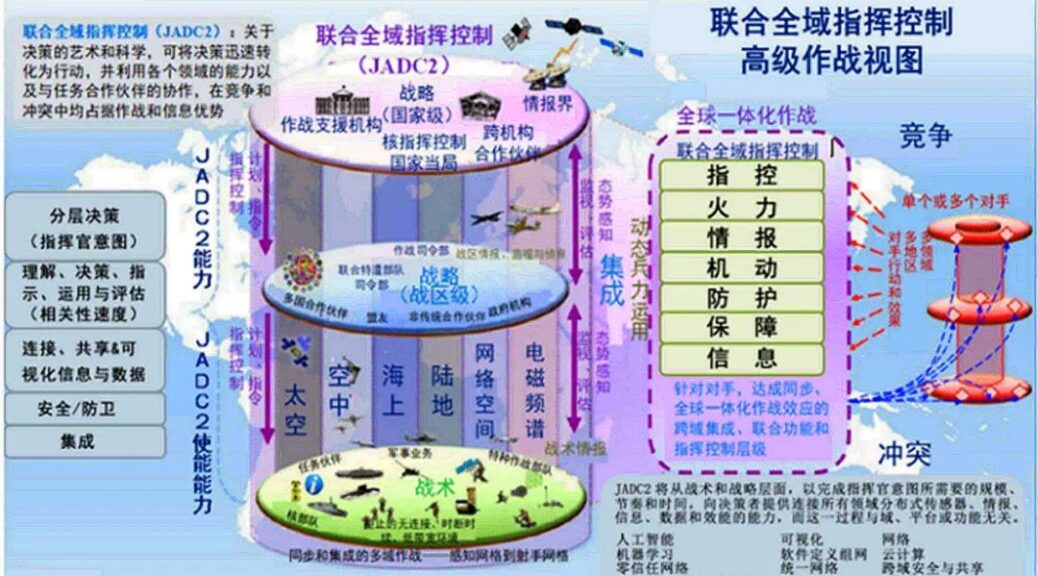
    Third, innovate future operational concepts. Operational concepts are forward-looking studies of future warfare styles and methods, often guiding new force organization and leapfrog development of weaponry. In recent years, the US military has proposed operational concepts such as “distributed lethality,” “multi-domain warfare,” and “mosaic warfare,” attempting to guide the direction of military transformation. Taking “mosaic warfare” as an example, this concept treats various sensors, communication networks, command and control systems, and weapon platforms as “mosaic fragments.” These “fragment” units, empowered by artificial intelligence technology, can be dynamically linked, autonomously planned, and collaboratively combined through network information systems, forming an on-demand integrated, highly flexible, and mobile lethality network. In March 2022, the US Department of Defense released the “Joint All-Domain Command and Control (JADC2) Strategic Implementation Plan,” which aims to expand multi-domain operations to an all-domain operations concept, connecting sensors from various services to a unified “Internet of Things” and using artificial intelligence algorithms to help improve operational command decisions. ③

    War and conflict have spurred the weaponization of artificial intelligence.

    In recent years, local conflicts such as the Libyan conflict, the Nagorno-Karabakh conflict, the Ukraine crisis, and the Kazakh-Israeli conflict have continued, further stimulating the development of the weaponization of artificial intelligence.

    In the Libyan conflict, both sides employed various types of drones for reconnaissance and combat missions. A report by the UN Group of Experts on Libya noted that the Turkish-made Kargu-2 drone conducted a “pursuit and long-range engagement” operation in Libya in 2020, autonomously attacking retreating enemy soldiers. This event marked the first use of a lethal autonomous weapon system in actual combat. As American scholar Zachary Callenburn stated, if anyone were to die in such an autonomous attack, it would likely be the first known instance of an AI-powered autonomous weapon being used for killing. In the 2020 Nagorno-Karabakh conflict, Azerbaijan successfully penetrated Armenian air defenses using a formation of Turkish-made TB2 “Standard” drones and Israeli-made Harop drones, gaining air superiority and the initiative. The significant success of Azerbaijani drone warfare largely stemmed from the Armenian army’s underestimation of the enemy’s capabilities and insufficient understanding of the importance and threat posed by drones in modern warfare. Secondly, from the perspective of offensive strategy, the Azerbaijani army has made bold innovations in drone warfare. They have flexibly utilized advanced equipment such as reconnaissance and strike drones and loitering munitions, which has not only improved combat efficiency but also greatly enhanced the surprise and lethality of the battles. ⑤

    During the 2022 Ukraine crisis, both Russia and Ukraine extensively used military-grade and commercial drones for reconnaissance, surveillance, artillery targeting, and strike missions. The Ukrainian army, through the use of the TB2 “Standard” drone and the US-supplied “Switchblade” series of suicide drones, conducted precision strikes and achieved high kill rates, becoming a notorious “battlefield killer.” In the Israeli-Kazakhstan conflict, the Israeli military was accused of using an artificial intelligence system called “Lavender” to identify and lock onto bombing targets in Gaza, marking as many as 37,000 Palestinians in Gaza as suspected “militants” and identifying them as targets for direct assassination. This Israeli military action drew widespread international attention and condemnation.

    Security risks arising from the weaponization of artificial intelligence

    From automated command systems to intelligent unmanned combat platforms, and then to intelligent decision-making systems in cyber defense, the application of artificial intelligence (AI) technology in the military field is becoming increasingly widespread and has become an indispensable part of modern warfare. However, with the trend of weaponizing AI, its misuse, abuse, and even malicious use will also bring significant risks and challenges to international security.

    It intensifies the arms race and disrupts the strategic balance.

    In the information and intelligent era, the disruptive potential of artificial intelligence is irresistible to major military powers, who are all focusing on the development and application of AI military capabilities, fearing that falling behind in this field will result in missing strategic opportunities. Deepening the military application of artificial intelligence can achieve “asymmetric advantages” in a lower cost and with higher efficiency.

    First, countries are vying for “first-mover advantage.” When a country achieves a technological lead in the development of intelligent weapon systems, it signifies that the country possesses more advanced artificial intelligence and related application capabilities, giving it a first-mover advantage in weapon system development, control, and contingency response. This advantage includes higher autonomy, intelligence, and adaptability, thereby increasing the country’s military strength and strategic competitive advantage. At the same time, the military advantage of a first-mover can become a security threat to competitors, leading to a competitive race among countries to advance the military application of advanced technologies. ⑦ In August 2023, U.S. Deputy Secretary of Defense Kathleen Hicks announced the “Replicator initiative,” which aims to deploy thousands of “autonomous weapon systems” in the Indo-Pacific region in less than two years. ⑧

    Secondly, the lack of transparency in the development of AI-based military equipment by various countries may exacerbate the arms race. This is mainly due to two reasons: First, AI technology is an “enabling technology” that can be used to design a variety of applications. This means that verifying the specific military applications of AI is extremely difficult, unlike nuclear weapons, where monitoring uranium, centrifuges, and weapon and delivery systems can help determine whether a country is developing or deploying nuclear weapons. The differences between semi-autonomous and fully autonomous weapon systems are primarily due to differences in computer software algorithms, making it difficult to verify treaty compliance through physical means. Second, to maintain their strategic advantage, countries often keep details of the military applications of advanced technologies secret, preventing adversaries from discerning their strategic intentions. In the current international environment, this lack of transparency not only intensifies the arms race but also sows the seeds for future escalation of conflict.

    Third, the uncertainty of national strategic intentions also exacerbates the arms race. The impact of artificial intelligence on strategic stability, nuclear deterrence, and the escalation of war largely depends on other countries’ perception of its capabilities, rather than its actual capabilities. As American scholar Thomas Schelling pointed out, international relations often feature risk competition, testing courage more than force. The relationship between major adversaries is determined by which side is ultimately willing to invest more power, or to make it appear as if it is about to invest more power.⁹ An actor’s perception of the capabilities of others, whether true or false, significantly influences the progress of the arms race. If a country vigorously develops intelligent weapon systems, competitors, uncertain of the other’s intentions, will become suspicious of the competitor’s military capabilities and the intentions behind their military development, often taking reciprocal measures, namely, developing their own military to meet their own security needs. It is this ambiguity of intention that stimulates technological accumulation, exacerbates the instability of weapons deployment, and ultimately leads to a vicious cycle.

    Empowering operational processes increases the risk of conflict.

    Empowered by big data and artificial intelligence technologies, traditional combat processes will undergo intelligent restructuring, shifting from “situational awareness—command and decision-making—offensive and defensive coordination—comprehensive support” to “intelligent situational awareness across the entire domain—human-machine integrated hybrid decision-making—manned/unmanned autonomous coordination—proactive and on-demand precise support.” However, while this intelligent restructuring of combat processes improves operational efficiency and accuracy, it also increases the risk of conflict and miscalculation.

    First, wars that break out at “machine speed” will increase the risk of hasty action. Artificial intelligence weapon systems demonstrate formidable capabilities in precision and reaction speed, making future wars likely to erupt at “machine speed.”⑩ However, excessively rapid warfare will also increase the risk of conflict. In areas that emphasize autonomy and reaction speed, such as missile defense, autonomous weapon systems, and cyberspace, faster reaction times will bring significant strategic advantages. At the same time, they will drastically reduce the time window for the defending side to react to military actions, placing commanders and decision-makers under immense “time pressure,” exacerbating the risk of “hasty action,” and increasing the possibility of unexpected escalation of the crisis.

    Second, relying on system autonomy may increase the probability of misjudgment under pressure. The U.S. Department of Defense believes that “highly autonomous artificial intelligence systems can autonomously select and execute corresponding operations based on dynamic changes in mission parameters, efficiently achieving human-preset goals. Increased autonomy not only significantly reduces reliance on human labor and improves overall operational efficiency, but is also regarded by defense planners as a key element in maintaining tactical leadership and ensuring battlefield advantage.” ⑪ However, because human commanders cannot react quickly enough, they may gradually delegate control to autonomous systems, increasing the probability of misjudgment. In March 2003, the U.S. Patriot missile system mistakenly identified a friendly Tornado fighter jet as an anti-radiation missile. Under pressure with only a few seconds to react, the commanders chose to launch the missile, resulting in the deaths of two pilots.⑫

    Third, it weakens the effectiveness of crisis termination mechanisms. During the Cold War, the US and the Soviet Union spearheaded a series of restrictive measures to curb the escalation of crises and prevent them from evolving into large-scale nuclear war. In these measures, humans played a crucial “monitoring” role, able to initiate termination measures within sufficient time to avert large-scale humanitarian catastrophes should a risk of spiraling out of control. However, with the increasing computing power of artificial intelligence systems and their deep integration with machine learning, combat responses have become more rapid, precise, and destructive, potentially weakening human intervention mechanisms for crisis termination.

    Accountability for war is difficult, and collateral damage is increased.

    Artificial intelligence weapon systems make it more difficult to define responsibility in war. In traditional warfare, weapon systems are controlled by humans, and if errors or crises occur, the human operator or the developer of the operating system bears the corresponding responsibility. Artificial intelligence technology itself weakens human agency and control, making the attribution of responsibility for technical actions unclear.

    First, there’s the “black box” problem of artificial intelligence. While AI has significant advantages in processing and analyzing data, its internal operating principles and causal logic are often difficult for humans to understand and explain. This makes it challenging for programmers to correct erroneous algorithms, a problem often referred to as the “black box” of algorithmic models. If an AI-powered weapon system poses a security threat, the “algorithm black box” could become a convenient excuse for those responsible to shirk accountability. Those seeking accountability would face generalized blame-shifting and deflection, ultimately pointing the finger at the AI ​​weapon system. In practice, the inability to understand and explain the decision-making process of AI can lead to a series of problems, such as decision-making errors, trust crises, and information misuse.

    Secondly, there is the issue of delineating human-machine responsibility in military operations. When an AI system malfunctions or makes a decision-making error, should it be treated as an independent entity and held responsible? Or should it be considered a tool, with human operators bearing all or part of the responsibility? The complexity of this responsibility delineation lies not only in the technical aspects but also in the ethical and legal ones. On the one hand, although AI systems can make autonomous decisions, their decision-making process is still limited by human-preset programs and algorithms, therefore their responsibility cannot be completely independent of humans. On the other hand, in certain situations, AI systems may exceed the pre-set limits of humans and make independent decisions; how to define their responsibility in such cases also becomes a difficult problem in the field of arms control.

    Thirdly, there is the issue of the allocation of decision-making power between humans and AI weapon systems. Depending on the level of machine autonomy, AI systems can execute tasks in three decision-making and control modes: semi-autonomous, supervised autonomy, and fully autonomous. In semi-autonomous systems, human decision-making power rests with the user; in supervised autonomy, humans supervise and intervene when necessary; in fully autonomous operations, humans do not participate in the process. As the military application of AI deepens, the role of humans in combat systems is gradually shifting from the traditional “human-in-the-loop” model to “human-on-the-loop,” evolving from direct controllers within the system to external supervisors. However, this shift also raises new questions. How to ensure that AI weapon systems adhere to human ethics and values ​​while operating independently is a major challenge currently facing the field of AI weapon development.

    Lowering the threshold for dissemination leads to misuse and abuse.

    Traditional strategic competition typically involves large-scale weapons system development and procurement, requiring substantial financial and technological support. With the maturation and diffusion of artificial intelligence (AI) technology, its accessibility and low cost make it possible for even small and medium-sized countries to develop advanced intelligent weapons systems. Currently, strategic competition in the field of military AI is primarily concentrated among major military powers such as the US and Russia. However, in the long run, the proliferation of AI technology will broaden the scope of strategic competition, posing a disruptive threat to the existing strategic balance. Once smaller countries possessing AI technology achieve relatively strong competitiveness, their willingness to confront threats from major powers may increase.

    First, artificial intelligence (AI) facilitates the development of lightweight and agile combat methods, encouraging smaller states and non-state actors to engage in small-scale, opportunistic military adventures to achieve their strategic objectives at a lower cost and with more diverse means. Second, the rapid development of AI has led to the increasing prominence of new forms of warfare such as cyber warfare and electronic warfare. In a highly competitive battlefield environment, malicious third-party actors can manipulate information to influence military planning and strategic deterrence, leading to escalation. The 2022 Ukraine crisis saw numerous instances of online disinformation used to confuse the public. Third, the widespread application of AI technology has also reduced strategic transparency. Traditional military strategies often rely on extensive intelligence gathering, analysis, and prediction; however, with the assistance of AI, operational planning and decision-making processes become more complex and unpredictable. This lack of transparency can lead to misunderstandings and misjudgments, thereby increasing the risk of conflict escalation.

    Governance Path of Artificial Intelligence Weaponization Security Risks

    To ensure the safe development of artificial intelligence and avoid the potential harm caused by its weaponization, we should strengthen international communication on governance strategies, seek consensus and cooperation among countries on the military applications of artificial intelligence, promote dialogue and coordination on laws and regulations to form a unified and standardized legal framework, strengthen ethical constraints on artificial intelligence to ensure that technological development conforms to ethical standards, and actively participate in global security governance cooperation to jointly safeguard the peace and stability of the international community.

    We attach great importance to strategic communication at the international level.

    Artificial intelligence governance is a global issue that requires concerted efforts from all countries to resolve. On the international stage, the interests of nations are intertwined yet conflicting; therefore, addressing global issues through effective communication channels is crucial for maintaining world peace and development.

    On the one hand, it is essential to accurately grasp the challenges of international governance of artificial intelligence. This involves understanding the consensus among nations on the weaponization of AI, while also closely monitoring policy differences among countries regarding the security governance of AI weaponized applications. Through consultation and cooperation, relevant initiatives should be aligned with the UN agenda to effectively prevent the misuse of AI for military purposes and promote its peaceful application.

    On the other hand, it is crucial to encourage governments to reach relevant agreements and build strategic mutual trust through official or semi-official dialogues. Compared to the “Track 1 dialogue” at the government level, “Track 1.5 dialogue” refers to dialogues involving both government officials and civilians, while “Track 2 dialogue” is a non-official dialogue conducted by academics, retired officials, and others. These two forms of dialogue offer greater flexibility and serve as important supplements and auxiliary means to official intergovernmental dialogues. Through diverse dialogue methods, officials and civilians can broadly discuss possible paths to arms control, share experiences and expertise, and avoid escalating the arms race and worsening tensions. These dialogue mechanisms will provide countries with a continuous platform for communication and cooperation, helping to enhance mutual understanding, strengthen strategic mutual trust, and jointly address the challenges posed by the militarization of artificial intelligence.

    Scientifically formulate laws and ethical guidelines for artificial intelligence.

    Artificial intelligence (AI) technology itself is neither right nor wrong, good nor evil. However, there are certainly distinctions of good and evil intentions in the design, research and development, manufacturing, use, operation, and maintenance of AI. The weaponization of AI has sparked widespread ethical concerns. Under the framework of international law, can autonomous weapon systems accurately distinguish between combatants and civilians on complex battlefields? Furthermore, if AI weapon systems cause unintended harm, how should liability be determined? Is entrusting life-or-death decision-making power to machines in accordance with ethical standards? These concerns highlight the necessity of strengthening ethical constraints on AI.

    On the one hand, it is essential to prioritize ethics and integrate the concept of “intelligent for good” from the very source of technology. In the design of AI military systems, values ​​such as human-centeredness and intelligent for good should be embedded within the system. The aim is to prevent potential indiscriminate killing and harm caused by AI at the source, control its excessive destructive power, and prevent accidental damage, thereby limiting the extent of damage caused by AI weapon systems to the smallest possible range. Currently, nearly a hundred institutions and government departments both domestically and internationally have published various AI ethics principles documents, and the academic and industrial communities have reached a consensus on basic AI ethical principles. In 2022, China’s “Position Paper on Strengthening Ethical Governance of Artificial Intelligence,” submitted to the United Nations, provided an important reference for the development of global AI ethics regulation. The document explicitly emphasizes that AI ethics regulation should be promoted through measures such as institutional construction, risk management, and collaborative governance.

    On the other hand, it is necessary to improve relevant laws and regulations and clarify the boundaries of rights and responsibilities of artificial intelligence entities. Strict technical review standards should be established to ensure the safety and reliability of AI systems. Comprehensive testing should be conducted before AI systems are deployed to ensure they do not negatively impact human life and social order. The legal responsibilities of developers, users, maintainers, and other parties throughout the entire lifecycle of AI systems should be clearly defined, and corresponding accountability mechanisms should be established.

    We will pragmatically participate in international cooperation on artificial intelligence security governance.

    The strategic risks posed by the military applications of artificial intelligence further highlight the importance of pragmatic international security cooperation. It is recommended to focus on three key areas:

    First, we should promote the formulation of guidelines for the application of artificial intelligence in the military field. Developing codes of conduct for the military application of artificial intelligence is an important responsibility of all countries in regulating its military use, and a necessary measure to promote international consensus and comply with international regulations. In 2021, the Chinese government submitted its “Position Paper on Regulating the Military Application of Artificial Intelligence” to the UN Convention on Certain Conventional Weapons Conference, and in 2023, it released the “Global Artificial Intelligence Governance Initiative,” both of which provide constructive references for improving the codes of conduct for regulating the military application of artificial intelligence.

    Second, it is essential to establish a suitable regulatory framework. The dual-use nature of artificial intelligence (AI) involves numerous stakeholders, making the role of non-state actors such as NGOs, technical communities, and technology companies increasingly prominent in the global governance of AI, thus becoming a crucial force in building a regulatory framework for the military application of AI. Technical regulatory measures that countries can adopt include: clarifying the scope of AI technology use, responsible parties, and penalties for violations; strengthening technological research and development to improve the security and controllability of the technology; and establishing regulatory mechanisms to monitor the entire process of technology research and development and application, promptly identifying and resolving problems.

    Third, we will jointly develop technologies and solutions for AI security. We encourage the inclusion of bilateral or multilateral negotiations between governments and militaries in the dialogue options for military AI applications, and promote extensive exchanges on military AI security technologies, operating procedures, and practical experience. We will also promote the sharing and reference of relevant risk management technical standards and usage norms, and continuously inject new stabilizing factors into the international security and mutual trust mechanism in the context of the militarization of AI.

    (The author is the director and researcher of the National Defense Science and Technology Strategy Research Think Tank at the National University of Defense Technology, and a doctoral supervisor; Liu Hujun, a master’s student at the School of Foreign Languages ​​of the National University of Defense Technology, also contributed to this article.)

現代國語:

朱啟超
《人民論壇》(2025年02月05日 第 02版)

【摘要】人工智能武器化是新一輪軍事變革的必然趨勢,近年來的局部戰爭衝突進一步刺激相關國家推進人工智能武器化戰略部署,搶占未來戰爭制高點。人工智能武器化的潛在風險不容忽視,將可能加劇軍備競賽,打破戰略平衡;賦能作戰流程,加大衝突風險;提升問責難度,增加附帶傷亡;降低擴散門檻,導致誤用濫用。對此,應加強國際間戰略溝通,確保各國在人工智能軍事應用上的共識與協作;推進法律法規建設的對話與協調,以形成統一規範的法律框架;加強人工智能倫理約束,確保技術發展符合道德標準;積極參與全球安全治理合作,共同維護國際社會的和平與穩定。

【關鍵詞】人工智能 軍事應用 安全風險 安全治理 【中圖分類號】F113 【文獻標識碼】A

人工智能武器化,是將人工智能相關技術、平台與服務應用到軍事領域,使其成為賦能軍事行動的重要驅動力量,進而提升軍事行動的效率、精準度和自主性。隨著人工智能技術在軍事領域的廣泛應用,各主要大國和軍事強國紛紛加大戰略與資源投入,加快研發應用步伐。近年來頻發的地區戰爭衝突也進一步刺激了人工智能的戰場運用,並深刻形塑戰爭形態以及軍事變革的未來走向。

不容忽視的是,人工智能作為一類快速發展中的技術,其本身由於內在技術的不成熟、場景匹配的不准確、支持條件的不完備,可能存在潛在風險,而由於人為的誤用、濫用甚至惡意使用,也容易給軍事領域乃至國際安全領域帶來多種風險挑戰。認真貫徹落實習近平總書記提出的全球安全倡議,必須直面世界範圍內人工智能武器化的發展趨勢,深入分析人工智能武器化應用可能帶來的安全風險,並思考科學可行的治理思路與舉措。

當前人工智能武器化的發展趨勢

近年來,人工智能在軍事領域的應用,正在從根本上重塑未來戰爭形態、改變未來作戰體系,影響軍事變革的未來走向。主要軍事大國已將人工智能視為改變未來戰爭規則的顛覆性關鍵技術,紛紛挹注大量資源,推進人工智能武器的研發與應用。

人工智能武器化是軍事變革的必然趨勢。

隨著科學技術的飛速發展,軍事變革的必要性與緊迫性愈發凸顯。人工智能通過模擬人類的思維過程,延展人類的腦力與體力,可實現信息快速處理、分析和決策,可研發日益複雜的無人化武器系統平台,從而為軍事行動提供前所未有的智能化支持。

一是為軍事情報偵察與分析提供智能支持。傳統的情報偵察方式受到人力和時間等多重因素制約,難以有效應對大規模、高速度和高複雜度的情報處理需求。人工智能技術的引入,為情報偵察領域帶來革新和突破。在軍事基礎設施中,應用人工智能技術,可構建智能監測系統,提供高精度實時的情報感知服務。在情報偵察領域,人工智能技術具備對多個“信息流”進行實時處理的能力,從而極大地提高分析效率。 ①通過使用深度學習等技術工具,還可以“透過現像看本質”,挖掘出各類碎片化情報信息中的深層脈絡與因果聯繫,將海量碎片化數據快速轉變為可以利用的情報,從而提升情報分析的質效。

二是為作戰指揮與決策提供數據支持。人工智能在戰場態勢感知方面為作戰指揮和軍事決策提供有力支持。 ②其優勢在於能夠進行數據挖掘、數據融合以及預測分析等關鍵任務。在信息化智能化戰爭中,戰場環境瞬息萬變,情報信息量龐大,要求決策響應迅速且準確。因此,先進的計算機系統就成為協助指揮人員管理情報數據、進行敵情判斷、提出作戰方案建議以及擬制計劃與命令的重要工具。以美軍為例,美國雷神技術公司(Raytheon Technologies Corporation)研製的ISTAR(情報、監視、目標識別和跟踪)系統,涵蓋了情報採集、監視、目標識別及跟踪功能,可匯聚來自衛星、艦船、飛機及地面站等多元信息源的數據,並對其進行深度分析與處理。這不僅顯著提高了指揮官獲取信息的速度,而且可藉助智能分析系統提供數據支持,使決策更加快速、高效和精準。

三是為無人作戰系統提供重要支撐。無人作戰系統是一種無需人類直接操縱,便可獨立完成軍事任務的新型武器裝備系統,主要包括智能化無人作戰平台、智能化彈藥和智能化作戰指揮控制系統等組成部分,具備顯著的自主性和智能化特徵。無人作戰系統,作為引領未來戰爭形態變革的技術裝備,已成為國家間軍事競爭的重要籌碼。該系統通過運用自主導航、目標識別、路徑規劃等關鍵技術,實現了不同戰場環境及作戰空間的適應能力。借助深度學習、強化學習等先進算法,無人作戰系統能夠獨立完成導航任務,並實現精準打擊目標。這種系統的設計理念是“平台無人,系統有人”,其本質是對有人作戰系統的智能化延伸。例如,美國國防部高級研究計劃局(DARPA)研發的“MQM-57獵鷹者”無人機,就採用了先進的人工智能技術,具備高度自主的目標識別和追踪功能。

四是為軍事後勤與裝備保障提供技術支持。在信息化戰爭的背景下,戰爭進程加快、機動性提升、作戰消耗顯著增加。傳統的“超量預儲”保障模式已無法適應現代戰場快速變化的需求,因此,對作戰部隊進行適時、適地、適需、適量的快速精確後裝保障提出了更高的要求。人工智能作為一種具有溢出帶動和交叉融合特性的技術,與物聯網、大數據、雲計算等前沿技術相互融合,使得人工智能知識群、技術群和產業群全面滲透到軍事後裝領域,顯著提升了後勤裝備保障能力。

主要國家紛紛佈局人工智能軍事應用。

為增強在人工智能領域的全球競爭力,美國、俄羅斯、日本等主要大國加緊對人工智能軍事應用的戰略佈局。首先,通過更新和調整人工智能領域的頂層戰略規劃,為未來的發展提供明確指導;其次,針對未來戰爭需求,加快人工智能技術與軍事領域的深度融合,推動裝備系統的智能化、自主化和無人化發展;此外,積極創新作戰概念,以驅動作戰力量創新,進而提升作戰效能和競爭優勢。

一是製定戰略規劃。基於技術霸權追求軍事霸權、政治霸權、經濟霸權的戰略偏執,美國正加快自身軍事智能化進程。 2023年11月,美國國防部發布《數據、分析與人工智能採用戰略》,旨在擴展整個國防部體系的先進能力,以獲得持久的軍事決策優勢。俄軍頒布被稱為“3.0版本”的《2024年至2033年俄羅斯武器裝備發展綱要》,旨在為未來10年武器裝備發展提供指導,綱要強調繼續推進核武器和常規武器建設,並重點研究人工智能和機器人技術、高超音速武器和其他基於新物理原理的打擊兵器。

二是研發先進裝備系統。美軍自2005年開始每隔幾年都會發布一版“無人系統路線圖”,以展望並設計空中、地面、水面/水下等各領域無人系統平台,貫通研發—生產—測試—訓練—作戰—保障等無人化武器裝備發展鏈路。目前,世界上已有70多個國家可以研發無人化系統平台,各種類型的無人機、無人車、無人船(艇)、無人潛航器如雨後春筍般不斷出現。 2024年7月15日,美軍參聯會前主席馬克·米利接受《美國防務新聞》採訪時稱,到2039年,三分之一的美軍部隊將由機器人組成。俄軍研發的平台-M作戰機器人、“柳葉刀”自殺式無人機和S70“獵人”重型無人機等,已投入實戰檢驗。

三是創新未來作戰概念。作戰概念是對未來戰爭樣式與作戰方式進行的前瞻性研究,往往可牽引新的作戰力量編組及武器裝備跨越發展。美軍近年來先後提出“分佈式殺傷”“多域戰”“馬賽克戰”等作戰概念,試圖引領軍事變革的發展方向。以“馬賽克戰”為例,該作戰概念將各種傳感器、通信網絡、指揮控制系統、武器平台等視為“馬賽克碎片”,這些“碎片”單元在人工智能技術賦能支持下,通過網絡信息系統可動態鏈接、自主規劃、協同組合,從而形成一個按需集成、極具彈性、靈活機動的殺傷網。 2022年3月,美國國防部發布《聯合全域指揮控制(JADC2)戰略實施計劃》,該計劃旨在將多域作戰向全域作戰概念拓展,將各軍種傳感器連接到一個統一“物聯網”中,利用人工智能算法幫助改善作戰指揮決策。 ③

戰爭衝突刺激人工智能武器化進程。

近年來,利比亞衝突、納卡衝突、烏克蘭危機、哈以沖突等局部衝突不斷,進一步刺激了人工智能武器化的發展進程。

在利比亞衝突中,交戰雙方採用多種型號無人機執行偵察和作戰任務。據聯合國利比亞問題專家小組發布的報告指出,土耳其製造的“卡古-2”(Kargu-2)無人機2020年在利比亞執行了“追捕並遠程交戰”行動,可自主攻擊撤退中的敵方士兵。這一事件標誌著致命性自主武器系統在實戰中的首次運用。如美國學者扎卡里·卡倫伯恩所述,若有人在此類自主攻擊中不幸喪生,這極有可能是歷史上首個已知的人工智能自主武器被用於殺戮的例子。在2020年納卡衝突中,阿塞拜疆運用土耳其生產的“旗手”TB2無人機編隊和以色列生產的“哈洛普”無人機成功突破了亞美尼亞防空系統,掌握了戰場製空權和主動權。 ④ 阿塞拜疆軍隊無人機作戰的顯著成效,在很大程度上源於亞美尼亞軍隊的“輕敵”心態,對無人機在現代戰爭中的重要性和威脅性認識不足。其次,從進攻策略的角度來看,阿塞拜疆軍隊在無人機戰法上進行了大膽的創新。他們靈活運用察打一體無人機和巡飛彈等先進裝備,不僅提升了作戰效率,也大大增強了戰鬥的突然性和致命性。 ⑤

在2022年爆發的烏克蘭危機中,俄羅斯和烏克蘭都廣泛使用軍用級和商用無人機執行偵察監視、火砲瞄準和打擊任務。烏克蘭軍隊通過使用“旗手”TB2無人機以及美國援助的“彈簧刀”系列自殺式無人機,實施精確打擊和高效殺傷,成為令世界矚目的“戰場殺手”。在哈以沖突中,以色列軍方被指控使用名為“薰衣草”(Lavender)的人工智能係統來識別並鎖定加沙境內的轟炸目標,曾將多達3.7萬名加沙巴勒斯坦人標記為“武裝分子”嫌疑對象,並將其認定為可直接“暗殺”的目標,以軍行動引發了國際社會廣泛關注和譴責。 ⑥

人工智能武器化帶來的​​安全風險

從自動化指揮系統到智能無人作戰平台,再到網絡防禦中的智能決策系統,人工智能技術在軍事領域的應用正變得愈發普遍,已成為現代戰爭不可或缺的一部分。然而,人工智能武器化的趨勢下,其誤用、濫用甚至惡意使用,也將給國際安全帶來不可忽視的風險挑戰。

加劇軍備競賽,打破戰略平衡。

在信息化智能化時代,人工智能所具有的顛覆性潛力讓軍事大國都難以抗拒,紛紛聚焦人工智能軍事能力的開發和運用,唯恐在這一領域落後而喪失戰略機遇。深化人工智能軍事應用,則能夠以更低成本、更高效率的方式獲得“非對稱優勢”。

一是各國紛紛搶抓“先行者優勢”。當一個國家在智能武器系統開發領域取得技術領先地位時,意味著該國具備更高級的人工智能和相關應用能力,使其在武器系統開發、控制和應急響應等方面具有先發優勢。這種優勢包括更高的自主性、智能化程度和自適應能力,從而增加了該國的軍事實力和戰略競爭優勢。與此同時,先行者的軍事優勢可能會成為競爭對手的安全威脅,導致各國在先進技術的軍事應用上呈現出你爭我趕的態勢。 ⑦ 2023年8月,美國國防部副部長凱瑟琳·希克斯宣布了“複製者計劃”(Replicator initiative),該倡議力求在不到兩年的時間內在印太地區部署數千個“自主武器系統”。 ⑧

二是各國人工智能軍備建設的不透明性可能加劇軍備競賽。這主要有兩個方面的原因:一是人工智能技術是一種可用於設計多種應用的“使能技術”,這意味著人工智能軍事應用具體情況核查難度較高,難以像核武器可以通過對鈾、離心機以及武器和運載系統的監測來判斷一個國家是否在進行核武器的開發或部署。半自主、完全自主武器系統之間的差別主要是由於計算機軟件算法不同導致的,很難通過物理核查手段來對各國的條約執行情況進行核查。二是各國為了保持己方的戰略優勢,往往對先進技術的軍事應用相關細節採取保密措施,從而使對手無法探知其戰略意圖。在當前國際環境中,這種不透明性不僅僅加劇了軍備競賽,更為未來衝突升級埋下了伏筆。

三是各國戰略意圖的不確定性也會加劇軍備競賽。人工智能對於戰略穩定、核威懾和戰爭升級的影響,很大程度上取決於他國對於其能力的感知,而非其實質能力。正如美國學者托馬斯·謝林指出,國際關係常常具有風險競爭的特徵,更多的是對勇氣而不是武力的考驗,主要對手之間的關係是由哪一方最終願意投入更大的力量,或者使之看起來即將投入更大的力量來決定的。 ⑨ 一個行為體對於他者能力的感知,無論真假,都會在很大程度上影響軍備競賽進程。如果一個國家大力發展智能武器系統,競爭對手在不確定對方意圖的情況下,會對競爭對手的軍備能力及發展軍備的意圖產生猜忌,往往採取對等措施,即通過發展軍備來滿足自身安全需求。正是這種意圖的模糊性刺激了技術積累,加劇武器部署的不穩定性,最終導致惡性循環。

賦能作戰流程,加大衝突風險。

在大數據和人工智能技術賦能下,傳統作戰流程將實現智能化再造,即由“態勢感知—指揮決策—攻防協同—綜合保障”向“全域態勢智能認知—人機一體混合決策—有人/無人自主協同—主動按需精准保障”轉變。然而,作戰流程的智能化再造雖然提高了作戰的效率和精確性,但也提升了衝突和誤判的風險。

一是以“機器速度”爆發的戰爭將增加倉促行動的風險。人工智能武器系統在精確度和反應速度上表現出強大的能力,使得未來戰爭將以“機器速度”爆發。 ⑩ 但戰爭速度過快也將升高衝突風險。在導彈防禦、自主武器系統和網絡空間等重視自主性以及反應速度的領域,更快的反應速度將帶來巨大的戰略優勢,同時也極大地壓縮了防禦方對軍事行動作出反應的時間窗口,導致作戰指揮員和決策者置身於巨大的“時間壓力”之下,加劇了“倉促行動”的風險,並增加了危機意外升級的可能性。

二是依賴系統自主性可能增加壓力下的誤判機率。美國國防部認為,“高度自主化的人工智能係統,能夠根據任務參數的動態變化,自主選擇並執行相應操作,高效實現人類預設的目標。自主性的增加不僅大幅減少了對人力的依賴,提高了整體操作效率,更被國防規劃者視為保持戰術領先、確保戰場優勢的關鍵要素。”⑪然而,由於人類指揮官無法作出足夠快的反應,可能逐漸將控制權下放給自主系統,增加誤判機率。 2003年3月,美國“愛國者”導彈系統曾錯誤地將友軍的“龍捲風”戰鬥機標記為反輻射導彈,指揮人員在只有幾秒鐘反應時間的壓力狀態下,選擇發射導彈,造成了兩名飛行員的死亡。 ⑫

三是削弱了危機終止機制的有效性。冷戰時期,美蘇主導構建了一系列限制性措施來遏制危機的升級,避免其演化為大規模的核戰爭。在這些措施中,人類扮演著至關重要的“監督者”角色,在可能出現風險失控時,能夠在充足的時間內啟動終止措施,避免大規模人道主義災難發生。但是,隨著人工智能係統運算能力的提升及其與機器學習的深度融合,作戰響應變得更為迅捷、精確和具有破壞性,人類對於危機的終止干預機制將可能被削弱。

戰爭問責困難,增加附帶傷亡。

人工智能武器系統使得戰爭責任更難界定。在傳統作戰模式下,由人類控制武器系統,一旦造成失誤或危機,人類操作員或者操作系統的研發者將承擔相應的責任。人工智能技術本身弱化了人類的能動性和控制能力,致使技術性行為的責任歸屬變得模糊不清。

一是人工智能“黑箱”問題。儘管人工智能在處理和分析數據方面有著顯著優勢,但是其內部運行規律和因果邏輯卻常常難以被人類理解和解釋,這使得程序員難以對錯誤算法進行糾偏除誤,這一問題常常被稱為算法模型的“黑箱”。一旦人工智能武器系統產生安全危害,“算法黑箱”可能成為相關責任方推卸責任的合理化藉口,追責者只能面臨泛化的卸責與推諉,並將責任矛頭指向人工智能武器系統。在實踐中,如果無法理解並解釋人工智能的決策過程,可能會引發一系列的問題,如決策失誤、信任危機、信息濫用等。

二是軍事行動中人機責任劃分問題。當人工智能係統出現故障或者決策失誤時,是否應將其視為一種獨立的實體來承擔責任?或者,是否應該將其視為一種工具,由人類操作者承擔全部或部分責任?這種責任劃分的複雜性不僅在於技術層面,更在於倫理和法律層面。一方面,人工智能係統雖然能夠自主決策,但其決策過程仍然受到人類預設的程序和算法限制,因此其責任不能完全獨立於人類。另一方面,人工智能係統在某些情況下可能會超越人類的預設範圍,作出獨立的決策,此時其責任又該如何界定,也成為軍控領域的難題。

三是人與人工智能武器系統的決策權分配問題。按照機器自主權限的不同,人工智能係統能夠以半自主、有監督式自主以及完全自主三種決策與控制方式執行任務。在半自主系統中,行動的決策權由人類掌控;在有監督式自主行動中,人類實施監督並在必要時干預;在完全自主行動中,人類不參與行動過程。隨著人工智能軍事應用程度的逐漸加深,人在作戰系統中的角色正經歷由傳統的“人在迴路內”模式逐步向“人在迴路上”轉變,人類從系統內部的直接操控者演化為系統外部的監督者。然而,這一轉變也引發了新的問題。如何確保人工智能武器系統在獨立運作時仍能遵循人類倫理和價值觀,這是當前人工智能武器研發領域面臨的重大挑戰。

降低擴散門檻,導致誤用濫用。

傳統的戰略競爭通常涉及大規模的武器系統研發和採購,需要大量資金和技術支持。人工智能技術成熟擴散後,具有易獲取且價格低廉等優勢,即便是中小國家也可能具備開發先進智能武器系統的能力。當前,軍用人工智能領域的戰略競爭主要集中在美俄等軍事大國之間。但長遠來看,人工智能技術的擴散將擴大戰略競爭的範圍,對現有的戰略平衡構成破壞性威脅。一旦掌握人工智能技術的較小規模國家擁有相對較強的競爭力,這些國家在面臨大國威脅時發起對抗的意願可能就會增強。

一是人工智能有助於發展一些輕便靈巧的作戰手段,從而鼓勵一些中小國家或者非國家行為體利用其開展小型的、機會主義的軍事冒險,以更低廉的成本和更豐富的途徑來達到其戰略目地。二是人工智能的快速發展使得網絡戰、電子戰等新型戰爭形態日益凸顯。在競爭激烈的戰場環境中,惡意的第三方行為體可以通過操縱信息來影響軍事規劃和戰略威懾,導致局勢升級。在2022年爆發的烏克蘭危機中,就有眾多網絡虛假信息傳播混淆視聽。三是人工智能技術的廣泛應用還降低了戰略透明度。傳統的軍事戰略往往依賴於大量的情報收集、分析和預測,而在人工智能技術的輔助下,作戰計劃和決策過程變得更加複雜和難以預測。這種不透明性可能導致誤解和誤判,從而增加了衝突升級的風險。

人工智能武器化安全風險的治理路徑

為確保人工智能安全發展,避免其武器化帶來的​​潛在危害,應加強國際間的治理戰略溝通,尋求各國在人工智能軍事應用方面的共識與協作;推進法律法規對話協調,以形成統一規範的法律框架;加強人工智能倫理的約束,確保技術發展符合道德標準;積極參與全球安全治理合作,共同維護國際社會的和平與穩定。

高度重視國際層面戰略溝通。

人工智能治理是一個全球性問題,需要各國通力合作,共同解決。在國際舞台上,各國利益交融與利益衝突並存,因此,通過有效的溝通渠道來處理全球性問題成為維護世界和平與發展的關鍵。

一方面,要準確把握人工智能國際治理挑戰。既要把握各國對人工智能武器化發展的共識,也要密切關注各國在人工智能武器化應用安全治理方面的政策差異,通過協商合作,使相關倡議與聯合國議程相協調,從而有效防止人工智能在軍事上的濫用,推動人工智能用於和平目的。

另一方面,推動各國政府通過官方或半官方對話,達成相關協議,建立戰略互信。相較於政府層面的“1軌對話”,“1.5軌對話”指的是政府官員與民間人士共同參與的對話,而“2軌對話”則是由學者、退休官員等進行的民間非官方形式的對話。這兩種對話形式具有更高的靈活性,是政府間官方對話的重要補充和輔助手段。通過多樣化的對話交流方式,官方和民間人士可以廣泛磋商軍備控制的可能實現路徑,分享經驗和專業知識,以避免軍備競賽的升級和緊張局勢的惡化。這些對話機制將為各國提供持續的溝通與合作平台,有助於增進相互理解、加強戰略互信,共同應對人工智能軍事化應用帶來的挑戰。

科學制定人工智能法律和倫理規約。

人工智能技術本身並無對錯善惡之分,但對於人工智能的設計、研發、製造、使用、運行以及維護確有善惡意圖之別。人工智能武器化引發了廣泛的倫理關注。國際法框架下,自主武器系統是否能夠在復雜戰場上精準區分戰鬥人員與平民?此外,若人工智能武器系統導致非預期的傷害,其責任歸屬如何界定?將關乎生死的決策權交付於機器,這一做法是否符合道德倫理標準?這些擔憂凸顯了加強人工智能倫理約束的必要性。

一方面,要堅持倫理先行,從技術源頭上融入“智能向善”的理念。在人工智能軍事系統的設計過程中,將以人為本、智能向善等價值觀內嵌於系統中。其目的是從源頭上杜絕人工智能可能引發的濫殺濫傷行為,控制其過度殺傷力,防範意外毀傷的發生,從而將人工智能武器系統所帶來的毀傷程度限制在盡可能小的範圍內。目前,國內外已有近百家機構或政府部門發佈各類人工智能倫理原則文件,學術界和產業界亦就人工智能基本倫理原則達成共識。 2022年,中國向聯合國遞交的《關於加強人工智能倫理治理的立場文件》為全球人工智能倫理監管的發展提供了重要參考。文件明確強調,應通過制度建設、風險管控、協同共治等多方面的措施來推進人工智能倫理監管。

另一方面,要完善相關法律法規,明確人工智能主體的權責邊界。制定嚴格的技術審核標準,確保人工智能係統的安全性和可靠性。在人工智能係統上線前進行全面的測試,確保其不會對人類生活和社會秩序造成負面影響。明確開發者、使用者、維護者等各方在人工智能係統全生命週期中的法律責任,以及建立相應的追責機制。

務實參與人工智能安全治理國際合作。

人工智能軍事應用所帶來的戰略風險,更加凸顯出國際安全務實合作的重要性。建議重點從三個方面著手:

一是推動制定人工智能在軍事領域的運用準則。制定人工智能軍事應用的行為準則,是各國規範人工智能軍事應用的重要責任,也是推動國際共識和遵守國際法規的必要舉措。中國政府2021年向聯合國《特定常規武器公約》大會提交了《中國關於規範人工智能軍事應用的立場文件》,2023年發布《全球人工智能治理倡議》,這些都為完善規範人工智能軍事應用的行為準則提供了建設性參考。

二是建立適用的監管框架。人工智能軍民兩用性使其涉及眾多利益攸關方,一些非國家行為體如非政府組織、技術社群、科技企業在人工智能全球治理進程中的作用將更加突出,成為人工智能軍事應用監管框架建設的重要力量。各國可採取的技術監管措施包括:明確人工智能技術的使用範圍、責任主體和違規處罰措施;加強技術研發,提高技術的安全性和可控性;建立監管機制,對技術的研發和應用進行全程監管,及時發現和解決問題。

三是共同研發人工智能安全防範技術和解決方案。鼓勵將政府間和軍隊間的雙邊或多邊談判納入軍用人工智能應用的對話選項,就軍用人工智能安全防範技術、操作規程及實踐經驗廣泛交流,推動相關風險管理技術標準和使用規範的分享借鑒,為人工智能軍事化背景下的國際安全互信機制不斷注入新的穩定因素。

(作者為國防科技大學國防科技戰略研究智庫主任、研究員,博導;國防科技大學外國語學院碩士研究生劉胡君對本文亦有貢獻)

【註釋】

①Katz B. Analytic edge: Leveraging emerging technologies to

transform intelligence analysis [R]. Washington D.C.: Center for

Strategic and International Studies, 2020.

②Paul McLeary. Pentagon’s Big AI Program, Maven, Already

Hunts Data in Middle East, Africa[N]. Breaking Defense, May 1, 2018.

③唐新華:《美國綜合威懾戰略中的技術互操作性》,《太平洋學報》, 2022年第12期,第15-25頁。

aijan’s Drones Owned the Battlefield in

Nagorno-Karabakh—and Showed Future of Warfare[N]. The

Washington Post, November 11, 2020.

⑤朱啟超、陳曦、龍坤:《無人機作戰與納卡衝突》,《中國國際戰略評論》,2020年第2期,第167-183頁。

⑥The Verge Report: Israel used AI to identify bombing targets in

Gaza [EB/OL].[2024-04-05].

artificial-intelligence-gaza-ai#:~:text.

⑦羅易煊、李彬:《軍用人工智能競爭中的先行者優勢》,《國際政治科學》, 2022第3期,第1-33頁。

⑧U.S. Department of Defense. Deputy Secretary of Defense

Kathleen Hicks Keynote Address: The Urgency to Innovate (As

Delivered) [EB/OL]. [2023-08-28]. https://www.defense.gov/News/Speeches/Speech/Article/3507156/deputy-

secretary-of-defense-kathleen-hicks-keynote-address-the-urgency-

to-innov/.

⑨[美]托馬斯·謝林著,毛瑞鵬譯:《軍備及其影響》,上海:上海人民出版社,2017年,第81頁。

⑩Rautenbach P. Keeping Humans in the Loop is Not Enough to

Make AI Safe for Nuclear Weapons[EB/OL],

enough-to-make-ai-safe-for-nuclear-weapons/,2023-02-16/2024-01-

09.

⑪Mayer M. The new killer drones: understanding the strategic

implications of next-generation unmanned combat aerial vehicles[J],

International Affairs, 2015,91(04):771.

⑫[美]保羅·沙瑞爾著,朱啟超、王姝、龍坤譯:《無人軍隊:自主武器與未來戰爭》,北京:世界知識出版社,2019年,第153-156頁。

中國原創軍事資源:https://paper.people.com.cn/rmlt/pc/content/202502/05/content_30058889349.html

STRENGTHENING THE FOUNDATION FOR CHINESE MILITARY INTELLIGENT TRANSFORMATION

加強中國軍事情報轉型的基礎

現代英語:

The nature of warfare is rapidly evolving towards intelligence. The intelligent transformation of the military is not merely a simple accumulation of technologies, but a systemic change supported by data, algorithms, and computing power. These three elements mutually empower and organically integrate, forming the technological foundation for generating new combat capabilities. To accelerate the intelligent development of the military, we must deeply grasp the technological logic of intelligent transformation, solidify the data foundation, activate the algorithm engine, and strengthen computing power support to provide a solid guarantee for winning future intelligent wars.

Operational data: the “digital cornerstone” of intelligent transformation

Data is the “lifeblood” of intelligence. Without the accumulation of high-quality, large-scale, and multi-dimensional operational data, the transformation of military intelligence will be like water without a source or a tree without roots. In intelligent warfare, all activities across the entire chain, including battlefield perception, command and decision-making, and combat operations, are essentially processes of data generation, flow, processing, and application. The completeness, accuracy, and timeliness of operational data directly determine the perception precision, decision-making speed, and strike accuracy of intelligent systems, and are an indispensable cornerstone for the intelligent transformation of the military field.

The core value of operational data lies in breaking through the “fog of war” and enabling a shift from experience-driven to data-driven approaches. In traditional warfare, commanders primarily rely on battlefield reconnaissance, intelligence analysis, and combat experience to make decisions. Limited by the breadth and depth of information acquisition, these decisions often carry a degree of subjectivity and limitation. However, in the era of intelligent warfare, a single reconnaissance drone can transmit 5GB of image data per second, and satellite networks constantly track tens of thousands of ground targets, resulting in a geometrical increase in the rate of battlefield data generation. This operational data, originating from multiple domains including land, sea, air, space, cyber, electronic, and psychological domains, can, after standardized processing and in-depth analysis, construct a transparent battlefield situation across all domains, providing commanders with precise decision-making support.

Building a comprehensive operational data resource system requires focusing on key aspects of the entire lifecycle governance. In the data acquisition phase, it’s essential to base data acquisition on the needs of all-domain operations, broaden data source channels, and achieve full coverage of data in both traditional and new domains. Traditional domains should focus on land, sea, and air battlefields, accurately collecting data on troop deployments, equipment performance, and terrain. New domains should extend to outer space, deep sea, polar regions, and cyberspace, prioritizing the collection of data on space target trajectories, deep-sea environmental parameters, and cyberspace situational awareness. In the data fusion and processing phase, a unified data standard system must be established to address prominent issues such as multiple values ​​for a single data point and inconsistent formats, achieving interconnectivity between data from different sources and of different types. In the data sharing phase, a sound cross-domain sharing mechanism must be established, along with tiered and categorized sharing rules, breaking down service-specific barriers, departmental boundaries, and network isolation to build a ubiquitous, all-encompassing, and interconnected data sharing environment, maximizing the utilization of data resources.

To fully leverage the multiplier effect of combat data, the key lies in cultivating data-driven thinking and building a strong professional team. Data-driven thinking is the prerequisite for activating data value. It is essential to guide officers and soldiers to develop the habit of “thinking with data, speaking with data, managing with data, and making decisions with data,” abandoning traditional thinking patterns based on experience and intuition. In operational planning, quantitative analysis should be based on data; in training evaluation, precise measurement should be based on data standards; and in equipment development, iterative optimization should be supported by data. Simultaneously, efforts should be focused on building a professional data talent team, clarifying the responsibilities of each position, and connecting the entire process from data generation to data application. Through various means such as academic training, on-the-job experience, and specialized training, the professional skills of officers and soldiers in data collection, processing, analysis, and application should be improved, creating a composite talent team that understands both military operations and data technology, providing talent support for releasing the value of data.

Specialized Algorithms: The “Digital Engine” of Intelligent Transformation

If data is the “fuel” of intelligence, then algorithms are the “engine” that transforms fuel into power. Specialized algorithms, as the core driving force of military intelligence, are the key link in realizing the transformation of data into knowledge, knowledge into decision-making, and decision-making into combat effectiveness. In intelligent warfare, the quality of algorithms directly determines the reaction speed, decision-making accuracy, and combat effectiveness of the combat system, becoming the engine of intelligent transformation in the military field.

The core advantage of algorithms lies in reconstructing the operational chain and achieving rapid iteration of the OODA loop. In traditional warfare, the chain of observation, judgment, decision-making, and action is lengthy and often struggles to adapt to rapidly changing battlefield situations due to limitations in human processing capabilities. Intelligent algorithms, however, can leverage machine learning, deep learning, and other technologies to process massive amounts of operational data in seconds, perform real-time analysis, and uncover patterns, significantly shortening the decision-making cycle. In simulation tests, foreign military AI command systems generated multiple complete operational plans in a very short time, demonstrating response speed and decision-making efficiency far exceeding that of human command teams, fully showcasing the enormous advantages of algorithms in accelerating the decision-making process. In combat operations, algorithms can span the entire chain, from reconnaissance and perception, command and decision-making, fire strikes, and effect assessment, constructing an autonomous, closed-loop “kill chain.” From target identification to threat ranking, from plan generation to fire allocation, from strike implementation to damage assessment, algorithms can autonomously complete a series of complex tasks, achieving a “detect and destroy” operational effect.

Enhancing the practical application effectiveness of algorithms requires strengthening technological innovation and scenario empowerment. In terms of technological innovation, it is essential to keep pace with the development trends of artificial intelligence and accelerate the military application transformation of cutting-edge algorithms. Focusing on emerging technologies such as generative AI, neuromorphic computing, and brain-computer interfaces, we should explore pathways for the deep integration of algorithms with military needs. Regarding scenario empowerment, we must build diverse typical scenarios for algorithms based on actual combat requirements, develop specialized algorithms for target recognition, situational assessment, and virtual training, overcome bottlenecks in information processing in complex electromagnetic environments, promote the modularization and lightweight transformation of algorithms, and rapidly integrate them with command and control systems and unmanned equipment systems. This will allow algorithms to continuously iterate and optimize in specific tasks within typical scenarios, transforming algorithmic advantages into practical combat capabilities.

Strengthening algorithm security is crucial for ensuring the steady and sustainable development of intelligent transformation. While algorithms enhance combat effectiveness, they also face security risks such as tampering, deception, and misuse, potentially leading to serious consequences like “algorithmic runaway.” It is essential to establish an algorithm security review mechanism to conduct full-process security assessments of algorithm models in military intelligent systems, focusing on their reliability, transparency, and controllability to prevent algorithmic bias and logical vulnerabilities. Strengthening the research and development of algorithmic countermeasures technologies is also vital. This involves improving the anti-interference and anti-attack capabilities of our own algorithms while mastering techniques to interfere with and deceive enemy algorithms, thus gaining the initiative in algorithmic confrontation. Simultaneously, it is crucial to emphasize algorithmic ethics, clearly defining the boundaries and rules of algorithm application to ensure that algorithm development and use comply with international laws and ethical standards, avoiding any violations of war ethics.

Supercomputing Power: The “Digital Energy” for Intelligent Transformation

Computing power is the fundamental capability supporting data processing and algorithm execution, much like the “energy support” for intelligent systems. In the transformation towards military intelligence, the explosive growth of data and the increasing complexity of algorithms have placed unprecedented demands on computing power. The scale, speed, and reliability of supercomputing power directly determine the operational efficiency and combat effectiveness of military intelligent systems, becoming the driving force behind the intelligent transformation of the military field.

The core role of computing power lies in overcoming performance bottlenecks and supporting the efficient operation of complex intelligent tasks. The demand for computing power in intelligent warfare exhibits an “exponential growth” characteristic: an advanced AI command system needs to run thousands of algorithm models simultaneously when processing battlefield data across the entire domain; a swarm of drones performing collaborative combat missions requires real-time interaction and decision-making calculations involving massive amounts of data; a large-scale virtual combat training exercise needs to simulate the interactive behaviors of tens or even hundreds of thousands of combat units. The completion of these complex tasks is inseparable from powerful computing power. Without sufficient computing power, even the highest quality data cannot be processed quickly, and even the most advanced algorithms cannot operate effectively. Currently, computing power has become a crucial indicator for measuring the level of military intelligence; whoever possesses stronger computing power holds the initiative in intelligent warfare.

Building a computing power system adapted to the needs of intelligent transformation requires creating a collaborative computing power layout across the cloud, edge, and terminal. In the cloud, distributed cloud computing centers need to be constructed to build a computing power foundation that covers the entire domain and is elastically scalable. Relying on infrastructure such as big data centers and supercomputing centers, various computing resources should be integrated to form a large-scale, intensive computing power supply capability. At the edge, computing power should be deployed more readily, enhancing the autonomous computing capabilities of the battlefield. For special scenarios such as forward positions, naval vessels, and air platforms, miniaturized, low-power, and highly reliable edge computing nodes should be developed to transfer some computing tasks from the cloud to the edge. This reduces reliance on communication links and data transmission latency, and ensures that combat units can autonomously complete basic tasks such as target identification, path planning, and coordination even in extreme environments such as communication interruptions or signal blackouts, thus improving the system’s survivability. At the terminal, the built-in computing power of equipment should be strengthened to improve the intelligence level of individual combat platforms. By embedding high-performance AI chips into platforms such as drones, unmanned vehicles, and missile weapons, equipment is endowed with the ability to autonomously perceive, make decisions, and act, making it an intelligent unit with independent combat capabilities and laying the foundation for cluster collaboration and system-on-system confrontation.

Enhancing the combat readiness of computing power support requires strengthening technological innovation and security protection. In terms of technological innovation, it is crucial to keep pace with the development trends of computing power technology and accelerate the military application of new computing technologies. Focusing on cutting-edge areas such as quantum computing, photonic computing, and neuromorphic computing, we must break through the performance bottlenecks of traditional computing architectures and develop disruptive new computing power equipment. Simultaneously, we must strengthen the construction of computing power networks, building high-bandwidth, low-latency, and interference-resistant computing power transmission networks. By integrating technologies such as 5G, 6G, and satellite communication, we can ensure computing power collaboration and data interaction between the cloud, edge, and terminals, achieving seamless connection and efficient scheduling of computing power resources. In terms of security protection, we must establish a computing power security system to prevent the risks of attacks, hijacking, and misuse of computing power resources. By adopting technologies such as encrypted computing and trusted computing, we can ensure the security and privacy of data during the computing process; strengthen the physical and network protection of computing power facilities, and build a multi-layered, all-round protective barrier to ensure that the computing power system can operate stably in wartime and is not subject to enemy interference or damage.

現代國語:

戰爭形態正加速向智慧化演進,軍事領域的智慧轉型絕非單純的技術疊加,而是以數據、演算法、算力為核心支撐的體系性變革,三者相互賦能、有機融合,構成了新型戰鬥力生成的技術基礎。加速軍事領域智慧化發展進程,應深刻掌握智慧轉型的技術邏輯,夯實數據基石、啟動演算法引擎、做強力支撐,為打贏未來智慧化戰爭提供堅實保障。

作戰數據:智慧轉型的“數位基石”

數據是智慧化的“血液”,沒有高品質、大規模、多維度的作戰數據積累,軍事智慧轉型就會成為無源之水、無本之木。在智慧化戰爭中,戰場感知、指揮決策、作戰行動等全連結活動,本質上都是資料的產生、流轉、處理與應用過程。作戰數據的完備性、準確性和時效性,直接決定了智慧系統的感知精度、決策速度和打擊準度,是軍事領域智慧轉型不可或缺的基石。

作戰資料的核心價值在於打破“戰爭迷霧”,實現從經驗驅動到數據驅動的轉變。在傳統戰爭中,指揮官主要依賴戰場偵察、情報研判和實戰經驗來做出決策,受限於資訊獲取的廣度和深度,決策往往帶有一定的主觀性和限制。而在智慧化戰爭時代,一架偵察無人機每秒可傳回5GB影像數據,衛星網路時刻追蹤成千上萬個地面目標,戰場數據生成速率呈幾何級數增長。這些來自陸、海、空、天、網、電、心理等多域的作戰數據,經過規範化處理和深度挖掘後,能夠建構起全局透明的戰場態勢,為指揮官提供精準決策支撐。

建構全域覆蓋的作戰資料資源體系,需要抓好全生命週期治理的關鍵環節。在資料擷取環節,要立足全域作戰需求,拓寬資料來源管道,實現傳統空間與新域空間的資料全覆蓋。傳統空間要聚焦陸戰場、海戰場、空戰場等傳統領域,精準採集兵力部署、裝備性能、地形地形等資料;新域空間要向太空、深海、極地、網路空間等領域延伸,重點收集太空目標軌跡、深海環境參數、網路空間態勢等資料。在資料融合處理環節,要建立統一的資料標準體系,解決「一數多值」「格式不一」等突出問題,實現不同來源、不同類型資料的互聯互通。在資料共享環節,要健全跨域共享機制,建立分級分類共享規則,打破軍種壁壘、部門界限和網路隔離,建構「無所不在、無所不含、無所不聯」的數據共享環境,實現數據資源的最大化利用。

發揮作戰數據的戰鬥力倍增效應,關鍵在於培育數據思維與建強專業隊伍。數據思維是啟動數據價值的前提,要引導官兵養成「用數據思考、用數據說話、用數據管理、用數據決策」的行為習慣,摒棄憑經驗、靠直覺的傳統思維模式。在作戰籌劃中,要以數據為依據進行量化分析;在訓練評估中,要以數據為標準進行精準衡量;在裝備研發中,要以數據為支撐進行迭代優化。同時,要著力建構專業化的資料人才隊伍,明確各環節職務職責,貫通從資料產生到資料運用的全流程連結。透過院校培養、職缺歷練、專案訓練等多種方式,提升官兵資料收集、處理、分析、運用的專業技能,打造一支既懂軍事業務又通資料技術的複合型人才隊伍,為資料價值釋放提供人才支撐。

專業演算法:智慧轉型的“數位引擎”

如果說數據是智慧化的“燃料”,那麼演算法就是將燃料轉化為動力的“引擎”。專業演算法作為軍事智慧的核心驅動力,是實現數據向知識、知識向決策、決策轉化為戰鬥力的關鍵環節。在智慧化戰爭中,演算法的優劣直接決定了作戰體系的反應速度、決策精準度和對抗效能,成為軍事領域智慧轉型的引擎。

演算法的核心優勢在於重構作戰鏈路,實現OODA循環的極速迭代。傳統作戰中,觀察、判斷、決策、行動的連結較長,受限於人工處理能力,往往難以適應瞬息萬變的戰場態勢。而智慧演算法能夠依賴機器學習、深度學習等技術,對海量作戰資料進行秒級處理、即時分析與規律挖掘,大幅縮短決策週期。外軍AI軍事指揮系統在模擬測試中,僅用很短時間就生成多套完整作戰方案,響應速度和決策效率遠超人類指揮團隊,充分展現了演算法在加速決策流程中的巨大優勢。在作戰行動中,演算法能夠貫穿偵察感知、指揮決策、火力打擊、效果評估等全鏈路,建構自主閉環的「殺傷鏈」。從目標識別到威脅排序,從方案生成到火力分配,從打擊實施到毀傷評估,演算法能夠自主完成一系列複雜任務,實現「發現即摧毀」的作戰效果。

提升演算法的實戰應用效能,需要強化技術創新與場景賦能。在技​​術創新方面,要緊跟人工智慧發展趨勢,加速前沿演算法的軍事應用轉換。聚焦生成式AI、神經形態運算、腦機介面等新技術方向,探索演算法與軍事需求的深度融合路徑。在場景賦能方面,要立足實戰需求建構多元演算法典型場景,研發目標辨識、態勢研判、虛擬訓練等專用演算法,突破複雜電磁環境資訊處理瓶頸,推動演算法模組化、輕量化改造,與指揮控制系統、無人裝備系統快速整合,讓演算法在典型場景具體任務中不斷迭代優化,讓優勢轉化為最佳化演算法。

築牢演算法安全防線,是確保智慧轉型行穩致遠的重要保障。演算法在帶來作戰效能提升的同時,也面臨被竄改、被欺騙、被濫用等安全風險,甚至可能出現「演算法失控」的嚴重後果。要建立演算法安全審查機制,對軍事智慧系統中的演算法模型進行全流程安全評估,重點在於審查演算法的可靠性、透明度和可控性,防止演算法偏見、邏輯漏洞等問題。加強演算法對抗技術研發,既要提升己方演算法的抗干擾、抗攻擊能力,也要掌握幹擾、欺騙敵方演算法的技術手段,在演算法對抗中佔據主動。同時,要注重演算法倫理建設,明確演算法應用的邊界和規則,確保演算法的研發和使用符合國際法律和倫理標準,避免違反戰爭倫理的情況。

超智算力:智慧轉型的“數位能量”

算力是支撐資料處理和演算法運作的基礎能力,如同智慧化體系的「能量支撐」。在軍事智慧轉型中,數據的爆炸性成長和演算法的複雜化發展,對算力提出了前所未有的高要求。超智算力的規模、速度和可靠性,直接決定了軍事智慧系統的運作效率和實戰效能,成為軍事領域智慧轉型的動力系統。

算力的核心作用在於突破性能瓶頸,支撐複雜智慧任務的高效運作。智慧化戰爭對算力的需求呈現出「指數級增長」特徵:一套先進的AI指揮系統,在處理全局戰場數據時,需要同時運行數千個演算法模型;一支無人機蜂群在執行協同作戰任務時,需要實時進行海量數據交互和決策計算;一次大規模的虛擬對抗訓練,需要模擬數萬甚至數十萬作戰單元的互動行為。這些複雜任務的完成,離不開強大的算力支撐。沒有足夠的算力,再優質的數據也無法快速處理,再先進的演算法也無法有效運作。目前,算力已成為衡量軍事智慧化程度的重要指標,誰掌握了更強的算力,誰就掌握了智慧對抗的主動權。

建構適應智慧轉型需求的算力體系,需要打造「雲端端」協同的算力佈局。在雲端,要建置分散式雲算力中心,建構覆蓋全域、彈性伸縮的算力基座。依託大資料中心、超級運算中心等基礎設施,整合各類運算資源,形成規模化、集約化的算力供給能力。在邊端,要推進算力下沉部署,提升戰場末端的自主運算能力。針對前線陣地、海上艦艇、空中平台等特殊場景,研發小型化、低功耗、高可靠的邊緣運算節點,將部分運算任務從雲端轉移至邊緣端。這樣既可以降低對通訊鏈路的依賴,減少資料傳輸延遲,又能在通訊中斷或訊號黑障等極端環境下,保障作戰單元自主完成目標辨識、路徑規劃、協同配合等基本任務,提升體系生存能力。在終端,要強化裝備內置算力,提升單一作戰平台的智慧等級。透過在無人機、無人車、飛彈武器等平台中嵌入高性能AI晶片,賦予裝備自主感知、自主決策、自主行動的能力,使其成為具備獨立作戰能力的智慧單元,為集群協同和體系對抗奠定基礎。

提升算力保障的實戰化水平,需要強化技術創新與安全防護。在技​​術創新方面,要緊跟算力技術發展趨勢,加速新型計算技術的軍事應用。聚焦量子運算、光子運算、神經形態運算等前沿方向,突破傳統運算架構的效能瓶頸,研發具有顛覆性的新型算力裝備。同時,要加強算力網路建設,建構高頻寬、低時延、抗干擾的算力傳輸網路。透過融合5G、6G、衛星通訊等技術,確保雲端、邊端、終端之間的算力協同與資料交互,實現算力資源的無縫銜接與高效調度。在安全防護方面,要建立算力安全保障體系,防範算力資源被攻擊、被劫持、被濫用的風險。透過採用加密運算、可信任運算等技術,確保資料在運算過程中的安全性和隱私性;加強算力設施的實體防護和網路防護,建構多層次、全方位的防護屏障,確保算力系統在戰時能夠穩定運行,不受敵方幹擾破壞。 (李建平、紀鳳珠、趙輓)

2025年12月30日09 | 資料來源:解放軍報

中國原創軍事資源:https://military.people.com.cn/n1/2025/1230/c1011-40688835461.html

A Look at Chinese Intelligent Warfare | “Order Dispatch”: A New Style of Precision Strike

中國情報戰概覽 | 「命令派遣」:一種新型的精確打擊方式

現代英語:

“Order Dispatch”: Precise Targeting of New Patterns

  introduction

  As Lenin said, “Without understanding the times, one cannot understand war.” In recent years, the widespread application of information and intelligent technologies in the military field has promoted the deep integration of technology and tactics. Relying on intelligent network information systems, it has given rise to “order-based” precision strikes. Commanders and command organs can generate strike requirements in a formatted manner according to combat missions. The decision-making system intelligently matches strike platforms, autonomously plans action paths, and scientifically selects strike methods based on personalized requirements such as strike time, operational space, and damage indicators, thereby rapidly and accurately releasing strike effectiveness.

  The operational characteristics of “order dispatch” type precision strike

  As the informatization and intelligence of weapons and ammunition continue to improve, the cost of modern warfare is also constantly increasing. How to achieve the highest cost-effectiveness ratio with limited strike resources and maximize combat effectiveness has become a central issue for commanders and command organs in operational planning. “Order-based” precision strikes can provide a “feasible solution” for this.

  Real-time, precise, and targeted strikes. Modern warfare places greater emphasis on structurally disrupting enemy operational systems, achieving operational objectives through the rapid and precise release of combat effectiveness. This requires commanders and command organs to seize fleeting “windows of opportunity” to strike high-value, nodal, and critical targets within an enemy’s operational system before the enemy can react. The traditional “detection-guided-strike-assessment” operational loop is time-consuming and ineffective. Therefore, “order-based” precision strikes rely on advanced intelligent network information systems, without pre-determining strike platforms. Target lists are released in real-time, and auxiliary decision-making systems rapidly assess the strike performance of various weapon platforms and the expected damage to targets. Tasks are autonomously allocated to strike platforms, rapidly linking and controlling multi-domain firepower, autonomously closing the kill chain, and conducting rapid strikes against key targets.

  Multi-domain coordinated strike. The advantage of modern precision strike over traditional firepower lies in its information-based and intelligent combat system. It requires no human intervention and autonomously completes tasks such as reconnaissance, control, strike, and assessment based on a closed strike chain. This not only saves strike costs and reduces resource waste but also enables adaptive coordination based on unified operational standards. Therefore, “order-based” precision strikes require firepower forces distributed across various operational domains to establish a unified standard grid. Once a demand is issued from one point, multiple points can respond and coordinate globally, flexibly concentrating forces and firepower, using multiple means to rapidly and multi-domain convergence, and determining the strike direction, sequence, and method for each strike platform while on the move. Through system integration, time is effectively saved, enabling multi-domain precision strikes against key enemy nodes and critical parts of core targets, fully leveraging the combined power of the integrated combat effectiveness of various operational units.

  The key to victory lies in swift and decisive action. Modern warfare is a “hybrid war” conducted simultaneously across multiple domains, where the interplay and confrontation of new domains and new types of forces, such as information, aerospace, and artificial intelligence, are becoming increasingly pronounced. This necessitates that both sides be able to detect and act faster than the enemy, crippling their operational systems and reducing their operational efficiency. On the one hand, it is crucial to pinpoint key nodes in the enemy’s system and launch timely and precise strikes; on the other hand, it is essential to conceal one’s own intentions and strike forces, striking swiftly and unexpectedly. “Order-based” precision strikes perfectly meet these two requirements. Supported by network information systems, they intelligently integrate firepower from various domains, achieving multi-source information perception, data interconnection, and multi-domain coordinated strikes. This enables seamless and high-speed operation of “target perception—decision and command—firepower strike—damage assessment,” resulting in a high degree of information and firepower integration and the rapid achievement of operational objectives.

  The system of “order dispatch” type precision strike

  ”Order dispatch” precision strikes compress action time and improve strike effectiveness by building an efficient closed strike chain, enabling various fire strike platforms to better integrate into the joint fire strike system and provide rapid and accurate battlefield fire support. Its key lies in the “network” and its focus is on the “four” systems.

  Multi-domain platform access network. Supported by information and intelligent technologies, an integrated information network system with satellite communication as the backbone is established. Firepower strike platforms distributed across multiple domain battlefields are integrated into the combat network to create a battlefield “cloud.” Different combat modules are distinguished, and “sub-network clouds” such as “reconnaissance, control, strike, and assessment” are established. Relying on an integrated communication network, the “sub-network clouds” are linked to the “cloud.” This can enhance the firepower strike platform’s capabilities in all domains, all times, on the move, autonomous networking, and spectrum planning, and realize network interconnection between firepower platforms, domain combat systems, and joint combat systems, as well as the interconnection and interoperability of internal strike forces.

  Joint reconnaissance and sensing system. This system leverages various reconnaissance and surveillance forces within the joint operations system to achieve all-weather, multi-directional, and high-precision battlefield awareness of the operational area. This requires constructing a ubiquitous, multi-dimensional reconnaissance and sensing force system encompassing physical and logical spaces, tangible and intangible spaces. It involves widely deploying intelligent sensing devices to form an intelligence data “cloud.” Through this intelligence data “cloud,” the system analyzes the enemy situation, identifies key points in the enemy’s operational system and time-sensitive targets, updates reconnaissance information in real time, and displays target dynamics.

  Intelligent Command and Decision-Making System. Relying on a new command and control system with certain intelligent control capabilities, this system constructs various planning and analysis models, expands functions such as intelligent intelligence processing, intelligent mission planning, automatic command generation, and precise action control, and expands and improves databases such as target feature database, decision-making knowledge base, and action plan database. It strengthens the system support capabilities for mission planning, action decision-making, and control during combat organization and implementation, enhances planning and decision-making and combat action control capabilities, clarifies “how to fight, where to fight, and who will fight,” and achieves precise “order dispatch.”

  Distributed fire strike system. Relying on intelligent network information systems, on the one hand, it integrates multi-dimensional fire strike platforms across land, sea, air, and space, enhancing functions such as intelligent target identification and remote-controlled strike, enabling various combat modes such as remote-controlled operations, manned-unmanned collaborative operations, and flexible mobile operations; on the other hand, it can construct a low-cost fire strike platform mainly composed of low-altitude and ultra-low-altitude unmanned strike platforms such as racing drones and loitering munitions. By adding different functional combat payloads, it can closely coordinate with high-end fire strike platforms to carry out tasks such as battlefield guidance, precision strikes, and fire assessment, efficiently completing “orders”.

  Autonomous Damage Assessment System. This system, built upon reconnaissance and surveillance capabilities within the joint operations system, autonomously assesses the effectiveness of attacks on targets after the firepower platform has completed its strike. It conducts real-time, dynamic, objective, and systematic analysis and evaluation of the target’s external condition and degree of functional loss, and promptly transmits relevant information back to decision-making and command centers at all levels via video images. The assessment centers then determine “how well it went” and whether the expected damage requirements were met. If not, operational actions can be adjusted in a timely manner for supplementary strikes, providing strong support for maximizing operational effectiveness.

  The planning and implementation of “order dispatch” style precision strikes

  The “order dispatch” style of precision strike is similar to the operation of ride-hailing services. Through a series of processes such as formatted “order” generation, intelligent target matching, and autonomous route planning, it autonomously completes the “OODA” combat cycle, making its actions more efficient, its strikes more precise, and its collaboration closer.

  Real-time reporting of firepower requirements allows combat units to submit orders on demand. Reconnaissance elements distributed across different operational areas and multi-dimensional battlefield spaces are acquired through radar, optical, infrared, and technical reconnaissance methods, forming battlefield target intelligence information across a wide area and multiple sources. This information is transmitted to the battlefield information network via intelligence links, and is constantly relayed to combat units. Combat units then perform correlation processing, multi-source comparison and verification, and comprehensively compile battlefield target information to generate precise mission orders. Combat units analyze target value and connect to the decision-making platform as needed, constructing a closed-loop strike chain based on these orders, and submitting mission orders in real time, achieving dynamic optimization and precise adaptation.

  The decision-making center intelligently “dispatches” fire support missions, differentiating them from actual fire strike missions. Through the battlefield information network and relying on an intelligent mission planning system, the center can automatically analyze the mission “order” information data submitted by combat units. Based on the nature, coordinates, movement status, and threat level of battlefield targets, it automatically generates mission requirements such as the type and quantity of ammunition needed for fire strike operations, the strike method, and damage indicators, forming a fire support mission “order.” By intelligently matching the optimal fire support platform and connecting link nodes as needed, the center conducts intelligent command-based “order dispatch,” delivering the orders instantly to the standby fire support platforms.

  Optimal target matching is performed continuously, and firepower platforms swiftly “accept orders.” Multiple firepower platforms distributed across the battlefield respond rapidly to these orders via the battlefield information network. The platforms autonomously establish links with combat units, mutually verifying their identities before directly establishing a guided strike chain. They coordinate firepower strikes, adjusting strike methods and firing parameters in a timely manner based on target damage and battlefield target dynamics before conducting further strikes until the assigned mission is completed. Firepower platforms consistently adhere to the principle of “strike-relocate-strike-relocate,” completing strike missions and rapidly relocating to new positions, maintaining a state of constant readiness and receiving orders online in real time. After the mission concludes, the guided strike chain between the firepower platform and the combat unit is automatically terminated.

  Multi-source damage information acquisition and real-time assessment by the evaluation center. Utilizing a comprehensive range of long-range, intelligent, and information-based reconnaissance methods, including satellite, radar, and drone reconnaissance, multi-domain, three-dimensional reconnaissance is conducted to acquire real-time target fire damage information, providing accurate assessments for precision fire strikes. A comprehensive assessment of damage effects is performed, quantitatively and qualitatively evaluating the strike results, distinguishing between physical, functional, and systemic damage states, and promptly feeding back to the decision-making center. Based on the damage assessment results, timely adjustment suggestions are made to modify fire strike plans, optimize operational actions, and achieve precise control of fire strikes. This facilitates commanders’ accurate control of the operational process and efficient command and control of fire strike effectiveness.

現代國語:

「訂單派單」:精確打擊新樣式

引言

列寧說過,「不理解時代,就不能理解戰爭」。近年來,資訊化智慧化技術在軍事領域的廣泛運用,促進了技術與戰術深度融合,依托智能化網路資訊體系,催生出「訂單派單」式精確打擊。指揮及指揮機關可依據作戰任務格式化產生打擊清單需求,決策系統依據打擊時間、作戰空間、毀傷指標等個人化需求智慧匹配打擊平台、自主規劃行動路徑、科學選擇打擊方式,進而快速精準釋放打擊效能。

「訂單派單」式精準打擊的作戰特點

隨著武器彈藥資訊化智慧化程度不斷提升,現代作戰成本也不斷提高。如何運用有限打擊資源打出最高效費比,實現作戰效能最大化,已成為指揮員及指揮機關作戰籌劃的中心問題,「訂單派單」式精準打擊可為此提供「可行解」。

即時聚優精確釋能。現代作戰更強調對敵作戰體系進行結構性打擊破壞,透過快速且精準地釋放作戰效能來實現作戰目的。這就要求指揮官及指揮機關能夠抓住稍縱即逝時機的“窗口”,在敵未做出反應之時對其作戰體系內高價值、節點性、關鍵性目標實施打擊。傳統的「發現—引導—打擊—評估」的作戰環路耗時長,作戰效果不佳。因此,「訂單派單」式精確打擊,需要依托先進的智慧化網路資訊體系,不預先確定打擊平台,即時發布打擊目標清單,由輔助決策系統對各種武器平台的打擊性能與目標打擊毀傷預期等進行快速評估,自主分配打擊平台任務,快速連結調控多領域火力打擊力量,自主閉合殺傷鏈,對關鍵目標實施快速打擊。

多域聚能協同打擊。現代作戰精準打擊較以往火力打擊的優勢在於資訊化智能化的作戰體系,不需人工介入,依托閉合打擊鏈自主完成「偵、控、打、評」等任務,不僅能夠節省打擊成本,減少資源浪費,還能夠實現基於統一作戰標準的自適應協同。因此,「訂單派單」式精確打擊,需要分佈在各作戰領域的火力打擊力量能夠建立統一標準網格,只要一點發出需求,就能夠多點響應、全局聯動,靈活集中兵力、火力,多手段、快速多域聚能,動中確定各打擊平台打擊方向、打擊次序以及打擊方式。透過體系整合有效節約時間,對敵關鍵節點目標以及核心目標的關鍵部位實施多域精確打擊,充分發揮各作戰單元作戰效能疊加融合的整體威力。

擊要破體速戰速決。現代作戰是在多領域同步實施的“混合戰爭”,資訊、空天、智慧等新域新質力量交織影響、對抗更加明顯。這就需要作戰雙方能夠快敵一秒發現、快敵一步行動,毀癱敵作戰體系、降低敵體系運作效率。一方面,要透過找準敵體系節點,即時聚優精準打擊;另一方面,要隱藏己方企圖及打擊力量,乘敵不備快速打擊。 「訂單派單」式精確打擊能夠很好地契合這兩點需求,在網路資訊系統的支撐下,智慧融合各領域火力打擊力量,實現資訊多源感知、數據交鍊、多域協同打擊,實現「目標感知—決策指揮—火力打擊—毀傷評估」無縫高速運轉,資訊火力高度融合,快速達成作戰目的。

「訂單派單」式精確打擊的體系構成

“訂單派單”式精確打擊通過構建高效閉合打擊鏈,壓縮行動時間,提高打擊效果,使各火力打擊平台能夠更好地融入聯合火力打擊體系,並提供快速精準的戰場火力支援,其關鍵在“網”,重點在“四個”系統。

多領域平台接入網。在資訊化智慧化技術支撐下,建立以衛星通訊為骨幹的一體化資訊網系,將分佈在多維域戰場的火力打擊平台融入作戰網路建立戰場“雲”,區分不同作戰模組,建立“偵、控、打、評”等“子網雲”,並依託一體化的通訊網鏈將“子網雲”鏈入“雲端”,能夠提升火力打擊平台全局全時、動中接入、自主組網、頻譜規劃的能力,實現火力平台、分域作戰體系與聯合作戰體系的網絡互聯,以及內部打擊力量的互聯互通。

聯合偵察感知系統。依托聯合作戰體系內的各種偵察監視力量對作戰地域進行全天候、多方位、高精度戰場感知。這就要建構物理空間和邏輯空間、有形空間和無形空間泛在存在的全維域偵察感知力量系統,廣域佈設智能感知設備,形成情報數據“雲”,通過情報數據“雲”分析敵情態勢,找出敵作戰體系關鍵點以及時敏性目標,實時更新偵察信息,展現目標動態。

智能指揮決策系統。依托具備一定智能控制能力的新型指控系統,建構各類規劃分析模型,擴展情報智能處理、任務智能規劃、指令自動生成、行動精確控制等功能,擴充完善目標特徵庫、決策知識庫、行動預案庫等資料庫,強化戰鬥組織與實施過程中的任務規劃、行動決策和控制的系統支撐能力,提昇決定決策和戰鬥能力,明確怎麼打」。

分佈火力打擊系統。依托智慧網路資訊系統,一方面,融入陸、海、空、天等多維域火力打擊平台,強化目標智慧識別、遠程遙控打擊等功能,實現作戰單元遠程遙控作戰、有人無人協同作戰、靈活機動作戰等多種作戰方式;另一方面,可建構以穿越機、巡飛彈等低空超低空無人打擊平台為主的低成本火力打擊平台,透過加掛不同功能作戰載重,與高端火力打擊平台密切協同來實施戰場引導、精確打擊、火力評估等任務,高效完成「訂單」。

自主毀傷評估系統。依托聯合作戰體系內的偵察監視力量建構毀傷評估系統,在火力平台打擊完畢後,自主對目標實施打擊效果查核。主要就目標的外觀狀態、功能喪失程度等進行實時、動態、客觀、系統的分析和評估,並及時通過視頻圖像的方式將相關信息回傳至各級決策指揮中心,由評估中心判斷“打得怎麼樣”,是否達到預期毀傷要求。如不符合,可適時調控作戰行動,進行補充打擊,為最大限度釋放作戰效能提供強力支撐。

「訂單派單」式精確打擊的規劃實施

「訂單派單」式精準打擊就如同叫車的運作方式一樣,透過格式化「訂單」產生、智慧化物件配對、自主化路徑規劃等一系列流程,自主完成「OODA」作戰循環,其行動更為高效、打擊更為精準、協同更為密切。

即時提報火力需求,作戰單元按需「提單」。分佈在不同作戰地域、多維戰場空間的偵察要素,透過雷達、光學、紅外線和技術偵察等方式,廣域多源偵獲形成戰場目標情報資訊。這些資訊依托情報鏈路接入戰場資訊網,隨時隨地被傳至作戰單元,由作戰單元進行關聯處理、多方對比印證,綜合整編戰場目標訊息,產生精確的任務「訂單」。作戰單元分析目標價值按需連通決策平台,建構“訂單”式閉合打擊鏈,實時提報任務“訂單”,實現動中集優、精準適配。

區分火力打擊任務,決策中心智能「派單」。決策中心透過戰場資訊網,依托智能任務規劃系統,能夠自動解析作戰單元提報的任務「訂單」資訊數據,根據戰場目標性質、座標方位、移動狀態、威脅程度等,自動產生火力打擊行動所需彈種彈量、打擊方式和毀傷指標等任務要求,形成火力支援任務「訂單」,透過智慧服務火力平台,按需使用火力平台節點,按需通路,支援任務「訂單」。

全時匹配最優目標,火力平台迅即「接單」。多點分佈在戰場區域內的火力平台,透過戰場資訊網迅即響應“接單”,火力平台與作戰單元之間自主建鏈,相互核驗“身份”後直接建立引導打擊鏈,協同配合火力打擊行動,並根據打擊後目標毀傷情況以及戰場目標動態,及時調整打擊方式、射擊參數等,而後再次實施火力打擊,直至完成“派單”任務。火力平台始終遵循「打擊—轉移—打擊—轉移」的原則,完成打擊任務,迅即轉移陣地,全時保持待戰狀態,即時在線接收「訂單」。任務結束後,火力平台與作戰單元之間的引導打擊鏈會自動取消。

多源獲取毀傷訊息,評估中心即時「評單」。綜合運用衛星偵察、雷達偵察、無人機偵察等遠距離資訊化智慧化偵察手段,實施多域立體偵察,即時取得目標的火力毀傷訊息,為進行精確火力打擊提供準確評估。綜合判定毀傷效果,對打擊效果進行定量和定性評估,區分目標物理、功能和系統三種毀傷狀態,及時回饋至決策中心。根據打擊目標的毀傷評估結果,適時提出調控建議,調整火力打擊計劃,優化作戰行動,實現對火力打擊的精確控制,便於指揮員精準把控作戰進程,達成對火力打擊效能的高效指揮控制。 (高凱 陳良)

中國原創軍事資源:https://www.news.cn/milpro/20250123/8f71783cff6a4284a43871e996bc31888a7/c.html

Chinese Military Analysis of Developing Intelligent Command and Information Systems

中國軍方對發展智慧指揮資訊系統的分析

現代英語:

The era of intelligent warfare has begun. Intelligent command and information systems will become the “central nervous system” of future intelligent combat command and control, serving as a supporting means for intelligent combat command and control. Accelerating the construction of intelligent command and information systems is an inherent requirement for the development of military intelligence. Only by clarifying the essence of intelligent command and information system development, grasping the key points of intelligent command and information system research and development, and exploring the essentials of intelligent command and information system development can we better promote the construction and development of intelligent command and information systems and gain a competitive advantage in future intelligent warfare.

Clarify the key points of the development of intelligent command and information systems

Intelligent command and information systems are an inevitable choice in the development of warfare towards informationized and intelligent warfare, a natural outcome of the technological revolution, and a contemporary demand for the intelligent development of the military. Clarifying the key points of intelligent command and information system development helps to grasp the direction of its construction and establish long-term goals.

Promoting the intelligent evolution of warfare. In future intelligent warfare, the battlefield situation will change rapidly and the battlefield environment will be complex and harsh. In order to gain the initiative on the battlefield, “intellectual superiority” will become the new commanding height. Intelligent command and information systems are undoubtedly an important support for future combat command and operations. Their intelligent development can help promote the intelligent evolution of warfare and is an important foundation for gaining the initiative and seeking victory in intelligent warfare.

Supporting Intelligent Innovation in Combat Concepts. Future intelligent warfare requires corresponding combat command concepts, and intelligent command information systems are a crucial foundation for the practical application of these concepts, serving as the fertile ground for their innovation and development. New intelligent combat command concepts such as human-machine hybrid command formations, data-driven command activities, open development command models, and intelligent convergence command processes all rely on the support of intelligent command information systems. These systems will act as an extension of the human brain, breaking through the physiological limits of the human body and achieving the organic integration of the art of combat command and intelligent technology.

Promoting the intelligent transformation of combat methods. The widespread application of artificial intelligence technology in the military field has brought about significant changes in the mechanisms of combat victory. Intelligence has surpassed firepower and information power to become the primary factor determining the outcome of war. The development and construction of intelligent command and control information systems will promote the transformation of combat methods towards intelligence, shifting combat methods from the “combat network + precision-guided weapons” of the information age to the “intelligent Internet of Things + manned/unmanned combat platforms” of the intelligent age. Correspondingly, the basic combat style is evolving from “network-centric warfare” to “cognition-centric warfare”.

Focus on the key points of intelligent command and information system research and development

Command and information systems are a product of the information warfare era. With the rapid development of military intelligence and the research and practical application of intelligent warfare mechanisms, the intelligent upgrading and construction of command and information systems is urgently needed. Emphasis should be placed on key functional development aspects to create a completely new intelligent command and information system.

“Super-brain-based” decision-making. In future intelligent warfare, the battlefield information data is massive and complex, and commanders are easily overwhelmed by the “sea of ​​information,” leading to confusion and affecting command and decision-making. With the emergence of intelligent decision-making technology and “cloud brains” and “digital advisors,” a new decision-making model based on the collaboration of “human brain + artificial intelligence” is quietly taking shape. Intelligent command information systems will break through the limits of human intelligence, acting as an extension of the human brain to assist commanders in their work, transforming war decision-making from purely human brain-based decision-making to super-brain-based command and decision-making combining “human brain + artificial intelligence.”

“All-dimensional” situational awareness. Future intelligent warfare will be characterized by multi-dimensional space, diverse forces, varied tactics, and accelerated pace. A comprehensive and flexible grasp of the battlefield situation will be fundamental to commanders’ decision-making. The integrated, intelligent, and dynamic presentation of the all-dimensional battlefield situation across multiple domains is an inevitable requirement for the development of command information systems. Command information systems are expanding their perception, understanding, integration, and prediction of battlefield situations, such as target identification, threat level assessment, operational action prediction, and future battle trajectory forecasting, from land, sea, air, space, electromagnetic, and cyberspace to the cognitive and social domains, achieving “all-dimensional” situational awareness.

“Intelligent connectivity” is crucial for future intelligent warfare. This will involve numerous intelligent command and control platforms and intelligent weapon platforms, connected by intelligent information and communication systems. Like the nerves and blood vessels of the human body, intelligent information and communication systems act as a link and lubricant in intelligent warfare. Therefore, it is essential to establish a comprehensive, uninterrupted intelligent information network to support the connectivity and control of intelligent equipment, enabling intelligent optimization of the network structure, intelligent reorganization to withstand network damage, and intelligent anti-interference capabilities. This will ensure intelligent collaborative operations between platforms and maximize overall combat effectiveness.

“Unmanned” Autonomous Collaboration. The extensive use of drones in recent local conflicts worldwide, playing a crucial role in determining the course of war, has attracted widespread attention. Unmanned weaponry is the material foundation of intelligent warfare, leading to disruptive combat styles such as intrusive lone-wolf operations, manned/unmanned collaborative system sabotage operations, independent operations by unmanned system formations, and drone swarm operations. While unmanned warfare is human-led, with machines granted a degree of autonomy from the backend, enabling unmanned operations on the front lines, the unmanned battlefield is constantly evolving. Disruptions to human-machine collaboration will become commonplace. Therefore, the command and control systems of unmanned intelligent equipment platforms must be more intelligent, capable of autonomous collaborative operations based on operational objectives.

“Proactive” information defense. Intelligent warfare will inevitably face diverse and multi-dimensional information attacks from powerful adversaries. The level of information security protection capabilities directly affects the outcome of the battle for “intellectual dominance” on the battlefield and is a key aspect of the construction of intelligent command information systems. Therefore, proactive measures should be taken to actively formulate and improve network protection strategies, enrich intrusion detection capabilities and authentication and identification methods, strengthen the application of advanced information security technologies, enhance the anti-interference and anti-interference capabilities of various wireless transmission methods, and build strong intelligent traceability and countermeasure capabilities to effectively curb information attacks.

Exploring the key points of intelligent command and information system development

The development of intelligent command and information systems is not merely a matter of technological innovation; it also requires further liberating our thinking and updating our concepts. To advance the development of intelligent command and information systems, we must change the traditional approach of simply adding hardware, building large networks, and collecting and storing various types of data. We must break through existing hierarchical structures, create open and service-oriented systems, and target the needs of intelligent combat command and action, exploring and researching the key aspects of intelligent command and information system development.

Innovation Concept. Guided by innovative thinking, and drawing on the development strategies of intelligent command and information systems for building a strong military, we will explore a development path with our own characteristics, tailored to actual needs. We must break away from traditional “chimney” approaches, adhere to top-level design and overall planning of the command and information system, unify interfaces, protocols, and standards, and form an open and sustainable system architecture. We must adhere to a system development approach that combines research, development, and application, formulating short-term, medium-term, and long-term development strategies to standardize the direction of system construction and development. We must adhere to iterative upgrades and optimization strategies to continuously improve the intelligence level of various subsystems, including command and control, intelligence reconnaissance, communication, information warfare, and comprehensive support, ensuring the continuous and healthy development of the intelligent command and information system.

Focusing on Key Capabilities. Concentrating on building key capabilities of intelligent command and information systems is crucial for intelligent warfare to leverage intelligence to achieve victory, and is key to gaining the “right to win” in intelligent warfare. Algorithms, computing power, and data are not only the intrinsic driving force and support for the development of artificial intelligence, but also the core capability requirements and advantages of intelligent command and information systems. The development of intelligent command and information systems must adhere to algorithmic innovation research to improve the system’s cognitive, speed, and decision-making advantages; accelerate the research and development of next-generation computers, such as quantum computers, to provide stronger computing power support for intelligent command and information systems; and deeply mine the deeper and broader information value from massive combat data resources to seek the initiative in victory.

Collective Efforts to Overcome Challenges. The construction and development of intelligent command and information systems is one of the major projects in military intelligence. It is a complex and collaborative project involving multiple fields, disciplines, departments, and units. The construction and development of intelligent command and information systems must adhere to the spirit of collective wisdom, collaborative problem-solving, and pioneering innovation. It should target strategic and forward-looking fields such as sensors, quantum information, network communication, integrated circuits, key software, big data, artificial intelligence, and blockchain. It should be driven by high-tech advancements and the demands of intelligent warfare, conducting in-depth research and exchanges across multiple fields, levels, and forms to continuously break through, innovate, and upgrade, making the functions of intelligent command and information systems more complete and intelligent.

Collaborative Development. To deeply promote the construction and development of intelligent command and information systems, it is essential to fully absorb advanced local technological achievements and integrate into the global trend of artificial intelligence innovation. Currently, artificial intelligence technology is booming worldwide, accumulating strong development momentum and technological advantages. Artificial intelligence technology has strong versatility in application, and its technological achievements have broad prospects for transformation and application, making it an important pathway to the construction and development of intelligent command and information systems. It is necessary to research and formulate general technical standards, break down barriers, overcome obstacles, and facilitate military-civilian cooperation to achieve the sharing and linkage of technological achievements. Through collaboration, it is also crucial to cultivate and shape new types of military personnel, enabling them to continuously adapt to the needs of various positions under intelligent conditions and fully leverage the effectiveness of intelligent command and information systems.

現代國語:

智慧化戰爭時代序幕已經拉開,具有智慧化特徵的指揮資訊系統將成為未來智慧化作戰指揮的“中樞神經”,是智慧化作戰指揮控制的支撐手段。加速智慧化指揮資訊系統建設是軍事智慧化發展的內在要求,只有明晰智能化指揮資訊系統發展要義,抓住智慧化指揮資訊系統研發要點,探索智能化指揮資訊系統發展要津,才能更好地推動智能化指揮資訊系統建設發展進程,贏得未來智能化作戰制勝先機。

明晰智能化指揮資訊系統發展要義

智慧化指揮資訊系統是戰爭形態朝向資訊化智能化戰爭發展的必然選擇,是科技革命發展的必然結果,也是軍事智能化發展的時代訴求。明晰智能化指揮資訊系統發展要義,有助於把脈智能化指揮資訊系統建設方向,確立系統發展長遠目標。

助推戰爭形態智能化演進。未來智能化作戰,戰場形勢瞬息萬變、戰場環境復雜嚴酷,要想在戰場上取得主動,「制智權」成為新的製高點,而智能化指揮資訊系統無疑是未來作戰指揮和行動的重要支撐手段,其智能化發展可助推戰爭形態向智能化演變,是智能化作戰贏得先機、謀求勝利的重要依托。

支撐作戰理念智能化創新。未來智慧化作戰,需要與之相適應的作戰指揮理念,而智慧化指揮資訊系統是作戰指揮理念實踐運用的重要依托,是智慧化作戰指揮理念創新、發展的土壤。如人機混合指揮編組、數據驅動指揮活動、開放發展指揮模式、智能聚力指揮過程等智能化作戰指揮新理念,都離不開智能化指揮信息系統的支撐,智能化指揮信息系統將作為人腦的外延,突破人體生理極限,實現作戰指揮藝術和智能技術的有機融合。

促進作戰方式智能化轉變。人工智慧技術在軍事領域的廣泛應用,使得作戰制勝機理發生重大變化,智慧超越火力、資訊力,成為決定戰爭勝負的首要因素。智慧化指揮資訊系統建設發展將促進作戰方式向智慧化轉變,使得作戰方法從資訊時代的「作戰網絡+精確制導武器」向智慧時代的「智慧物聯網+有人/無人作戰平台」轉變、基本作戰樣式相應地從「網絡中心戰」向「認知中心戰」演進。

抓住智慧化指揮資訊系統研發點

指揮資訊系統是資訊化戰爭時代的產物,隨著軍事智慧化的快速發展、智慧化作戰制勝機理的研究和實踐運用,指揮資訊系統智慧化升級建設迫在眉睫。應突顯功能研發點,打造全新智慧化指揮資訊系統。

“超腦化”輔助決策。未來智能化作戰,戰場資訊數據量龐大且複雜多變,指揮員在指揮過程中易陷入「資訊海洋」而導致資訊迷茫,影響指揮決策。隨著智慧輔助決策技術和「雲端大腦」「數字參謀」的出現,以「人腦+人工智慧」協作為基本方式的新決策模式正悄悄形成。智慧化指揮資訊系統將突破人類智力極限,作為人腦的外延,輔助指揮員工作,使戰爭決策由單純的人腦決策發展為「人腦+人工智慧」的超腦化指揮決策。

「全維化」態勢感知。未來智能化作戰,空間多維、力量多元、樣式多樣、節奏加快趨勢突出,全面靈動地掌握戰場態勢成為指揮員決策的基礎,多域一體、智能動態地呈現全維戰場態勢成為指揮資訊系統建設發展必然要求。指揮資訊系統對諸如目標識別、威脅等級估計、作戰行動預判和未來戰況走向預估等戰場態勢的感知、理解、融合和預測,正在從陸、海、空、天、電磁、網絡等空間擴展至認知域、社會域,實現「全維化」態勢感知。

「智聯化」網絡通聯。未來智慧化作戰將使用大量智慧指揮控制平台和智慧化武器平台,而連接指揮控制平台和武器平台的必然是智慧化的資訊通訊系統。如同人體的神經和血管,智慧化的資訊通訊系統在智慧化作戰中扮演連結和潤滑作用。因此,要建立全維度覆蓋、不間斷的智慧化資訊網絡,支撐智慧化裝備的連結和控制,形成網絡結構智能優化、網絡抗毀智能重組以及智能抗干擾能力,以確保平台間智能化的協同作戰,發揮最佳的整體作戰效能。

「無人化」自主協同。近期世界局部沖突中,無人機大量運用並起到決定戰爭走向的重要作用,引起了各方的廣泛關注。無人化武器裝備是智慧化作戰的物質基礎,並依此形成了顛覆式作戰樣式,如侵入式獨狼作戰、有人/無人協同體系破擊作戰、無人系統編隊獨立作戰、無人機蜂群集群作戰等。無人作戰雖是由人主導,並在後台賦予機器一定程度的自主行動權限,從而實現機器在一線無人作戰行動。然而無人作戰戰場瞬息萬變,人機協同被破壞將成為常態,無人智慧化裝備平台指控系統必須更加智慧,要能根據作戰目的進行自主協同作戰。

“主動化”訊息防禦。智慧化作戰必將面臨強敵全維多樣的資訊攻擊,資安防護能力的高低,直接影響戰場「制智權」鬥爭的勝負,是智慧化指揮資訊系統建設的關鍵環節。因此,應主動作為,積極制定及完善網絡防護策略,豐富入侵檢測能力及認證識別手段,加強資訊安全高新技術運用,強化各類無線傳輸方式的抗干擾、抗介入能力,建強智能化溯源反制能力,有效遏止資訊攻擊。

探索智慧化指揮資訊系統發展要津

智慧化指揮資訊系統發展不單單是技術的革新,更需要進一步解放思想、更新理念。推動智慧化指揮資訊系統發展,要改變傳統添硬體、建大「網」、收集存儲各類數據的思路,突破固有層級設定,打造開放式、服務型系統,瞄準智能化作戰指揮與行動需要,探索研究智能化指揮資訊系統發展要津。

創新理念。堅持以創新的思維理念為指引,借用軍事強國智慧化指揮資訊系統發展思路,結合實際需求,探索具有自身特色的發展道路。要打破傳統「樹煙囪」做法,堅持指揮資訊系統頂層設計和整體規劃,統一介面、協議和標準,形成開放式、可持續發展的系統架構佈局;堅持研建用相結合的系統研發策略,制定近期、中期、長期不同階段發展策略,規範系統建設發展方向;堅持迭代升級、優化持續策略,不斷提升指揮、長期不同階段發展策略,規範系統建設發展方向;堅持迭代升級、優化持續性策略,不斷提升指揮控制、長期不同階段發展策略、各分列系統建設發展方向;堅持版本

聚力關鍵。聚力智能化指揮資訊系統關鍵能力建設,是智慧化作戰以智聚優、以智制勝的重要依托,是智慧化作戰取得「制勝權」的關鍵。演算法、算力、數據既是人工智慧發展的內在動力和支撐,也是智慧化指揮資訊系統的核心能力要求和優勢。智慧化指揮資訊系統發展要堅持演算法創新研究,提高系統認知優勢、速度優勢和決策優勢;加快量子計算機等為代表的下一代計算機研發,為智能化指揮信息系統提供更強的算力支持;深度挖掘海量作戰數據資源中更深層次、更廣維度信息價值,謀求制勝先機。

集智攻關。智慧化指揮資訊系統建設發展是軍事智慧化的主要工程之一,是一個多領域、多學科交叉,多部門、多單位參與的大融合大聯動的攻堅工程。智慧化指揮資訊系統建設發展要堅持群策群力、集智攻關、開拓創新的精神,瞄準傳感器、量子信息、網絡通信、集成電路、關鍵軟件、大數據、人工智能、區塊鍊等戰略性前瞻領域,堅持高新技術推動、智能化作戰需求拉動,開展多領域、多層次、多形式深度研究交流,更加創新、進一步迭代創新

協作發展。深入推動智慧化指揮資訊系統建設發展,必須充分吸收地方先進技術成果,融入世界人工智慧創新發展的時代洪流。當前,世界人工智慧技術蓬勃發展,積蓄了強大發展動能和技術優勢,人工智慧技術應用通用性強,技術成果轉化應用前景廣闊,是智慧化指揮資訊系統建設發展的重要實現途徑。要研究制定通用技術標準,拆壁壘、破堅冰、暢通軍地合作,實現技術成果共享連結。要透過協作培養塑造新型軍事人才,使其不斷適應智慧化條件下各類崗位需求,充分發揮智慧化指揮資訊系統效能。

來源:解放軍報 作者:李建平 紀鳳珠 李琳 責任編輯:王鳳 2022-08-0x

中國原創軍事資源:http://www.mod.gov.cn/gfbw/jmsd/8884917735.html

Chinese Military: Drones Possessing Swarm Intelligence What Combat Advantages Exist?

中國軍方:具備群體智慧的無人機有哪些作戰優勢?

現代英語:

A drone is an unmanned aerial vehicle that uses radio remote control equipment or autonomous control devices to control its flight.

Compared with manned aircraft, unmanned aircraft have advantages such as greater flexibility and higher cost-effectiveness in combat.

However, in system-of-systems warfare, due to the complex battlefield environment, dispersed resource allocation, and multi-dimensional combat styles, a single UAV is difficult to perform diverse combat missions.

By leveraging swarm intelligence to conduct intelligent drone swarm operations, the numerical advantage of drones can be transformed into an asymmetric warfare advantage.

Intelligent combat style of drone swarm

In recent years, unmanned aerial vehicle (UAV) swarms have played an increasingly important role in combat missions such as collaborative detection, all-domain strikes, and tactical deception, becoming one of the key development directions in the military field.

Based on the current level of collective intelligence and combat style of drone swarms, they can be divided into three types:

—Pseudo-swarm. This is a type of “swarm” where multiple drones are controlled separately by ground personnel. While the drones appear to be in a swarm, they are actually independent and do not interact or coordinate with each other.

In 2016, the U.S. Navy conducted hundreds of simulation tests of drone swarm attacks against the Aegis defense system. The results showed that when a swarm of eight drones launched a penetration attack, the defense system struggled to allocate firepower effectively, with an average of about 2.8 drones managing to evade the interception system and carry out the attack each time.

In the above cases, the drones appear to be in a “swarm” but lack collective intelligence; their combat capabilities are only enhanced by the numerical advantage brought about by the aggregation of multiple drones.

—Centralized Cluster. This is a clustering approach where a ground command center acts as the cluster’s brain, and drones operate independently, all under the unified command and control of this brain. In November 2020, the U.S. military conducted a two-hour autonomous, coordinated flight test using ground-based software to drive a cluster of Avenger drones. This project utilizes software to determine the optimal combat strategy, improving the flexibility and survivability of existing unmanned combat forces.

Centralized clusters have low levels of intelligence and face potential problems such as single-chain failures and poor reliability. When the communication link between the ground command center and the cluster is damaged, the entire cluster will lose its combat capability due to loss of control.

In 2018, Syrian opposition forces deployed a concentrated swarm of 13 fixed-wing drones to harass and attack a Russian airbase. Russia responded using electronic warfare combined with firepower to intercept the drones, ultimately capturing six and shooting down seven.

—Distributed Cluster. This is a cluster approach where there is no central controller, and drones collaborate and cooperate to execute combat missions through information sharing. This approach has advantages such as decentralization, low complexity, and self-organization, greatly improving the ability to perform complex tasks.

In 2017, the United States used three F/A-18 fighter jets to launch 103 drones, forming a distributed swarm for flight tests. The tests demonstrated functions such as aircraft launch and formation changes, achieving the expected combat results.

Compared to centralized clusters, distributed clusters possess a distributed architecture, and inter-machine information interaction provides the necessary conditions for the emergence of swarm intelligence. Unmanned aerial vehicle (UAV) swarms with swarm intelligence exhibit high autonomy and good security, representing a major development direction for swarm warfare.

Empowering clusters with intelligence by leveraging group behavior characteristics

In the magnificent natural world, there exist biological communities such as schools of fish, herds of mammals, swarms of bees, and flocks of birds. These individual organisms are fragile, but the groups they form through interaction and cooperation possess stronger abilities in foraging, seeking advantage and avoiding harm, and migration.

Biological communities achieve efficient collaboration through simple communication, exhibiting behavioral characteristics such as collaborative aggregation, target attraction, and collision avoidance and repulsion, thus achieving a win-win cluster effect.

This macroscopic intelligent behavior, exhibited by social organisms through cooperation, is known as swarm intelligence. Swarm intelligence is an important research area in artificial intelligence.

By combining unmanned aerial vehicle (UAV) system technology with research on the theory and methods of swarm intelligence, it is hoped that UAV swarms with more autonomous intelligence characteristics can be explored, thus forming advanced swarm intelligence.

—Based on the characteristics of collaborative aggregation behavior, distributed operation of UAV swarms is achieved. In nature, schools of fish foraging for food can gather through local information exchange to improve foraging efficiency. When encountering predators, they can quickly disperse and escape, distracting the predators and reducing the risk of being preyed upon. Similarly, the flight control of UAV swarms, through information exchange between adjacent UAVs, designs a UAV collaborative control protocol, enabling each member in the swarm to reach a “consensus” on global consistency, directional convergence, and desired formation, truly realizing distributed operation of the swarm. Just like the phenomenon of wave motion, information is transmitted rapidly and accurately between them, thereby achieving consistency in action.

—Utilizing target attraction behavior, drone swarms can achieve formation tracking. Just as a wolf pack, led by an alpha wolf, can divide tasks and cooperate closely to hunt prey, with the alpha wolf tracking the target and issuing commands, while the pack members perform different roles and work together efficiently to complete the hunt, drone swarms can follow a similar model. The alpha drone, with its strong detection, identification, and analysis capabilities, is responsible for tracking the target and generating its trajectory. Leveraging its high performance and situational awareness, it achieves real-time target tracking. Follower drones not only track the alpha drone’s trajectory in real time but also form the necessary swarm configuration through inter-drone collaboration, improving payload distribution efficiency and enhancing mission execution.

—Based on collision avoidance and repulsion behavior characteristics, intelligent collision avoidance is achieved for UAV swarms. Intelligent collision avoidance is a fundamental requirement for ensuring the flight safety and successful execution of missions by UAV swarms during combat operations. “Intelligent collision avoidance for swarms” aims to enable individual UAVs to avoid obstacles in the battlefield environment in real time, while preventing collisions between swarm members. To achieve this, an “intelligent repulsive potential field” can be constructed between UAVs and between the swarm and obstacles: when the relative distance is too small, a collision avoidance and repulsion mechanism is triggered, effectively coping with complex environments and combat modes.

Intelligent clusters lead to a new style of system-of-systems warfare

Judging from the development trends of the world’s military powers, with the application of information, unmanned and intelligent technologies on the battlefield, the ability to conduct systematic combat will become an important factor in determining the success or failure of a war.

The development of swarm intelligence technology will greatly promote the transformation of unmanned aerial vehicle (UAV) swarm warfare, and is an important means for future militaries to adapt to complex battlefield environments and enhance their combat capabilities. UAV swarms will revolutionize traditional warfare and become a new type of combat style for winning future battlefields.

Unmanned aerial vehicle (UAV) swarms possessing a certain degree of coordination and autonomy can carry different types of payloads and perform diverse combat missions. Experimental results from UAV swarm collaboration verification projects such as the US’s “Gremlins” and “Partridges” demonstrate that miniaturized, low-cost UAV swarms are expected to achieve collaborative capabilities in detection, perception, identification, communication, and attack in the short term through inter-UAV information sharing.

In light of this, major military powers continue to develop unmanned aerial vehicle (UAV) swarm warfare capabilities, hoping to use systematic, low-cost UAV swarms to harass relatively isolated, high-value military targets and leverage the advantages of asymmetric warfare.

With the continuous upgrading of artificial intelligence technology, drone swarms with collective intelligence can leverage their advantages of strong environmental adaptability, flexible deployment, functional integration, small size and high efficiency to achieve intelligent networking, collaborative combat and strategic confrontation, implement all-round penetration against defense systems, form a “reconnaissance-resistance-strike-assessment” combat closed loop, and defeat the enemy in future multi-domain and multi-dimensional systemic warfare.

現代國語:

無人機蜂群作戰系統示意圖。

無人機是一種利用無線電遙控設備或者自主控制裝置操縱飛行狀態的無人飛行器。

與有人機相比,無人機在作戰中具備靈活性強、作戰效費比高等優勢。

然而,在體系化作戰中,由於戰場環境復雜、要素配置分散、作戰樣式多維,單一無人機難以勝任多樣化作戰任務。

依托群體智能開展智能化無人機集群作戰,可將無人機數量優勢轉化為非對稱作戰優勢。

無人機集群智能化作戰樣式

近年來,無人機集群在協同探測、全域打擊、戰術騙擾等作戰任務中,逐漸發揮出越來越重要的作用,成為軍事領域重點發展方向之一。

按照目前無人機集群的群體智能化程度與作戰樣式,可將其劃分為3種類型:

——偽集群。這是一種由地面人員分別操控多架無人機構成的“集群”方式。無人機看上去是集群,其實相互獨立,並不存在信息交互協同。

2016年,美國海軍進行了數百次無人機“集群”進攻“宙斯盾”防御系統的模擬試驗。結果表明,當由8架無人機組成的“集群”突防攻擊時,防御系統難以合理分配火力,平均每次約有2.8架無人機可避開攔截系統實施打擊。

上述案例,無人機在形式上表現為“集群”,但不存在群體智能,僅靠多架無人機集聚帶來的數量優勢提高作戰能力。

——集中式集群。這是一種以地面指揮中心作為集群大腦、無人機之間無交互、統一受集群大腦指揮調度的集群方式。2020年11月,美軍通過地面軟件驅動“復仇者”無人機組成集群,進行了約2小時的自主協同飛行試驗。該項目利用軟件確定最優作戰方案,提高了現有無人作戰力量的靈活性和生存能力。

集中式集群智能化程度低,面臨單鏈失效、可靠性差等潛在問題。當地面指揮中心與集群通信鏈路遭到破壞時,整個集群將因失去控制而喪失作戰能力。

2018年,敘利亞反對派出動13架固定翼無人機構成集中式集群,對俄羅斯空軍基地進行襲擾攻擊。俄方利用電子戰加火力殺傷的手段實施攔截,最終俘獲6架無人機,擊落7架無人機。

——分布式集群。這是一種不存在中心控制器、各無人機通過機間信息共享、協同配合執行作戰任務的集群方式。該方式具有去中心化、低復雜度和自組織性等優勢,極大提高了遂行復雜任務能力。

2017年,美國利用3架F/A-18戰斗機釋放了103架無人機,形成分布式集群進行飛行試驗,實現了載機發射、隊形變換等功能,達到了預期作戰效果。

相比於集中式集群,分布式集群具備了分布式體系結構,機間信息交互為群體智能的產生提供了必要條件。擁有群體智能的無人機集群,自主性高、安全性好,是集群作戰的主要發展方向。

利用群體行為特征為集群賦智

在瑰麗的自然界中,存在著魚群、獸群、蜂群和鳥群等生物群落。這些生物個體本身是脆弱的,但通過交互協作聚集而成的群體,則擁有更強的覓食、趨利避害和遷徙等能力。

生物群落通過簡單通信實現高效協同,表現出協同聚集、目標吸引和避撞排斥等行為特征,能夠達成合作共贏的集群效果。

這種由群居性生物通過協作表現出的宏觀智能行為特征,即為群體智能。群體智能是人工智能的一個重要研究方向。

結合無人機系統技術,研究群體智能的理論與方法,有望探求到更具自主智能特性的無人機集群,形成高級群體智能。

——根據協同聚集行為特征,實現無人機集群的分布式作業。在自然界中,覓食的魚群能通過局部信息交流聚集,提高覓食效率。在遭遇捕食者時,又可快速散開逃逸,分散捕食者注意力,降低被捕食風險。與之類似,無人機集群的飛行控制,通過相鄰無人機的信息交互,設計無人機協同控制協議,使得集群中的每一成員就全局一致、方向趨同和期望隊形等達成“共識”,真正實現集群的分布式作業。就像波動現象一樣,相互間迅速准確地傳導信息,從而達成行動的一致性。

——利用目標吸引行為特征,實現無人機集群的編隊跟蹤。狼群能在頭狼帶領下進行任務分工,密切配合圍捕獵物。頭狼負責追蹤目標並發布命令,狼群則擔負不同職責共同協作高效完成捕獵任務。無人機集群可參照狼群模式,利用目標吸引行為特征,形成領航跟隨任務模式。領航機探測識別與分析處理能力較強,負責跟蹤目標生成航跡,發揮高性能優勢和態勢感知能力,實現對目標的實時跟蹤,跟隨機既能實時跟蹤領航機航跡,又能通過機間協同形成任務所需的集群構型,提高載荷分布配置效能,強化任務執行力。

——依據避撞排斥行為特征,實現無人機集群的智能防撞。無人機集群在執行作戰任務時,實現智能防撞是保證自身飛行安全和順利執行任務的基本要求。“集群智能防撞”,就是要讓各無人機實時規避戰場環境中的障礙物,同時集群間不發生碰撞。要實現這一效果,可構建無人機之間和集群與障礙物之間的“智能斥力勢場”:當相對距離過小時,觸發避撞排斥機制,有效應對復雜環境和作戰模式。

智能集群引領體系化作戰新樣式

從世界軍事強國發展趨勢來看,隨著信息化、無人化和智能化技術應用於戰場,是否具備體系化作戰能力將成為決定戰爭成敗的重要因素。

群體智能技術的發展,將極大推動無人機集群作戰模式的變革,是未來軍隊適應復雜戰場環境、提升作戰能力的重要手段。無人機集群將顛覆傳統戰爭形態,成為制勝未來戰場的新型作戰樣式。

具備一定協同能力與自主性的無人機集群,可搭載不同種類載荷,執行多樣化作戰任務。從美國的“小精靈”“山鶉”等無人機集群協同作戰驗證項目的實驗效果來看,小型化、低成本的無人機集群,在短期內有望通過機間信息共享,形成探測、感知、識別、通信和攻擊等協同能力。

鑑於此,各軍事強國持續發展無人機集群作戰力量,期望以成體系的低成本無人機集群,襲擾相對孤立的高價值軍事目標,發揮出非對稱作戰優勢。

隨著人工智能技術的不斷升級,擁有群體智能的無人機集群,可發揮其環境適應能力強、部署靈活、功能集成、小型高效的優勢,實現智能組網、協同作戰與博弈對抗,對防御系統實施全向突防,形成“偵-抗-打-評”作戰閉環,在未來多域多維的體系化作戰中克敵制勝。

中國原創軍事資源:http://www.81.cn/yw_208788827/10085732.html

Analysis of Chinese Military Development Trend of Collaborative Combat in the Era of Intelligentization

智能化時代中國協同作戰軍事發展趨勢分析

現代英語:

Operational coordination is a key element in modern warfare for achieving system-of-systems operations, unleashing overall effectiveness, and achieving operational objectives. In recent years, with breakthroughs in military science and technology, particularly artificial intelligence, the empowering and efficiency-enhancing role of technology has become increasingly prominent. While profoundly changing the nature of warfare and operational styles, it has also given rise to a new operational coordination model—autonomous coordination. Currently, we should scientifically grasp the opportunities and challenges of the new military revolution, dynamically coordinate the development of autonomous coordination, and thus accelerate the transformation and upgrading of operational methods.

Transforming towards intelligent empowerment and autonomous collaboration

Future warfare will be a comprehensive confrontation between opposing sides employing “human + intelligent equipment.” Limited by military technology, system platforms, and combat capabilities, traditional combat coordination, with its fixed cycles and low fault tolerance, is no longer suitable for the rapidly changing modern battlefield. With the powerful support of advanced technologies such as artificial intelligence and big data, the autonomy and automation of combat coordination will be greatly enhanced, and intelligently empowered autonomous coordination will become key to victory.

Wide-area ubiquitous collaboration. In recent years, the profound development of communication and intelligent technologies, along with the accumulation and superposition of data, algorithms, and computing power, has promoted the interconnection and aggregation of people, machines, things, and energy. This has extended the military Internet of Things (IoT) to many fields such as situational awareness, command and control, information and fire strikes, and logistical support. While promoting the iterative upgrading of combat capabilities, it has also provided more options for modern combat collaboration. It is foreseeable that the military IoT will shine on the future battlefield, serving not only as a key infrastructure supporting combat operations but also as a crucial hub for maintaining combat collaboration. Based on this, ubiquitous warfare characterized by wide-area dispersion of forces, modular organizational structures, and highly coordinated actions will emerge, characterized by being omnipresent, ubiquitous, and autonomous without control.

Deep human-machine collaboration. In the Nagorno-Karabakh conflict, the Azerbaijani army leveraged its drone advantage to build a strong battlefield advantage, marking the beginning of “robot warfare.” In future warfare, unmanned combat forces such as drones, unmanned vehicles, and unmanned ships are rapidly moving from back-end support to the front lines, becoming the “protagonists” of the battlefield. Compared to traditional combat collaboration, manned-unmanned intelligent collaboration exhibits characteristics such as decentralized command, de-division of labor in combat processes, advanced skill operation, and blurred lines between the front and rear, placing greater emphasis on human-machine collaboration and algorithmic victory. Especially in recent years, intelligent unmanned swarms have emerged as a powerful force, strongly impacting the modern battlefield. Faced with these new situations and changes, we should comprehensively utilize swarm formation algorithms, formation control algorithms, and complex scenario optimization algorithms to promote networked communication and intelligent collaboration between unmanned and manned systems, facilitating the integrated operation of the intelligence chain, command chain, mobility chain, strike chain, and support chain, and accelerating the generation of comprehensive precision-based combat capabilities.

Data-driven collaboration. The traditional operational collaboration model under hierarchical command is no longer suitable for the multi-dimensional and fast-paced nature of modern warfare. In future warfare, intelligence is key, and data is king. The deep integration of big data, cloud computing, and artificial intelligence enables the storage, analysis, fusion, and application of massive amounts of battlefield data, making command and control more scientific and operational collaboration more efficient. Leveraging powerful resource integration, computing power, and data analysis capabilities, battlefield intelligence can be rapidly integrated, battlefield situation awareness can be achieved in real time, collaborative plans can be efficiently formulated, and threat levels can be assessed instantly. This allows for the integrated planning of predicting combat actions, analyzing typical scenarios, deploying combat forces, and allocating combat resources, thereby comprehensively improving the overall effectiveness of command and control, firepower strikes, and integrated support, and driving a revolutionary change in operational collaboration.

Towards Multi-Domain Collaborative Autonomous Evolution

Future warfare will feature complex and diverse participating forces, a mix of advanced and less sophisticated weaponry, and a hybrid application of combat methods. It will exhibit distinct characteristics such as intelligent, dynamically decentralized command and control, intelligent and wide-area deployment of combat forces, and intelligent allocation and dynamic differentiation of combat missions. It is foreseeable that multi-domain联动 (interconnected and autonomous) collaboration will become a crucial component of operational coordination.

System self-restructuring and collaboration. Future warfare will involve a multi-domain battlefield space that combines virtual and real elements, with diverse military operations interacting and constraints and collaboration shifting randomly. Only an engineered and systematic organizational model can adapt to the complex needs of multi-domain collaboration. The essence of this collaboration model is to form a wide-area holographic support architecture for system self-restructuring and collaboration. Specifically, this means emphasizing the concept of system-of-systems warfare, comprehensively resolving practical contradictions in organizational system construction, institutional mechanism establishment, and collaborative rule formulation; focusing more on the system integration effect, achieving beyond-visual-range and cross-domain collaborative operations for combat units across a wide area; emphasizing efficient and flexible command, refining command relationships and clarifying command responsibilities from multiple dimensions; and paying more attention to data-driven precision, integrating network system platforms at all levels to establish a dynamic optimization network for reconnaissance, control, strike, assessment, and support missions. Once this collaboration model is formed, it will undoubtedly be able to analyze and predict typical confrontation scenarios based on the operational environment, adversaries, and missions, dynamically select action collaboration links, and plan operational actions across various domains in an integrated manner.

Tactical Adaptive Collaboration. Recent local wars have repeatedly demonstrated that the complexity and systemic nature of operational collaboration have increased exponentially due to the extension of operational data and information sharing to the tactical level. Only by achieving efficient processing, integration, and sharing of operational data and information can adaptive and autonomous collaboration among operational users be guaranteed. This collaborative model places greater emphasis on scientific planning and innovative methods to form a universal battlefield situation map with full-dimensional coverage. It supports hierarchical, cross-level, and cross-domain sharing and collaboration among users deployed across a wide area, enabling command elements and operational units to jointly perceive the battlefield situation and ensuring self-synchronous operations within a unified strategic intent, operational guidance, and collaborative planning framework. This collaborative model further emphasizes vertical integration of strategy, operations, and tactics, and horizontal integration of land, sea, air, space, and cyberspace. It provides powerful information sharing services in detection, early warning, and surveillance, and promotes the extension of operational-level joint operations to tactical-level joint operations through information media. This collaborative model further highlights the standardized operation of command and control, and the use of cutting-edge technologies such as big data and cloud computing to promote the connection of operational command levels, cross-domain linkage, element interaction, and situational awareness sharing. It achieves intelligent collaboration among command systems, weapon platforms, and sensors, and implements the key to victory through speed.

Complementary and Synergistic Advantages. In future warfare, operations in space, cyberspace, and other domains will be deeply integrated into the traditional battlefield, requiring higher standards and more stringent planning and design for the overall operation. Only by clarifying the complementary relationships and proportions of input and output across different operational domains, and then outlining the operational relationships for cross-domain collaboration, can we bridge the gaps in domain operations and achieve multi-dimensional battlefield complementarity. Essentially, this is also a concentrated reflection of the concept of war effectiveness. From another perspective, in a war, when local battlefield advantages are not obvious or harbor hidden dangers, overall victory can still be achieved by gaining local advantages in other domains to compensate and achieve comprehensive superiority. In future informationized and intelligent warfare, this will be even more prominent and complex, requiring comprehensive strategies targeting military, political, public opinion, legal, psychological, and diplomatic fields, leveraging each other to fully unleash maximum operational effectiveness; requiring close cooperation between traditional and new-type forces, building an integrated operational system based on network information systems, and maximizing overall effectiveness through synergistic advantages.

Towards Dynamic Coupling and Autonomous Collaborative Transition

In the era of artificial intelligence, with the profound changes in information technology and weaponry, combat operations place greater emphasis on breaking down traditional force formations, integrating the functions of traditional platforms, and dismantling traditional offensive and defensive boundaries, so as to achieve all-weather dynamic control of combat operations through dynamic coupling and autonomous collaboration.

Dynamic convergence and coordination. Future warfare will see more intense adversarial confrontations and more volatile battlefield situations, rendering the static, extensive, and methodical coordination methods of the past inadequate. It is imperative to pay close attention to key operational nodes, closely monitoring the overall situation, anchoring operational tasks, and focusing on operational objectives. This requires assessing the situation, seizing opportunities, and swiftly changing coordination partners, flexibly adjusting coordination strategies, and autonomously negotiating coordinated actions based on predetermined coordination rules. It is important to note that this coordination method based on key operational nodes particularly emphasizes the ability of combat forces to overcome structural barriers and organically aggregate operational effectiveness. Through the flexible structure of the coordination organization, conflicts can be self-coupled and autonomously resolved, gaps in cooperation can be bridged, and the precise release of the combined forces of the operational system can be promoted.

Dynamic control and coordination. The battlefield situation in future warfare is constantly changing, and the course of operations often deviates from the predetermined plan, resulting in significant uncertainty. This implicitly requires us to break through traditional operational thinking and closely monitor changes in the battlefield situation to implement real-time, flexible, and autonomous coordination of the operational process. This coordination method, through real-time assessment of changes in the battlefield situation, the extent of damage to enemy targets, and the scale and effectiveness of operational operations, enables rapid command and control and precise coordination in areas such as force projection, fire support, and comprehensive support, ensuring that we always maintain the initiative on the battlefield. This coordination method requires relying on advanced intelligent auxiliary means to quickly divide the operational phases, predict the duration of operational operations, analyze the overall deployment of operational forces, calculate the allocation of operational resources, and accordingly precisely control the decision-making cycle and operational rhythm, accurately coordinating troop actions and the operational process to ensure effective response to various randomness and uncertainties in combat.

Dynamic Response and Coordination. The unpredictable nature of future warfare, coupled with the profound effects of asymmetric warfare, hybrid games, and system emergence, means that planned operations will inevitably encounter various unforeseen circumstances during execution. Therefore, dynamic coordination in response to unforeseen situations is an effective strategy for resolving these contradictions. This coordination method emphasizes dynamically adjusting actions based on different situations. When unforeseen circumstances arise in a local battlefield or operation, with minimal impact on the overall operation and sufficient time, the operational system automatically responds, partially adjusting operational deployments and actions to ensure the achievement of expected operational objectives. When multiple urgent and non-urgent situations coexist on the battlefield and partially affect the overall situation, operations are dynamically and instantly coordinated according to the principle of prioritizing urgent matters, pushing the battle situation in our favor. When multiple major unexpected situations or unforeseen changes occur in the overall battle situation, coordination is carried out according to the principle of prioritizing primary directions and then secondary directions, rapidly generating new coordinated response measures to effectively address various unforeseen battlefield situations. (Wu Siliang, Jia Chunjie, Hou Yonghong)

Source: PLA Daily

(Editors: Wang Xiaoxiao, Ren Yilin)

現代國語:

2025年04月01日08:59 |

小字号

引言

作战协同是现代战争中实现体系作战、释放整体效能、达成作战目标的关键要素。近年来,随着以人工智能为代表的军事科学技术取得突破性进展,科技的赋能增效作用进一步凸显,在深刻改变战争形态、作战样式的同时,也催生出一种新的作战协同模式——自主协同。当前,应科学把握新军事革命的机遇挑战,动态统筹好自主协同发展走向,从而推动作战方式加速转型升级。

向智能赋能自主协同蜕变

未来战争将是对抗双方采用“人+智能装备”展开的全方位对抗。受军事技术、系统平台、作战能力等限制,传统作战协同因为存在周期固化、容错率低等局限,已难以适应战机转瞬即逝的现代战场。在人工智能、大数据等先进技术手段的强力支撑下,作战协同的自主性、自动化水平将极大提升,智能赋能下的自主协同亦将成为克敌制胜的关键。

广域泛在协同。近年来,通信技术、智能技术的深度发展,数据、算法、算力的积累叠加,促进了人、机、物、能的互联聚合,将军事物联网延伸扩展至态势感知、指挥控制、信火打击、后装保障等诸多领域,在促进作战能力迭代升级的同时,也为现代作战协同提供了更多选项。可以预见,军事物联网将在未来战场大放异彩,不仅是支撑作战行动的关键性基础设施,也是维系作战协同的关节枢纽。以此为依托,将催生出力量广域分散、组织模块构成、行动高度协同的泛在式作战,无时不在、无处不在、无控自主。

人机深度协同。纳卡冲突中,阿塞拜疆军队凭借无人机优势构建起强大战场优势,某种程度也宣告“机器人战争”登场。未来战争,无人机、无人车、无人舰等无人作战力量,正加速从后台支援保障走向一线作战前台,开始担当战场“主角”。较之传统作战协同,有人无人智能协同呈现出作战指挥“去中心化”、作战过程“去分工化”、技能操作高端化、前沿与后方模糊化等特点,更加强调人机协同、算法取胜。尤其是近年来,智能无人集群异军突起,开始强烈冲击现代战场。面对这些新情况新变化,应统筹运用集群编队算法、队形控制算法以及复杂场景优化算法等,推动无人与有人组网通信、智能协同,促进情报链、指挥链、机动链、打击链和保障链一体运转,加快生成精确制敌综合作战能力。

数智驱动协同。逐层递进指挥下的传统作战协同模式,已难以适应现代战争的多维度快节奏。未来战争,智能为要,数据为王。大数据、云计算、人工智能等深度融合,实现了对海量战场数据的存储、分析、融合和运用,从而使得指挥控制更加科学、作战协同更加高效。借助强大的资源整合、计算处理和数据分析能力,可以快速融合战场情报、实时感知战场态势、高效制订协同计划、瞬时评估威胁等级,将预测作战行动、解剖典型场景、布势作战力量和配置作战资源一体统筹,从而全面提升指挥控制、火力打击、综合保障等方面的综合质效,推动作战协同革命性变革。

向多域联动自主协同演进

未来战争,参战力量复杂多元、武器装备高低搭配、作战方法混合运用,呈现作战指挥智能动态分散、作战力量智联广域部署、作战任务智配动态区分等鲜明特征。可以预见,多域联动自主协同将成为作战协同的重要构成。

体系自重塑协同。未来战争多域战场空间虚实结合、多样军事行动交互作用,约束与协作随机转化,只有采取工程化、系统化的组织模式,才能适应庞杂的多域协同需要。这种协同模式,其实质是要形成体系自重塑协同的广域全息支撑架构。具体来看,就是更加突出体系作战理念,从整体上破解组织体系构建、制度机制设立、协同规则制订等现实矛盾;更加注重体系融合效应,从广域上实现作战单元超视距作战、跨域协同作战;更加强调高效灵活指挥,从诸维度细化指挥关系、厘清指挥权责;更加关注数据精准驱动,从各层级整合网络系统平台,建立侦控打评保任务动态优化网。这种协同模式一旦形成,无疑能够针对作战环境、作战对手和作战任务等,研判预测典型对抗态势场景,动态选择行动协同链路,一体规划各领域作战行动。

战术自适应协同。近年来的局部战争冲突一再表明,由于作战数据信息向战术层共享应用延伸,作战协同的复杂性系统性呈指数级跃升。只有实现作战数据信息的高效处理、融合共享,才能保证作战用户间自适应、自主化协同。这种协同模式,更加注重科学规划、创新手段,形成全维覆盖的通用战场态势图,支持广域分散部署的各级各类用户间按级、越级、跨域共享协作,实现指挥要素、作战单元共同感知战场态势,确保在统一的战略意图、战役指导、协同计划框架内自同步作战。这种协同模式,更加强调纵向贯通战略、战役、战术,横向融汇陆海空天电,在探测、预警、监视等方面提供强力信息共享服务,依托信息介质推动战役级联合向战术级联合延伸。这种协同模式,更加突出指挥运行、力量运用等的标准化运行,借助大数据、云计算等前沿技术推动作战指挥层级衔接、跨域联动、要素交互、态势共享,实现指挥系统、武器平台、传感器间的智能化协同,落地落实以快制慢制胜关键。

优势智互补协同。未来战争,太空、网络等领域作战行动深度融入传统战场空间,要求对作战全局实施更高标准更高要求的规划设计。只有搞清各作战域优势互补关联、投入成效比重,进而梳理出跨领域协同的运行关系,才能弥合领域作战缝隙,实现多维战场优势互补。从本质上看,这也是战争效益观的集中反映。从另一视角来看,一场战争,当战场局部优势不明显或暗藏危机时,通过在其他领域取得局部优势予以弥补并达成综合优势,同样可以实现整体制胜目的。未来信息化智能化战争,这一点将体现得更为突出也更为复杂,要求针对军事、政治、舆论、法理、心理、外交等领域综合施策,相互借力充分释放最大作战效能;要求传统力量、新质力量密切配合,依托网络信息体系打造一体化作战体系,通过优势协同实现整体效能最大化。

向动态耦合自主协同变迁

人工智能时代,伴随信息技术和武器装备的深度变革,作战行动更加强调打散传统力量编组、打通传统平台功能、打破传统攻防界限,通过动态耦合自主协同实现对作战行动的全时动态可控。

动态聚点协同。未来战争敌我对抗更加激烈、战场态势更为多变,以往那种静态粗放、按部就班的协同方式将难以适应。必须对作战的关键节点给予高度关注,在紧盯整体态势、锚定作战任务、聚焦作战目标的基础上,审时度势把握战机,依据预定的协同规则,敏捷变换协同对象、灵活调整协同策略、自主协商协同行动。需要注意的是,这种基于关键作战节点的协同方式,尤为强调作战力量跨越结构壁垒、有机聚合作战效能,通过协同组织的弹性结构,自耦合自主化消解矛盾冲突、弥合作战缝隙,促进作战体系合力精准释放。

动态调控协同。未来战争战场态势瞬息万变,作战进程往往难以按照预定作战计划推进,作战行动有着极大的不确定性。在无形中,这也要求我们突破传统作战思维,紧盯战场态势变化对作战进程实施即时灵活自主协同。这种协同方式,通过实时评估战场态势变化、敌方目标毁伤程度、作战行动规模效益等,从而在力量投送、火力支援、综合保障等方面实现快速指控、精准协同,始终把握战场主动权。这种协同方式,要求依托智能辅助先进手段,快速切分作战阶段,预测作战行动持续时间,研判作战力量整体布势,计算作战行动资源分配,据此精准控制决策周期和作战节奏,精准协调部队行动和作战进程,确保能够有效应对作战中的各种随机性、不确定性。

动态响应协同。未来战争作战机理变化莫测,非对称作战、混合博弈、体系涌现等的深层作用,使得预定作战方案计划在执行中必然遇到各类突发情况。为此,针对突发情况动态协同是解决上述矛盾问题的有效策略。这种协同方式,更加强调依据不同情况动态调整协同行动。当局部战场或局部行动出现突发情况,对作战全局影响不大且时间充裕时,作战体系自动响应,部分调整作战部署和作战行动,确保实现预期作战目标。当战场出现多个急缓并存情况且部分影响战场态势时,根据具体情况按照先急后缓原则动态即时协调作战行动,推动战局向着有利于我的方向发展。当战局整体发展出现多个重大意外情况或出现未曾预想的变化时,按先主要方向、后次要方向的原则展开协同,快速生成新的协同处置措施,有效应对战场各类突发情况。(吴思亮、贾春杰、侯永红)

来源:解放军报

(责编:王潇潇、任一林)

中國原創軍事資源:https://military.people.com.cn/n1/2025/0401/c1011-40451255888.html

Chinese Military Research Application of Quantum Technology for Warfare Uses

中國軍方研究量子技術在戰爭中的應用

現代英語:

Quantum technology is considered one of the world-changing technologies of the 21st century and is a cutting-edge field of scientific and technological development, encompassing multiple aspects such as quantum communication, quantum computing, and quantum detection. In recent years, significant progress has been made in the preparation of quantum entangled states, the realization of quantum communication, and quantum computing. The latest advancements in quantum technology have brought revolutionary changes to the military field, and major military forces worldwide are paying close attention to its development and application. To this end, the National Strategy Research Institute of Shanghai Jiao Tong University has conducted a special study on the application of quantum technology in the military field. Excerpts of some of the research results are presented below:

I. Some major applications of quantum technology in the military field

1. Encrypted communication

Quantum communication technology utilizes the quantum entanglement effect for information transmission, offering unparalleled confidentiality compared to traditional communication methods. Quantum key distribution (QKD) is a secure communication technology based on the principles of quantum mechanics, ensuring the security of information during transmission. The U.S. military has been operating an experimental quantum key distribution network since 2003, and the White House and the Pentagon have also installed and are using quantum communication systems.

Research on the application of quantum technology in the military field 2.png

2. Navigation and Positioning

Quantum positioning technology is an emerging navigation and positioning technology that utilizes quantum accelerators and quantum gyroscopes to provide high-precision, lightweight navigation devices. These devices do not require periodic position correction via navigation satellites, significantly improving the autonomous navigation capabilities of military platforms. For example, the Royal Navy found that its submarine’s quantum navigation system had a positioning error of only 1 meter over 24 hours during testing.

Research on the application of quantum technology in the military field 3.png

Scientists are testing quantum gyroscopes.

3. Intelligence reconnaissance

Quantum imaging technology has important applications in military intelligence reconnaissance. It can simultaneously detect and identify multiple targets, offering advantages such as high imaging speed, anti-jamming capabilities, and anti-radiation properties. Furthermore, quantum imaging can precisely track and monitor moving targets, improving the efficiency and accuracy of intelligence gathering.

4. Data Processing

Quantum computing boasts the advantage of parallel processing, enabling the rapid aggregation and analysis of massive amounts of battlefield data. Following the laws of quantum mechanics, quantum computers utilize physical properties such as quantum superposition and entanglement, using qubits (quantum bits) composed of microscopic particles as their basic units, and achieving computational processing through the controlled evolution of quantum states. This will drive the real-time and efficient connection of battlefield IoT and various information terminals, realizing the intelligent and networked upgrade of the battlefield.

5. Battlefield decision support

Quantum technology can enhance the confidentiality of military network information, improve the accuracy of military navigation and positioning, and enable the efficient processing of massive amounts of intelligence, thus providing strong support for battlefield decision-making. The ultrafast computing power of quantum computers can help analyze complex battlefield situations, provide more accurate battlefield simulations and predictions, and assist commanders in making more informed strategic decisions.

The application of quantum technology in the military field will have a significant impact on the future form of warfare and combat methods. As quantum technology continues to develop and mature, its application in the military will become increasingly widespread, providing strong technical support for improving military operational efficiency, ensuring information security, and enhancing battlefield command capabilities.

II. Application Prospects of Quantum Technology in the Civilian Field

1. Quantum communication

Quantum communication is an important application area of ​​quantum technology, utilizing quantum entanglement and the no-cloning principle to achieve secure information transmission. Quantum key distribution (QKD) is a secure communication technology based on quantum mechanics principles, ensuring the security of information during transmission. Through quantum communication, metropolitan quantum communication networks, intercity quantum networks, and even long-distance quantum communication via satellite relay can be realized, providing secure data and information transmission for fields such as finance and government.

2. Quantum computing

Quantum computing leverages the superposition and entanglement properties of qubits to significantly surpass the computational capabilities of traditional computers for specific problems. Quantum computers have potential applications in areas such as cryptography, optimization problems, drug discovery, and materials science. For example, quantum factorization algorithms can break the widely used RSA encryption system, while quantum search algorithms can provide exponential speedups in areas such as database queries.

Research on the application of quantum technology in the military field 4.jpg

The same superconducting quantum computer as the “Zu Chongzhi” series

3. Quantum precision measurement

Quantum precision measurement leverages the hypersensitivity of quantum states to achieve measurement accuracy surpassing classical methods. This can be applied to gravitational wave detection, geophysics, biology, and other scientific fields, as well as improving the accuracy and reliability of navigation systems. For example, new approaches to gravitational wave detection can be achieved through quantum entangled light sources and precise optical clocks, or quantum mechanical nonlocality tests can be conducted over distances on the order of light seconds between the Earth and the Moon.

4. Quantum Simulation

Quantum simulators can simulate complex quantum systems, providing new tools for research in fields such as physics, chemistry, and materials science. Through quantum simulators, scientists can explore complex phenomena such as high-temperature superconductivity and quantum phase transitions, accelerating the development of new materials and drugs.

5. Quantum Networks

Quantum networks combine quantum communication and quantum computing, enabling the efficient transmission and processing of quantum information. The development of quantum networks will drive the formation of a quantum internet, providing a new platform for applications such as information security, telemedicine, and intelligent transportation.

6. Quantum Imaging

Quantum imaging technology utilizes the principles of quantum entanglement and quantum interference to achieve high-resolution imaging in low-light or high-noise environments. This has important applications in fields such as medical imaging, night vision systems, and remote sensing.

7. Quantum Sensing

Quantum sensors utilize the properties of quantum states to achieve extremely high-precision measurements of physical quantities. Quantum sensing technology can be applied to fields such as precision measurement, environmental monitoring, and geological exploration, improving the accuracy and reliability of measurements.

現代國語:

量子技術被認為是21世紀改變世界的技術之一,也是科技發展的前沿領域,涉及量子通訊、量子計算和量子探測等多個面向。近年來,量子糾纏態的製備、量子通訊的實現和量子計算等方面取得了顯著的進展,量子技術的最新進展為軍事領域帶來了革命性的變革可能,世界主要軍事力量高度關注量子技術的發展與應用。為此,上海交通大學國家戰略研究院對量子技術在軍事領域的應用進行了專題研究,現在將部分研究成果摘錄如下:

一、量子技術在軍事領域的一些主要應用方向

1.加密通信

量子通訊技術利用量子糾纏效應進行資訊傳遞,具有傳統通訊方式無法比擬的保密性。量子金鑰分發(QKD)是一種基於量子力學原理的安全通訊技術,能夠保證資訊在傳輸過程中的安全性。美軍自2003年起開始運行實驗性量子金鑰分發網絡,而白宮和五角大廈也已安裝使用量子通訊系統。

量子技術在軍事領域的應用研究2.png

2.導航定位

量子定位技術是近年來新興的導航定位技術,利用量子加速器和量子陀螺儀,可以提供高精度、重量輕的導航設備。這些設備無需定期通過導航衛星校正位置,大大提高了軍事平台的自主導航能力。例如,英國皇家海軍在測試潛水艇的量子導航系統時發現,其在24小時內的定位誤差僅1公尺。

量子技術在軍事領域的應用研究3.png

科學家在測試測試量子陀螺儀

3.情報偵察

量子成像技術在軍事情報偵察領域有重要應用。量子成像技術可以同時對多個目標進行探測識別,具有成像速度快、抗干擾、反輻射等優勢。此外,量子成像還可以對動態目標進行精確追蹤監視,並提高情報收集的效率和準確性。

4.數據處理

量子運算具有平行運算優勢,能夠實現對戰場海量資料的快速匯聚與分析計算。量子電腦遵循量子力學規律,利用量子疊加和糾纏等物理特性,以微觀粒子構成的量子位元為基本單元,透過量子態的受控演化實現計算處理。這將推動戰場物聯網及各類資訊終端即時高效連接,實現戰場智慧化、網路化升級。

5.戰場決策支持

量子技術可增強軍事網路資訊保密性,提高軍事導航定位精度,實現大量情報高效處理,進而為戰場決策提供強而有力的支援。量子電腦的超快運算能力可以幫助分析複雜的戰場情況,提供更精確的戰場模擬和預測,輔助指揮官做出更明智的戰略決策。

量子科技在軍事領域的應用將對未來戰爭形態和作戰方式產生重要影響。隨著量子技術的不斷發展和成熟,其在軍事領域的應用將越來越廣泛,為提高軍事作戰效率、保障資訊安全和提升戰場指揮能力提供強大的技術支援。

二、量子技術在民用領域的應用前景

1.量子通信

量子通訊是量子技術的一個重要應用領域,它利用量子糾纏和量子不可複製原理來實現資訊的安全傳輸。量子金鑰分發(QKD)是一種基於量子力學原理的安全通訊技術,能夠保證資訊在傳輸過程中的安全性。透過量子通信,可以實現城域量子通訊網路、城際量子網絡,甚至透過衛星中轉實現遠距離量子通信,為金融、政務等領域提供資料和資訊的安全傳輸。

2.量子計算

量子運算利用量子位元的疊加和糾纏特性,能夠在特定問題上大幅超越傳統電腦的運算能力。量子電腦在破解密碼、最佳化問題、藥物發現、材料科學等領域具有潛在的應用價值。例如,量子因數分解演算法可以破解目前廣泛使用的RSA加密體系,而量子搜尋演算法則能夠在資料庫查詢等方面提供指數級的加速。

量子技術在軍事領域的應用研究4.jpg

「祖沖之號」同款超導量子計算機

3.量子精密測量

量子精密測量利用量子態的超敏感性來實現超越經典方法的測量精度。這可以應用於重力波探測、地球物理學、生物學和其他科學領域,以及提高導航系統的精度和可靠性。例如,透過量子糾纏光源和精準的光鐘,可以實現重力波探測的新途徑,或在地球和月球之間進行光秒量級距離的量子力學非定域性檢驗。

4.量子模擬

量子模擬器可以模擬複雜的量子系統,為物理學、化學和材料科學等領域的研究提供新的工具。透過量子模擬器,科學家可以探索高溫超導、量子相變等複雜現象,加速新材料和藥物的開發。

5.量子網絡

量子網路結合了量子通訊和量子運算,可以實現量子資訊的高效傳輸和處理。量子網路的發展將推動量子網路的形成,為資訊安全、遠距醫療、智慧交通等應用提供新的平台。

6.量子成像

量子成像技術利用量子糾纏和量子乾涉原理,可以在低光照或高雜訊環境下實現高解析度成像。這在醫學影像、夜視系統、遙感偵測等領域有重要應用。

7.量子感測

量子感測器利用量子態的特性來實現對物理量的極高精度測量。量子感測技術可應用於精密測量、環境監測、地質探勘等領域,提升測量的準確性與可靠性。

中國原創軍事資源:https://niss.sjtu.edu.cn/web/main/cgcp/600ad41bb50841d2bb9283642a4d14d888e

The Chinese Communist Party’s Application of Quantum Technology in Warfare

中國共產黨在戰爭中應用量子技術

現代英語:

On November 1, 2022, Huawei, a major Chinese mobile phone manufacturer, announced its patent for a superconducting quantum chip, stating that the invention reduced crosstalk between quantum bits. Huawei has been investing in quantum chip research and development for more than 5 years and has published a number of quantum technology patents. In addition, it is rumored that the Chinese quantum computer “Wukong” will be unveiled soon, and the first quantum chip production line is being rushed to completion, using the “NDPT-100 non-destructive probe electrical measurement platform” developed by Origin Quantum in Hefei to improve yield. At the same time, the University of Science and Technology of China also announced on November 20 that it has achieved quantum storage of photons in the communication band, which can be directly connected to the existing fiber optic network, and may be able to build a long-distance, large-scale fiber optic quantum network in the future. [1]

On the other hand, the U.S. Department of Defense released the 2022 China Military Power Report on November 29, pointing out that the CCP discussed a new core operational concept in 2021—”Multi-Domain Precision Warfare”—using big data and artificial intelligence technologies to identify vulnerabilities in the opponent’s combat system and then carry out precise strikes. At the same time, the CCP has also acquired emerging technologies for both military and civilian use through its military-civilian integration strategy, such as artificial intelligence, autonomous systems, quantum technology, biotechnology, and advanced materials. [2]

Although quantum technology is still in the “proof of concept” (POC) stage and will take a considerable amount of time before it can be put into practical use, China’s quantum technology continues to make progress despite the strong technological blockade by the United States, and its application in combat may be prioritized, which deserves our special attention.II. Safety ImplicationsI. The CCP will take the lead in establishing a global quantum communication network.Quantum technology[3] is mainly divided into three major fields: quantum computing, quantum communication and quantum sensing.[4]

China’s quantum communication technology currently holds a leading position in the world and may be the first to complete industrialization.[5] Following the opening of the world’s first quantum communication network, the Hefei Metropolitan Area Quantum Communication Experimental Demonstration Network, in 2012, China successfully launched the world’s first quantum satellite, Micius, in 2016.

Subsequently, it achieved three major technological breakthroughs: quantum key distribution (QKD) between satellite and ground, quantum teleportation between ground and satellite, and quantum entanglement key distribution over a thousand kilometers. In 2017, the CCP opened the Beijing-Shanghai quantum communication line, which is more than 2,000 kilometers long. With the connection between the satellite “Micius” and the Beijing-Shanghai quantum communication line, the world’s first intercontinental (Beijing-Vienna) quantum communication video call was completed through the collaboration between Austrian scholar Anton Zeilinger[6] and Chinese quantum expert Pan Jianwei.The successful distribution of “space-to-ground quantum key” enables the CCP to use “low orbit satellites” (LEO) as relay stations to share keys between any two locations in the world.

If further combined with ground fiber optic quantum communication networks, a quantum communication network covering the whole world can be established. Currently, the CCP is planning to build a “national quantum internet” with a length of 35,000 kilometers, extending to Urumqi in Xinjiang and Lhasa in Tibet. In addition to ensuring that the content of messages is not intercepted or eavesdropped on, [7] “Quantum Digital Signature” (QDS) and “Quantum Secure Identification” (QSI) can also improve communication security. In military applications, in addition to ensuring the security of military communications, quantum communication networks can also be used as military 6G technology to assist quantum communication between space, special forces and different military branches, and solve the problem of underwater communication being susceptible to interference, thereby improving underwater combat capabilities. [8]

II. China’s quantum computing technology will accelerate the realization of unmanned intelligent warfare.The global quantum computing market is currently led by the United States and China, which are driving the development of related system software and algorithms. There are multiple technical approaches, with superconductivity and “ion trap” technology being the most advanced. On May 8, 2020, the CCP unveiled the superconducting quantum computer prototype “Zu Chongzhi”; on December 4 of the same year, it announced the successful construction of the photonic quantum computer prototype “Jiuzhang”. Currently, it is using ion trap technology to improve the computing power of photonic quantum chips. [9]

Quantum computers can combine artificial intelligence and big data analysis to process large amounts of information quickly, and are mainly used in chemical analogy, system optimization, password cracking, machine learning and other fields. In the military, in addition to being able to quickly crack public key cryptography and improve network combat capabilities,[10] quantum computing can also be used in battlefield simulation, wireless spectrum analysis, logistics management, energy management and other fields. It can also optimize existing combat command, deployment, decision-making, war game simulation, system verification, predictive analysis and other fields, and significantly shorten the time for weapon design and manufacturing, new material development and military battery research and development. Quantum edge computing can be applied to the collaborative operations of unmanned vehicles or unmanned weapons (see attached table). In addition, if the CCP can establish a battlefield “Internet of Military Things” (IoMT), it can realize precise, fast and highly complex unmanned intelligent operations in advance.

III. Quantum radar and quantum navigation capabilities will reverse the course of war.Quantum sensing technology uses quantum measurement of physical properties such as magnetic fields, electric fields, and gravity, which can greatly improve the accuracy of existing measurements. The main types include quantum radar, quantum navigation, and quantum imaging. Quantum sensing technology can identify targets in complex environments such as high noise, low light, and underwater, and the advantages of current ballistic missiles, stealth aircraft, and underwater nuclear submarines will no longer exist. [11]

In 2017, the CCP claimed that its “quantum imaging technology” (QI) could enable spy satellites to track US B-2 bombers and identify stealth fighters at night. [12]

China Electronics Technology Group Corporation (CETC) showcased the world’s first single-photon quantum radar prototype at the 2018 Zhuhai Airshow and recently claimed that it had completed a target detection test at a range of 100 kilometers in a real atmospheric environment, implying that its quantum radar was about to be launched. [13]

In addition, quantum positioning, timing and navigation (PNT) systems based on high-precision quantum clocks determine the coordinates of ground users by obtaining the time difference between the transmission of entangled photon pairs between the satellite and the ground through quantum satellites. [14]

Since it does not rely on the Global Positioning System (GPS), infrared or radar navigation, quantum navigation can not only greatly enhance the existing Global Navigation Satellite System (GNSS), but also function in environments where GPS cannot work, such as underwater, underground or in environments severely interfered with by electromagnetic waves. Once it is put into practical use, the CCP’s quantum navigation technology will improve the hit rate of its various weapons.

3. Trend Analysis

I. The CCP may be developing “quantum warfare”.Although the CCP acknowledges that its quantum technology still has many shortcomings and that it will take a considerable amount of time before it is commercialized, it has already identified quantum technology as a key technology for breaking through the US’s technological encirclement and establishing itself as a technologically powerful nation. The “second quantum revolution” will overturn existing technological, economic, and military models. It is conceivable that the CCP will continue to invest heavily in quantum technology development through a nationwide system. Under this general direction, the quantum industry and quantum military applications will be accelerated. In the future, as existing computers move towards miniaturization, cloud computing, and edge computing, quantum computers or quantum sensors may be deployed on smaller weapons and equipment, such as satellites, drones, or individual soldier mobile phones, and even for “quantum warfare” (see attached diagram).

II. Taiwan may need to develop quantum defense capabilities in advance.China’s quantum communication technology is currently ranked first in the world, and its quantum computing and quantum sensing technologies are ranked second in the world. Therefore, if China uses quantum technology to fight against us, our country may not have any ability to retaliate. In March 2022, China established a quantum national team, selected 17 industry-academia-research teams, and pointed out the development direction of quantum technology in the next 5 years. [15]

However, its plans are mostly biased towards the technological and economic aspects, and there are no defense measures against the Chinese Communist Party’s possible future attacks on us, such as password cracking, quantum navigation, quantum radar, and even quantum network warfare, quantum space warfare and quantum underwater warfare. Perhaps the Chinese Academy of Sciences should join the quantum national team in advance and cooperate with private industry-academia-research personnel to think about how to defend against the Chinese Communist Party’s future quantum warfare.Appendix: Examples of Military Applications of Quantum Technology

 fieldPossible applications
Quantum CommunicationQuantum key distribution ( QKD )Quantum communication technology is the most mature and is already commercially available.Long -distance quantum communication can be achieved through repeaters such as satellites.
Post-quantum cryptographyUsed to defend against attacks from quantum computersThe United States expects to complete standardization in 2023-2024.
Quantum Communication NetworkQuantum networks: quantum-secure direct communication in space, special forces, and between different military branches → military 6GQuantum digital signature ( QDS )Quantum Identity Recognition ( QSI )Quantum cryptography technology that requires specific locations to transmit and receive: military satellite communicationsQuantum clocks enable more precise time synchronization: C4ISR collaborative action
Quantum computingQuantum simulationBattlefield    simulation, weapon development, simulation and verification
Quantum optimizationOptimize    current operational deployments, exercises, system verification, predictive analysis, etc.Cracking    existing passwords
Big Data Analytics/Machine LearningWireless    spectrum analysis, logistics management, energy managementDecision    Analysis and Reference
Edge computingConsistency of action of unmanned    vehicles or unmanned weapons within the same time period   Cooperative operations between different military branches
Quantum sensingQuantum positioning, navigation, and timing ( PNT )High -precision quantum clockQuantum inertial navigation and quantum-enhanced navigation can be deployed on autonomous unmanned vehicles or missiles.Quantum navigation that does not rely on a global satellite navigation system
Quantum intelligence surveillanceSurface and subsurface monitoring: Quantum sensing technology deployed on low-Earth orbit satellites and unmanned vehicles
Quantum imaging: quantum 3D cameras, quantum gas sensors, low signal-to-noise ratio battlefield vision equipment, quantum rangefinders, quantum ghost imaging, etc.
Quantum Underwater WarfareQuantum inertial navigation can be applied to large submarines and underwater vehicles.Quantum magnetometers can assist in mapping the seabed, detecting underwater mines, and, in conjunction with other sensors, perform underwater detection and analysis.
Quantum radar and quantum laser radar, etc.Quantum laser radar: Short-range target illumination, applicable to anti-drone surveillance, short-range air defense, and small satellite detection in space.Quantum -enhanced radar: A high-precision, low-noise quantum radar that can be used to detect small, slow-moving objects such as drones.
otherCombat Applications Quantum electronic warfareSmaller general-purpose quantum antennas and array-type quantum radio frequency sensorsQuantum computing and quantum clocks can enhance the capabilities of existing electronic warfare systems.Quantum electronic warfare can interfere with, deceive, and obstruct the enemy.
Quantum Space WarfareDeployment and development of technologies such as quantum radar, quantum electronic warfare, quantum sensing, and quantum communication on low-Earth orbit satellites
Biochemical Simulation and DetectionAt least 200 qubits and more logic bits are required for simulation.It can be installed on drones and ground vehicles for detecting biochemical toxins in the environment.
quantum materialsDeveloping new military materials for camouflage, stealth, and high-temperature resistance by utilizing quantum properties such as superconductivity and topology.

Source: Table compiled by author Wang Xiuwen based on the literature. Michal Krelina, “Quantum Technology for Military Application,” EPJ Quantum Technology, (2021) 8:24,

Wang Xu Wen

https://reurl.cc/DXYWaj.

現代國語:

壹、新聞重點

2022年11月1日,中共手機大廠「華為」公司公布其「超導量子晶片」專利,指出該項發明降低了量子比特串擾。「華為」投入量子晶片研發超過5年,已公開多項量子技術專利。此外,據聞中共量子電腦「悟空」即將公開,第一條量子晶片產線正加緊趕工,並採用合肥「本源量子」公司研發的「NDPT-100無損探針電學測量平台」來提高良率。同時,中國科學技術大學也在11月20日宣布已實現通訊波段光子之量子存儲,可直接對接現行的光纖網路,未來可能建構出長距離、大尺度的光纖量子網。 [1]

另一方面,美國國防部11月29日公布《2022年中國軍力報告》(2022 China Military Power Report),指出中共在2021年曾討論新核心作戰概念──「多領域精確作戰」(Multi-Domain Precision Warfare),以大數據和人工智慧等技術,找出對手作戰系統之脆弱點後予以精準打擊。同時,中共也透過軍民融合戰略取得軍民兩用的新興技術,如:人工智慧、自主系統、量子技術、生物技術、先進材料等。[2]

儘管量子技術目前仍處於「概念驗證」(Proof of Concept, POC)階段,距離實用化尚需相當的時間,但是中共量子技術在美國強力的科技圍堵下仍持續進展,且作戰應用可能優先落實,值得我國特別注意。

貳、安全意涵

一、中共將率先建立全球量子通訊網

量子技術 [3]主要分為「量子計算」、「量子通訊」、「量子感測」三大領域,[4] 中共量子通訊技術目前持世界牛耳,且可能最先完成產業化。[5] 繼2012年開通全球第一個量子通訊網路「合肥城域量子通信試驗示範網」之後,中共2016年成功發射全球第一顆量子衛星「墨子號」,其後陸續達成「星地(衛星─地面)量子密鑰分發」(Quantum Key Distribution, QKD)、「地星(地面─衛星)量子隱形傳態」及「千公里級量子糾纏密鑰分發」三大技術突破。2017年,中共開通全長2,000餘公里的量子通訊線路「京滬幹線」,並在「墨子號」與「京滬幹線」之星地鏈結下,透過奧地利學者柴林格(Anton Zeilinger)[6] 和中國量子專家潘建偉之師徒合作,完成全球首次跨洲(北京─維也納)量子通訊之視訊通話。

「星地量子密鑰」分發成功,使中共能以「低軌衛星」(LEO)為中繼站,進行全球任意兩個地點之間的密鑰共享。若進一步結合地面光纖量子通訊網路,可建立覆蓋全球的量子通訊網。目前中共正計畫建構長達35,000公里的「全國量子互聯網」,範圍擴及新疆烏魯木齊和西藏拉薩。量子通訊除可確保訊息內容不被半途截取或竊聽之外,[7] 「量子數位簽名」(Quantum Digital Signature, QDS)和「量子身份識別」(Quantum Secure Identification, QSI)也可提高通訊安全。在軍事應用上,量子通訊網除了保障軍事通訊安全之外,也可作為軍用6G技術協助太空、特種部隊及不同軍種之間的量子通訊,並解決水下通訊易受到干擾之問題,提高水下作戰能力。 [8]

二、中共量子計算技術將加速無人智慧化戰爭之實現

全球量子計算市場目前以美國和中國為兩大領先者,推動相關系統軟體和演算法之發展,並有多種技術途徑,以超導和「離子陷阱」(Ion Trap)技術之發展較為超前。2020年5月8日,中共公開超導量子電腦原型機「祖沖之號」;同年12月4日又宣布光子量子電腦原型機「九章」建構成功,目前正運用離子陷阱技術提升光量子晶片之計算能力。 [9]

量子電腦可結合人工智慧和大數據分析,快速處理大量資訊,主要應用在化學類比、系統優化、密碼破解、機器學習等方面。在軍事上,量子計算除了可快速破解公鑰密碼、提高網路作戰能力之外,[10] 還可運用於戰場模擬、無線頻譜分析、後勤管理、能源管理等,也可優化現有的作戰指揮、部署、決策、兵棋推演、系統驗證、預測分析等,並大幅縮短武器設計製造、新材料開發、軍用電池研發之時間;量子邊緣運算則可應用於無人載具或無人武器之協同作戰(參見附表)。此外,中共若能建立戰場「軍事物聯網」(Internet of Military Things, IoMT),可提早實現精準快速且高度複雜的無人智慧化作戰。

三、量子雷達及量子導航等能力將扭轉戰爭態勢

量子感測技術是以量子測量磁場、電場、重力等物理性質,可大幅提昇現有測量之精度,主要有:量子雷達、量子導航、量子成像等。量子感測技術可在高噪音、光線微弱、水下等複雜環境中辨識出目標,現行彈道飛彈、隱形飛機、水下核潛艦等武器優勢將不復存在。[11]

中共2017年宣稱,其「量子成像技術」(Quantum Imaging,QI)已可使間諜衛星在夜間追蹤美國B-2轟炸機和辨識隱形戰機。[12] 「中國電科集團」則在2018年珠海航展中展示全球第一台單光子量子雷達樣機,最近更宣稱已在真實大氣環境下完成百公里級的目標探測試驗,暗指其量子雷達即將問世。 [13]

此外,以高精度量子時鐘為基礎的量子定位、授時和導航(PNT)系統,是透過量子衛星取得衛星與地面間傳遞糾纏光子對之時間差,來確定地面用戶座標。[14] 由於不依賴全球定位系統(GPS)、紅外線或雷達導航,量子導航除了可大幅增強現行全球衛星導航系統(GNSS)之外,在GPS無法作用之環境如:水下、地表下或被電磁波嚴重干擾之環境中也能發揮功能。一旦進入實用化,中共量子導航技術將提高其各種武器之命中率。

參、趨勢研判

一、中共或將發展出「量子戰爭」(Quantum Warfare)

雖然中共亦承認自身的量子技術仍有許多「短板」,且量子技術距離市場化仍需要不短的時間,但是量子技術已被中共視為突破美國科技圍堵、建立科技強國之關鍵技術。「第二次量子革命」將翻轉現有的科技、經濟和作戰模式,可以想見,中共未來仍將以舉國體制,加碼投入各種資源發展量子技術。在此大方向之下,量子產業及量子軍事應用都將加速落實。未來,隨著搭配現有電腦朝小型化、雲端化、邊緣運算方向發展,量子電腦或量子感測器可能部署在更小型的武器裝備上,如:衛星、無人機或單兵手機等,甚至進行「量子戰爭」(參見附圖)。

二、我國恐需預先發展量子防禦能力

中共量子通訊技術目前位居世界第一、量子計算和量子感測技術均居世界第二。因此,中共若將量子技術用於對我作戰,我國恐無任何還擊能力。我國在2022年3月成立量子國家隊,選出17個產學研團隊,並指出未來5年量子科技發展方向。[15] 但是,其規劃多半偏向科技面和經濟面,對於中共未來可能對我進行的密碼破解、量子導航、量子雷達,甚至量子網路戰、量子太空戰和量子水下戰等,沒有任何防禦對策。或許中科院應優先且早期加入量子國家隊,和民間產學研人士合作,共思如何防禦中共未來的量子作戰。

附表、量子技術軍事應用之例

 領域可能應用
量子通訊量子密鑰分發(QKD)ž 是量子通訊技術中最為成熟者,已可商用ž 透過衛星等中繼器,可進行遠距離量子通訊
後量子密碼ž 用於防禦量子電腦之攻擊ž 美國預計2023-2024年完成標準化
量子通訊網ž 量子網絡:太空、特種部隊、不同軍種間的量子安全直接通訊→軍用6Gž 量子數位簽名(QDS)ž 量子身份識別(QSI)ž 特定位置才能收發的量子密碼技術:軍事衛星通信ž 量子時鐘更精確的時間同步:C4ISR協同行動
量子計算量子模擬ž   戰場模擬、武器之開發、模擬和驗證
量子優化ž   優化現行作戰部署、演習、系統驗證、預測分析等ž   破解現有密碼
大數據分析∕機器學習ž   無線頻譜分析、後勤管理、能源管理ž   決策分析及參考
邊緣運算ž   無人載具或無人武器同一時間內之行動一致性ž   不同軍種之協同作戰
量子感測量子定位、導航及定時(PNT)ž 高精度量子時鐘ž 量子慣性導航、量子增強導航,可部署在自主無人載具或飛彈上ž 不需要依賴全球衛星導航系統之量子導航
量子情監偵ž 地表與地下監測:部署於低軌衛星、無人載具之量子感測技術
ž 量子成像:量子3D相機、量子氣體感測器、低信噪比之戰場視覺裝備、量子測距儀、量子鬼成像等
量子水下作戰ž 量子慣性導航可應用於大型潛艦和水下載具ž 量子磁力計可協助繪製海底地圖、探測水下水雷,配合其他感測器進行水下探測和分析
量子雷達與量子雷射雷達等ž 量子雷射雷達:短距離之目標照明,可運用於反無人機監視、短程防空、太空之小衛星探測ž 量子增強雷達:高精度低噪音量子雷達,可用於探測無人機等小型慢速移動物體
其他作戰應用 量子電子戰ž 更小型的通用量子天線、陣列式量子射頻感測器ž 量子計算及量子時鐘可增強現有的電子戰系統能力ž 量子電子作戰可對敵進行干擾、欺騙和阻攔
量子太空戰ž 量子雷達、量子電子戰、量子感測、量子通訊等技術在低軌衛星之部署和研發
生化模擬與檢測ž 至少需要200個以上的量子比特和更多的邏輯比特數量才可進行模擬ž 可安裝在無人機和地面車輛上,用於檢測環境中的生化毒物等
量子材料利用超導、拓樸等量子特性開發偽裝、隱形、耐高溫等新軍用材料

中國原創軍事資源:https://indsr.org.tw/respublicationcon?uid=12&resid=1928&pid=3582

Chinese Military & the Emerging Potential of Quantum Computing in Unconventional Warfare

中國軍事與量子運算在非常規戰爭中的新興潛力

現代英語:

The following article is from Zhuanzhi Intelligent Defense , authored by Zhuanzhi Defense.

Quantum computing represents a paradigm shift in computing technology, promising to revolutionize various industries, including national security and defense. While the capabilities of quantum computing remain largely theoretical, significant progress is underway. Experiments by companies like Google and IBM have demonstrated early instances of quantum supremacy, where quantum computers outperform classical systems in specific tasks. These breakthroughs suggest that quantum computing is not only imminent but is considered an inevitable advancement, and stakeholders should prepare now.

Unlike classical computers, which rely on binary bits (1s and 0s) to process information in a linear or symmetric manner, quantum computers utilize qubits, or “qubits,” which can exist in multiple states simultaneously. This may be a difficult concept to grasp, but this capability enables quantum computers to perform complex calculations at unprecedented speeds, solving problems that even the most powerful supercomputers currently cannot. As irregular warfare and gray-zone conflicts increasingly rely on advanced technologies, the application of quantum computing in these areas has the potential to pose new threats, but also new strategic advantages. Quantum computing may fundamentally change the way conflicts are managed and resolved in the 21st century.

Understanding Quantum Computing

Classical computing, the backbone of today’s digital infrastructure, operates on a binary system where data is represented by “bits” of “0” or “1”. These bits are processed sequentially, and classical computers execute tasks step by step. While powerful, this approach faces significant limitations when dealing with complex problems requiring vast amounts of computational resources. Quantum computing, however, utilizes the principles of quantum mechanics, allowing qubits (also known as “qubits”) to exist in multiple states simultaneously through a phenomenon called superposition. Essentially, classical bits must choose between 0 and 1, while qubits can represent both states at the same time. Entanglement, another quantum property, connects qubits so that the state of one qubit directly influences the state of another, regardless of distance.

To better understand the power of quantum computing, it’s helpful to intuitively see how it solves problems compared to classical computing. The podcast “Ask A Spaceman” uses a very relatable analogy to illustrate this. Imagine you have a complex task that requires searching through a vast number of possibilities, like finding a mouse hiding somewhere in a huge mansion. What better way to find the mouse than with a cat? In this scenario, a classical computer is like a cat, methodically searching room by room. The cat can only stay in one room at a time, and it must explore each room sequentially until it finds the mouse. If the mansion is large, this process is extremely time-consuming. Now imagine a quantum computer as a cat with a unique ability: it can be in every room of the mansion simultaneously. You could call it a “q cat.” This “q cat” doesn’t need to search room by room; instead, it can examine every possible location in the mansion at the same time. The mouse’s location can be found almost instantly, without the need for methodical exploration of each room. This analogy captures the essence of quantum computing: the ability to perform multiple computations simultaneously. By utilizing the principles of superposition and entanglement, quantum computers can solve problems several times faster than classical computers.

The impact of quantum computing on irregular warfare

As quantum computing moves from theoretical research into practical applications, it has the potential to dramatically alter the landscape of irregular warfare and gray-zone conflicts. For example, adversaries possessing quantum-enhanced decryption capabilities could intercept and decrypt military communications, weakening security operations and exposing critical intelligence. Similarly, quantum-based data processing allows adversaries to analyze massive amounts of intercepted data in real time, uncovering patterns of action or vulnerabilities. With the continued development of quantum computing, the ability to rapidly process and analyze massive amounts of data could shift the balance of power, introducing previously unimaginable new methods of conflict. The promise of quantum computing lies not only in strengthening existing strategies but also in its potential to create new methods of engagement, forcing state and non-state actors to rethink their modus operandi. Understanding the potential applications of quantum computing in irregular warfare is crucial for predicting future threats and developing effective countermeasures, especially when adversaries attempt to exploit these technologies for their own strategic gain.

Feasible applications of quantum computing in irregular warfare

The following section explores some of the most viable applications of quantum computing in irregular warfare, highlighting how this emerging technology can enhance strategic capabilities and provide a competitive advantage in increasingly complex and unpredictable conflict environments.

  • Enhanced cryptographic capabilities

One of the most anticipated applications of quantum computing is its ability to break traditional cryptographic systems. Classical encryption, the foundation for secure communications and intelligence, relies on the computational difficulty of factoring large prime numbers, a method easily cracked by quantum algorithms like the Shor algorithm. This will have profound implications, as state and non-state actors could potentially intercept and decrypt sensitive communications, disrupting operations on multiple levels. This emerging threat has sparked a global race in “post-quantum cryptography” to develop encryption methods resistant to quantum attacks. This arms race between offensive quantum decryption capabilities and defensive quantum-resistant encryption is expected to be a decisive aspect of the future conflict landscape. As the U.S. and our adversaries develop increasingly sophisticated tools, the stakes for national security, espionage, and the protection of critical infrastructure are higher than ever.

  • Optimize actions and decisions

The potential of quantum computing in optimizing complex operations is particularly relevant to the logistical and decision-making needs of irregular warfare. Quantum algorithms can process massive datasets simultaneously, thus simplifying logistics, resource allocation, and strategic planning. Just as the advent of radar during World War II revolutionized military operations, providing near real-time intelligence on enemy movements and fundamentally altering the nature and outcome of battles, quantum computing could also transform modern conflict by enabling predictive conflict management. This involves simultaneously analyzing geopolitical, economic, and social variables to predict potential conflict zones or flashpoints. A study published in *Stability* within the *International Journal of Security and Development* demonstrates the feasibility and added value of machine learning in conflict prediction, primarily using classical computational methods. However, the principles explored in this study can be directly applied to quantum computing, offering a glimpse into how advanced quantum algorithms can enhance predictive conflict management. This capability will enable military and intelligence agencies to preemptively deploy resources and personnel, reducing reaction time and managing conflict in a more proactive manner. As these technologies advance, quantum-enhanced decision-making processes could allow operators to navigate the unpredictability of conflicts with greater confidence and precision.

  • Simulation and Modeling: The ability to simulate and model complex battlefield environments is another key area where quantum computing promises to have a significant impact. Traditional simulation methods often struggle to capture the unpredictability inherent in conflicts employing decentralized and variable tactics. Quantum-enhanced war games can revolutionize this process, enabling military strategists to run countless potential scenarios in parallel, exploring not only known strategies but also new and unforeseen outcomes. These simulations will provide unprecedented insights into adversary behavior, operational risks, and tactical opportunities, leading to more effective strategic planning. Beyond battlefield tactics, quantum computing can also simulate highly interconnected cyber-physical systems, such as power grids, transportation networks, and communication infrastructure. This helps identify vulnerabilities caused by unconventional threats like cyberattacks or sabotage and predict cascading failures. This ability to test the resilience of critical infrastructure in real time will provide decision-makers with actionable insights to mitigate risks and strengthen defenses, ensuring operational stability even under mixed or gray zone pressures.
  • Influence operations and information warfare

Quantum computing’s unparalleled data processing capabilities can significantly enhance influence operations and information warfare, which are central to modern irregular warfare and gray-zone conflicts. Quantum computing can analyze massive amounts of social media and information network data to identify patterns, trends, and anomalies that may indicate an adversary’s attempts to manipulate public opinion or spread disinformation. Beyond identifying these activities, quantum-enhanced disinformation countermeasures can go even further. By simulating how disinformation spreads in networks, quantum computers can generate counter-narratives on a massive scale in real time, dismantling adversary influence operations before they gain traction. This would mark a significant advancement in countering cognitive warfare tactics and information manipulation.

  • Addressing hybrid threats

Hybrid threats, often combining conventional warfare, cyberattacks, misinformation, and irregular tactics, are particularly challenging to address due to their multifaceted nature. Quantum computing offers a powerful solution through quantum-enhanced human topography mapping—a capability distinct from battlefield simulation. Unlike simulations that primarily focus on operational and tactical scenarios, human topography mapping centers on the socio-political and economic environment at the time of conflict. This speculative yet feasible application can rapidly analyze large datasets, such as demographic sentiment, resource distribution, and political instability, to identify patterns and trends indicating social unrest, insurgency, or emerging cross-regional conflicts.

For example, quantum-enhanced systems can integrate data from social media, economic reports, and historical conflict patterns to map areas of escalating tensions and predict where hybrid threats are most likely to occur. By providing a nuanced understanding of the human environment, military and intelligence organizations can develop tailored strategies to mitigate risks before they escalate. This capability will complement battlefield simulations, addressing the broader contextual factors driving conflict and providing a more comprehensive approach to addressing hybrid threats. These advances in human topography mapping, along with the continued development of quantum computing, could transform how policymakers navigate the complexities of gray zone conflicts, where the lines between peace and war are intentionally blurred.

Future Applications

While many of the potential uses of quantum computing in irregular warfare are near-term viability, some speculative ideas push the boundaries of current technology. These unconventional concepts offer glimpses into how quantum computing could radically alter future conflicts, introducing capabilities currently unattainable but potentially becoming a reality as technology advances.

  • Quantum autonomous systems

One of the most intriguing yet fascinating applications of quantum computing in irregular warfare is the development of quantum-driven artificial intelligence (AI)-controlled autonomous systems. Unlike current AI models that rely on the limitations of classical computing, quantum AI can process and adapt to massive amounts of battlefield data in real time. This will enable autonomous drones or ground systems to operate with unprecedented agility, making decisions faster and more accurately in highly dynamic and unpredictable operational environments. These systems can evolve and learn in ways that current machine learning models cannot match, leading to a new generation of adaptive warfare technologies. Such quantum-driven autonomous systems could alter the balance of power in conflict zones, creating advantages where rapid adaptability is crucial. Furthermore, these systems can operate across decentralized networks, coordinating seamlessly without continuous human intervention, further enhancing their effectiveness in conflict scenarios.

  • Quantum-supported surveillance evasion

A more speculative yet equally transformative application may involve quantum entanglement to develop untraceable communication networks. Quantum-supported surveillance evasion would leverage the principles of quantum mechanics to create detection systems that can evade traditional surveillance methods. By using entangled particles, information can be transmitted in such a way that any attempt to intercept or observe the communication alters its state, effectively rendering the transmission undetectable. This would provide a game-changing stealth capability, enabling agents or military assets to communicate and maneuver without fear of detection. This would have profound potential implications for covert operations, intelligence gathering, and reconnaissance missions. If fully realized, this technology would render traditional surveillance methods obsolete, requiring adversaries to develop entirely new methods to counter these stealthy quantum systems.

  • Strategic deception at the quantum levelQuantum mechanics elevates the concepts of false alarms and deception to a whole new level. It allows for the creation of false alarms or decoy signals that appear legitimate before being observed—a phenomenon deeply rooted in quantum mechanics itself. This will revolutionize deception operations. By exploiting the unique property of quantum superposition, quantum-based deception can simultaneously present multiple layers of false information, making it nearly impossible for the adversary to distinguish between real and fabricated data. Quantum-level strategic deception will provide a tactical advantage, forcing the adversary to waste resources and time on misleading targets. Furthermore, quantum-based deception can be used to manipulate decision-making processes, creating confusion or hesitation within enemy ranks. In an era where perception is often as important as reality, quantum mechanics can provide a powerful tool to shape the information environment in unpredictable and deceptive ways.

Quantum Limitations and Challenges

While quantum computing holds great promise, several major technical challenges must be addressed to fully realize its potential, particularly in military applications. The most significant of these is scalability. Current quantum computers remain experimental, with most systems capable of handling only a limited number of qubits. This limitation restricts their ability to handle the large-scale computations required for complex defense scenarios. Furthermore, quantum systems are highly sensitive to environmental factors such as temperature and electromagnetic interference, which can cause qubits to lose their quantum states during decoherence. This instability severely impacts the reliability of quantum computers, posing a significant obstacle to their widespread adoption.

Error correction is another key challenge. While error correction techniques in classical computing are quite mature, the situation is different for quantum systems. Due to the inherent fragility of qubits, quantum systems require much more complex methods. However, significant progress is being made in this area, and researchers are developing new quantum error correction techniques to mitigate these challenges. Although these advances show promise, creating scalable, stable quantum systems capable of real-time error correction remains crucial for deploying quantum systems in future warfare environments.

Beyond the technological challenges, the application of quantum computing in warfare raises significant strategic questions, particularly the potential for a quantum arms race. As nations strive to develop advanced quantum capabilities, the rapid pace of technological innovation risks escalating into a competition for quantum dominance. This competition could lead to instability, as nations prioritize offensive quantum technologies such as encryption breaking systems and autonomous combat capabilities, while others rush to build defensive systems to counter these emerging threats. The ability to decrypt secure communications, manipulate information on an unprecedented scale, or deploy autonomous quantum systems could disrupt the balance of power, putting pressure on nations to outpace each other technologically. Furthermore, quantum technologies could be misused for disinformation campaigns, elusive surveillance, or sabotage of critical infrastructure, further complicating the global security landscape. As quantum computing continues to advance, establishing an international framework to regulate its use in conflict is crucial to mitigating the risks posed by the unchecked development of quantum technologies.

in conclusion

As quantum computing continues its transition from theoretical exploration to practical applications, a comprehensive understanding of its potential and risks is crucial to shaping the future of irregular warfare. Integrating quantum technology into conflict scenarios will not only redefine strategic capabilities but also necessitate the establishment of robust international norms, regulatory frameworks, and multilateral agreements. These structures are essential to ensuring that the rapid development of quantum computing does not trigger an out-of-control arms race, exacerbate global tensions, or undermine geopolitical stability. While the full impact of quantum computing on irregular warfare remains to be seen, its disruptive potential is undeniable. As nations grapple with the opportunities and challenges presented by this revolutionary technology, quantum computing is poised to become a central element in the ongoing evolution of conflict dynamics in the 21st century.

Reference source: irregular warfare center

Reprinted from: Zhuanzhi Intelligent Defense

現代國語:

以下文章來自專知智能國防 ,作者專知國防

量子運算代表著運算技術的典範轉移,有望徹底改變包括國家安全和國防在內的各行各業。儘管量子運算的能力在很大程度上仍停留在理論層面,但它正在取得重大進展。谷歌和 IBM 等公司的實驗已經展示了量子優越性的早期實例,即量子電腦在特定任務中的表現優於經典系統。這些突破表明,量子計算不僅即將到來,而且被認為是一種不可避免的進步,而利益相關者現在就應該做好準備。

與依靠二進位位元(1 和 0)以線性或對稱方式處理資訊的經典電腦不同,量子電腦利用的是量子位元或 “量子位元”,它們可以同時以多種狀態存在。這可能是一個很難理解的概念,但這種能力使量子電腦能夠以前所未有的速度進行複雜計算,解決目前即使是最強大的超級電腦也無法解決的問題。隨著非正規戰爭和灰色地帶衝突越來越依賴先進技術,量子運算在這些領域的應用有可能帶來新的威脅,同時也有可能帶來新的戰略優勢。量子運算可能從根本上改變 21 世紀管理和解決衝突的方式。

了解量子計算
經典計算是當今數位基礎設施的支柱,它在二進位系統上運行,數據的 “比特 ”以 “0 ”或 “1 ”表示。這些比特按順序處理,經典計算機按部就班地執行任務。這種方法雖然功能強大,但在面對需要大量運算資源的複雜問題時,卻面臨很大的限制。然而,量子運算利用量子力學原理,透過一種稱為疊加的現象,允許量子位元(也稱為 “量子位元”)同時存在於多種狀態中。從本質上講,經典位元必須在 0 或 1 之間做出選擇,而量子位元則可以同時代表這兩種狀態。糾纏是量子的另一個特性,它使量子位元相互連接,使一個量子位元的狀態直接影響另一個量子位元的狀態,而不受距離的影響。

要更理解量子計算的威力,直觀地了解它與經典計算相比是如何解決問題的,會很有幫助。播客 「Ask A Spaceman 」使用了一個非常貼近生活的比喻來說明這一點。想像一下,你有一項複雜的任務,需要在大量的可能性中進行搜索,就像在一座巨大的豪宅中尋找一隻藏在某處的小老鼠。有什麼辦法比用一隻貓在大宅裡找到老鼠更好呢?在這種情況下,經典計算機就像一隻貓,有條不紊地一個房間一個房間地搜索。貓一次只能待在一個房間裡,它必須按順序探索每個房間,直到找到老鼠為止。如果豪宅面積很大,這個過程就會非常耗時。現在把量子電腦想像成一隻具有獨特能力的貓:它可以同時出現在大宅的每個房間裡。可以說是一隻 “q 貓”。這隻 「q 貓 」不需要一個房間一個房間地搜索,而是可以同時檢查大宅中每一個可能的位置。老鼠的位置幾乎可以瞬間找到,而不需要有條不紊地探索每個房間。這個比喻抓住了量子計算的精髓:同時執行多項計算的能力。利用疊加和糾纏原理,量子電腦解決問題的速度是經典電腦的數倍。

量子計算對非正規戰爭的影響
隨著量子計算開始從理論研究進入實際應用,它有​​可能極大地改變非正規戰爭和灰色地帶衝突的模式。例如,擁有量子增強解密能力的敵對國家可以攔截和解密軍事通信,使安全行動變得脆弱,並揭露關鍵情報。同樣,量子化數據處理可以讓對手即時分析大量截獲的數據,發現行動模式或漏洞。隨著量子運算的不斷發展,快速處理和分析大量資料的能力可能會改變力量平衡,為衝突引入以前無法想像的全新方法。量子運算的前景不僅在於加強現有策略,還在於有可能創造新的交戰方法,迫使國家和非國家行為者重新考慮他們的行動方式。了解量子運算在非正規戰爭中的可能應用,對於預測未來威脅和製定有效對策至關重要,尤其是在對手試圖利用這些技術為自己謀取戰略利益的時候。

量子計算在非正規戰爭中的可行應用
下文探討了量子運算在非正規戰爭中的一些最可行的應用,重點介紹了這項新興技術如何在日益複雜和不可預測的衝突環境中增強戰略能力並提供競爭優勢。

增強密碼能力

量子運算最受期待的應用之一是其破解傳統密碼系統的能力。經典加密方法是確保通訊和情報安全的基礎,它依賴大素數因式分解的計算難度,而像肖爾這樣的量子演算法可以輕鬆破解這種方法。這將產生深遠的影響,因為國家和非國家行為者有可能攔截和解密敏感的通信,從而在多個層面上破壞行動。這種新出現的威脅引發了一場全球性的 “後量子密碼學 ”競賽,旨在開發能夠抵禦量子攻擊的加密方法。這種進攻性量子解密能力與防禦性抗量子加密技術之間的軍備競賽預計將成為未來衝突格局的決定性面向。隨著美國和我們的對手開發出越來越複雜的工具,國家安全、間諜活動和關鍵基礎設施保護的利害關係比以往任何時候都要大。

優化行動和決策

量子運算在優化複雜行動的潛力與非正規戰爭的後勤和決策需求特別相關。量子演算法能夠同時處理龐大的資料集,因此可以簡化後勤、資源分配和策略規劃。二戰期間雷達的出現徹底改變了軍事行動,它提供了關於敵機動向的近乎即時的情報,從根本上改變了戰鬥的方式和勝負。同樣,量子計算也可以透過實現預測性衝突管理,對地緣政治、經濟和社會變數進行同步分析,預測潛在的衝突地區或爆發點,從而徹底改變現代衝突。國際安全與發展期刊》(International Journal of Security and Development)在《穩定》(Stability:國際安全與發展期刊》(International Journal of Security and Development)上發表的一項研究證明了機器學習在衝突預測中的可行性和附加價值,該研究主要使用經典計算方法。突管理。

模擬和建模 模擬和建模複雜戰場環境的能力是量子運算有望產生重大影響的另一個關鍵領域。傳統的模擬方法往往難以捕捉到採用分散和多變戰術的衝突所固有的不可預測性。量子增強的戰爭博弈可以徹底改變這個過程,使軍事戰略家能夠並行運行無數潛在的場景,不僅探索已知的戰略,而且探索新的、不可預見的結果。這些模擬將為了解對手行為、作戰風險和戰術機會提供前所未有的洞察力,從而製定更有效的戰略計劃。除戰場戰術外,量子運算還能模擬高度互聯的網路實體系統,如電網、交通網路和通訊基礎設施,這有助於識別網路攻擊或破壞等非常規威脅造成的漏洞並預測連鎖故障。這種即時測試關鍵基礎設施復原力的能力將為決策者提供可操作的見解,以降低風險並加強防禦措施,確保即使在混合或灰色地帶壓力下也能保持行動穩定。

影響力行動與資訊戰

量子運算無與倫比的資料處理能力可以大大增強影響行動和資訊戰,而影響行動和資訊戰是現代非正規戰爭和灰色地帶衝突的核心。量子運算可以分析大量社群媒體和資訊網路數據,識別可能表明對手試圖左右公眾輿論或傳播虛假訊息的模式、趨勢和異常現象。除了辨識這些活動,量子增強的假訊息反制措施還能更進一步。透過模擬假訊息在網路中的傳播方式,量子電腦可以即時大規模地產生反擊敘事,在對手的影響行動獲得牽引力之前就將其瓦解。這將標誌著在抵禦認知戰戰術和資訊操縱方面取得了重大進展。

應對混合威脅

混合威脅往往融合了常規戰爭、網路攻擊、錯誤訊息和非正規戰術,由於其多面性,應對起來尤其具有挑戰性。量子運算可以透過量子增強的人體地形圖繪製提供強大的解決方案–這種能力有別於戰場模擬。與主要關注作戰和戰術場景的模擬不同,人類地形測繪以衝突發生時的社會政治和經濟環境為中心。這種推測性但可行的應用可以快速分析大量資料集,如人口情緒、資源分佈和政治不穩定性,以確定顯示社會動盪、叛亂活動或跨地區新興衝突的模式和趨勢。

例如,量子增強系統可以整合來自社群媒體、經濟報告和歷史衝突模式的數據,繪製緊張局勢加劇地區的地圖,並預測混合威脅最有可能在哪些地方發生。透過提供對人類環境的細緻入微的了解,軍事和情報組織可以製定量身定制的策略,在風險升級之前將其降低。這種能力將補充戰場模擬,解決驅動衝突的更廣泛的背景因素,為應對混合威脅提供更全面的方法。隨著量子運算的不斷發展,人類地形測繪的這些進步可能會改變決策者駕馭灰色地帶衝突複雜性的方式,因為在灰色地帶衝突中,和平與戰爭的界限被有意地模糊了。

未來應用
雖然量子計算在非正規戰爭中的許多潛在用途都具有近期可行性,但也有一些推測性想法突破了當前技術的界限。這些突破常規的概念讓我們得以一窺量子運算如何徹底改變未來的衝突,引入目前無法企及的能力,但隨著技術的發展,這些能力可能很快就會成為現實。

量子自主系統

量子運算在非正規戰爭中的一個最令人猜測但最引人入勝的應用是開發由量子驅動的人工智慧(AI)控制自主系統。與目前依賴經典運算限制的人工智慧模型不同,量子人工智慧可以即時快速處理和適應大量戰場數據。這將使自主無人機或地面系統以前所未有的敏捷性運行,在高度動態和不可預測的作戰環境中更快更準確地做出決策。這些系統可以以當前機器學習模型無法比擬的方式進化和學習,從而產生新一代自適應戰爭技術。這種量子驅動的自主系統可以改變衝突地區的力量平衡,在快速適應性至關重要的情況下創造優勢。此外,這些系統還可以在分散的網路中運行,無需人類持續幹預即可無縫協調,進一步提高其在衝突場景中的有效性。

量子支援的監控規避

一種更具猜測性但同樣具有變革性的應用可能涉及量子糾纏,以開發不可追蹤的通訊網路。量子支援的監控規避將利用量子力學原理來創建可​​規避傳統監控方法的探測系統。透過使用糾纏粒子,訊息可以這樣的方式傳輸,即任何試圖攔截或觀察通訊的嘗試都會改變其狀態,從而有效地使傳輸變得無法檢測。這將提供一種改變遊戲規則的隱形能力,使特工或軍事資產能夠在不擔心被發現的情況下進行通訊和機動。這將對秘密行動、情報收集和偵察任務產生深遠的潛在影響。如果完全實現,這項技術將使傳統的監視手段變得過時,這就要求對手開發全新的方法來對抗這些隱身的量子化系統。

量子層面的戰略欺騙

量子力學將誤報和欺騙的概念提升到了一個全新的高度,可以利用量子力學製造誤報或誘餌訊號,這些訊號在被觀察到之前看起來是合法的,這種現象深深植根於量子力學本身。這將徹底改變欺騙行動。透過利用量子疊加的特殊性質,基於量子的欺騙行動可以同時呈現多層次的虛假訊息,使對手幾乎無法區分真實數據和偽造數據。量子層面的戰略欺騙將提供戰術優勢,迫使對手將資源和時間浪費在誤導目標上。此外,基於量子的欺騙還可用於操縱決策過程,在敵方隊伍中製造混亂或猶豫。在這個感知往往與現實同等重要的時代,量子力學可以提供一個強大的工具,以不可預測和迷惑性的方式塑造資訊環境。
量子限制與挑戰
雖然量子運算前景廣闊,但要充分發揮其潛力,特別是在軍事應用方面,還必須解決幾個重大的技術挑戰。其中最主要的是可擴展性。目前的量子電腦仍處於實驗階段,大多數系統只能處理有限數量的量子位元。這種限制限制了它們處理複雜防禦場景所需的大規模計算的能力。此外,量子系統對溫度和電磁幹擾等環境因素高度敏感,會導致量子位元在退相干過程中失去量子態。這種不穩定性嚴重影響了量子電腦的可靠性,對其廣泛應用構成了巨大障礙。

糾錯是另一個關鍵挑戰。經典計算的糾錯技術已經非常成熟,而量子系統則不同,由於量子位元本身的脆弱性,量子系統需要更複雜的方法。不過,這一領域正在取得顯著進展,研究人員正在開發新的量子糾錯技術,以減輕這些挑戰。雖然這些進展顯示了前景,但創建可擴展、穩定且能即時糾錯的量子系統對於未來在戰爭環境中部署量子系統仍然至關重要。

除了技術挑戰,量子運算在戰爭中的應用也引發了重要的戰略問題,特別是量子軍備競賽的可能性。隨著各國努力發展先進的量子能力,技術創新的快速步伐有可能升級為量子主導地位的競爭,這種風險越來越大。這種競爭可能會導致不穩定,因為各國會優先發展進攻性量子技術,如加密破解系統和自主作戰能力,而其他國家則急於建立防禦系統,以應對這些新興威脅。解密安全通訊、以前

中國原創軍事資源:https://www.c2.org.cn/h-nd-1667.html

Chinese Military’s Exploration Regarding Evolution of Intelligent Warfare Practices

中國軍隊對智慧化戰爭實踐演進的探索

現代英語:

Recent global regional wars and military conflicts demonstrate that modern warfare practice is gradually evolving toward an information-based, intelligent form. Facing a new wave of military revolution, to fully explore the evolutionary laws of intelligent warfare practice, we need to further clarify the fundamental underpinnings of this evolution, fully assess the technological advantages of warfare practice, and identify the key challenges driving the current evolution of warfare practice.

  The evolution of intelligent warfare practice requires the support of social practice foundation

  As an important part of social activities, military activities have a very close relationship with social activities. Similarly, as a specific form of military activities, war practice cannot be examined in isolation from the larger system of social practice.

  The level of development of productive forces determines the height of practical evolution. Warfare is part of human social practice and always aligns with the level of social production. How humans conduct material production often determines how they organize war; the way humans conduct warfare reflects their mode of production. Engels argued that victory through violence is based on the production of weapons, which in turn is based on the entire production system. Therefore, with the development of productive forces, the means of warfare are also constantly evolving. Just as it was impossible to find a weapon from the information age in the cold weapon age, it is difficult to use typical cold weaponry on the battlefields of the information age. Even daggers produced in the information age differ from those of the cold weapon age. From the alloy composition to the forging and molding technology, they embody the technological advancements of the information age and are weapons of the information age.

  Changes in the production relations system influence the outcomes of practical evolution. As a special form of social practice, the development and changes in war practice closely revolve around the direction and speed of social practice evolution. In other words, behind every transformation in war practice, a similar social transformation is also taking place simultaneously, and success requires the completion of a systemic transformation of production relations as a whole. Marx insightfully pointed out that in all social forms, a certain type of production determines the status and influence of all other types of production, and thus its relations also determine the status and influence of all other relations. This is a pervasive light that obscures all other colors and alters their characteristics. Concepts of war practice that are too far ahead of their time often struggle to succeed due to a lack of hardware and software support that aligns with the development of contemporary social practice. For example, the concept of joint operations was unlikely to emerge in the era of cold weapons. Even if military theorists had anticipated this concept a priori, they would have been unable to apply it in practice. Modern joint operations, however, are in fact a microcosm of large-scale socialized joint production in military practice. Therefore, the design of war should return to social practice itself, seeking inspiration and reflection from it. Ignoring the overall level of development in production relations and prematurely designing war scenarios for the intelligent era can lead to scenarios and objectives that become sci-fi, game-like, and fictional.

  The winning effect of intelligent warfare practice requires further testing in war

  The goal of the evolution of warfare practice is always to enhance operational superiority and achieve victory. However, this does not mean that the evolutionary process will naturally lead to this goal. Sometimes, in the early stages of a change in warfare practice, the effectiveness of victory is not obvious, and the effectiveness of various combat methods must be continuously evaluated during the development process.

  A first-mover advantage does not guarantee victory on the battlefield. While it’s undeniable that whoever first masters the latest winning strategies will be able to seize the initiative on the battlefield through technical and tactical advantages, this first-mover advantage does not necessarily lead to ultimate victory. While a first-mover advantage does have a significant impact on winning wars, the history of warfare demonstrates that technical and tactical advantages can be offset by mistakes or disadvantages in other areas. In World War II, the German army, which was the first to master the winning strategies of mechanized warfare, gained an advantage in the initial battles on the Western Front in Europe and the Eastern Front between the Soviet Union and Germany. However, this initial advantage was quickly eroded by strategic errors and overall disadvantages.

  First-mover advantage rarely creates an absolutely overwhelming advantage. In the era of globalization, human social practices are closely interconnected, and technological innovations from one country or region quickly spread abroad. Therefore, technological and tactical advantages in the intelligent era are often short-term and localized, making it difficult for a single country or region to establish a long-term, global, monopolistic lead. Currently, the rapid development of network communications technology is bringing humans closer than ever before. Similarly, in the practice of intelligent warfare, various advanced reconnaissance methods will continue to penetrate the secrecy of both sides. Sometimes, after the emergence of a new weapon, countervailing weapons or methods will quickly be invented.

  The advantages of intelligence don’t necessarily create optimal combat situations. Currently, the intelligence content of war practice has yet to become a decisive factor in determining victory or defeat. Currently, the practice of intelligent warfare is still in its infancy. The mechanisms of victory in war require in-depth research, many equipment require further development and verification, and various experimental pre-war practices require further testing and improvement. In comparison, the practice of informationized warfare is relatively mature, with various types of weapons and equipment, as well as supporting operational and tactical means, becoming more stable. This leaves much room for the application of informationized warfare methods. Therefore, as war practice evolves, we must continuously innovate the means of intelligent warfare practice while fully tapping the operational potential of informationized warfare practice.

  The development and transformation of intelligent warfare practice requires the integrated promotion of people and technology

  There are many factors that drive the evolution of intelligent practice. On the premise of clarifying development support and evaluating the effectiveness of combat methods, it is necessary to comprehensively analyze various contradictions, grasp the key points, distinguish the main points, and highlight the leading role of people.

  Technological change is the most dynamic factor. Science and technology are core combat capabilities. As the most revolutionary factor in the development of war practice, every major scientific and technological innovation has a profound impact on the nature of warfare. Engels once pointed out that once technological advances can be applied to military purposes and have already been applied to military purposes, they immediately and almost forcibly, and often against the will of the commander, lead to changes or even revolutions in combat methods. However, equating the intelligent military revolution with the high-tech revolution, leading to an overemphasis on intelligent technology and an excessive pursuit of the development of various intelligent weapons, undoubtedly fails to correctly grasp the essence of the evolution of intelligent warfare practice. While technology plays an important role, it is not the only decisive factor; culture, politics, and individuals themselves also play a role. In his book A History of World Wars, British historian Jeremy Black repeatedly reminds readers not to fall into the trap of technological determinism and simply attribute all major changes in military history to technological innovation.

  Institutional innovation is a challenge. To fully leverage the combat effectiveness of equipment in the evolution of intelligent warfare, all operational elements must be integrated into a unified system, integrating ideology, combat methods, organizational structures, education and training, and military technology. Renowned military theorist Dupuy argued in his book The Evolution of Weapons and Warfare that no matter how much a weapon’s lethality improves, its compatibility with military tactics and organizational structure is far more important than its invention and adoption. Only when the advantages of equipment are integrated into scientific organizational structures can optimal combat effectiveness be achieved. Historically, Britain was the first country to possess aircraft carriers and tanks, but it was not the country that successfully led the mechanized warfare revolution. While the most easily achieved transformation in warfare practice is the upgrading of weaponry and equipment, comprehensive innovation in warfare practice requires holistic innovation at the institutional level to achieve a comprehensive effect. A military that only upgrades equipment without institutional reform will struggle to develop sustained and effective combat effectiveness and cannot truly lead a revolution in warfare practice.

  The integration of people and weapons is crucial. People are the primary actors in the practice of warfare. In the era of intelligent warfare, the decisive role of people in warfare remains unchanged and remains the driving force behind its evolution. From the perspective of the two major categories of people and weapons, military technology falls more heavily on the “weapons” side, while other elements of warfare, such as military strategy, organizational structure, strategic tactics, and combat methods, fall more heavily on the “people” side. The more advanced high-tech equipment becomes, the more it requires human expertise to master and utilize it. In the era of intelligent warfare, greater emphasis must be placed on the importance of wisdom and strategy, relying more heavily on individuals equipped with the concepts and thinking of the intelligent era to direct and design operations. Therefore, promoting the evolution of warfare requires focusing on people as the decisive factor, fully integrating “people” and “weapons,” vigorously developing joint education within the context of intelligent warfare, and focusing on cultivating scientific and technical personnel and command personnel who meet the requirements of intelligent warfare.

現代國語:

近年來的世界局部戰爭和軍事衝突表明,現代戰爭實踐正逐步朝向資訊化智慧化形態演變。面對新一波軍事革命浪潮,為充分探究智慧化戰爭實踐演進規律,需要進一步釐清戰爭實踐演進的基礎支撐,充分評估戰爭實踐的技術優勢,找準推動當前戰爭實踐演進的重難。

智能化戰爭實踐的演進需要社會實踐基礎作為支撐

作為社會活動的重要組成部分,軍事活動與社會活動有著十分密切的關係。同樣,作為軍事活動的一種具體形式,戰爭實踐也不能離開社會實踐的大系統去孤立地考察。

生產力發展水準決定實踐演進的高度。戰爭實踐是人類社會實踐的一部分,始終與社會生產水準相適應。人類怎樣進行物質生產活動,往往就怎樣組織戰爭,人類從事戰爭的方式,反映了它們的生產方式。恩格斯提出,暴力的勝利是以武器生產為基礎的,而武器的生產又是以整個生產為基礎的。因此,伴隨生產力的發展,戰爭實踐手段也不斷發展。正如在冷兵器時代無法尋覓到一件資訊化時代武器一樣,在資訊化時代的戰場上也難以運用典型的冷兵器時代的武器。即使是資訊化時代生產的匕首,也已然不同於冷兵器時代的匕首,從合金成分比例到鍛造造成型技術,它本身蘊含了資訊化時代的工藝水平,屬於資訊化時代的武器。

生產關係系統變化影響實踐演進的結果。作為一種特殊形式的社會實踐,戰爭實踐發展變化緊緊圍繞著社會實踐演進方向和速度。也就是說,一場戰爭實踐變革背後,也同步進行著相似的社會變革實踐,需要伴隨整個生產關係的系統變革完成才能成功。馬克思精闢地指出,在一切社會形式中都有一種一定的生產決定其他一切生產的地位和影響,因而它的關係也決定其他一切關係的地位和影響,這是一種普照的光,它掩蓋了一切其他色彩,改變著它們的特點。過於超越時代的戰爭實踐設想,往往會因缺乏符合同時代社會實踐發展所匹配的軟硬體支撐而難以成功。例如聯合作戰概念很難在冷兵器時代出現,即使有軍事理論家先驗地預想到這種理念,也無法在實踐中運用。而現代聯合作戰實踐其實正是社會化聯合大生產在軍事上的縮影。因此,設計戰爭應回歸社會實踐本身,從中尋找靈感與鏡像。若忽略生產關係的整體發展水平,超前設計智慧化時代戰爭場景,將可能使場景目標變得科幻化、遊戲化和虛構化。

智能化戰爭實踐的勝利效果需要戰爭的進一步檢驗

戰爭實踐演進的目標總是瞄準提高作戰優勢和勝利效果展開,然而這並不意味著演進過程會自然指向這一目標。有時候在戰爭實踐變革初期,其致勝效果並不明顯,需要在發展的過程中持續評估各種作戰手段的效果。

先發優勢不等於戰場上的必勝之勢。毫無疑問,誰先掌握了最新戰爭制勝機理,誰就能夠憑藉技戰術優勢掌握戰場主動權,但這種先發優勢並不會必然導致戰爭最終勝利。先發優勢的確對贏得戰爭有巨大影響,但戰爭實踐發展史表明,技戰術先發優勢會被其他方面的失誤或劣勢抵消。在第二次世界大戰中,率先掌握了機械化戰爭制勝機理的德軍,儘管在西線歐洲戰場以及東線蘇德戰場的最初較量中獲得了優勢,然而這種初始優勢很快因其戰略上的失誤以及總體實力上的劣勢而被消耗殆盡。

先發優勢難以構成絕對的壓倒性態勢。在全球化時代,人類社會實踐緊密相連,一個國家或地區的技術創新很快就會被外溢傳播,所以智慧化時代的技戰術優勢往往是短期局域性的,一個國家或一個地區很難形成長期全局性的壟斷式領先。目前,網路通訊技術迅速發展,讓人類空前地彼此接近。同樣,在智慧化戰爭實踐中,各類先進偵察手段將不斷洞穿作戰雙方的保密堡壘,有時一種新型武器出現以後,其製衡性武器或手段很快會被發明創造出來。

智能化優勢未必造成最佳作戰局勢。從目前來看,戰爭實踐的智慧化含量尚未成為影響戰爭勝負的決定因素。目前,智慧化戰爭實踐尚處於不成熟的萌芽期,戰爭制勝機理有待深入研究,許多裝備有待進一步開發驗證,各類試驗性的戰爭預實踐有待進一步檢驗和完善。相較而言,資訊化戰爭實踐已相對成熟,各類武器裝備以及配套的戰役戰術手段已趨於穩定,資訊化作戰方式仍有很大應用空間。因此在戰爭實踐演進中,要在不斷創新智慧化戰爭實踐手段的同時,充分發展資訊化戰爭實踐的作戰潛能。

智能化戰爭實踐的發展變革需要人與技術綜合推動

推動智慧化實踐演進的因素很多,需要在釐清發展支撐、評估作戰方式成效的前提下,綜合分析各類矛盾,抓住關鍵、區分要點,突顯人的主導作用。

技術變革是最活躍因素。科技是核心戰鬥力。作為戰爭實踐發展中最具革命性的因素,每一次重大科技創新都會對戰爭形態產生深遠影響。恩格斯曾指出,一旦技術上的進步可以用於軍事目的並且已經用於軍事目的,它們便立刻幾乎強制地,而且往往是違反指揮官的意志而引起作戰方式上的改變甚至變革。但是,將智能化軍事革命等同於高新技術革命,以至於過於注重對智能化技術的強調,過於追求各類智能化武器的研發,無疑是沒能正確掌握智能化戰爭實踐的演進本質。科技雖然發揮重要作用,但並非起決定性的唯一因素,文化、政治以及人本身都在發揮作用。英國歷史學家傑瑞米·布萊克在《世界戰爭史》一書中不斷提醒讀者,不要掉進技術決定論的陷阱,不能簡單地把軍事史上所有重大變革都歸因於科技革新。

制度化創新是難點。為充分發揮好智慧化戰爭演進中的裝備作戰效能,需要將所有作戰要素凝聚為一個體系,將思想理論、作戰方式、編制體制、教育訓練等與軍事技術融為一體。著名軍事理論家杜普伊在《武器與戰爭的演變》一書中提出,無論兵器的殺傷力有多大提高,新兵器跟軍事戰術和編制的兼容統一,要比新兵器的發明和採用重要得多。裝備的優勢只有融入科學的組織形態,才能創造出最佳戰鬥力。從歷史實踐來看,英國是第一個擁有航空母艦和坦克的國家,但並不是成功引領機械化戰爭革命的國家。戰爭實踐變革中,最容易實現的是武器裝備的更新換代,但戰爭實踐全面創新需要在製度層面進行整體創新,形成整體效應。只有裝備更新而無制度變革的軍隊,是難以形成持久有效戰鬥力的,也無法真正引領戰爭實踐革命。

人與武器結合是關鍵。人是戰爭實踐的主體。在智慧化戰爭時代,人對戰爭實踐的決定性作用絲毫沒有改變,仍是推動戰爭實踐演進的主導。從人與武器這兩大範疇看,軍事技術比較屬於「武器」這一方面,而戰爭實踐中的其他要素,如軍事謀略、編制體制、組織結構、戰略戰術、作戰方式等則更屬於「人」這一方面。高新技術裝備越先進,越需要有人去掌握運用,智能化戰爭時代需要更多關注智慧和謀略的重要性,需要更多依靠具備智能化時代觀念和思維的人去指揮和設計。因此,推動戰爭實踐演進要聚焦人這一決定性要素,把「人」和「武器」充分結合起來,大力發展智能化戰爭背景下的聯合教育,聚力培養符合智能化戰爭要求的科技人才、指揮人才。 (沈文科 宋騰淵 岳明峰)

中國原創軍事資源:http://www.xinhuanet.com/milpro/20250313/e495926c8f4d41f8bf0350a4c5b93f8e/c888.html