Artificial intelligence is a general term for cutting-edge technology groups such as big data, automated decision-making, machine learning, image recognition and space situational awareness. It can liberate the “cognitive burden” of human intelligence and physical energy, and enable technology users to gain the advantages of foresight, preemption and preemptive decision-making and action. As a “force multiplier” and “the foundation of future battles”, artificial intelligence will fundamentally reshape the future war form, change the country’s traditional security territory, impact the existing military technology development pattern, reconstruct the future combat system and military force system, and become an important dominant force on the future battlefield.
With the rapid development of technology and the continuous acceleration of competition, major countries have launched their own artificial intelligence development plans, and accelerated the promotion of organizational mechanism reform, scientific and technological research and development, and tactical and combat innovation, promoting the military use of artificial intelligence and seizing the commanding heights of future wars.
Accelerate organizational form innovation
Promote technology transformation and application
Unlike traditional technologies, the research and development and transformation of artificial intelligence have their own characteristics. The institutional settings and operation methods of the traditional national defense system are difficult to adapt to the needs of the rapid development of artificial intelligence. To this end, the armed forces of relevant countries have vigorously carried out organizational system reform and innovation, breaking the institutional barriers in the process of artificial intelligence technology research and development, and accelerating the transformation and application of related technologies.
Emphasize “connection between the near and the far”. The United Kingdom, with the “Defense Data Office” and the “Digital Integration and Defense Artificial Intelligence Center” as the main body, integrates route planning, specification setting, technology governance and asset development, and removes administrative obstacles that restrict the development and application of artificial intelligence technology. The United States, relying on the “Strategic Capabilities Office” and the “Chief Digital and Artificial Intelligence Officer”, uses the Army Future Command as a pilot to integrate decentralized functions such as theoretical development, technology research and development, and equipment procurement, focusing on strengthening the innovative application of existing platforms in a “potential tapping and efficiency increase” manner, while buying time for the medium- and long-term technological innovation of the Defense Advanced Research Projects Agency, so as to effectively balance practical needs and long-term development.
Attach importance to “research and use conversion”. The application of artificial intelligence in the military field will have a profound impact on battlefield combat methods, tactical and combat selection, and other aspects. Russia has established institutions such as the “Advanced Research Foundation” and the “National Robotics Technology Research and Development Center” to guide the design, research and development and application of artificial intelligence technology in the Russian military to improve the practical conversion rate of scientific research results. The United States has established the “Joint Artificial Intelligence Center” and relied on the “National Mission Plan” and “Service Mission Plan” to coordinate military-civilian collaborative innovation and scientific and technological achievements transformation, and promote the widespread application of artificial intelligence in the U.S. Department of Defense and various services.
Focus on “military-civilian integration”. Russia has established institutions such as the “Times Science and Technology City” in Anapa and other places, relying on the “Advanced Research Foundation” to fully absorb military and civilian talents, actively build scientific and technological production clusters and research clusters, and effectively expand the two-way exchange mechanism of military and civilian talents. The United States has established institutions such as the “Defense Innovation Experimental Group” in Silicon Valley and other places, relying on the “Defense Innovation Committee”, so that the latest achievements in technological innovation and theoretical development in the field of artificial intelligence can directly enter high-level decision-making. France has established innovative defense laboratories, defense innovation offices and other technical research and development institutions in the Ministry of Defense, aiming to solicit private capital investment and defense project cooperation to improve scientific research efficiency.
Highlight the “combination of science and technology”. The Israel Defense Forces has established a digital transformation system architecture department, which fully demonstrates new technologies, new theories, and new concepts based on the specific effects of various systems organically integrated into various services and arms, so as to determine the corresponding technology research and development priorities and strategic development directions. The United States has enhanced the overall management of national defense technology innovation and application by re-establishing the position of Deputy Secretary of Defense for Research and Engineering and creating the Chief Digital and Artificial Intelligence Officer. It has also relied on theoretical methods such as red-blue confrontation, simulation and deduction, and net assessment analysis to conduct practical tests on various new ideas, concepts, and methods, so as to select the focus of various technology research and development and the direction of strategic and tactical research, and achieve a benign interaction between technology development and theoretical innovation.
Project establishment for military needs
Seize the opportunity for future development
In recent years, various military powers have aimed at the research and development of cutting-edge artificial intelligence technologies, and have widely established projects in the fields of situational awareness, data analysis, intelligence reconnaissance, and unmanned combat, intending to seize the opportunity for future development.
Situational awareness field. Situational awareness in the traditional sense refers to the collection and acquisition of battlefield information by means of satellites, radars, and electronic reconnaissance. However, under the conditions of “hybrid warfare” with blurred peace and war, integration of soldiers and civilians, internal and external linkage, and full-domain integration, the role of situational awareness in non-traditional fields such as human domain, social domain, and cognitive domain has received unprecedented attention. The US “Computable Cultural Understanding” project aims to process multi-source data through natural language processing technology to achieve cross-cultural communication; the “Compass” project aims to extract cases from unstructured data sources, integrate key information, and respond to different types of “gray zone” operations. The French “Scorpion” combat system project aims to use intelligent information analysis and data sharing platforms to improve the fire support effectiveness of the French army’s existing front-line mobile combat platforms to ensure the safety of operational personnel.
Data analysis field. Relying on artificial intelligence technology to improve intelligent data collection, identification analysis and auxiliary decision-making capabilities can transform information advantages into cognitive and operational advantages. Russia’s “Combat Command Information System” aims to use artificial intelligence and big data technology to analyze the battlefield environment and provide commanders with a variety of action plans. The UK’s “THEIA Project” and France’s “The Forge” digital decision support engine are both aimed at enhancing information processing capabilities in command and control, intelligence collection, and other aspects, and improving commanders’ ability to control complex battlefields and command effectiveness.
Intelligence reconnaissance field. Compared with traditional intelligence reconnaissance, using artificial intelligence algorithms to collect and process intelligence has the advantages of fast information acquisition, wide content sources, and high processing efficiency. The Japanese Self-Defense Forces’ satellite intelligent monitoring system is designed to identify and track foreign ships that may “infringe” its territorial waters near key waters. The U.S. military’s “Causal Exploration of Complex Combat Environments” project aims to use artificial intelligence and machine learning tools to process multi-source information and assist commanders in understanding the cultural motivations, event roots, and relationships behind the war; the “Marvin” project uses machine learning algorithms and face recognition technology to screen and sort out various suspicious targets from full-motion videos, providing technical support for counter-terrorism and other operations.
Unmanned combat field. In some technologically advanced countries, unmanned combat systems are becoming more mature and equipment types are becoming more complete. The Israeli military’s M-RCV unmanned combat vehicle can perform a variety of tasks such as unmanned reconnaissance, firepower strikes, and transport and recovery of drones in all-terrain and all-time conditions. The Russian military’s “Outpost-R” drone system, which has the ability to detect and strike in one, can detect, track, and strike military targets in real time. It also has certain anti-reconnaissance and anti-interference capabilities, and has been tested on the battlefield. The U.S. military’s “Future Tactical Unmanned Aerial Vehicle System” project aims to comprehensively improve the U.S. Army’s effectiveness in performing combat missions such as reconnaissance and surveillance, auxiliary targeting, battle damage assessment, and communication relay.
Adapting to the transformation of future battlefields
Continuously exploring new tactics
In order to adapt to the tremendous changes in the battlefield environment in the intelligent era, relevant countries have explored a series of new tactics by improving the participation efficiency of artificial intelligence in key military decisions and actions.
Algorithmic warfare, that is, relying on big data and artificial intelligence technology, fully utilizing the powerful potential of combat networks, human-machine collaboration, and autonomous and semi-autonomous weapons, so that the “observation-adjustment-decision-action” cycle of the side always leads the opponent, thereby destroying the enemy’s combat plan and achieving preemptive strike. In December 2015, the Russian army relied on unmanned reconnaissance and intelligent command information systems to guide ground unmanned combat platforms to cooperate with Syrian government forces, and quickly eliminated 77 militants within the target range at the cost of 4 minor injuries. In 2021, the U.S. Air Force conducted a test flight of the first intelligent drone “Air Borg”, marking the U.S. military’s algorithmic warfare further moving towards actual combat.
Unmanned warfare, guided by low-cost attrition warfare of saturated quantity attack and system attack and defense operations, strives to achieve all-round situation tracking, dynamic deterrence and tactical suppression of the enemy’s defense system through human-machine collaboration and group combat mode. In May 2021, the Israeli army used artificial intelligence-assisted drone swarms in the conflict with the Hamas armed group, which played an important role in determining the enemy’s position, destroying enemy targets, and monitoring enemy dynamics. In October 2021 and July 2022, the US military launched drone targeted air strikes in northwestern Syria, killing Abdul Hamid Matar, a senior leader of al-Qaeda, and Aguer, the leader of the extremist organization “Islamic State”.
Distributed warfare, relying on the unlimited command and control capabilities of artificial intelligence and new electronic warfare means, uses shallow footprints, low-feature, fast-paced forces such as special forces to form small groups of multi-group mobile formations, disperse and infiltrate the combat area in a multi-directional and multi-domain manner, continuously break the enemy’s system shortcomings and chain dependence, and increase the difficulty of its firepower saturation attack. In this process, “people are in command and machines are in control”. In recent years, the US military has successively launched a number of “distributed combat” scientific research projects such as “Golden Tribe” and “Elastic Network Distributed Mosaic Communication”.
Fusion warfare, relying on network quantum communication and other means, builds an anti-interference, high-speed “combat cloud” to eliminate the technical barriers of data link intercommunication, interconnection and interoperability between military services and achieve deep integration of combat forces. In 2021, the joint common basic platform developed by the US Joint Artificial Intelligence Center officially has initial operational capabilities, which will help the US military break data barriers and greatly improve data sharing capabilities. During the NATO “Spring Storm” exercise held in Estonia in 2021, the British Army used artificial intelligence technology to conduct intelligent analysis and automated processing of battlefield information of various services, which improved the integration between services and enhanced the effectiveness of joint command and control.
(Author’s unit: National University of Defense Technology)
The weaponization of artificial intelligence is an inevitable trend in the new round of military transformation. Local wars and conflicts in recent years have further stimulated relevant countries to promote the strategic deployment of artificial intelligence weaponization and seize the commanding heights of future wars. The potential risks of artificial intelligence weaponization cannot be ignored. It may intensify the arms race and break the strategic balance; empower the combat process and increase the risk of conflict; increase the difficulty of accountability and increase collateral casualties; lower the threshold of proliferation and lead to misuse and abuse. In this regard, we should strengthen international strategic communication to ensure consensus and cooperation among countries on the military application of artificial intelligence; promote dialogue and coordination on the construction of laws and regulations to form a unified and standardized legal framework; strengthen the ethical constraints of artificial intelligence to ensure that technological development meets ethical standards; actively participate in global security governance cooperation and jointly maintain peace and stability in the international community.
The weaponization of artificial intelligence is to apply artificial intelligence-related technologies, platforms and services to the military field, making it an important driving force for enabling military operations, thereby improving the efficiency, accuracy and autonomy of military operations. With the widespread application of artificial intelligence technology in the military field, major powers and military powers have increased their strategic and resource investment and accelerated the pace of research and development and application. The frequent regional wars and conflicts in recent years have further stimulated the battlefield application of artificial intelligence, and profoundly shaped the form of war and the future direction of military transformation.
It cannot be ignored that, as a rapidly developing technology, AI itself may have potential risks due to the immaturity of its inherent technology, inaccurate scene matching, and incomplete supporting conditions. It is also easy to bring various risks and challenges to the military field and even the international security field due to human misuse, abuse, or even malicious use. To conscientiously implement the global security initiative proposed by General Secretary Xi Jinping, we must face the development trend of weaponization of AI worldwide, conduct in-depth analysis of the security risks that may be brought about by the weaponization of AI, and think about scientific and feasible governance ideas and measures.
Current trends in the weaponization of artificial intelligence
In recent years, the application of artificial intelligence in the military field is fundamentally reshaping the future form of war, changing the future combat system, and affecting the future direction of military reform. Major military powers have regarded artificial intelligence as a subversive key technology that will change the rules of future wars, and have invested a lot of resources to promote the research and development and application of artificial intelligence weapons.
The weaponization of artificial intelligence is an inevitable trend in military transformation.
With the rapid development of science and technology, the necessity and urgency of military reform have become increasingly prominent. Artificial intelligence can simulate human thinking processes, extend human brainpower and physical strength, realize rapid information processing, analysis and decision-making, and develop increasingly complex unmanned weapon system platforms, thus providing unprecedented intelligent support for military operations.
First, it provides intelligent support for military intelligence reconnaissance and analysis. Traditional intelligence reconnaissance methods are constrained by multiple factors such as manpower and time, and it is difficult to effectively respond to large-scale, high-speed and high-complexity intelligence processing needs. The introduction of artificial intelligence technology has brought innovation and breakthroughs to the field of intelligence reconnaissance. In military infrastructure, the application of artificial intelligence technology can build an intelligent monitoring system to provide high-precision and real-time intelligence perception services. In the field of intelligence reconnaissance, artificial intelligence technology has the ability to process multiple “information flows” in real time, thereby greatly improving analysis efficiency. ① By using technical tools such as deep learning, it is also possible to “see the essence through the phenomenon”, dig out the deep context and causal relationship in various types of fragmented intelligence information, and quickly transform massive fragmented data into usable intelligence, thereby improving the quality and efficiency of intelligence analysis.
Second, provide data support for combat command and decision-making. Artificial intelligence provides strong support for combat command and military decision-making in terms of battlefield situation awareness. ② Its advantage lies in the ability to perform key tasks such as data mining, data fusion, and predictive analysis. In information-based and intelligent warfare, the battlefield environment changes rapidly, and the amount of intelligence information is huge, requiring rapid and accurate decision-making responses. Therefore, advanced computer systems have become an important tool to assist commanders in managing intelligence data, making enemy situation judgments, proposing combat plan suggestions, and formulating plans and orders. Taking the US military as an example, the ISTAR (Intelligence, Surveillance, Target Identification and Tracking) system developed by Raytheon Technologies Corporation of the United States covers intelligence collection, surveillance, target identification and tracking functions, and can gather data from multiple information sources such as satellites, ships, aircraft and ground stations, and conduct in-depth analysis and processing. This not only significantly improves the speed at which commanders obtain information, but also can provide data support with the help of intelligent analysis systems, making decisions faster, more efficient and more accurate.
Third, it provides important support for unmanned combat systems. Unmanned combat systems are a new type of weapon and equipment system that can independently complete military tasks without direct human manipulation. They mainly include intelligent unmanned combat platforms, intelligent ammunition, and intelligent combat command and control systems, and have significant autonomy and intelligent features. As a technical equipment that leads the transformation of future war forms, unmanned combat systems have become an important bargaining chip in military competition between countries. The system has achieved adaptability to different battlefield environments and combat spaces by using key technologies such as autonomous navigation, target recognition, and path planning. With the help of advanced algorithms such as deep learning and reinforcement learning, unmanned combat systems can independently complete navigation tasks and achieve precise strikes on targets. The design concept of this system is “unmanned platform, manned system”, and its essence is an intelligent extension of manned combat systems. For example, the “MQM-57 Falconer” drone developed by the US Department of Defense’s Advanced Research Projects Agency (DARPA) uses advanced artificial intelligence technology and has highly autonomous target recognition and tracking functions.
Fourth, provide technical support for military logistics and equipment support. In the context of information warfare, the war process has accelerated, mobility has improved, and combat consumption has increased significantly. The traditional “excessive pre-storage” support model can no longer adapt to the rapidly changing needs of the modern battlefield. Therefore, higher requirements are placed on combat troops to provide timely, appropriate, appropriate, appropriate, and appropriate rapid and accurate after-sales support. As a technology with spillover and cross-integration characteristics, artificial intelligence is integrated with cutting-edge technologies such as the Internet of Things, big data, and cloud computing, allowing artificial intelligence knowledge groups, technology groups, and industrial groups to fully penetrate the military after-sales field, significantly improving the logistics equipment support capabilities.
Major countries are planning to develop military applications of artificial intelligence.
In order to enhance their global competitiveness in the field of artificial intelligence, major powers such as the United States, Russia, and Japan have stepped up their strategic layout for the military application of artificial intelligence. First, by updating and adjusting the top-level strategic planning in the field of artificial intelligence, they provide clear guidance for future development; second, in response to future war needs, they accelerate the deep integration of artificial intelligence technology and the military field, and promote the intelligent, autonomous, and unmanned development of equipment systems; in addition, they actively innovate combat concepts to drive combat force innovation, thereby improving combat effectiveness and competitive advantages.
The first is to formulate a strategic plan. Based on the strategic paranoia of pursuing military hegemony, political hegemony, and economic hegemony with technological hegemony, the United States is accelerating its military intelligence process. In November 2023, the U.S. Department of Defense issued the “Data, Analysis and Artificial Intelligence Adoption Strategy”, which aims to expand the advanced capabilities of the entire Department of Defense system to gain lasting military decision-making advantages. The Russian military promulgated the “Russian Weapons and Equipment Development Outline from 2024 to 2033”, known as the “3.0 version”, which aims to provide guidance for the development of weapons and equipment in the next 10 years. The outline emphasizes the continued advancement of nuclear and conventional weapons construction, and focuses on the research of artificial intelligence and robotics technology, hypersonic weapons and other strike weapons based on new physical principles.
The second is to develop advanced equipment systems. Since 2005, the U.S. military has released a version of the “Unmanned System Roadmap” every few years to look forward to and design unmanned system platforms in various fields such as air, ground, surface/underwater, and connect the development chain of unmanned weapons and equipment such as research and development-production-testing-training-combat-support. At present, more than 70 countries in the world can develop unmanned system platforms, and various types of drones, unmanned vehicles, unmanned ships (boats), and unmanned submarines are springing up like mushrooms after rain. On July 15, 2024, Mark Milley, former chairman of the U.S. Joint Chiefs of Staff, said in an interview with U.S. Defense News that by 2039, one-third of the U.S. military will be composed of robots. The Platform-M combat robot, the “Lancet” suicide drone, and the S70 “Hunter” heavy drone developed by the Russian army have been put into actual combat testing.
The third is to innovate future combat concepts. The combat concept is a forward-looking study of future war styles and combat methods, which can often lead to the leapfrog development of new combat force formations and weapons and equipment. In recent years, the US military has successively proposed combat concepts such as “distributed lethality”, “multi-domain warfare” and “mosaic warfare” in an attempt to lead the development direction of military transformation. Taking “mosaic warfare” as an example, this combat concept regards various sensors, communication networks, command and control systems, weapon platforms, etc. as “mosaic fragments”. These “fragment” units, with the support of artificial intelligence technology, can be dynamically linked, autonomously planned, and collaboratively combined through network information systems to form an on-demand integrated, highly flexible, and flexible killing network. In March 2022, the US Department of Defense released the “Joint All-Domain Command and Control (JADC2) Strategic Implementation Plan”, which aims to expand multi-domain operations to all-domain operations concepts, connect sensors of various services to a unified “Internet of Things”, and use artificial intelligence algorithms to help improve combat command decisions. ③
War conflicts stimulate the weaponization of artificial intelligence.
In recent years, local conflicts such as the Libyan conflict, the Nagorno-Karabakh conflict, the Ukrainian crisis, and the Israeli-Kazakh conflict have continued, further stimulating the development of the weaponization of artificial intelligence.
In the Libyan conflict, the warring parties used various types of drones to perform reconnaissance and combat missions. According to a report released by the United Nations Panel of Experts on Libya, the Turkish-made Kargu-2 drone carried out a “hunt and engage remotely” operation in Libya in 2020, and could autonomously attack retreating enemy soldiers. This incident marked the first use of lethal autonomous weapon systems in actual combat. As American scholar Zachary Cullenborn said, if someone unfortunately died in such an autonomous attack, this would most likely be the first known example in history of artificial intelligence autonomous weapons being used for killing. In the 2020 Nagorno-Karabakh conflict, Azerbaijan used a formation of Turkish-made “Flagship” TB2 drones and Israeli-made “Harop” drones to successfully break through the Armenian air defense system and gain air superiority and initiative on the battlefield. ④ The remarkable results of the Azerbaijani army’s drone operations are largely due to the Armenian army’s “underestimation of the enemy” mentality and insufficient understanding of the importance and threat of drones in modern warfare. Secondly, from the perspective of offensive strategy, the Azerbaijani army has made bold innovations in drone warfare. They flexibly use advanced equipment such as reconnaissance and strike drones and cruise missiles, which not only improves combat efficiency, but also greatly enhances the suddenness and lethality of combat. ⑤
During the Ukrainian crisis that broke out in 2022, both Russia and Ukraine widely used military-grade and commercial drones to perform reconnaissance, surveillance, artillery targeting and strike missions. The Ukrainian army used the “Flagship” TB2 drone and the “Switchblade” series of suicide drones assisted by the United States to carry out precision strikes and efficient killings, becoming a “battlefield killer” that attracted worldwide attention. In the Israeli-Kazakhstan conflict, the Israeli military was accused of using an artificial intelligence system called “Lavender” to identify and lock bombing targets in Gaza. It once marked as many as 37,000 Palestinians in Gaza as suspected “militants” and identified them as targets that could be directly “assassinated”. The Israeli military’s actions have attracted widespread attention and condemnation from the international community. ⑥
Security risks posed by weaponization of artificial intelligence
From automated command systems to intelligent unmanned combat platforms, to intelligent decision-making systems in network defense, the application of artificial intelligence technology in the military field is becoming more and more common and has become an indispensable part of modern warfare. However, with the trend of weaponization of artificial intelligence, its misuse, abuse and even malicious use will also bring risks and challenges to international security that cannot be ignored.
Intensify the arms race and disrupt the strategic balance.
In the information and intelligent era, the disruptive potential of artificial intelligence is hard for major military powers to resist. They are all focusing on the development and application of artificial intelligence military capabilities, fearing that they will fall behind in this field and lose strategic opportunities. Deepening the military application of artificial intelligence can gain “asymmetric advantages” at a lower cost and with higher efficiency.
First, countries are scrambling to seize the “first mover advantage”. When a country achieves technological leadership in the development of intelligent weapon systems, it means that the country has more advanced artificial intelligence and related application capabilities, giving it a first-mover advantage in weapon system development, control, and emergency response. This advantage includes higher autonomy, intelligence, and adaptability, which increases the country’s military strength and strategic competitive advantage. At the same time, the military advantage of the first mover may become a security threat to competitors, leading to a scramble among countries in the military application of advanced technologies. ⑦ In August 2023, US Deputy Secretary of Defense Kathryn Hicks announced the “Replicator initiative”, which seeks to deploy thousands of “autonomous weapon systems” in the Indo-Pacific region in less than two years. ⑧
Second, the opacity of AI armament construction in various countries may intensify the arms race. There are two main reasons for this: First, AI technology is an “enabling technology” that can be used to design a variety of applications, which means that it is difficult to verify the specific situation of AI military applications. It is difficult to determine whether a country is developing or deploying nuclear weapons by monitoring uranium, centrifuges, weapons and delivery systems, as is the case with nuclear weapons. The difference between semi-autonomous and fully autonomous weapon systems is mainly due to different computer software algorithms, and it is difficult to verify the implementation of treaties by various countries through physical verification. Second, in order to maintain their strategic advantages, countries often take confidentiality measures for the details of the military application of advanced technologies, so that opponents cannot detect their strategic intentions. In the current international environment, this opacity not only intensifies the arms race, but also lays the groundwork for future escalation of conflicts.
Third, the uncertainty of the strategic intentions of various countries will also intensify the arms race. The impact of artificial intelligence on strategic stability, nuclear deterrence and war escalation depends largely on other countries’ perception of its capabilities rather than its actual capabilities. As American scholar Thomas Schelling pointed out, international relations often have the characteristics of risk competition, which is more of a test of courage than force. The relationship between major opponents is determined by which side is ultimately willing to invest more power, or make it look like it is about to invest more power. ⑨ An actor’s perception of the capabilities of others, whether true or false, will greatly affect the progress of the arms race. If a country vigorously develops intelligent weapon systems, competitors will become suspicious of their competitors’ armament capabilities and intentions to develop armaments without being sure of the other party’s intentions, and often take reciprocal measures, that is, to meet their own security needs by developing armaments. It is this ambiguity of intention that stimulates technological accumulation, exacerbates the instability of weapons deployment, and ultimately leads to a vicious cycle.
Empowering operational processes increases the risk of conflict.
Empowered by big data and artificial intelligence technologies, traditional combat processes will be rebuilt intelligently, that is, from “situational awareness – command decision-making – attack and defense coordination – comprehensive support” to “intelligent cognition of global situation – human-machine integrated hybrid decision-making – manned/unmanned autonomous coordination – proactive on-demand precise support”. However, although the intelligent reconstruction of combat processes has improved the efficiency and accuracy of operations, it has also increased the risk of conflict and misjudgment.
First, wars that break out at “machine speed” will increase the risk of hasty actions. Artificial intelligence weapon systems have demonstrated strong capabilities in accuracy and response speed, making future wars break out at “machine speed”. ⑩ However, too fast a war will also increase the risk of conflict. In areas such as missile defense, autonomous weapon systems, and cyberspace that value autonomy and response speed, faster response speeds will bring huge strategic advantages, but will also greatly compress the time window for the defender to respond to military actions, causing combat commanders and decision makers to be under tremendous “time pressure”, exacerbating the risk of “hasty action” and increasing the possibility of accidental escalation of crises.
Second, reliance on system autonomy may increase the chance of misjudgment under pressure. The U.S. Department of Defense believes that “highly autonomous artificial intelligence systems can autonomously select and execute corresponding operations based on the dynamic changes in mission parameters, and efficiently achieve human preset goals. The increase in autonomy not only greatly reduces dependence on manpower and improves overall operational efficiency, but is also regarded by defense planners as a key factor in maintaining tactical leadership and ensuring battlefield advantage.” ⑪ However, since human commanders cannot respond quickly enough, they may gradually delegate control to autonomous systems, increasing the chance of misjudgment. In March 2003, the U.S. Patriot missile system mistakenly marked a friendly Tornado fighter as an anti-radiation missile. The commander chose to launch the missile under the pressure of only a few seconds to react, resulting in the death of two pilots. ⑫
Third, it weakens the effectiveness of the crisis termination mechanism. During the Cold War, the United States and the Soviet Union led the construction of a series of restrictive measures to curb the escalation of crises and prevent them from evolving into large-scale nuclear wars. In these measures, humans play a vital role as “supervisors”. When risks may get out of control, they can initiate termination measures in sufficient time to avoid large-scale humanitarian disasters. However, with the improvement of the computing power of artificial intelligence systems and their deep integration with machine learning, combat responses have become faster, more precise and destructive, and humans’ termination intervention mechanism for crises may be weakened.
War accountability is difficult and collateral casualties increase.
Artificial intelligence weapon systems make it more difficult to define responsibility for war. In traditional combat modes, weapons systems are controlled by humans. Once errors or crises occur, human operators or developers of operating systems will bear corresponding responsibilities. Artificial intelligence technology itself weakens human initiative and control capabilities, making the attribution of responsibility for technical behavior unclear.
The first is the problem of the “black box” of artificial intelligence. Although artificial intelligence has significant advantages in processing and analyzing data, its internal operating rules and causal logic are often difficult for humans to understand and explain, which makes it difficult for programmers to correct errors in the algorithm. This problem is often referred to as the “black box” of the algorithm model. Once the artificial intelligence weapon system poses a safety hazard, the “algorithm black box” may become a rational excuse for the relevant responsible parties to shirk responsibility. Those who pursue responsibility can only face generalized shirking and shirking of responsibility, and point the finger of responsibility at the artificial intelligence weapon system. In practice, if the decision-making process of artificial intelligence cannot be understood and explained, it may cause a series of problems, such as decision-making errors, trust crises, and information abuse.
The second is the division of responsibilities between humans and machines in military operations. When an AI system fails or makes a wrong decision, should it be considered an independent entity to bear responsibility? Or should it be considered a tool, with human operators bearing all or part of the responsibility? The complexity of this division of responsibilities lies not only in the technical level, but also in the ethical and legal levels. On the one hand, although AI systems can make autonomous decisions, their decision-making process is still limited by human preset procedures and algorithms, so their responsibilities cannot be completely independent of humans. On the other hand, AI systems may go beyond the preset scope of humans and make independent decisions in some cases. How to define their responsibilities at this time has also become a difficult problem in the field of arms control.
The third is the issue of the allocation of decision-making power between humans and artificial intelligence weapon systems. According to the different autonomous powers of the machine, the artificial intelligence system can perform tasks in three decision-making and control modes: semi-autonomous, supervised autonomous, and fully autonomous. In a semi-autonomous system, the decision-making power of the action is controlled by humans; in supervised autonomous actions, humans supervise and intervene when necessary; in fully autonomous actions, humans do not participate in the action process. With the gradual deepening of the military application of artificial intelligence, the role of humans in the combat system is undergoing a gradual transformation from the traditional “man in the loop” mode to the “man on the loop”, and humans have evolved from direct operators inside the system to supervisors outside the system. However, this transformation has also raised new problems. How to ensure that artificial intelligence weapon systems can still follow human ethics and values when operating independently is a major challenge facing the current field of artificial intelligence weapon research and development.
Lowering the threshold for proliferation leads to misuse and abuse.
Traditional strategic competition usually involves large-scale research and development and procurement of weapons systems, which requires a lot of money and technical support. After AI technology matures and spreads, it has the advantages of being easy to obtain and inexpensive. Even small and medium-sized countries may have the ability to develop advanced intelligent weapon systems. At present, strategic competition in the field of military AI is mainly concentrated between major military powers such as the United States and Russia. However, in the long run, the spread of AI technology will expand the scope of strategic competition and pose a destructive threat to the existing strategic balance. Once smaller countries that master AI technology have relatively strong competitiveness, their willingness to initiate confrontation when facing threats from major powers may increase.
First, artificial intelligence helps develop some lightweight and agile means of warfare, thereby encouraging some small and medium-sized countries or non-state actors to use it to carry out small, opportunistic military adventures, achieving their strategic goals at a lower cost and with more abundant channels. Second, the rapid development of artificial intelligence has made new forms of warfare such as cyber warfare and electronic warfare increasingly prominent. In a highly competitive battlefield environment, malicious third-party actors can influence military planning and strategic deterrence by manipulating information, leading to an escalation of the situation. In the Ukrainian crisis that broke out in 2022, a lot of false information was spread on the Internet to confuse the public. Third, the widespread application of artificial intelligence technology has also reduced strategic transparency. Traditional military strategies often rely on a large amount of intelligence collection, analysis and prediction, and with the assistance of artificial intelligence technology, combat planning and decision-making processes have become more complex and unpredictable. This opacity may lead to misunderstandings and misjudgments, thereby increasing the risk of escalating conflicts.
Governance Path for Security Risks of Weaponized Artificial Intelligence
To ensure the safe development of artificial intelligence and avoid the potential harm caused by its weaponization, we should strengthen international communication on governance strategies, seek consensus and cooperation among countries on the military application of artificial intelligence; promote dialogue and coordination on laws and regulations to form a unified and standardized legal framework; strengthen the constraints on artificial intelligence ethics to ensure that technological development complies with ethical standards; and actively participate in global security governance cooperation to jointly maintain peace and stability in the international community.
Attach great importance to strategic communication at the international level.
AI governance is a global issue that requires the concerted efforts of all countries to solve. On the international stage, countries have both mixed and conflicting interests. Therefore, dealing with global issues through effective communication channels has become the key to maintaining world peace and development.
On the one hand, we need to accurately grasp the challenges of international governance of AI. We need to grasp the consensus of various countries on the development of weaponized AI, pay close attention to the policy differences among countries in the security governance of weaponized AI applications, and coordinate relevant initiatives with the UN agenda through consultation and cooperation, so as to effectively prevent the military abuse of AI and promote the use of AI for peaceful purposes.
On the other hand, governments should be encouraged to reach relevant agreements and establish strategic mutual trust through official or semi-official dialogues. Compared with the “Track 1 Dialogue” at the government level, the “Track 1.5 Dialogue” refers to dialogues between government officials and civilians, while the “Track 2 Dialogue” is a non-official dialogue between scholars, retired officials, etc. These two forms of dialogue have higher flexibility and are important supplements and auxiliary means to official dialogues between governments. Through a variety of dialogue and communication methods, officials and civilians can widely discuss possible paths to arms control, share experiences and expertise, and avoid the escalation of the arms race and the deterioration of tensions. These dialogue mechanisms will provide countries with a continuous communication and cooperation platform, help enhance mutual understanding, strengthen strategic mutual trust, and jointly respond to the challenges brought about by the militarization of artificial intelligence.
Scientifically formulate laws and ethical norms for artificial intelligence.
Artificial intelligence technology itself is neither right nor wrong, good nor evil, but there are differences in good and bad intentions in the design, development, manufacturing, use, operation and maintenance of artificial intelligence. The weaponization of artificial intelligence has aroused widespread ethical concerns. Under the framework of international law, can autonomous weapon systems accurately distinguish between combatants and civilians on a complex battlefield? In addition, if artificial intelligence weapon systems cause unexpected harm, how to define the responsibility? Is it in line with moral and ethical standards to give machines the decision-making power of life and death? These concerns highlight the need to strengthen the ethical constraints of artificial intelligence.
On the one hand, we must insist on ethics first and integrate the concept of “intelligent for good” from the source of technology. In the design process of artificial intelligence military systems, values such as people-oriented and intelligent for good will be embedded in the system. The purpose is to eliminate the indiscriminate killing and injury that may be caused by artificial intelligence from the source, control its excessive lethality, and prevent accidental damage, so as to limit the damage caused by artificial intelligence weapon systems to the smallest possible range. At present, nearly 100 institutions or government departments at home and abroad have issued various artificial intelligence ethical principle documents, and academia and industry have also reached a consensus on the basic ethical principles of artificial intelligence. In 2022, China’s “Position Paper on Strengthening the Ethical Governance of Artificial Intelligence” submitted to the United Nations provided an important reference for the development of global artificial intelligence ethical supervision. The document clearly emphasizes that artificial intelligence ethical supervision should be promoted through institutional construction, risk control, collaborative governance and other measures.
On the other hand, we need to improve relevant laws and regulations and clarify the boundaries of rights and responsibilities of AI entities. We need to formulate strict technical review standards to ensure the security and reliability of AI systems. We need to conduct comprehensive tests before AI systems go online to ensure that they do not have a negative impact on human life and social order. We need to clarify the legal responsibilities of developers, users, maintainers and other parties throughout the life cycle of AI systems, and establish corresponding accountability mechanisms.
Pragmatically participate in international cooperation on artificial intelligence security governance.
The strategic risks brought about by the military application of artificial intelligence further highlight the importance of pragmatic cooperation in international security. It is recommended to focus on three aspects:
First, promote the formulation of guidelines for the use of artificial intelligence in the military field. Formulating a code of conduct for the military application of artificial intelligence is an important responsibility of all countries to regulate the military application of artificial intelligence, and it is also a necessary measure to promote international consensus and comply with international laws and regulations. In 2021, the Chinese government submitted the “China’s Position Paper on Regulating the Military Application of Artificial Intelligence” to the United Nations Convention on Certain Conventional Weapons Conference, and issued the “Global Artificial Intelligence Governance Initiative” in 2023. These have provided constructive references for improving the code of conduct for regulating the military application of artificial intelligence.
The second is to establish an applicable regulatory framework. The dual-use nature of AI involves many stakeholders. Some non-state actors, such as non-governmental organizations, technology communities, and technology companies, will play a more prominent role in the global governance of AI and become an important force in the construction of a regulatory framework for the military application of AI. The technical regulatory measures that countries can take include: clarifying the scope of use of AI technology, responsible entities, and penalties for violations; strengthening technology research and development to improve the security and controllability of technology; establishing a regulatory mechanism to supervise the development and application of technology throughout the process, and promptly discover and solve problems.
Third, jointly develop AI security prevention technologies and solutions. Encourage bilateral or multilateral negotiations between governments and militaries to be included in the dialogue options for military AI applications, conduct extensive exchanges on military AI security prevention technologies, operating procedures and practical experience, promote the sharing and reference of relevant risk management technical standards and usage specifications, and continuously inject new stability factors into the international security mutual trust mechanism under the background of AI militarization.
(The author is the director, researcher, and doctoral supervisor of the National Defense Science and Technology Strategic Research Think Tank of the National University of Defense Technology; Liu Hujun, a master’s student at the School of Foreign Languages of the National University of Defense Technology, also contributed to this article)
三是創新未來作戰概念。作戰概念是對未來戰爭樣式與作戰方式進行的前瞻性研究,往往可牽引新的作戰力量編組及武器裝備跨越發展。美軍近年來提出「分散式殺傷」「多域戰」「馬賽克戰」等作戰概念,試圖引領軍事變革的發展方向。以“馬賽克戰”為例,該作戰概念將各種感測器、通訊網路、指揮控制系統、武器平台等視為“馬賽克碎片”,這些“碎片”單元在人工智慧技術賦能支援下,透過網路資訊系統可動態連結、自主規劃、協同組合,從而形成一個按需整合、極具彈性、靈活機動的殺傷網。 2022年3月,美國國防部發布《聯合全域指揮控制(JADC2)戰略實施計畫》,該計畫旨在將多域作戰向全局作戰概念拓展,將各軍種感測器連接到一個統一「物聯網」中,利用人工智慧演算法幫助改善作戰指揮決策。 ③
Modern war presents the explosive growth of battlefield information and new combat style. With the continuous emergence of new technologies such as artificial intelligence and edge computing, a new generation of command information system is coming. Based on the international fourth generation command information system, this paper imagines the overall architecture of the fifth generation command information system, expounds the technical characteristics of its knowledge center, intelligent enabling, cloud edge integration, independent evolution and resilience adaptation, analyze its key technologies, continuously improves the battlefield information advantage, and transforms to the battlefield cognitive advantage, decision-making advantage and action advantage.
Abstract
Modern war presents the explosive growth of battlefield information and new combat style. With the continuous emergence of new technologies such as artificial intelligence and edge computing, a new generation of command information system is coming. Based on the international fourth generation command information system, this paper imagines the overall architecture of the fifth generation command information system, expounds the technical characteristics of its knowledge center, intelligent enabling, cloud edge integration, independent evolution and resilience adaptation, analyze its key technologies, continuously improves the battlefield information advantage, and transforms to the battlefield cognitive advantage, decision-making advantage and action advantage.
Download CitationsZHANG Zhi-hua , WANG Fan . The Fifth Generation Command Information System and Its Intelligent Technology. Command Control and Simulation . 2021, 43(5): 1-7 https://doi.org/10.3969/j.issn.1673-3819.2021.05.001
Previous Article Next Article In his report to the 19th CPC National Congress, President Xi Jinping clearly pointed out that “we should accelerate the development of military intelligence and improve the joint combat capability and all-domain combat capability based on network information systems”
[ 1 ] . This statement indicates that future wars will be based on networked and intelligent system operations. The fifth-generation command information system will focus on intelligence, strengthen battlefield information advantages, and strive for battlefield cognitive advantages, decision-making advantages, and action advantages. According to relevant reports, the international command information system has gone through four stages of development
[ 2 ] and is evolving towards the fifth-generation command information system. The system architecture is developing towards intelligence, knowledge, cloud edge, and service. The fourth-generation system in the world mainly uses networking, service, and cloud to build an overall coordinated command information system
[ 2 ] , which meets the needs of coordinated operations to a certain extent and achieves information advantages. However, with the explosive growth of battlefield information, it is difficult to transform the system information advantage into the commander’s cognitive and decision-making advantages. With the emergence of new combat styles such as unmanned combat and cyber warfare, in order to adapt to the complexity and nonlinear characteristics of combat command, the command information system must break through cognitive technology and provide accurate battlefield situation cognition and planning and decision-making capabilities. The fifth-generation command information system is envisioned to be centered on artificial intelligence, edge computing, and cloud brain technology to enhance battlefield cognitive advantages, decision-making advantages, and action advantages, support combat command to move from the information domain to the cognitive domain, and realize capabilities such as information knowledge, intelligent decision-making, agile command and control, multi-domain collaboration, and edge services.
1 New Concept of Command and Control
1.1 Intelligent command and control
Intelligent command and control is to use artificial intelligence methods to achieve the transformation from “information-based, network-centric” to “intelligent, knowledge-centric”, and assist commanders in solving perception, understanding, and cognitive problems in the command field. The system architecture and technical architecture of the command information system will change. The system will apply corresponding intelligent technologies around functional domains such as situation, command, control, and support to improve the cognitive and decision-making efficiency of combat command. Foreign militaries pay great attention to the intelligent application of combat command. Since 2007, the US DARPA has published three white papers on national and military development strategies for artificial intelligence, and has launched plans such as “Deep Green”
[ 3 ⇓ – 5 ] , “The High-Tech Holy Grail of the Third Offset Strategy”, and “Commander’s Virtual Staff”. In the field of intelligence perception and tactical decision-making, it has launched artificial intelligence projects such as “Insight”, “Xdata”, “Deep Learning”, “Deep Text Search and Filtering”, “Distributed Battlefield Management”, “Human-Machine Collaboration”, “Mind’s Eye”, “Trace”, “Human-Machine Collaboration”, “X-Plan”, “Cognitive Electronic Warfare”, and “AlphaAI Air Combat”, realizing the ability to deeply understand battlefield intelligence, predict situation cognition, and automatically generate and deduce tactical plans. Since then, the U.S. military has also set up projects such as “Autonomous Negotiation Formation”, “Big Dog”, and “Hummingbird” to improve the manned and unmanned collaborative control capabilities. Overall, the U.S. military currently has the world’s leading level of intelligent combat command. In addition, Germany, France, Russia and other countries have also conducted extensive research in intelligent information perception and processing, intelligent autonomous unmanned combat platforms, etc., and have achieved fruitful research results
With the development of military technology, traditional large-scale cluster combat methods are gradually transformed into small-scale asymmetric combat. Combat activities at the tactical edge will play an important role in war. The tactical edge is also known as the “first tactical mile”
[ 9 ] . It is far away from the command center and has limited communication, computing, and service resources. It is usually composed of combat platforms, tactical units, and special forces. In order to gain information and decision-making advantages, command units at all levels use ubiquitous networks, micro-clouds, and other technologies to achieve information and resource sharing. Mobile computing devices at the tactical edge use fog computing methods to integrate into larger combat units and form micro-clouds under self-organizing networks. The large amount of situation information obtained by the tactical edge is calculated, stored, and shared in the tactical micro-cloud, which simplifies the scale of interaction with the command center, improves the timeliness of information interaction, and solves the problem of insufficient service capabilities at the tactical frontier in the past.
1.3 Multi-Domain Battle Command and Control
In 2016, the U.S. Army proposed the concept of “multi-domain warfare”
[ 10 ] , taking “synchronous cross-domain firepower” and “all-domain mobility” as core elements, promoting the high integration of combat elements, enhancing all-domain strike capabilities, and attempting to eliminate the “anti-access/area denial” capabilities of China, Russia and other countries. It mainly has the following three characteristics
[ 10 ] . First, the combat domain is expanded in multiple dimensions, enabling the U.S. Army to deploy forces from the ground to multiple combat domains such as sea, air, electricity, and the Internet, and has the ability to integrate with other services. Second, the combat elements are highly integrated, and the various services and combat functional domains can share information, coordinate tactics, and synchronize actions, which promotes the transformation of joint services to the integration of combat capability elements. Third, the command chain is developing in a flat direction, and the command mechanism is efficient and flexible. It is necessary to have centralized planning and decentralized execution, and to share information and instructions with various command nodes and individual soldiers, extend the tactical command chain, and realize rapid, multi-line, and multi-domain combat command.
1.4 Mosaic Combat Command and Control
In 2017, DARPA proposed the concept of “mosaic warfare”
[ 11-12 ] , which takes into account both ” threat-based” and “capability-based” equipment construction methods, and flexibly combines sensors, command and control nodes, combat platforms, and cooperative manned and unmanned systems in multiple combat domains on demand to form a mission system. System integration uses a building block approach to dynamically link dispersed fine-grained systems together to form a combat system similar to a “mosaic block”. “Mosaic warfare” uses intelligent decision-making tools to provide distributed situational awareness and adaptive planning and control, assist in combat mission planning, and implement distributed combat management. “Mosaic warfare” requires the replacement of fixed combat force composition with adaptive system reorganization, and the combat command has a resilient and adaptable information system that can customize physically dispersed mixed combat units on demand and meet various dynamic and collaborative combat requirements
2. Transformation of the Characteristics of the Fifth Generation Command Information System
1) The system shifts from network-centric to knowledge-centric. The network-centric approach brings battlefield information advantage, which is then transformed into cognitive advantage and decision-making advantage. The information sharing between systems shifts to knowledge-centric intelligence sharing, which promotes the transformation of the entire command system into decision-making and action advantage.2) The cloud architecture is transformed into cloud-edge-end integration. Expand the original cloud resource sharing capabilities
[ 2 ] and extend them to the platforms, teams, and individual soldiers at the tactical edge, realize the integrated hybrid service capabilities of the battlefield center cloud, mobile cloud, and edge micro-cloud in a mobile environment, and enhance the tactical frontier resource service capabilities.3) Transformation from scheduled integration to resilient adaptability. Currently, the system is deployed and operated according to preset rules. When the mission changes, it must be regulated according to the pre-planned plan. In the future, battlefield systems are vulnerable to attacks and paralysis, requiring the system to have the ability to self-reconstruct, resilient and adaptable when disturbances occur to ensure that the core mission is uninterrupted
[ 13-14 ] .4) Transformation from computational intelligence to cognitive intelligence. Intelligence is manifested in computational intelligence, perceptual intelligence, and cognitive intelligence. Currently, computational intelligence provides a tactical deterministic solution method. In the future battlefield, intelligent technology must be used to improve the accuracy and real-time degree of cognition in terms of massive intelligence processing, situational awareness, and decision-making reasoning.5) Performance changes from fixed fixed to autonomous learning evolution. The system’s algorithm and performance are generally determined and fixed during the design period, and performance improvement is achieved through upgrading and transformation. Intelligent systems have the ability of self-learning and self-evolution, and can learn algorithms for situational awareness and intelligent decision-making online to improve system performance.6) Construction shifts from capability-based to knowledge-based. Command information systems are generally constructed based on capability elements, and system integration is integrated based on capability elements. Intelligent systems pay more attention to the intellectual construction of the system, focusing on the construction of system knowledge, rules, algorithms, and data.7) The interaction mode will shift to human-machine fusion intelligent interaction. Human-machine fusion intelligent perception, anthropomorphic interaction, intention-oriented intelligent human-machine interface interaction, wearable human-machine fusion computing, and fusion and linkage interaction will become the main interaction mode of future systems, and the human-machine control system will progress towards human-machine fusion.8) The separation of combat and training has shifted to the integration of combat, training, exercise and research. The fifth-generation command information system tightly couples combat command and tactical training, and has parallel simulation and reasoning capabilities. It can not only update intelligent algorithms, but also conduct combat and tactics confrontation research, obtain tactical data, and promote algorithm learning. Exercise training has developed from war game simulation to battlefield virtual game.
3 Overall Architecture Concept
The overall architecture of the future fifth-generation command information system should be a command information system that is knowledge-centric, human-machine integrated, intelligently empowered, cloud-edge integrated, autonomously evolving, and resilient and adaptable. The following article mainly describes the overall system from the perspectives of system architecture, service architecture, and technical architecture
[ 15 ] . The system architecture mainly refers to the composition of the system’s logical elements and their relationships, the service architecture describes the integration model of information and computing resources between systems, and the technical architecture describes the system’s technical reference model.
3.1 System Architecture Concept
The system is changing from “information-based, network-centric” to “intelligent, knowledge-centric”, while extending to the tactical edge. Based on the original system integration, the system integrates knowledge and algorithms, applies intelligent technology in functional domains such as situation, command, control, and support, and improves the cognition and decision-making efficiency of combat command. The system architecture is envisioned as follows:
Figure 1 Conceptualization of the fifth-generation command information system architecture
第五代指揮資訊系統架構概念
The fifth-generation system expands the functional domain of parallel deduction and learning training on the basis of functional elements such as situational awareness, command decision-making, action control, support and guarantee, and information services to meet the needs of combat branch evaluation and algorithm learning. In terms of situational awareness, it covers computational intelligence, perceptual intelligence, and cognitive intelligence, mainly completing battlefield intelligence processing and target identification, understanding and predicting the situation, having state and momentum, and improving information advantage; in terms of command decision-making, it is mainly based on cognitive intelligence, which can machine tactical reasoning, generate plans and plans, and improve decision-making level; in terms of action control, it is mainly based on computational intelligence and cognitive intelligence, completing task monitoring and temporary tactical control, and providing action optimization strategies based on knowledge reasoning, such as command guidance, firepower coordination, and unmanned cluster intelligent control; in terms of comprehensive guarantee, it is mainly based on computational intelligence, completing the optimal allocation of battlefield resources under prior knowledge and rules; in terms of parallel deduction and learning training, it combines command and control with simulation training, trains personnel and algorithms in peacetime, and conducts parallel plan deduction in wartime.In addition, the fifth-generation system has an autonomous evolving learning mechanism: first, autonomous learning within the node to optimize the algorithm and knowledge base; second, the nodes share intelligent algorithms and knowledge through the command cloud to collaboratively complete the evolution. Each node can upload the learned algorithms and knowledge to the command cloud to update the algorithms and knowledge of the knowledge center; third, the system issues instructions to tactical nodes, weapon nodes, detection nodes, and combat support nodes, and collects execution feedback. These feedback results can be used to learn and evolve the algorithm.Between the fifth-generation systems, based on the original comprehensive integration based on the cloud/end architecture, an integrated sharing method for knowledge and intelligent algorithms has been added. Each command information system uploads intelligent algorithms and knowledge rules to the knowledge center for plug-and-play sharing by heterogeneous nodes such as battlefield detection, command, and weapons. The command information system can obtain existing intelligent knowledge from the knowledge center and conduct secondary learning and training in combination with its own battlefield data to improve algorithm capabilities. The command cloud will eventually form an intelligent knowledge center for the battlefield, and a battlefield knowledge network will be formed between the intelligent command information systems.
3.2 Concept of cloud-edge-device service architecture
In the future, ubiquitous network connections will extend from command units to various squads, individual soldiers, and platforms at the tactical edge. The fifth-generation command information system will use fog computing and distributed computing technologies to build tactical mobile clouds, squad micro-clouds (Cloudlet), and individual task group pico-clouds (Pico-Cloud) based on cloud architecture technology
[ 9 , 16 ] , forming tactical frontier mobile cloud service capabilities, realizing the hybrid service capabilities of battlefield centralized combat clouds, mobile tactical clouds, and edge micro-clouds and pico-clouds, forming an integrated resource service structure of “cloud, edge, and end”, and quickly building command chains and strike chains.
Concept of cloud-edge-end service architecture of the fifth-generation command information system
第五代指揮資訊系統雲端端服務架構構想
The cloud-edge-end integrated service capability supports the fifth-generation system to achieve dynamic aggregation and release of combat resources through “cloud deployment, cloud aggregation, cloud attack, and cloud dissipation”, thereby improving the combat effectiveness of the entire system
[ 17 ] . The centralized combat cloud is deployed in the command center in a fixed cloud manner
[ 16 ] to provide services for various combat nodes; air, land, and sea tactical clouds provide information, algorithms, computing, and storage services under mobile conditions for aircraft, ships, armored forces, and other forces at the tactical frontier, thereby improving the resource sharing level at the tactical frontier
[ 9 , 16 , 18-19 ] ; in tactical edge military operations, micro-clouds and pico – clouds are constructed. Micro-clouds are deployed in fog computing on vehicles, aircraft, and boats within one hop of the communication distance of the frontier contact unit, expanding the tactical information processing and sharing capabilities of the frontier unit personnel. When individual soldiers and units cannot access micro-clouds, mobile ad hoc networks and distributed computing technologies can be used to construct pico-clouds to support dynamic information aggregation and resource sharing end-to-end under weak connections at the tactical edge, thereby extending the command chain.
3.3 Technical Architecture Concept
The fifth-generation command information system will extend the war from the physical domain and information domain to the cognitive domain, and will change the way of command and control. Its technical architecture is as follows:
Technical architecture of the fifth-generation command information system
第五代指揮資訊系統技術架構
The fifth generation command information system adds tactical edge services and intelligent computing environments based on the networked computing environment of the fourth generation command information system, which is compatible with the system architecture and meets the intelligent requirements of the system. The tactical edge service computing environment provides micro-cloud and pico-cloud basic computing, storage, and information service platforms for weakly connected terminals; the intelligent computing environment provides intelligent services for situation, decision-making, control, and human-computer interaction.The intelligent technology environment layer includes the following five parts. The intelligent computing hardware platform is equipped with AI acceleration processors such as GPU, FPGA, and TPU to adapt to the computing power required by deep learning. Some algorithms use brain-like chips with neuron processing mechanisms or solidified dedicated intelligent computing chips; the intelligent data management platform mainly manages data, samples, cases, models, and knowledge; the deep learning framework integrates the runtime library and basic algorithm library of deep learning and reinforcement learning; the traditional artificial intelligence computing framework includes traditional algorithm support libraries such as spark and bigflow for search and solution, data mining, and parallel processing; intelligent services include application-oriented intelligent algorithm service libraries, such as intelligent interactive recognition, valuation network calculation, and strategy network calculation services, which provide solution interfaces for application development.The intelligent application layer mainly provides functional elements such as intelligent situational awareness, planning and decision-making, action control and information services, human-computer interaction, learning and training. It is the system’s main functional interface for users and the core problem that intelligence needs to solve.The fifth-generation system technology architecture model mentioned above mainly uses cloud computing and intelligent technology support services to achieve the sharing of situations, instructions, algorithms and knowledge between systems, and supports system autonomous evolution, algorithm upgrades and knowledge updates. System intelligence can be divided into levels 0 to 4
[ 20 ] . Level 0: full manual control; Level 1: computing intelligence, deterministic complex tactical calculations and information automation processing; Level 2: having certain perceptual intelligence, able to understand, evaluate and predict battlefield situations; Level 3: having cognitive intelligence, able to provide machine decision-making and decision-making deduction capabilities; Level 4: having human-machine integration and symbiosis capabilities, and the core algorithm can self-learn and self-evolve. At present, the intelligence level of the fourth-generation system is generally at level 1, and situation understanding and command decisions are still controlled by humans. The intelligence of the fifth-generation system can reach the fourth level through three stages. The first stage is to realize the ability to perceive, understand and evaluate the battlefield situation; the second stage is to build a knowledge base of tactics and enable machine decision-making based on rules, knowledge and algorithms; the third stage is to realize machine self-learning and self-evolution of core tasks, and have the function of autonomous decision-making, reaching a highly intelligent level of human-machine integration
4 Key technologies of the system and its intelligent concept
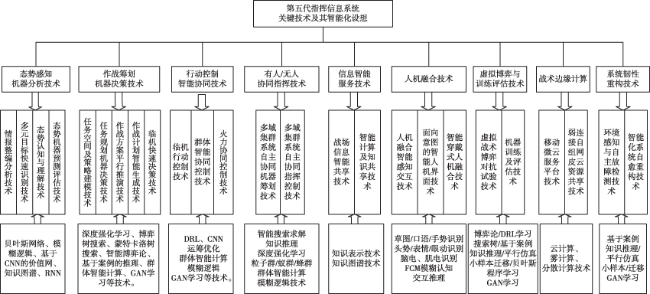
The key technologies of the fifth-generation command information system mainly solve the above – mentioned problems of intelligence, cloud – edge-end integration, and system resilience and adaptability. The key technologies of the system and its intelligent concept is the following
Key technologies of the system and its intelligent concept
系統關鍵技術及智慧化理念
The key technologies of the fifth-generation command information system cover all aspects of the command and control OODA loop, and can support the system’s intelligence, resilience, and edge command and control requirements in terms of detection, decision-making, control, and strike, thereby building a precise perception chain, rapid control chain, precise strike chain, and agile service chain, extending to the tactical edge and improving command effectiveness.
1) Situational Awareness Machine Analysis TechnologyIntelligence compilation and analysis technology.
Use big data, deep learning, knowledge graphs and other technologies to perform intelligent information correlation matching, text semantics intelligent analysis, and public opinion intelligent search and extraction to obtain valuable intelligence from massive, multi-source, and heterogeneous battlefield information.
Multiple target rapid recognition technology. Using deep learning methods, a multi-layer CNN convolutional neural network is constructed, and sample feature parameter learning is used to complete feature extraction and rapid target recognition of optical, infrared, electromagnetic, and acoustic information.Situation recognition and understanding technology. Analyze the enemy’s combat intentions and combat capabilities, use the reinforcement learning valuation network technology to simulate the commander’s situation recognition process, and combine the CNN nonlinear battlefield situation fitting ability to establish a mapping from situation images to situation understanding
Situation machine prediction and assessment technology. Based on situation understanding, the enemy’s tactical behavior is estimated. First, the strategy network is used to obtain the enemy’s activity rules, and then the parallel deduction method is used to perform multi-branch situation deduction. Finally, a prediction network is constructed to predict the situation.
Combat mission space and strategy modeling technology. Modeling the state and action strategy of the combat mission space and determining the description method of the mission state, strategy, and feedback are the basis for deep reinforcement learning to make decisions.Mission planning machine decision-making technology. Use operations optimization to complete target analysis and task allocation. Use deep reinforcement learning and swarm intelligence algorithms to machine plan force composition, firepower configuration, and collaborative paths. Tactical planning tends to be rule-based reasoning and easy to break through; campaign planning tends to be knowledge-based reasoning based on experience, involving the art of command, and is more difficult to break through.
Parallel simulation technology for combat plans. With reference to the parallel simulation technology of the “deep green” system the Monte Carlo search tree and game test method are used to simulate enemy combat behavior, rehearse and evaluate the action process, and accumulate feedback reward and punishment functions for learning, training, and decision optimization.
Intelligent generation technology of combat plans. Using intelligent perception algorithms such as natural language understanding, voice command recognition, and sketch recognition, combined with the extraction of elements from the task model, the knowledge graph is used to automatically extract the plan to generate combat plans and command sequences .
Rapid decision-making technology on the spot. Based on the current situation, using the learning data accumulated by the game platform, automatically matching the most appropriate plan adjustment, making dynamic decisions on the plan based on Monte Carlo tree search and transfer learning algorithms, reverse reinforcement learning, and enhancing the generalization ability of the plan.3) Intelligent motion control technologySituation-based improvisation control technology. According to the effects and deviations of combat operations, the resources, paths, and coordination modes of the mission are dynamically adjusted, and parallel simulation multi-branch deduction and reinforcement learning technology are used to correct the deviations, thus realizing tactical “feedforward” control .
Swarm intelligence collaborative control technology. Promote the maximization of the overall effectiveness of battlefield intelligent bodies in collaborative operations, use ant colony and bee colony control algorithms and deep reinforcement learning methods to build a global tactical value network, establish an effect feedback model, and perform strategic control based on the value network.Firepower collaborative control technology. Improve the speed and accuracy of friend-or-foe identification, firepower allocation, and collaborative dispatch, use swarm intelligence and deep reinforcement learning algorithms to automatically plan, coordinate and optimize the strike chain, and have a certain degree of autonomous decision-making ability.
Multi-domain cluster system autonomous collaborative machine planning technology. Use branch search solution, knowledge reasoning, and deep reinforcement learning to plan and allocate collaborative tasks for manned/unmanned systems, and use swarm intelligence optimization algorithms to plan collaborative trajectories for unmanned and manned platforms.Multi-domain cluster system autonomous collaborative command and control technology. It monitors the missions of unmanned clusters and provides autonomous collaborative command and guidance. It uses swarm intelligence algorithms to detect conflicts and avoid collisions among multiple unmanned platforms, and coordinates grouping, routing, and load.
5) Intelligent information service technology.
Intelligent battlefield information sharing technology uses reinforcement learning and semantic association technology to analyze users’ information needs and preferences, generate information needs based on users’ differentiated characteristics, and intelligently push tactical information to users.
Human-computer fusion intelligent perception interaction technology. Construct multi-channel human-computer interaction methods including sketches, spoken language, gestures, head postures, expressions, eye movements, etc., and provide natural, sensitive, accurate and anthropomorphic interaction strategies . Intention-oriented intelligent human-computer interface technology. Using FCM fuzzy cognitive interactive reasoning technology, infer the user’s interactive intention, and organize the interactive interface output by integrating different means such as spoken language, gestures, sketches, and natural language according to the user’s interface needs and interaction preferences.Smart wearable human-machine fusion technology. It uses edge computing technology and new human-machine interaction methods such as voice, gestures, eye movements, brain-computer interfaces, and augmented reality to provide soldiers with smart wearable devices that have a collaborative, integrated, and linked human-machine interaction mode.
7) Virtual gaming and training evaluation technology.
The combat virtual game technology builds a game confrontation test platform, conducts combat knowledge modeling, and uses parallel simulation, branch decision, differential confrontation and other technologies to conduct red-blue confrontation, which not only trains tactics and methods, but also collects tactical data.Machine training and evaluation technology uses the data accumulated by the game platform and the experience of personnel to model, adopts small sample transfer learning technology to train and optimize the algorithm, replays the real data afterwards, performs transfer learning optimization on the decision model, and updates the decision plan.
8) System resilience adaptive reconstruction technology.
Environmental perception and autonomous fault detection technology. Under soft and hard damage, it can detect the main faults and analyze abnormal correlations, predict the occurrence of faults that affect task execution, evaluate the impact of faults on tasks, and realize active perception and rapid location of system resources and faults.System self-healing and reconstruction intelligent technology. When key nodes of the system fail, an adaptive mechanism is used to reallocate resources, achieve capacity regeneration, and continuously ensure the completion of core tasks. The system changes from a fault repair method with preset rules and manual participation to an intelligent system reconstruction method.
9) Tactical edge computing technology.
Mobile micro-cloud service platform technology. Deployed in fog computing mode on vehicles, aircraft, and boats within one hop of the enemy, it provides shared processing capabilities for combat teams and expands the tactical information processing capabilities of team members.Pi-cloud resource sharing technology under weak connection ad hoc network. Based on the individual soldier ad hoc network, the Pi-cloud is constructed using distributed computing technology to support end-to-end autonomous collaborative information sharing and resource sharing between individual soldier mobile devices under weak connection to meet tactical edge needs.
5 Development ideas and ideas
1) Gradually progress in stages, starting with the easy and then moving on to the difficult. In the first stage, image, voice, gesture, face recognition, and natural language understanding are applied to intelligence analysis; in the second stage, deep learning and reinforcement learning are applied to situational awareness and command decision-making; in the third stage, cloud computing is used to realize a knowledge-centered, intelligently empowered system.
2) Select intelligent algorithms for application. Focusing on the application of deep learning in situation and deep reinforcement learning in planning and decision-making, select appropriate tactical backgrounds to verify intelligent algorithms. Tactical-level planning of paths, firepower, tasks, etc. can be used as breakthroughs.
3) Strengthen the construction of knowledge engineering in the field of combat command. Expert rules, military regulations, and actual combat data are the basis of intelligent command. The existing combat rules should be modeled and represented in a knowledge-based manner, and the input and output mapping relationship between knowledge representation and deep learning should be established. The research on knowledge learning and knowledge reasoning methods should be strengthened .
4) Establish a virtual confrontation game platform to accumulate data. Intelligent algorithms require a large number of learning samples. The ways to accumulate samples are: Establish a confrontation game platform to conduct war games, human-machine confrontation, and red-blue confrontation to accumulate data; Collect tactical data from actual combat exercises and build models as training samples.
6 Conclusion
This paper proposes the overall and intelligent concept of the fifth-generation command information system, constructs a new generation of command information system architecture with “intelligent empowerment, human-machine integration, cloud-edge integration, autonomous evolution, cloud-intelligence sharing, and resilience and adaptability”, analyzes its key technologies and capability characteristics, and attempts to achieve cognitive advantages, decision-making advantages, and action advantages based on the fourth-generation system in the world .
There are not many technical verifications for the fifth-generation system in the world, so we should not rush for quick success and still need to conduct sufficient research.
Adapt to the general trend of technological development and seize the high point of future war system ——
Artificial intelligence is a collective term for cutting-edge technology groups such as big data, automated decision-making, machine learning, image recognition, and spatial situational awareness. The “ cognitive burden ” that liberates human intelligent fitness enables technology users to obtain prophets, preemptive, Preemptive decision-making action advantage. As “ power multiplier ” and “ the basis for future combat ”, artificial intelligence will fundamentally reshape future war patterns, change the country’s traditional security territory, impact existing military technology development patterns, and reconstruct future operations The system and military power system have become important leading forces in the future battlefield.
With the rapid development of technology and the continuous pace of competition, major countries have launched their own artificial intelligence development plans, and accelerated the transformation of organizational mechanisms, scientific and technological research and development, and tactical tactical innovation, promote the use of artificial intelligence military, and seize future war commanding heights.
Speed up organizational innovation
Promote technology conversion applications
Unlike traditional technology, the research and development and transformation of artificial intelligence have its own characteristics. The institutional setting and operation of the traditional defense system make it difficult to adapt to the needs of rapid development of artificial intelligence. To this end, the military of relevant countries has vigorously carried out organizational reforms and innovations, removed institutional obstacles in the process of research and development of artificial intelligence technologies, and accelerated the transformation and application of related technologies.
Emphasize that “ is close to ”. The UK is mainly based on “ Defense Data Office ” and “ Digital Integration and Defense Artificial Intelligence Center ”, integrating energy efficiency such as route planning, specification setting, technical governance and asset development, and breaking down restrictions on the development and application of artificial intelligence technologies Administrative obstacles. The United States is based on the “ Strategic Competency Office ” and “ Chief Numbers and Artificial Intelligence Officer ”, and uses the Army’s Future Command as a pilot to integrate decentralized functions such as theoretical development, technology development, and equipment acquisition. Together, the focus is on “ Digging potential efficiency ” to strengthen the innovative use of existing platforms, while In order to effectively balance real needs with long-term development.
Pay attention to “ research conversion ”. The use of artificial intelligence in the military field will have a profound impact on battlefield methods, tactical tactical choice, etc. Russia has established “ Preliminary Research Foundation ” and “ National Robot Technology R&D Center ” and other institutions to guide the design, research and development and application of Russian military industrial and intelligent technology to improve the practical transformation of scientific research results rate. The United States has set up “ Joint Artificial Intelligence Center ”, relying on “ National Mission Plan ” and “ Military Type Mission Plan ”, focusing on coordinating military-site collaborative innovation and technological achievements transformation to promote artificial intelligence Wide application of the US Department of Defense and various services.
Focus on “ military-civilian integration ”. Russia has set up “Tech City ” and other institutions in Anapa and other places. Based on the “ Advanced Research Foundation ”, it fully absorbs military personnel, actively builds technological production clusters and research clusters, and effectively expands military personnel. Two-way communication mechanism. By setting up “ National Defense Innovation Test Group ” and other institutions in Silicon Valley and other places, the United States can directly enter high-level decision-making by relying on “ National Defense Innovation Committee”. France has established technical research and development institutions such as the Innovation Defense Laboratory and the Defense Innovation Division in the Ministry of National Defense, aiming to solicit private capital investment and cooperation in defense projects to improve scientific research energy efficiency.
Highlight “ combination of technology ”. The Israel Defense Forces established the Digital Transformation System Architecture Department to fully demonstrate new technologies, new theories, and new concepts based on the specific effects of the organic integration of various systems into various military services to determine the corresponding technology research and development priorities and strategic development directions. The United States has re-established the positions of Deputy Secretary of Defense Research and Engineering, created chief numbers and artificial intelligence officers to enhance the control of defense technology innovation and application, and relied on theoretical methods such as red and blue confrontation, analog deduction, and net assessment analysis. New ideas, new ideas, and new methods are tested in practice to select various types of technology research and development focus and strategic tactical attack directions, Achieve benign interaction between technological development and theoretical innovation.
Set up a project for military needs
Seize the opportunity for future development
In recent years, various military powers have aimed at the development of artificial intelligence frontier technology, and have established extensive projects in the fields of situational awareness, data analysis, intelligence reconnaissance, and unmanned combat, with the intention of seizing future development opportunities.
Situation awareness field. Situational awareness in the traditional sense refers to the collection and acquisition of battlefield information by means of satellite, radar, and electronic reconnaissance. However, under the conditions of “ mixed warfare ”, which is ambiguous in peace, unity of soldiers, internal outreach, and integration of all regions, the role of situational awareness in non-traditional fields such as human domain, social domain, and cognitive domain has received unprecedented attention. The US “ Computable Cultural Understanding ” project aims to process multi-source data through natural language processing technology to achieve cross-cultural communication; the “ compass ” project aims to extract cases from unstructured data sources, Integrate key information and respond to different types of “ gray zone ” actions. The French “ Scorpion ” Combat System project aims to use intelligent information analysis and data sharing platforms to enhance the fire support effectiveness of the French’s existing frontline mobile combat platform to ensure the safety of operational personnel.
Data analysis field. Relying on artificial intelligence technology to improve intelligent data collection, identification analysis and auxiliary decision-making capabilities can transform information advantages into cognitive and action advantages. Russia’s “ Combat Command Information System ” aims to provide commanders with multiple types of action plans by using artificial intelligence and big data technology to analyze the battlefield environment. The British “THEIA program ” and the French “The Forge” digital decision support engine are designed to enhance the information processing capabilities of command control, intelligence gathering, etc., and improve the commander’s ability to control complex battlefields. And command effectiveness.
Intelligence reconnaissance field. Compared with traditional intelligence reconnaissance, the use of artificial intelligence algorithms to collect and process intelligence has the advantages of fast access to information, wide content sources, and high processing efficiency. The Japan Self-Defense Force satellite intelligent monitoring system aims to identify and track foreign vessels in the vicinity of key waters that may “ infringe ” their territorial waters. U.S. military “ complex combat environment causal exploration ” project, which aims to use artificial intelligence and machine learning tools to process multi-source information to assist commanders in understanding the cultural drivers, root causes, and factors behind the war; “ Marvin ” The project uses machine learning algorithms, human face recognition technology, etc. to screen and list various suspicious targets from the full dynamic video, Provide technical support for counter-terrorism operations.
No one is fighting. In some technologically advanced countries, the unmanned combat system is maturing and the equipment species spectrum system is becoming more and more perfect. The Israeli M-RCV unmanned combat vehicle can perform diversified tasks such as unmanned reconnaissance, fire strike, carrying and recycling drones under all terrain and full-time conditions. The Russian army “ Outpost-R” UAV system with integrated capabilities can detect, track, and strike military targets in real time. It also has certain anti-reconnaissance and anti-interference capabilities and has been inspected on the battlefield. The US military “ Future Tactical UAV System ” project aims to comprehensively enhance the effectiveness of the US Army in performing reconnaissance and surveillance, auxiliary aiming, war damage assessment, and communications relay operations.
Adapt to future battlefield changes
Continuously explore new ways of warfare
In order to adapt to the tremendous changes in the battlefield environment in the intelligent era, relevant countries have explored a series of new warfare methods by enhancing the energy efficiency of artificial intelligence in key military decisions and operations.
Algorithmic warfare, that is, relying on big data and artificial intelligence technology, to give full play to the powerful potential of combat networks, human-machine collaboration, and autonomous and semi-autonomous weapons, so that the cycle cycle of “ observation-adjustment-decision-action” Always lead the opponent, thereby destroying the enemy’s combat plan and achieving preemption. In December 2015, the Russian army relied on the unmanned reconnaissance and intelligent command information system to guide the ground unmanned combat platform to cooperate with the Syrian government forces to quickly eliminate 77 armed elements within the target range at the cost of 4 minor injuries. In 2021, the US Air Force conducted a test flight of the first intelligent drone “ Air Borg ”, marking a further advancement of the US military algorithm warfare.
Unmanned warfare, guided by a saturated number of attacks and a low-cost war of system attack and defense operations, strives to achieve full-scale posture tracking, dynamic deterrence, and tactical suppression of the enemy defense system through human-computer coordination and group combat models. In May 2021, the Israeli army used artificial intelligence to assist the drone bee colony in the conflict with the Hamas armed group, which played an important role in determining the enemy’s position, destroying the enemy’s target, and monitoring the enemy’s dynamics. In October 2021 and July 2022, the US military launched a drone targeted air strike in northwestern Syria, killing Abdul Hamid Matar, a high-level leader of the “ base ” organization, and the extremist organization “ Islamic State ” Leader Agel.
Distributed warfare, based on artificial intelligence unlimited command and control capabilities and new electronic warfare methods, using shallow footprints such as special forces, low-characteristics, and fast-paced forces to form small groups of mobile formations, spreading infiltration into combat in a multi-diameter multi-domain manner Area, continue to break the shortboard and chain dependence of the enemy system, increasing the difficulty of its fire saturation attack. In this process, “ people are commanding and machines are controlling ”. In recent years, the US military has successively launched “ Golden Tribe ”“ Flexible Network Distributed Marseille Communication ” and other “ distributed operations ” scientific research projects.
Fusion warfare, relying on network quantum communication and other means to build a “ combat cloud ” that is resistant to interference and high rates, in order to eliminate the technical barriers of military data chain interconnection, interconnection and interoperability, and achieve deep integration of combat power. In 2021, the joint general basic platform developed by the United States Artificial Intelligence Center officially possessed initial operational capabilities, which will help the US military break down data barriers and significantly improve data sharing capabilities. During the NATO “ Spring Storm ” exercise held in Estonia in 2021, the British army used artificial intelligence technology to perform intelligent analysis and automated processing of battlefield information of various services, which improved the integration of arms and strengthened joint command and control effectiveness.
Establishing normative guidelines for the management of military information dissemination on the Internet
——Interpretation of the three highlights of the “Internet Military Information Dissemination Management Measures”
Strengthening the management of Internet military information dissemination is related to the overall situation of national defense and military construction, and to the image and reputation of the people’s army. The promulgation of the “Internet Military Information Dissemination Management Measures” (hereinafter referred to as the “Measures”) has established normative guidelines for the management of Internet military information dissemination. Its implementation will surely provide a strong legal guarantee for promoting the rule of law in cyberspace, regulating the order of Internet military information dissemination, and better promoting the healthy development of Internet military media. The “Measures” not only aims to solve the practical problems of Internet military information dissemination in recent years, but also looks forward to the future trend of military information dissemination. Overall, there are three highlights:
Improved the opening standards of platforms and columns
Once military-related, confidential or negative information is disseminated, it will inevitably damage national security and the image of the military. The key to managing this kind of network chaos is to correct the source and effectively regulate the source of information dissemination. The Measures clearly regulate the opening of military website platforms, military columns on website platforms, military accounts, etc. First, Internet military information service providers must obtain licenses and perform filing procedures in accordance with the law to ensure the authenticity of their identities. Second, Internet military information service providers are encouraged and supported to establish or clearly be responsible for editing agencies for military information services, and to be equipped with full-time editors and content reviewers appropriate to the scale of services to ensure the professionalism of their capabilities. Such standardization can further improve the effectiveness of Internet military information dissemination management and effectively enhance the quality and level of Internet military media.
List of positive and negative aspects of the content being spread
In the digital age, online public opinion has become an important force in shaping social concepts and behaviors, with both the supply and dissemination of positive information and the spread of illegal and negative information. The Measures aim to turn the Internet, the biggest variable, into the biggest increment in promoting the development of the cause of strengthening the military, and refine and clarify the positive list of Internet military information dissemination content, mainly involving 11 aspects of information, including the promotion of Xi Jinping Thought on Socialism with Chinese Characteristics for a New Era and Xi Jinping Thought on Strengthening the Military, the promotion of the nature, purpose, glorious history, fine traditions and style of the People’s Army, and the reflection of the achievements of national defense and military modernization. At the same time, the Measures also detailed and clarified a list of 12 negative aspects, including harmful information that endangers national sovereignty, security and territorial integrity, and undermines the absolute leadership of the Party over the military and the responsibility system of the Chairman of the Central Military Commission. Through these regulations, Internet military information service providers and users can be effectively guided to maintain a good military-related public opinion environment, maintain a good image of the People’s Army, and safeguard national security and military interests.
Standardized the supervision chain of military accounts
Military information is highly sensitive, professional, and confidential, and must be handled by professionals. In response to the current problems of low registration thresholds for a large number of military accounts, arbitrary release of military information that disrupts the order of communication, the Measures regulate the conditions for identifying military accounts, and clarify the verification and reporting of military accounts. These requirements are in line with the national policy requirements for doing a good job in the classification and filing of mobile Internet accounts, which is conducive to further clarifying the responsibilities of website platforms and improving the pertinence and accuracy of military account supervision.
In mid-July 2021 World Internet of Things Expo held a press conference and revealed that the expo is scheduled to be held in Wuxi in early September. At that time, the expo will be themed “Intelligently Connecting Everything and Leading the Future with Digital”, focusing on showcasing the latest achievements in the global Internet of Things field.
The Internet of Things is changing people’s daily lives, quietly changing the form of modern warfare, and promoting the development of intelligent warfare.
Professor Chen Yingwen from the National University of Defense Technology tells you about the military Internet of Things——
Everything is connected, winning thousands of miles away
■Feng Zijian, Qu Shenghui, Qi Xucong
Schematic diagram of military Internet of Things technology simulation.
A “bridge” connecting the virtual world and the real world
The so-called Internet of Things can be simply understood as an Internet that connects everything. If the Internet is a “dialogue” in the virtual world, then the Internet of Things is a “bridge” connecting the virtual world and the real world.
The application of the Internet of Things had already appeared in wars under the name of “sensor networks” more than half a century before it attracted people’s attention.
In the 1960s, the “Ho Chi Minh Trail” on the Vietnam battlefield was covered with tens of thousands of “tropical tree” vibration sensors. These sensors are like a dense “spider web”, waiting for the “prey” to arrive. Whenever a person or vehicle passes by, the sensor detects the vibration generated by the target and records data such as its direction and speed.
At this time, tens of thousands of kilometers away, in an infiltration surveillance center code-named “Task Force Alpha”, US military technicians were receiving and processing relevant information sent back by the “sensor network”. Once a Vietnamese military convoy was discovered passing by, the command center would send instructions to the US troops stationed in Vietnam, instructing fighter planes to fly over the target and carry out bombing.
Due to the limited technology at the time, the sensors could only work for a few weeks. The “spider web” carefully built by the US military ultimately failed to prevent the Vietnamese army from transporting troops and supplies.
Although this “cooperative” combat method between humans and objects did not achieve any good results in history, it has prompted Western countries led by the United States to conduct in-depth research on Internet technology and continuously explore the interconnection between humans and objects, and objects and objects. Its highly informationized advantages are highlighted in many areas of military applications.
After decades of development, some military powers have successively developed a series of military sensor network systems, including the “Smart Dust” system for collecting battlefield information, the “Lumbas” system for remotely monitoring the battlefield environment, the “Sand Straight Line” system for monitoring the movement of weapon platforms, and the “Wolf Pack” system specifically for detecting electromagnetic signals.
Among them, the detection element of the “smart dust” system is only the size of a grain of sand, but it can realize all functions such as information collection, processing and sending, thereby enhancing the ability to control information during combat.
No combat entity will become an “island”
In the world of the Internet of Things, every grain of “sand” will have its network address. For the military Internet of Things, no operational entity will become an “island”.
During the first Gulf War, many weapons and equipment transported by the US military could not be found, resulting in a large waste of war resources. The reason is that the containers transporting weapons and equipment were not clearly marked, and personnel were unable to track the location of the transported weapons and equipment, which led to the loss of a large number of weapons and equipment.
Twelve years later, during the Iraq War, the US military installed radio frequency microchips on every container shipped to the Gulf region, and placed readers and writers according to transportation and storage needs, thereby achieving full tracking of personnel, equipment, and materials, greatly improving the effectiveness of military logistics support.
Foreign research data revealed that compared with the Gulf War, the Iraq War’s sea transport volume decreased by 87%, air transport volume decreased by 88.6%, combat equipment reserves decreased by 75%, and strategic support equipment mobilization decreased by 89%.
In fact, from the moment the electronic tags are attached and the sensing systems are installed, the originally silent equipment becomes like an organic life form that can sense and communicate with each other. Through the transformation of the Internet of Things technology, each combat entity such as combat personnel and combat equipment has become a “network node”. Through perception and communication with each other, the battlefield situation is clearer and combat operations are more efficient.
Take the personnel assessment network established by the Australian Department of Defense as an example: during combat, commanders can assess the physical functions and conditions of soldiers through sensors worn by soldiers, and then combine them with satellite positioning information to obtain the physical function status of all personnel. Commanders can use this as a basis for allocating troops, which can greatly improve the efficiency of battlefield decision-making.
Military IoT technology will play a big role in future battlefields
In today’s world, there are more and more similar military news——
In June 2016, the US military launched an airstrike using drones, killing 16 Taliban members; in September of the same year, Turkish security forces killed 6 terrorists under the guidance of their domestically produced drones.
In the Nagorno-Karabakh conflict in the Middle East in 2020, a video released by Azerbaijan made many people feel the power of networked and intelligent weapons: after the drone discovered the enemy tank, it aimed and fired…
From sensing the battlefield situation to locking onto the target and then launching an attack on the target, the reason behind unmanned equipment becoming the main offensive entity is the huge support of military Internet of Things technology. This huge intelligent information network is like the “clairvoyance” and “super hearing” on the battlefield, allowing combat personnel to sit firmly in the “central military camp” and win the battle thousands of miles away.
“Everything is connected, and victory can be won thousands of miles away.” This is the development trend of military Internet of Things technology and an important feature of future intelligent warfare. In the era of the Internet of Everything, the military Internet of Things will connect several individual combat entities into intelligent combat groups and generate a smart combat system. In the future, it will only be necessary to give the smart combat system clear combat objectives, and military combat personnel will not have to participate in its execution process.
At present, the development of military Internet of Things technology still has a long way to go before it can realize the Internet of Everything, but we should be aware that when smart nodes reach a certain scale, the military Internet of Things will achieve a qualitative leap.
In future battlefields, military Internet of Things technology will surely play a big role in achieving victory through “connection”.
The metaverse is an artificial online virtual world that is born out of, parallel to, and independent of the real world. It is parallel to the real world, reacts to the real world, and integrates a variety of high technologies. These are the three major characteristics of the future metaverse. The operation of the metaverse conforms to the natural laws of human understanding and transformation of the world, and provides a new way of thinking to understand and discover the operating behavior, state, and laws of complex real systems, as well as a new means to explore objective laws and transform nature and society. Researching the application of the metaverse in the field of foreign military training and analyzing the opportunities and challenges that the metaverse brings to the field of military training have important theoretical and practical value in solving the key problems that need to be solved in military training in the intelligent era, promoting scientific and technological training, and promoting the innovative development of military training models.
Background of Cognitive Metaverse Empowered Military Training
The scientific and technological revolution has given rise to a new ecology of military training. Driven by the new scientific and technological revolution and the industrial revolution, cutting-edge technologies such as artificial intelligence, big data, cloud computing, and the Internet of Things have accelerated their development. Technology giants have laid out the metaverse, and human real life has migrated to the virtual world more rapidly. The metaverse integrates a variety of emerging technologies, thus generating new Internet applications and new social forms that integrate the virtual and the real. Perception technology supports the integration of the virtual and the real in the metaverse, “AI+” technology supports the social nature of the metaverse, data transmission technology supports the real-time nature of the metaverse, electronic game technology supports the diversity of the metaverse, digital twin technology supports the sustainability of the metaverse, and blockchain technology supports the security of the metaverse. The future metaverse, where virtual and real are highly interconnected, is born out of, parallel to, and independent of the real world. It integrates all elements such as the Internet, virtual reality, immersive experience, blockchain, and digital twins to build a new basic ecology for intelligent military training.
The evolution of war has dominated the transformation and upgrading of military training. With the advent of the intelligent era, the war situation has accelerated its evolution towards informationization and intelligence. The informationized warfare system with “information acquisition and utilization as the core” will gradually transition to the intelligent warfare system with “intelligent simulation and expansion as the core”. The trend of long-range precision, intelligence, stealth, and unmanned weapons and equipment has become more obvious, and intelligent warfare has surfaced. At the same time, combat elements represented by artificial intelligence such as “AI, cloud, network, group, and terminal” and their diversified combinations have formed a new battlefield ecology. The metaverse has constructed a new battlefield space where virtual and real are integrated and parallel interactions occur. The traditional war winning mechanism is being profoundly changed. The development and changes in the form of intelligent warfare have compulsorily driven the transformation and reshaping of the military’s thinking and concepts, requiring the accelerated transformation and upgrading of military training, greater attention to the impact of technological development and changes on warfare, and the use of the “new engine” of training and warfare to achieve “accelerated” preparations.
Foreign militaries explore breakthroughs in military training models. In order to seize the strategic commanding heights of military intelligence, the world’s military powers attach great importance to the innovation of military training models. Some countries have begun to try to apply the metaverse and related technologies to military training. For example, the United States has successively released the National Security Strategy, the National Defense Strategy and the Department of Defense Transformation Plan, focusing on building an “all-round army” and forming a “full spectrum advantage”. It has also simultaneously formulated the Training Transformation Strategic Plan and the Training Transformation Implementation Plan, and proposed the concept of a comprehensive training environment (STE), the core of which is immersive and integrated virtual training, which intends to integrate real-time, virtual, constructive and gaming environments into a comprehensive training environment. Russia also attaches great importance to the development of virtual training systems. Almost all of its advanced weapons and equipment are equipped with corresponding virtual training systems, and are moving towards universalization and embedding. The United Kingdom, Germany, South Korea, etc. are also actively developing various professional military training virtual environments. Intelligent training supported by technologies such as artificial intelligence, virtual reality and augmented reality is gradually becoming the mainstream of military training research in powerful countries.
Clarifying the Advantages of Metaverse-Enabled Military Training
The emergence of new concepts in military training. Only by leading the opponent in thought can we gain the upper hand in action. The emergence of disruptive technologies will inevitably rewrite the current military training rules and systems, and will also innovate the existing military training thinking concepts. On the one hand, the metaverse has set off a hurricane-like “brainstorm”, and the training thinking led by “intelligence” has organically connected training with actual combat, and upgraded to intelligent military training thinking. On the other hand, new technologies and new means represented by the metaverse empower military training, strengthen the concept of winning by science and technology and intelligent drive, and greatly improve the scientific and technological content of military training, in order to control the initiative in future wars. In the future, the metaverse will create more impossible possibilities by constructing a virtual battlefield space, designing wars and evolving wars.
Innovate new theories of military training. War is the area that needs innovation the most. Military training must adapt to the development of intelligent warfare, and theoretical innovation and training practice must be driven by both. Training transformation will not happen automatically. It requires not only a sharp and profound foresight to grasp the general trend, but also a scientific, powerful and solid theory to drive forward. On the one hand, by keeping up with the development of the times and starting from new concepts and new cognition, we can build a scientific theoretical system for metaverse-enabled military training. On the other hand, by following the laws of combat-training coupling, we can establish an innovative model of intelligent military training theory with the characteristics of the times, allowing the metaverse to empower and improve the efficiency of promoting the iterative development of military training transformation.
Transform the new military training model. The combat style determines the training mode, and intelligent warfare changes the “rules of the game”. Military training for the next war must adapt to the requirements of future wars by changing the training mode. First, it can build an intelligent blue army with “both form and spirit”. With the help of optimized AI technology, powerful computing power support, and realistic performance simulation, the Metaverse follows the evolutionary process of “knowing the enemy, imitating the enemy, surpassing the enemy, and defeating the enemy” to create an intelligent blue army with platform support and data empowerment, and carry out “real” confrontation training and effect evaluation in the Metaverse space. Second, it can carry out new domain and new quality combat training. The metaverse expands the practical application path with new domains and new types of combat forces as the leading elements, highlights the research and development of training methods and tactics that are compatible with advanced combat concepts and winning mechanisms, and creates new forms of training such as unmanned and seamless human-machine collaboration, becoming a new point of combat power growth. Third, it can cultivate new types of military talents. At present, the educational metaverse has led the intelligent transformation of education. In the future, the military metaverse will accelerate the realization of intelligent interaction between people and equipment, deep integration between people and systems, and adaptive evolution between people and the environment, and promote the integrated development of “commanders” and “fighters” into “scientists” and “technicians.”
Reshape the new ecology of military training. The multi-dimensional perception, virtual-real integration, free creativity, and open development of the metaverse will make the future metaverse a fully immersive, time-transcending, self-creating and developing space. First, create a digital twin “battlefield metaverse”. The “battlefield metaverse” will be a typical manifestation of the metaverse in the military field, with stricter security and confidentiality standards, stronger simulation computing capabilities, and more real-time and detailed interaction requirements. Secondly, create a full-dimensional three-dimensional metaverse training environment. The metaverse uses technologies such as virtual reality, augmented reality, and mixed reality to create an immersive and complex scene environment; using powerful data and network support, it builds a full-dimensional space such as land, sea, air, space, electricity, and the Internet. Furthermore, a Metaverse verification platform for weapons and equipment will be built. The platform will have functions such as new weapon and equipment design demonstration, weapon and equipment performance test, weapon and equipment compatibility test, and weapon system combat effectiveness test. In the future, the Metaverse will greatly shorten the timeline for weapons and equipment to go from “weak intelligence” to “strong intelligence” and then to “super intelligence”, realizing the intelligence multiplication effect of weapons and equipment.
Grasping the Key Points of Metaverse-Enabled Military Training
Focus on top-level design. From the perspective of the development of things, the metaverse is a new thing, and its maturity has yet to be verified. Intelligent military training is also a complex, arduous and long-term system engineering, which requires strengthening strategic planning and top-level layout. We should pay close attention to the development trends and technological trends of the metaverse, and scientifically formulate the development plan of the “training metaverse”. In the context of the integration of intelligence, informatization and mechanization, we should give full play to the outstanding advantages of the metaverse, such as enabling trainees to undergo immersive experiential training, so that the metaverse can not only be a display platform for virtual technology, but also a practical platform for improving the effectiveness of military training.
Strengthen technology research and development. From a technical perspective, the Metaverse has reintegrated existing technologies in the information and intelligent technology group, proposed an overall innovative concept, and provided comprehensive application scenarios, thereby giving birth to new vitality. To accelerate the development of the “training Metaverse”, we must speed up the research on basic software and hardware technologies such as algorithm engines and network communications, strengthen the research and development capabilities of core technologies such as artificial intelligence, digital twins, blockchain, and the Internet of Things, and at the same time strengthen the overall technical design and research and development of the Metaverse, such as immersion, sociality, openness, collaboration, and decentralization.
Create training types. From the perspective of time and space, the metaverse may create a vast virtual war space, recreate the war environment, present the war process, and virtualize the future of war. An intelligent military training operation system based on the metaverse should be built, military training concepts should be updated in a timely manner, and innovations in military training models, management support, and legal mechanisms should be deepened. A dynamic and high-level combat-oriented military training environment based on the metaverse should be built to fully support strategic, campaign, and tactical training as well as war simulations. At the same time, in the process of “intelligent adaptation” of military training, we will achieve the expansion of wisdom and intelligent evolution towards the unknown space of military training with “innovation, openness, diversified iteration, and new intelligent ecology”.
Attach importance to risk prevention and control. From the perspective of safety and controllability, the concept and technology of the Metaverse brings innovative opportunities to intelligent military training, but the potential risks associated with the technology itself cannot be ignored. The Metaverse is a huge technology group, and its system architecture, key technologies, and application environment are still in the development and implementation stage. The supporting protection system, safety technology, and management standards will bring security risks. In addition, the integrated application of various emerging technologies in the construction process, the complexity and confidentiality in the application process will be the unknown factors for the key prevention and risk challenges of the Metaverse in military training.
The organic combination of modern combat requirements of “fast, accurate and efficient” and electronic information technology has given birth to a new generation of combat weapons – intelligent weapons. The continuous emergence and frequent use of high-tech weapons with considerable intelligence on the battlefield will inevitably result in the emergence of intelligent combat styles. In the Gulf War, the US military used a large number of drones with intelligent control devices to conduct aerial reconnaissance, with a total of 522 sorties. The 282 “Tomahawk” cruise missiles launched by the US military attacked targets within 450-2600 kilometers, with a hit rate of more than 90%. The Kosovo War was even more of a “demonstration of results” of weapons with intelligent characteristics. Although precision-guided munitions only accounted for 35% of ground attack munitions in combat, the number of targets destroyed accounted for 74% of the total.
Intelligent technology is a marginal discipline that studies the relationship between electronic computers, human brains and intelligence. Intelligent weapons refer to high-tech weapons and equipment that have some (specific) functions of the human brain, such as reconnaissance, search, identification, aiming, and attacking targets, without manual operation and control, and can be independently completed without manual operation and control. Compared with precision-guided weapons, intelligent weapons can “consciously” find and identify targets to be attacked, and some of them have the ability to distinguish natural language. They are a “thinking” weapon system. In future combat, whoever masters advanced intelligent weapons and means will have stronger combat effectiveness and more initiative.
In terms of weapon intelligence, the key technologies currently under development include: robots; expert systems; intelligent machines and intelligent interfaces; machine vision and image understanding; speech recognition and natural language theory; weapon precision control and smart weapons; automatic target recognition; unmanned vehicles; neural networks and their applications, etc. According to scientific predictions, these technologies will have major breakthroughs in the 21st century and bring about a revolution in intelligent technology.
Scientists predict that intelligent weapons, military expert systems and military robot forces will occupy an important position in the future military field.
Characteristics of Intelligent Warfare
Intelligent warfare is a high-tech warfare form that uses intelligent weapons and means under information warfare conditions to achieve efficient command and control and implement precise and smart strikes. In essence, it is the radiation and extension of human “intelligence” to the information battlefield and weapon systems. From the perspective of combat procedures and means, intelligent warfare includes two major aspects: one is intelligent command and control warfare; the other is the offensive and defensive confrontation of intelligent weapons. The main signs of intelligent warfare are the emergence of intelligent weapon groups and intelligent means and their use on future battlefields. Future intelligent warfare has four significant characteristics.
———Command efficiency. During the Kosovo War, NATO commanded more than 38,000 flight missions to coordinate attacks on the Federal Republic of Yugoslavia from different airports, directions, altitudes, and times. Without the support of the C4I system, it would be impossible to rely on manual command. The amount of information on future battlefields will expand unprecedentedly, and it will be necessary to coordinate the combat forces of multiple services and complex weapon systems in full-dimensional space, which is even more inseparable from the support of advanced intelligent computers. In the future, four changes will be achieved in intelligent command and control: computers will shift from calculation, storage, transmission, and execution of commands to thinking and reasoning; information processing will shift to knowledge processing; the extension of hand functions will shift to the extension of brain functions; electronic warfare, psychological warfare, entity destruction, information deception, and military confidentiality in command and control operations will mainly shift to network operations, ultimately achieving a high degree of intelligence in command and control operations.
———Strike precision. In precision-guided weapons, no matter which guidance method is used, it is inseparable from the key control device with high-speed signal processing and feedback capabilities. It is mainly used to process a large amount of information in real time at high speed, determine the flight direction of the weapon, and control the tracking actuator to guide the weapon to the target. After adopting microcomputer control, each combat vehicle and weapon platform can be connected to the battlefield C4I system, which will further improve the accuracy of missile hits and combat performance. Precision warfare has become an important combat idea and principle of the 21st century military.
———Automated operation. Looking forward to the development of the 21st century, various advanced weapons will be equipped with various types of micro-intelligent computers in the future, various aircraft and ships will be equipped with machine (ship) intelligent computers, tanks will be equipped with vehicle-mounted intelligent computers, artillery systems will be equipped with fire control intelligent computers, anti-missile weapon systems will be equipped with large weapon control intelligent computers, unmanned aircraft known as the “air suicide squad” and unmanned autonomous tanks, tanks and other intelligent weapons will be fully implemented with computer intelligent control, achieving a high degree of automation and intelligence.
———Behavior intelligence. The behavior intelligence of weapons and equipment mainly refers to their “intelligence” such as self-memory, self-searching, self-selection, self-tracking, and self-identification, which greatly improves the combat performance and combat effectiveness of weapons and equipment. In the future, there will be many types of intelligent weapons, which can be divided into lethal intelligent weapons and non-lethal intelligent weapons. Among them, lethal intelligent weapons include soft kill and hard kill. At present and in the future, military intelligent weapons and equipment mainly include intelligent missiles, intelligent ground (water) mines, intelligent combat vehicles, intelligent aircraft, intelligent ships, intelligent C4I systems and intelligent robots, etc. Military robots will play an important role in future high-tech wars. The United States has included more than 100 types of military robots in its development plan. Some US military units have begun to equip application-oriented robots. For example, the 7 mine-sweeping robots of the US First Armored Division have cleared more than 1,000 mines without any casualties.
It can be foreseen that in addition to robot warfare, the 21st century will see the emergence of intelligent missile warfare, intelligent command and control warfare, intelligent network warfare, intelligent drone warfare, intelligent tank warfare, intelligent mine warfare, and so on.
The impact of intelligent warfare
This has led to a qualitative change in the form of war. With reference to the “heat energy” form of energy release in the industrial era, the energy release form of intelligent warfare in the information era is prominently manifested in the following ways: targeted energy release, or the controlled release of energy to make it more consistent with the purpose of war; intelligent energy release forms that combine man and machine, such as weapons that can automatically search, robot soldiers, and intelligent combat vehicles; and systematic energy release forms, which solve the technical problems of intelligent command and control, ensure the integration of joint combat command, and give full play to the overall combat effectiveness of various forces.
Changing the traditional principles of “concentration” and “mobility”. In the future, intelligent warfare will be able to achieve the effects of “point-to-point” and “1+1”, that is, a weapon platform launches a bomb to accurately destroy a target. Intelligent command and control will be able to concentrate various combat forces at the most favorable time and place, and strike the enemy reasonably and effectively. Therefore, intelligent warfare will make the connotation of “concentration” and “mobility” new. Concentration of troops and firepower will be changed to concentration of combat effectiveness; troop mobility will be changed to firepower mobility, so that future combat will develop in the direction of precision, dexterity, and economy.
Give new content to the relationship between people and weapons. No matter how “brave” intelligent weapons are, they cannot change the fundamental fact that people are the main body of war. Intelligent weapons and means are ultimately the extension and development of human capabilities. Compared with other weapons, intelligent weapons are also subject to various human and natural factors. The higher the degree of intelligence, the more it depends on system work. However, we cannot ignore the important role of intelligent weapons in future wars.
Meeting the Challenges of Intelligent Warfare
Develop 21st century combat theory. Our army has always had traditional advantages in military theory, but in the face of future operations, we still have shortcomings in combining combat guidance theory with practice. At present, the primary issue is to further break the old framework, change old concepts, enhance information combat awareness, intelligent combat awareness, strengthen the research of new combat theories in the future, and innovate military theories at all levels of strategy, campaign and tactics.
Develop intelligent technology and weapon systems. To win future wars, we must develop weapons that can win in the future, strive to be the vanguard in key technologies, use intelligent technology as a breakthrough, focus on solving the problems of “sharp eyes, smart brains, long legs, and accurate shooting” in weapon systems, highlight the construction of command automation systems, especially military expert systems, and strengthen the intelligent transformation of existing weapons.
Develop the organization and high-quality talent team of our army. Future intelligent warfare can be said to be a war of knowledge, strategy, technology, and talent. Intelligence will inevitably promote the leanness of the army and put forward higher requirements for the quality of talents. Abstract intelligent weapons are useless. Only by effectively combining well-trained personnel and intelligent weapons can we defeat the enemy. In terms of organizational structure, we should adapt to the needs of future operations, increase the proportion of information technology talents, command and control talents, and new combat forces (military robots, computer protection soldiers, etc.), optimize the combination, and obtain the maximum combat organization function. In terms of talent development, we should update the talent quality structure and knowledge structure, advance the cultivation of talents urgently needed for future operations, and comprehensively improve our army’s ability to win.
Wars in different eras have different characteristics, and the “fog of war” that accompanies them is constantly changing. Often when people feel that they have basically seen the way to win through multi-faceted exploration, the next war presents new uncertainties. Local wars such as the Syrian War and the India-Azerbaijan conflict have demonstrated the multifaceted and complex nature of modern warfare from different perspectives. It can be seen that although traditional firepower warfare is still on the stage, the characteristics of intelligence have already emerged; although the combat type is still an offensive and defensive struggle, the combat guidance, environmental conditions, and specific methods of play have undergone profound changes. Wars are accelerating their evolution towards intelligence. The battlefield space has expanded from land, sea, air, space, electricity, and the Internet to space, polar regions, deep sea, and cognitive confrontations. The game competition has changed from military confrontation to multi-dimensional competitions such as politics, economy, science and technology, and public opinion. The participating forces have developed from the two warring parties to global attention and multi-dimensional intervention. Information intelligence has moved from auxiliary support to comprehensive dominance, full penetration, and full coverage. The combat unit has evolved from scale optimization to small, micro, and sophisticated, and the form is scattered and capable. Intelligence and hybrid have become basic trends. In the face of evolving wars and new uncertainties, we need to be sensitive to change and respond proactively, accumulate momentum and forge ahead in the midst of change, so as to achieve leadership and surpass others and seize the opportunity to win.
Enhance the hybrid nature of war based on the “pan-variability”. War is the continuation of politics and has never been a simple military confrontation. In the era of intelligence, visible struggles and invisible struggles coexist, battlefields with gunpowder smoke and silent battles coexist, and gray areas, hybrid warfare, and marginal conflicts coexist. In the face of fierce and complex competitive game situations, it is necessary to accelerate the construction of a hybrid warfare system with military as the cornerstone. First, enrich strategic options. Closely follow the characteristics of the times, strengthen the exploration of the characteristics and laws of non-military confrontation and the construction of power means, implement relevant preparations, and form comprehensive advantages. Secondly, enhance invisible strength. Attach importance to geopolitical, cultural, psychological and other aspects of research, and form an effective discourse system through think tank exchanges, academic promotion, cultural integration, legal construction, media propaganda and other means to influence the other party’s cognition in a silent way. Thirdly, unite the forces of peace. Take the construction of a united front in the new era as an important means of hybrid confrontation, unite all forces that can be united, and enhance international influence and appeal.
Enhance the flexibility of tactics based on the “smart change” of the battlefield. Looking at recent local wars and conflicts, due to factors such as the regional dimension and the strength of both sides, the traces of traditional warfare are still relatively obvious, but intelligent and unmanned warfare has irreversibly come to the fore. It can be foreseen that comprehensive intelligent warfare is not far away, the extension range of weapons and equipment will be farther and wider, the combat perspectives of the opposing sides will be larger and wider, and the degree of hinge fusion between the physical domain, network domain, and cognitive domain will be deeper. The battlefield with deep “smart change” calls for concepts and tactics that are adapted to it. We should accelerate the promotion of intelligent thinking, intelligent technology, and intelligent network aggregation and empowerment to form a flexible closed link with fast perception, fast decision-making, fast judgment, fast action, and fast feedback, based on “OODA” and the kill chain to beat the slow with the fast and change with change. Relying on intelligent computing power and intelligent algorithms, we design wars in advance, build various models, and innovate tactics and training methods in peacetime. In wartime, we analyze the battle situation in real time, keenly seize opportunities, and make precise decisions and actions. We use “military + technology”, “theory + experiment”, and “algorithm + tactics” to integrate the art of strategy with intelligent technology to achieve a combination of the strange and the orthodox, take the lead in rapid changes, and win by intelligence.
Enhance the plasticity of forces based on the “micro-change” of units. One of the important characteristics of modern warfare is that large systems support elite combat, and combat units are becoming increasingly miniaturized, integrated, and modular. We must focus on the combat unit, the end of combat effectiveness, and forge a “sharp knife” and “sharp blade” that is small, fine, micro, and strong to adapt to intelligent warfare. On the one hand, strengthen its ability to integrate into the system and connect all parties, rely on ubiquitous access to information networks, and achieve decentralized combat and energy concentration through flexible matching and rapid reorganization; on the other hand, strengthen its independent decision-making and improvisation capabilities, improve robustness and self-recovery, and be able to survive, respond to emergencies, and fight in extreme situations. It is possible to explore the formation of a “micro-unit” concept force, implement a flexible organization, do not fix the number of personnel, and do not restrict the field. Advanced combat theories, new combat formations, and new weapons and equipment can be tested and verified in advance, so as to explore ways to achieve cloud combat, cloud joint, cloud energy gathering, and self-combination at the end of the strike chain.
Enhance strategic bottom line based on deterrence “evolution”. Deterrence has a long history like war. With the in-depth application of intelligent technology and weapons and equipment, the connotation and extension, force means, form and effect of deterrence are changing. Although traditional nuclear deterrence is still the cornerstone of bottom line, new deterrence capabilities have been quietly formed, requiring higher determination, strength, wisdom, and strategy. Focusing on the role of deterrence in blocking the enemy invisibly in peacetime, controlling the situation at the key in times of crisis, and winning the final victory in wartime, we should focus on strengthening the strong and making up for the weak, opening up new areas, and long-term strategy to maximize the strategic value of deterrence. First, we should give equal importance to conventional and unconventional, accelerate the development of new weapons and new forces, and achieve the predetermined deterrence intention through actual combat training and actual combat deployment, supplemented by the expression and transmission of strategic will. Secondly, we should continue to study new combat concepts and new combat theories, and promote the transformation of theories from “soft” to “hard” through academic exchanges, think tank collisions, and multi-track and multi-layer confrontations, and transform them into real deterrence. Thirdly, accelerate the transformation of science and technology into the military field, increase research efforts in cloud computing, blockchain, quantum technology, etc., and strive to form a potential deterrent to opponents.
National Defense University Research Center for Xi Jinping Thought on Socialism with Chinese Characteristics for a New Era
The Third Plenary Session of the 20th CPC Central Committee is a very important meeting held at a critical period of comprehensively promoting the great cause of building a strong country and national rejuvenation with Chinese-style modernization. It focuses on studying and deploying the issues of further comprehensively deepening reform and promoting Chinese-style modernization, and makes strategic deployments for continuously deepening national defense and military reforms, drawing a blueprint for the new journey of relaying reforms to strengthen the military and constantly creating a new situation in national defense and military modernization. All levels of the military should earnestly study and implement the spirit of the Third Plenary Session of the 20th CPC Central Committee, unify their thoughts, wills and actions, and thoroughly implement the strategy of reforming and strengthening the military, so as to provide strong guarantees for achieving the goal of building the army for 100 years as scheduled and basically realizing national defense and military modernization.
Reform is a key move in designing and shaping the future of the military
Reform and opening up are the most prominent features and the most magnificent aura of contemporary China. The military field is the field with the most intense competition and confrontation, and it is also the field with the most innovative vitality and the most need for reform and innovation. Whether a military can possess an unremitting spirit of reform and a pioneering and enterprising spirit of innovation is an important indicator of its ability to win. Deepening the reform of national defense and the military is the only way to strengthen the military. The driving force for strengthening the military lies in reform, the way out lies in reform, and the future also lies in reform.
The strength of the People’s Army comes from reform and innovation, and the victory of the People’s Army comes from reform and innovation. The history of the growth and development of the People’s Army is a history of reform and innovation. From the establishment of a complete set of principles and systems for building the army under the absolute leadership of the Party during the Agrarian Revolution, to the implementation of the policy of streamlining the military during the War of Resistance Against Japanese Aggression; from the establishment of five major field armies during the War of Liberation, to the repeated adjustments to the system and organization after the founding of New China, to the massive reduction of millions of troops in the new era of reform and opening up and socialist modernization… The People’s Army has been fighting and reforming, building and reforming, and has become stronger and stronger. From the “Sixteen-Character Formula” of the Red Army period, to the “Protracted War” of the Anti-Japanese War, from the “Ten Military Principles” of the Liberation War, to the “piecemeal” of the War to Resist U.S. Aggression and Aid Korea, to the continuous adjustment of military strategic policies after the founding of New China… The People’s Army learned war from war, explored laws from practice, and wrote a vivid chapter of continuous innovation in the art of war leadership in the history of world military. Along the way, reform and innovation have always been an important magic weapon for our army to grow from small to large, from weak to strong, and continuously from victory to victory. Deepening the reform of national defense and the military is the requirement of the times to realize the Chinese Dream and the dream of a strong military, the only way to strengthen the military, and a key move to determine the future of the military. At present, it is a period of hard struggle to achieve the goal of building the army for 100 years. In order to defend national sovereignty, security, and development interests with stronger capabilities and more reliable means, and to provide strategic support for comprehensively promoting the great rejuvenation of the Chinese nation with Chinese-style modernization, it is necessary to continue to deepen the reform of national defense and the military.
Only reformers can make progress, and only innovators can become strong. President Xi Jinping stressed that “the new military revolution has provided us with a golden opportunity. We must seize the opportunity and work hard to not only keep up with the trend and the times, but also strive to be at the forefront of the times.” In today’s world, the new military revolution is surging, the intelligent warfare form is gradually showing its true face in the practice of war, and the new military technology and weapons and equipment system are further affecting the rules of war. All these require us to maintain a keen sense of reform and cutting-edge innovative thinking, base ourselves on the actual development of our army, focus on the needs of preparing for war, think deeply about the new force structure and winning logic necessary to win modern wars, rely on reform to continuously optimize the military system, improve the effectiveness of military governance in line with actual combat requirements, and go all out to fight a tough battle to achieve the goal of building the army for the centenary.
Comprehensively deepening reform has achieved great changes in the People’s Army in the new era
Since the 18th CPC National Congress, the CPC Central Committee with Comrade Xi Jinping as its core has, with great political courage and wisdom, pushed forward the theory and practice of reform of socialism with Chinese characteristics to a new breadth and depth. In the new era and new journey, we must insist on deepening reform to gain creativity, cohesion and combat effectiveness, and insist on the unchanged direction, unswerving path and unreduced efforts, and continuously push forward the modernization of national defense and the army with better strategies, higher efficiency and faster speed, and resolutely complete the mission and tasks of the new era entrusted by the Party and the people.
Grasp the overall changes in deepening national defense and military reforms. Since the Third Plenary Session of the 18th CPC Central Committee, the People’s Army has adhered to the guidance of Xi Jinping Thought on Socialism with Chinese Characteristics for a New Era, thoroughly implemented Xi Jinping’s Thought on Strengthening the Army, and taken the Party’s goal of strengthening the army in the new era as its guide. It has comprehensively implemented the strategy of reform and strengthening the army, and has thoroughly resolved the institutional obstacles, structural contradictions, and policy issues that have long constrained national defense and army building, promoted the reform of the leadership and command system, the reform of the scale structure and force composition, and the reform of military policies and systems, and achieved historic achievements in deepening the reform of national defense and the army. The People’s Army has achieved an overall revolutionary reshaping; the new system, structure, pattern, and appearance have made our army’s winning advantage more prominent, its innovative vitality continuously released, and its morale more uplifting. Practice has fully proved that as long as we unswervingly continue to deepen the reform of national defense and the military, we will be able to create a new situation in the modernization of national defense and the military.
Adhere to the ideological guidance of deepening the reform of national defense and the military. President Xi’s series of important strategic thoughts on deepening the reform of national defense and the military, which are directional, fundamental, and overall, have profoundly clarified the contemporary significance, essential attributes, fundamental guidance, goals and tasks, core requirements, important directions, strategic measures, and scientific methods of deepening the reform of national defense and the military. To carry out the reform of national defense and the military to the end, we must adhere to Xi Jinping’s Thought on Strengthening the Military as the general guidance and general compliance, and consistently use Xi Jinping’s Thought on Strengthening the Military to arm the minds of officers and soldiers, further unify thoughts, deepen understanding, and use it to guide reform practice, further work on resolving deep-seated contradictions and problems, promote the implementation of reform arrangements, and realize the determination and intentions of the Party Central Committee, the Central Military Commission, and President Xi at a high standard.
Advancing national defense and military modernization requires continued reform
President Xi stressed: “On the road ahead, the People’s Army must be brave in reform and good at innovation, and never become rigid or stagnant at any time or under any circumstances.” The People’s Army is a strong backing for national security. The deeper the reform goes, the more it must take responsibility, move forward steadily and courageously, and there must be no slackness or rest. It is necessary to continue to deepen the reform of national defense and the army to provide security guarantees and strategic support for comprehensively promoting the construction of a strong country and the great cause of national rejuvenation with Chinese-style modernization.
The cause of strengthening the military is inspiring, and the goal of strengthening the military inspires fighting spirit. The Third Plenary Session of the 20th CPC Central Committee made strategic arrangements for deepening the implementation of the strategy of reform and strengthening the military. This is not only a call to action for continued reform and attack, but also a drumbeat for determination to strengthen the military. We must focus our efforts on implementing the strategy of reform and strengthening the military, and continuously push forward the cause of strengthening the military in the new era. The mission is imminent, and the goal calls. The goal of strengthening the military depicts the goal map, roadmap and development map for strengthening and revitalizing the military. It is the soul and main line that runs through the deepening of national defense and military reform. The promotion of reform must not deviate from the goal of strengthening the military for a moment or a single moment. The goal of strengthening the military must always be used to measure, regulate and correct, providing a strong impetus for advancing the modernization of national defense and the military.
A strong country must have a strong military, and a strong military must reform. National defense and military modernization are important components of China’s modernization. Further deepening reform and promoting China’s modernization will inevitably put forward new and higher requirements for deepening national defense and military reform. On the one hand, with the increase in the breadth and depth of the practice of China’s modernization, the new progress of comprehensively deepening reform requires our military construction to accelerate and build high quality in improving quality and efficiency. We must uphold the core position of innovation in our military construction and promote national defense and military modernization through reform and innovation. On the other hand, with the practice of modern warfare, especially the militarization of artificial intelligence, the profound changes in the internal mechanism of war and the mode of winning, etc., all require national defense and military reform to seize the opportunity and act in response to the times, and make greater efforts to enhance our military’s joint combat capability based on the network information system and the all-domain combat capability. The Third Plenary Session of the 20th CPC Central Committee made major strategic arrangements around the continued deepening of national defense and military reforms, and proposed a number of important reform measures involving the optimization and adjustment of systems, mechanisms, and institutions, which are highly contemporary, forward-looking, and targeted. All levels of the military must earnestly study and implement the spirit of the Third Plenary Session of the 20th CPC Central Committee, focus on improving the leadership and management system and mechanism of the People’s Army, deepen the reform of the joint combat system, deepen cross-military and local reforms, and constantly create a new situation in strengthening and revitalizing the army.
We should follow the general trend of reform and gather strong forces. To thoroughly implement the strategy of reform and strengthening the military, we need unity of purpose and unity of purpose. We should persist in using the Party’s innovative theories to unite our hearts and minds and strengthen our foundations, arm our heads with Xi Jinping’s thoughts on strengthening the military, unify our thoughts and actions with the decisions of the Party Central Committee, the Central Military Commission and Chairman Xi, and take on the responsibility of thoroughly implementing the strategy of reform and strengthening the military with a high degree of historical consciousness and a strong sense of mission, further consolidate the consensus on reform, strengthen the will to reform, and enhance the confidence in reform. We should focus on summarizing and applying the successful experience of national defense and military reform, deeply grasp the characteristics and laws of reform and strengthening the military, use reform to solve the problems encountered in development, and continuously promote the modernization of national defense and the military to break through obstacles. Party members and cadres in the military, especially leading cadres, must be good promoters and doers of reform, take the lead in tackling tough problems with practical actions, work hard and fast, and make great strides forward in the journey of building a world-class military in an all-round way.