An Analysis of the New Changes in the Ways to Win in Intelligent Warfare
■Wang Ronghui
President Xi Jinping pointed out that the core of studying warfare is to understand the characteristics, laws, and winning mechanisms of modern warfare. From the clash of bronze swords to the roar of tank engines and the saturation attacks of unmanned “swarms,” each leap in the form of warfare has profoundly changed the way wars are won. In the long era of cold weapons, firearms, and mechanized warfare, attrition warfare used the offsetting of national wealth and resources to exhaust the opponent’s will to resist. However, the new military revolution, led by the information technology revolution and accelerating towards the intelligent era, is pushing the way wars are won to a completely new dimension—dissipation warfare, which transforms the traditional method of war, which is mainly based on the consumption of materials and energy, into a comprehensive method of war that integrates the offsetting of materials, the offsetting of energy, and the confrontation of information.
The war of attrition is an iron law of traditional warfare.
In the long years before and during the Industrial Age, wars were primarily based on the struggle for material and energy resources, and the balance of power often tipped in favor of the side that could withstand greater material and energy losses.
The war of attrition is a major winning tactic in traditional warfare. In cold weapon warfare, the focus of confrontation lies in the number of soldiers, their physical endurance, and the competition of metal weapons and food reserves. The outcome of the war often depends on the size of the army and the strength of the logistical chain. For example, the siege warfare that was common in ancient times was essentially a war of attrition between the defender’s supplies and the attacker’s manpower and equipment. In firearms warfare, the use of gunpowder did not reduce the attrition of war; on the contrary, it pushed it to a new level. The dense charges of line infantry in the Napoleonic Wars, and the brutal trench warfare of Verdun and the Somme in World War I, all exemplified the nature of attrition warfare—trading space for steel and flesh. Mechanized warfare, with the advent of tanks, airplanes, and aircraft carriers, pushed the scale of material and energy consumption to its peak. In World War II, the Battle of Kursk on the Soviet-German front and the brutal Battle of Iwo Jima in the Pacific were the ultimate clashes between a nation’s industrial capacity and its military’s ability to withstand casualties.
The war of attrition is essentially a contest of material and energy resources. It’s a contest of size and reserves—static or slowly accumulating factors such as population size, resource reserves, industrial capacity, and troop strength. Its primary objective is to destroy the enemy’s manpower, war materials, and seize their territory and resources; essentially, it’s a contest of material and energy resources between the opposing sides. Klausewitz’s assertion that “war is a violent act that forces the enemy to submit to our will” is fundamentally based on the logic of violent attrition. The winning mechanism of a war of attrition is that victory belongs to the side that can more sustainably convert material resources into battlefield lethality and can withstand greater losses.
The war of attrition has revealed significant historical limitations in practice. From the long-term experience of traditional warfare, the fundamental limitations of the war of attrition manifest in the enormous loss of life and material wealth, the unbearable high costs to society, and the waste of vast amounts of energy and resources on non-critical targets, indiscriminate bombardment, and large-scale but inefficient charges. When both sides are evenly matched in strength and determined, the outcome is difficult to predict, leading to repeated back-and-forth battles and easily resulting in a protracted quagmire of attrition, as seen on the Western Front of World War I. Faced with increasingly networked and information-based modern warfare systems, the attrition model relying on large-scale firepower coverage is insufficient for accurately targeting the opponent’s key nodes and functional connections, resulting in diminishing returns.
The information technology revolution gave rise to the prototype of dissipative warfare
The information technology revolution in the second half of the 20th century injected a disruptive variable into the form of warfare. Information began to surpass matter and energy, becoming the core element of victory, and information warfare took center stage in history.
The focus of information warfare has shifted. The Gulf War is considered a milestone in information warfare, where multinational forces, relying on reconnaissance aircraft, early warning aircraft, electronic warfare systems, precision-guided weapons, and C4ISR systems, achieved overwhelming information superiority, realizing “one-way transparency” on the battlefield. The focus of this war was no longer on the complete annihilation of the opponent’s massive ground forces, but rather on the systematic destruction of its command and control systems, air defense systems, communication hubs, and logistical supply lines, leading to the rapid collapse of the opponent’s overall combat capability and plunging them into a chaotic state of fragmented operations and command failure. This marks a shift in the focus of warfare from “hard destruction” in the physical domain to “system disruption” and functional paralysis in the information domain.
The methods of winning in informationized warfare have changed. Informationized warfare alters the way and objectives of material and energy utilization through information superiority. The winning strategy is no longer simply about “consuming” the opponent’s materials and energy, but rather about guiding the flow of materials and energy through efficient information flow, precisely targeting the “key links” of the enemy’s operational system. This aims to achieve maximum chaos, disorder, functional collapse, and overall effectiveness reduction in the enemy system with minimal material and energy input. Therefore, informationized warfare is beginning to pursue “entropy increase,” or increased disorder, in the enemy’s operational system, causing it to move from order to disorder. This indicates that dissipative warfare, reflecting the complex system confrontation of intelligent warfare, is beginning to emerge.
Dissipation warfare is a typical form of intelligent warfare.
With the rapid development of intelligent technology and its widespread application in the military, intelligent warfare is becoming a new form of warfare after information warfare, and dissipation warfare is becoming a typical mode of intelligent warfare.
Dissipation warfare has adapted to the demands of the modern world security landscape. In the era of intelligence, the rapid development and application of intelligent technologies such as broadband networks, big data, cloud computing, brain-computer interfaces, intelligent chips, and deep learning have broadened connections between countries and nations. Non-traditional security threats have emerged and intertwined with traditional security threats, leading to a continuous expansion of the subject and scope of intelligent warfare. The time and space of warfare are constantly extending, and the warfare system is shifting from relatively closed to more open, forming a higher-level and broader-ranging confrontation. Dissipation warfare, as a winning strategy in the intelligent era, is becoming increasingly prominent.
Dissipation warfare reflects the historical development of methods for winning wars. Dissipation warfare has always existed, but before the advent of intelligent warfare, due to technological constraints, it remained in a relatively rudimentary and simple form, where the confrontation could only be manifested as a confrontation between one of the elements of matter, energy, or information. Cold weapon warfare was primarily a confrontation centered on the human body and dominated by material elements; firearms and mechanized warfare was primarily a confrontation centered on platforms and dominated by energy elements; and information warfare is primarily a confrontation centered on network information systems and dominated by information elements. Entering the intelligent era, intelligent technology highly unifies the cognitive, decision-making, and action advantages in the confrontation between enemies and ourselves. In essence, it highly unifies matter, energy, and information. By empowering, gathering, driving, and releasing energy with intelligence, it forms an intelligent warfare form dominated by intelligent elements and centered on intelligent algorithms. Its typical form is dissipation warfare, which reflects the complex system confrontation of intelligent warfare.
Dissipation warfare embodies the resilience of complex warfare systems. From the perspective of the winning mechanism, to gain a competitive advantage, it is necessary to construct a closed loop of dissipation warfare that enables rapid “perception, decision-making, action, and evaluation” based on the fundamental principles of “negative entropy infusion, threshold determination, phase transition triggering, and victory control.” This continuously increases the enemy’s entropy value in a dynamic hybrid game, causing the enemy to lose its overall combat capability. From the perspective of the path to victory, dissipation warfare emphasizes the comprehensive use of material attrition, energy confrontation, and information confrontation. Internally, it “establishes order” to achieve logical concentration, immediate accumulation, complementary advantages, and integrated strengths to form comprehensive combat power. Externally, it “increases entropy” by continuously exerting its effects through military, political, economic, technological, cultural, and diplomatic components until the effectiveness accumulates to a certain level, resulting in “rise and fall” and achieving a sudden change in combat power and the emergence of systemic effectiveness. In terms of its basic characteristics, dissipative warfare is characterized by comprehensive confrontation and competition, multiple subjects across domains, complex and diverse forms, integrated and concentrated forces, and the emergence of accumulated effectiveness. The core of the confrontation has evolved from the destruction of the physical domain and the control of the information domain to a game of disrupting and maintaining the “orderliness” inherent in the complex system of intelligent warfare.
Dissipation warfare encompasses various forms of intelligent warfare. Beyond the traditional attrition warfare across land, sea, air, space, cyberspace, and electronic domains, dissipation warfare also includes various forms of conflict employed by one or more countries against their adversaries in multiple social spheres. These include political isolation and encirclement, economic and financial blockades, disruption of technological supply chains, cultural strategic export, authoritative media campaigns to seize the initiative in discourse, manipulation of public opinion through trending events, AI-assisted social media information warfare, and the use of proxies to establish multilateral battlefields. The diverse forms of dissipation warfare allow it to be conducted in both war and peacetime. Sun Tzu’s Art of War principle, “Victorious armies first secure victory and then seek battle,” takes on new meaning in the context of war preparation in the intelligent age.
The shift in winning strategies from war of attrition to war of dissipation
Dissipative warfare manifests itself in the comprehensive confrontation across multiple domains, including the physical and information domains, in the intelligent era. It embodies a high degree of unity among political contests, economic competition, military offense and defense, cultural conflicts, and diplomatic checks and balances, reflecting the openness, complexity, and emergence of intelligent warfare systems.
The evolution from a war of attrition to a war of dissipation represents a comprehensive and profound transformation. The basis for victory has shifted from relying on the stock of resources such as population, mineral deposits, and industrial base to relying on information superiority, intelligent algorithm superiority, network structure superiority, and the ability to dynamically control the flow of energy and information. The target of action has shifted from focusing on destroying physical entities such as soldiers, tanks, and factories to focusing on dismantling the “function” and “order” of the war system. The pursuit of effectiveness has shifted from the absolute destruction and annihilation of manpower to the pursuit of highly efficient “asymmetric paralysis,” that is, inducing the greatest chaos and incompetence of the enemy’s combat system at the lowest cost on one’s own side, pursuing “paralysis” rather than “destruction.” The focus of war has shifted from confrontation mainly in the physical domains such as land, sea, and air to a comprehensive game in multiple domains such as the physical domain and the information domain. While the physical domain still exists, it is often determined by the advantages of higher-dimensional domains.
The evolution from war of attrition to war of dissipation reflects a change in the decisive advantage. In the era of intelligent warfare, victory will no longer simply belong to the side with the largest steel torrent, but will inevitably belong to the side that can more efficiently “establish order” and “induce entropy”—that is, the side that can maintain a highly ordered and efficient operation of its own war system, while precisely and intelligently dismantling the order of the enemy’s system, forcing it into irreversible “entropy increase” and chaos. To gain a decisive advantage in war, we must adapt to the openness, complexity, and emergence of intelligent warfare systems, shifting from the extensive consumption and utilization of single materials, energy, and information to a war system where intelligent advantages dominate dissipation, and striving to gain the initiative and advantage in comprehensive multi-domain games.
The evolution from war of attrition to war of dissipation is an inevitable trend driven by the tide of technological revolution. Technology is the core combat capability and the most active and revolutionary factor in military development. Currently, intelligent technology is developing rapidly. Only by proactively embracing the wave of intelligence and firmly grasping the key to victory in the accurate understanding, intelligent control, and efficient dissipation of the complex system of warfare can we remain invincible in the ever-changing landscape of future global competition and the profound transformation of warfare.
Joint operations are the basic form of combat in modern warfare. They emphasize the strength of more than two services and arms and other participating forces, and jointly implement operations in multi-domain space under unified command. “Single domain” and “multidomain” interdependence and interaction in joint operations are a pair of important military categories. Grasping the relationship between single domain and multi-domain is the core content and key to solving the “internal interface” problem in the construction and application of joint combat forces. The relationship between the two should be viewed dialectically and correctly handled, and the winning mechanism of joint operations should be continuously enriched to promote joint operations. Really achieve cross-domain integration, energy gathering and efficiency improvement.
“Single domain” is the constituent element and development basis of “multi-domain”
Joint operations emphasize the formation of advantageous multi-domains based on advantageous single domains, and place higher demands on the coupling relationship between each single domain that makes up the multi-domain. The development of a single domain can provide a solid foundation for the development of multiple domains and create prerequisites for achieving cross-domain integration.
In terms of historical process, single domain to multi-domain is the process of domain expansion. Throughout human history, the wars of each era have applied the techniques of their own era, imprinted the imprint of their own era, and developed with the time and space of the war. War in the agricultural era, with cold weapons as the main military equipment, battlefield fighting is mainly limited to land and offshore waters. It is a lower-level “full contact” war, and the combat domain is relatively single, making early operations “loose” Joint characteristics.
Entering the industrial era, with the invention and use of steam engines and internal combustion engines, air combat weapons represented by combat aircraft appeared on the battlefield. The combat space broke through the limitations of land and sea areas, forming a three-dimensional battlefield between land, sea and air. The war turned “semi-contact”, making joint operations take on “cooperative” joint characteristics. Entering the information age, the combat space breaks through the three-dimensional geographical space and forms a multi-domain integration of land, sea, air, space, electricity, network, and cognitive fields, making joint operations present multi-domain “integrated” characteristics. With the development of single domain to multi-domain, single-domain control rights such as land control, sea control, air control, heaven control, and information control have continued to appear, and the subsequent importance of single-domain control has continued to increase, promoting the connotation of multi-domain control. Expanding and changing, the competition for comprehensive control has become the first priority in the confrontation between ourselves and the enemy.
In terms of development form, single domain to multi-domain is a process of clustering into a network. Restricted by technical conditions and other constraints, combat activities before the information age, whether in terms of battlefield time, battlefield space, or the deployment and use of combat forces, have clear sections between single domains and clear levels of action at all levels, showing a strong Sequential and progressive, showing a single-domain chain development form.
Entering the information age, under the full “adhesion” of the network system, the multi-domain force formation develops from “combination” to “convergence”, forming an elastic structure with spatial dispersion and deployment, time coordination, and multi-dimensional energy release. According to the battlefield situation and changes in the situation, combat activities use the network information system as a “link” to connect the “links” of the combat single domain into a “network” shape, forming the focus of similar strong points and complementary advantages, and realizing each single domain “shape and spirit gathering” and “gathering fingers into fists”, The transition from single-domain chain to multi-domain network was achieved.
In terms of performance index, single domain to multi-domain is a process of energy aggregation and efficiency. Both opposing sides in the war tried to exert their overall combat power in order to achieve combat victory. However, due to the clear boundaries and loose connections of each single domain in the past, improving the overall combat power can only be achieved through the linearity “superposition” of each combat domain. With the development of information technology and intelligent technology, especially the widespread application of information systems in the military, the network information system realizes the command and control of each single domain force and can seamlessly link each combat domain. Each combat force maximizes The advantages of spatial multidimensionality and power diversity have been realized, and the strength and strength of each single domain and each level have been realized The high degree of integration, multi-dimensional cohesion, overall linkage and integrated energy release in terms of means and actions has achieved the effect of complementary advantages, synergy and cohesion, which is conducive to achieving a comprehensive advantage or local overwhelming advantage over the enemy.
“Multi-domain” is the direction-dominant and powerful dominance of “single-domain”
The essence of the winning mechanism of joint operations lies in cross-domain integration to achieve excellence and efficiency, which requires that single domain and multi-domain must be functionally “unified in the same direction”. “Multi-domain” stipulates the status and role of each single domain in combat. Each single domain must start from the overall functional needs of joint operations, focus on providing the ultimate contribution rate to the combat system, and achieve synchronous cross-domain maneuvering, cross-domain coordination, and cross-domain strike, to achieve system advantages in overall confrontation. Currently, the multi-domain dominates and dominates the single-domain in the direction of forming a resultant force with the system mainly from the following aspects.
Transition of multidomain operational requirements to hybrid war threats. At present, conventional threats are expanding and unconventional threats are becoming new and present threats, with the boundaries between regular and irregular battlefields tending to be blurred, between combatants and non-combatants and between physical and virtual dimensions. Joint operations are still the basic form of operations, but specific combat styles show a trend towards combining multiple styles. Various threats from traditional or non-traditional, formal or informal, high-intensity or low-intensity exist on land, sea, air, space, electricity, network, cognition and other multi-domains. These threats add a new dimension to the concept of war. Therefore, it is necessary not only to do a good job in the fight against a single threat, but also to develop the ability to integrate into multi-domain operations to deal with hybrid warfare.
The focus of multi-domain operations shifts to the network information system. Several informatization local wars that have broken out in recent years have shown that no war, no alliance, no alliance, no victory, the network information system that condenses various single-domain combat elements has become the focus of operations, and the combat command information system that gathers the combat power of the network information system has become the main basis for military operations “nerve center” and has become the key point for opponents to attack. The degree of integration of command and information systems is getting higher and higher, and the command systems of each single domain must converge and move closer to the overall command system, so as to achieve system integration of various services and combat units and deep coupling of various combat elements. In line with this, the information domain, the cognitive domain, and the electromagnetic domain, as emerging fields of warfare, have increased in their core status and importance, and have increasingly become the core operational domains for opposing sides to compete for control, becoming capable of causing enemy “blind, incapacitated, and mentally retarded” key operational domains. Therefore, each single domain must strengthen its ability to organically integrate into the network information system within the framework of a unified standard system and achieve interconnection and interoperability between each single domain, so as to ensure that it provides basic support in multi-domain precision warfare and thus wins overall advantages.
Transformation of multi-domain combat forces into joint combat units. Integrated joint operations have the characteristics of platform operations, system support and tactical operations, and strategic support. Strategic-level planning, campaign-level command, and tactical-level operations will become the norm in future wars. Large-scale corps operations may become increasingly rare and will be replaced by joint battles more often on multi-domain battlefields. The joint combat unit will bring together various single-domain combat forces and cover various combat elements. The level of the joint is reflected in the tactical level, presenting an independent combat capability that includes early warning and reconnaissance, information support, combat command, multi-domain attack and defense, combat support and other elements. Joint tactical unit form. Each “single-domain combat force” has a closer coupling relationship, and its own characteristics and advantages will become more prominent.
Accelerate the expansion of “single-domain advantages” to “multi-domain advantages”
For the dialectical unity of a single domain and a multi-domain, we must not only see the unity of a multi-domain, but also respect the independence of a single domain; we must neither completely oppose the two, nor erase the connection between them. In view of the actual situation of combat opponents, combat environment, own strength, etc., and taking into account various political, economic, technological, cultural and other factors, we should accelerate the expansion of “single-domain advantage” to “multi-domain advantage”, so as to form an information advantage, decision-making advantage and operational advantage against the enemy.
First, we must consolidate and expand the advantages of single domain.“ Metcalfe’s law ” tells us that increasing a network entity is capable of producing nonlinear exponential convergence of the combat power of the system. Multi-domain operations are deeply integrated system operations. As the basic element of multi-domain existence, the strength of each single domain’s construction will definitely affect the effectiveness of multi-domain integration. The essence of forming a multi-domain advantage is to deeply aggregate the advantages of each single domain. It is necessary to continuously strengthen the construction of single domain capabilities to form a single domain advantage and limit the opponent’s strength advantage to the limit. In fact, consolidating and expanding the advantages of single domains is not only to enhance single domain performance, but also to serve the purpose of multi-domain convergence. Single-domain construction requires strengthening top-level design, formulating standards and specifications, and striving to overcome conflicts caused by different combat construction concepts formed by the unique combat styles and combat culture of different services. At the same time, it is necessary to coordinate all military construction resources and focus on the development of multi-domain combat weapon platforms to meet the overall needs of joint operations, rather than just the needs of each single domain itself.
Second, we must promote the achievement of cross-domain synergy. Cross-domain synergy emphasizes breaking the boundaries between services and arms and integrating combat forces across services, arms and institutions. Based on the network information system, the combat forces in each domain are distributed in a wide area, and the multiple domains are linked as a whole to complement each other’s advantages and increase efficiency, and quickly gather energy step by step, promoting the expansion of single-domain advantages into multi-domain integration advantages and system advantages, and forming a concentrated energy strike against important enemy targets. In “joint operations”, combat forces in various fields must not only have the ability to independently perform a variety of combat missions, but also need to use their own cross-domain perception, target recognition and strike capabilities to support or even directly participate in other combat domain operations.
3. “Flexible mobile combat application is required!”. The winning mechanism of joint operations lies in the rapid and continuous integration of multi-domain combat forces to form multiple advantages and immediate advantages in specific time windows, forcing the enemy into passivity, disadvantage and dilemma. For the use of single-domain and multi-domain forces, such as the use of fingers and fists, whether it is “pointing points with hands” or “clenching fingers into fists”, or even the mutual transformation and use in combat, we must adhere to seeking truth from facts and comprehensively consider the efficiency of combat effects. Scientifically make decisions based on factors such as efficiency and contribution to the victory of war, and effectively use troops according to circumstances, location, and situation. If the single-domain combat force can solve the problem well, it is no longer necessary to use multi-domain combat forces, thereby improving operational effectiveness.
Theory is the precursor of action. Strengthening innovation in combat concepts and promoting innovation in combat guidance have always been important ways for militaries around the world to develop military advantages. In recent years, the U.S. military has successively proposed cutting-edge combat theories such as “cyber warfare”“ and mosaic warfare”, in order to realize that the combat model “production relationship” can be more adapted to the development of combat capabilities “productivity”. Through comparative analysis of these two combat theories, the world can get a glimpse of the changes in the thinking of building the US military’s combat capabilities, especially the understanding of the winning mechanism “mosaic warfare”, so as to find targeted and effective checks and balances.
● From threat response to war design——
Active shaping and improvement of traction combat capability
“Threat-based ”or “capability-based” are two basic ways to build military combat capabilities.“ Threat-based ”reflecting demand traction and focusing on solving real-life problems in the near and medium term are the basic rules that the military should follow in building combat capabilities; “based on capabilities” embodying goal traction, aiming at future strategic missions, and supporting strategic concepts with new combat theories are the key to military combat capabilities. The only way to innovate and surpass. The development from “cyber warfare” to “mosaic warfare” reflects the differences and evolution of the internal laws of the above two approaches, and also reflects the changes in the thinking and concepts of the US military in promoting combat capability construction in recent years.
New changes in concept origin. Cyberspace was originally born to solve human communication needs. Later, it gradually evolved into a new combat domain independent of land, sea, air, and space. From this, a “cyber war” with the struggle for cyberspace control as the core was derived. In comparison, “mosaic warfare” is a new combat concept actively developed and designed by the US military in order to continue to maintain its strategic advantage and directly target competitors. Its formation process reflects the integration of demand traction and capability traction, and its strategy, initiative, and traction Sex is more prominent.
New ideas for the use of technology.“ Cyber warfare ”emphasis on supporting the transformation and implementation of combat concepts through the development of new generation technologies.“ Mosaic Warfare” breaks out of this model and does not place too much emphasis on the development of a new generation of equipment technology. It pays more attention to the rapid transformation of general military and civilian technologies and the incremental iteration of mature technologies. The basic idea is to build on existing equipment and follow the application concepts of service platforms such as online ride-hailing and crowdfunding development. Through module upgrades and intelligent transformation, various combat system units “mosaicization” will be transformed into single-function, flexible Assemble and replaceable “building blocks” or “pixels” to build a dynamically coordinated, highly autonomous, and seamlessly integrated combat system Embodied new technology-driven ideas.
Path Development New Design.“ Cyber warfare ”as a companion concept to the network space, wherever the network space develops, “cyber warfare” will follow suit. Generally speaking, “objective” material conditions will be considered first, and then “subjective” conceptual design will be carried out. It has strong dependence on path development.“ Mosaic warfare ”first from “subjective” to “objective”, by developing a force design model that can dynamically adjust the functional structure, it can adapt to different combat needs and changes in the battlefield environment.
It can be seen that “mosaic warfare” has clearer goals, more mature technology, and more reliable paths than previous combat concepts such as “cyber warfare”, reflecting the change in thinking actively shaped by the US military.
● From network center to decision center——
Group intelligence to achieve optimal system energy release
AI technology is a key variable in the information age and a core increment in the development of the “mosaic warfare” system.“ Cyber warfare ”emphasis on “network center”, “mosaic warfare” closely focuses on the core of artificial intelligence technology, adjusts the key to victory from “network center” to “decision-making center”, and changes the combat system structure from system level and platform level Joint transformation to functional level and factor level integration, seeking to fully gather energy in the network The “group intelligence technology” realizes the optimal release of the system and gives new connotation to the war winning mechanism in the intelligent era.
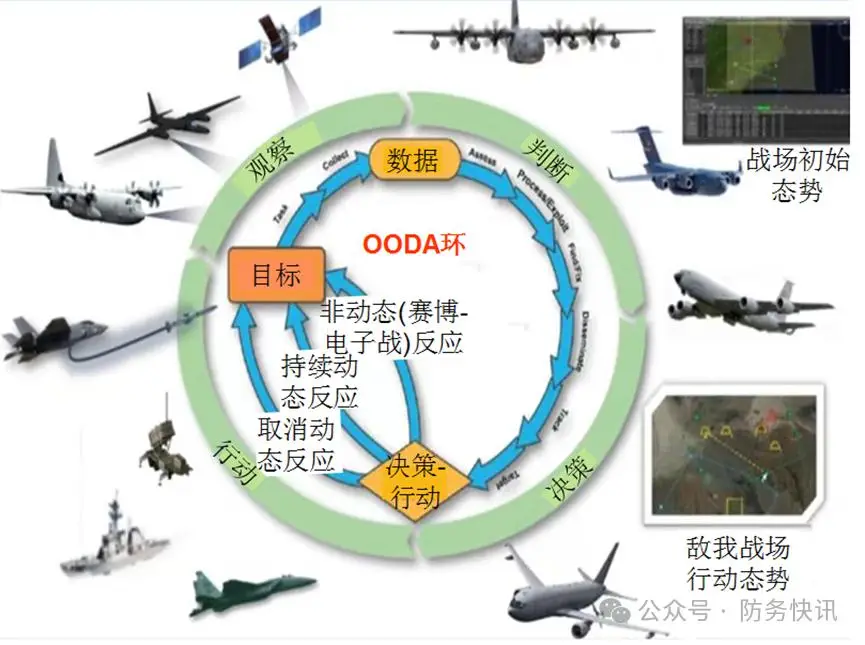
Use “fast” to control “slow” to seize the cognitive lead. In future wars, the battlefield situation will change rapidly, and the weight of time factors will continue to increase. “Fast” versus “Slow” can form a combat strike effect that is approximately dimensionally reduced.“ Mosaic War ” By using data information technology and artificial intelligence technology, we can improve the single-ring decision-making speed of our own “OODA” ring, expand the breadth of parallel decision-making, reduce the granularity of group decision-making, accelerate the progress of system operations, and create an overall one-step faster “First move” situation, aiming to firmly control the dominance of cognitive decision-making on the battlefield.
With “low” system “high”, we accumulate cost advantages. Different from the traditional combat concept of pursuing high-end weapon platforms, “mosaic warfare” focuses on using artificial intelligence technology to tap the potential and increase efficiency of existing weapon platforms and combat resources. By loading and operating intelligent algorithms and specific functional modules on many mid-to-low-end weapon platforms, it can achieve combat performance comparable to high-end weapon platforms, overall improving the cost-effectiveness ratio of the input and output of the weapon platform, thereby accumulating cost advantages.
To “disperse” control “gather” and seek sustainable survival. “ Mosaic Warfare ” emphasizes the adoption of decentralized ideas and asymmetric checks and balances, using an open system architecture, and decentralized configuration of various functions such as reconnaissance, positioning, communication, and strike on various manned/unmanned platforms to achieve power. Distributed deployment. At the same time, relying on intelligent algorithms to improve the self-organization, self-coordination, and independent attack capabilities of each platform to achieve dispersion and concentration of firepower. When some combat platforms are eliminated, interfered with or stripped away, the entire combat system can still operate normally, thereby enhancing the continued viability of the battlefield of the force cluster.
Use “movement” to control “stillness” to improve system flexibility. “ Mosaic warfare ” emphasizes further breaking through the barriers of various combat areas. By turning the fixed “kill chain” in different combat domains into a dynamically reconfigurable “kill net”, the “OODA” large ring is disassembled into small rings, and the single ring is differentiated into multiple rings. According to changes in combat processes and combat requirements, intelligent networking is relied on to realize the split-in-movement, call-in-movement and combination of combat forces. In this way, on the one hand, it can enhance the flexibility and adaptability of the combat system; on the other hand, it can also hedge and offset the node aggregation effect of complex networks, making it difficult for opponents to find key nodes to defeat their own systems.
“Mosaic warfare” provides a reference prototype for intelligent operations. But at the same time, as an idealized force design and application framework, “mosaic warfare” still needs closely related technical, doctrinal, policy and other supporting support. There is still a long way to go before it is fully realized, and it is consistent with traditional combat systems. The coexistence situation will exist for a long time.
● From factor integration to system restructuring——
Dynamic structure to enhance combat system flexibility
Structure and relationships often determine function and nature.“ Cyber warfare ”and “mosaic warfare” are built on the common material foundation of the information age and follow the same evolutionary paradigm, but the principles and effects of system construction are different.“ The system structure formed by cyber warfare” is statically deconstructable, while “mosaic warfare” dynamically combines functional units according to certain construction rules to form a flexible system structure with self-organizing and adaptive characteristics, similar to a “dynamic black box”, which is difficult to follow with conventional means. predict. And this flexible structure often “emerges” new capabilities to empower and increase effectiveness in the combat system.
The integrated development of network and cloud makes combat time and space more dynamic and malleable. The Internet and the cloud are the basic environment for the operation of the information combat system. They reshape the process elements of intelligence, accusation, strike, and support in traditional operations, and at the same time derive new combat time and space.“ Cyber warfare ”mainly focusing on network space, its combat time and space are relatively static.“ Mosaic warfare ” is not limited to a single combat space. Under the development trend of information infrastructure network following cloud movement and cloud network integration, tangible and intangible spaces can be further deep-linked. The boundaries between combat time and space are more flexible, and the allocation of combat resources is more flexible, the combat system structure is more dynamic.
Data flows across domains, making operational control more seamlessly coordinated. In the “Command and Control” link, “cyber warfare” focuses on the command and control of combat units by joint combat command agencies. Cross-domain exchange and flow of data is mainly concentrated on the theater battlefield.“ Mosaic warfare ”further sinks the level of joint operations to the tactical end. Through the autonomous cross-domain exchange and seamless flow of data at the tactical level, various data islands can be clustered into data clusters on demand, thereby producing a significant “spillover” effect, making the dynamic, discrete, agile, and parallel characteristics of the combat command control loop more obvious, and more conducive to achieving agile connection of each combat unit on demand Efficiently act in concert.
Algorithm full-dimensional penetration makes system operation more autonomous and efficient. Algorithms are the mapping of human consciousness in cyberspace, forming two basic forms: compilation codes transformed by intention and neural networks transformed by knowledge. In “cyber warfare”, compiled code is widely used, and neural networks are only used locally. In “Mosaic Warfare”, the algorithm expands the two key functions of shaping rules and providing engines, and the breadth and depth of application are more prominent. Shaping rules is mainly based on compilation code, supplemented by neural networks, to construct the process framework and operating logic of the “mosaic warfare” system, laying a structural foundation for its uncertainty, adaptability and ability “emergence”; the provision engine mainly integrates intelligent algorithms The model is distributed to the edge elements to operate, forming a knowledge diffusion effect, thereby comprehensively improving the intelligent autonomous combat capabilities of the “mosaic warfare” system.
The side end releases energy independently, making the combat style more flexible and polymorphic. The edge is an abstract model of various manned/unmanned combat functional units and a direct source of systemic capabilities “emergence”.“ Cyber warfare ”in a system where edge elements are closely coupled with superior and subordinate accusation processes and are in a state of precise control.“ In the mosaic warfare” system, the perception, interaction, reasoning, and decision-making capabilities of edge-end elements are greatly improved. Its “OODA” ring does not need to be linked back to the superior command structure, which is conducive to supporting the formation of a decentralized combat cluster with high and low matching and manned/unmanned combination. form, which can give edge-end elements more self-organizing authority and significantly enhance the battlefield confrontation advantage.
It can be seen that if “cyber warfare” is called a sophisticated war machine, “mosaic warfare” can be regarded as a complex “ecology” that can stimulate the dynamic growth of combat capabilities. New changes in network clouds, data, algorithms, and edges have contributed to The formation of a dynamically complex “system structure”. This structure in turn reversely regulates elements, platforms and systems, and new capabilities continue to emerge, playing an important role in enhancing and evolving the combat system.
● From “system breaking to compound confrontation——”
To analyse the advantages and disadvantages and seek effective checks and balances
“Mosaic warfare” represents to a certain extent the possible direction of the future development of joint operations. It is necessary to fully analyze and grasp the winning mechanism of “mosaic warfare”, shape the field of information and communication as a new quality and new domain that breaks the traditional boundaries of war time and space, create a new concept of network cloud-enabled combat, build and strengthen the support and support capabilities of national defense information infrastructure, and highlight military information network security defense capabilities, enhance the minimum support capabilities for the operation of strategic campaign command organizations, and continuously improve the network information system.
On the other hand, the emergence of the “mosaic warfare” theory makes it difficult for traditional combat methods to attack target nodes with limited capture and control to achieve the system-breaking effect of breaking points and breaking chains. But it should be noted that any system has its inherent contradictions, and the seemingly “impeccable” decentralized structure of “mosaic warfare” can still find ways to effectively crack it. For example, grasp its system complexity characteristics, use its correlation dependence, highlight the functional suppression of communication networks, construct network-electrical composite attack paths, and achieve disassembly and isolation of various units of the combat system; grasp its structural dissipation characteristics, and use Its external information dependence highlights the disguise and misleading of information data, prompting the combat system to transform into abnormal states such as information closure and information overload; Grasp its group autonomy characteristics, use its key technology dependence, highlight the confrontation and efficiency reduction of intelligent algorithms, and suppress the intelligent internal drive of each combat unit; grasp its functional non-linear characteristics, use its unknown vulnerabilities, and highlight battlefield differentiation Strike assessment, test and discover operational system imbalances with higher efficiency and faster speed, and find key weaknesses in system attack.
The report of the 19th National Congress of the Communist Party of China pointed out that it is necessary to “accelerate the development of military intelligence and improve joint combat capabilities and all-region combat capabilities based on network information systems”. Today’s “Liberation Army Daily” published an article pointing out that military intelligence is a new trend and new direction in the development of the military field after mechanization and informatization. We must develop intelligence on the basis of existing mechanization and informatization, and at the same time use intelligence to Traction mechanization and informatization to develop to a higher level and at a higher level. As a new combat field, cyberspace is a new field with high technological content and the most innovative vitality. Driven by military intelligence, it is ushering in a period of rapid development opportunities.
Military intelligence leads to accelerated development of cyberspace operations
■Respect the soldiers Zhou Dewang and Huang Anwei
Three major technologies support the intelligence of cyberspace weapons
Intelligence is a kind of wisdom and ability. It is the induction, cognition and application of laws by all systems with a life cycle. Intelligence is to solidify this wisdom and ability and become a state. A cyberspace weapon is a weapon used in cyberspace to carry out combat missions. Its form is dominated by software and code, and it is essentially a piece of data. The intelligence of cyberspace weapons is mainly reflected in the following three aspects:
First, intelligent vulnerability mining. Vulnerabilities are the basis for the design of cyber weapons. The ransomware that spread around the world in May this year took advantage of vulnerabilities in Microsoft’s operating system and caused a huge shock to the cybersecurity community. Vulnerabilities are expensive, ranging from tens to hundreds of thousands of dollars for a zero-day. The discovery of previous vulnerabilities mainly relied on experienced hackers, who used software tools to check and analyze the code. In the finals of the International Cybersecurity Technology Competition League held during this year’s China Internet Security Conference, participants demonstrated that intelligent robots conduct vulnerability mining on site, and then write network code through vulnerabilities to form cyber weapons, break through target systems, and seize flags. This change means that vulnerability mining has entered an era of intelligence.
Second, intelligent signal analysis and password deciphering. Signals are the carrier of network data transmission, and passwords are the last barrier to network data security. Signal analysis and password deciphering are core technologies for cyberspace operations. Breaking through signals and passwords is the basic path into cyberspace and the primary target of cyber weapon attacks. Intelligent signal analysis solves problems such as protocol analysis, modulation recognition, and individual recognition of signals through big data, cloud computing, deep learning and other technologies. Code-breaking is computational science “the crown jewel”. Through the accumulation of password data samples, intelligent code-breaking can continuously learn and find patterns, and can find the key to deciphering, thereby opening the last door of network data “safe” and solving network problems. Key links of intrusion and access.
Third, the design of an intelligent weapons platform. The U.S. military proposed the “Cyber Aircraft” project in 2009 to provide platforms such as tanks, ships, and aircraft for cyberspace operations. It can realize automatic reconnaissance, loading of cyber weapons, autonomous coordination, and autonomous attacks in cyberspace. When threatened, Self-destruction and removal of traces have certain intelligent characteristics. The weapons loaded by future “cyber aircraft” are not code compiled by software personnel, but directly based on the reconnaissance results to design intelligent cyber weapons on site in real time and achieve “ordered” development, thus greatly improving cyberspace operations. Targeted.
The intelligent trend of network-controlled weapons has become increasingly prominent
Weapons controlled by cyberspace are referred to as cyber-controlled weapons. They are weapons that connect through the network, accept cyberspace instructions, perform cross-domain tasks, and achieve combat effects in physical space. Most of the various combat weapons platforms in the future will be networked weapons platforms. In this way, the military information network is essentially the Internet of Things. Network entities such as uplink satellites, radars, and drones can detect, track, locate, and strike through the Internet. Space control, the intelligence of network-controlled weapons has flourished in battlefields such as land, sea, air, space and electricity.
In 2015, Syria used the Russian Robot Corps to defeat militants. The operation used 6 tracked robots, 4 wheeled robots, 1 automated artillery group, several drones and 1 command system. The commander dispatches drone reconnaissance through the chain of command to spot the militants, and the robots charge the militants, while accompanied by artillery and drone attack force support, delivering a fatal blow to the militants. It was only a small-scale battle, but it set the precedent for robot “group” operations.
Network-controlled intelligent weapons for sea and air battlefields are being developed and verified in large quantities. In 2014, the U.S. Navy used 13 unmanned surface boats to demonstrate and verify that unmanned boat groups intercepted enemy ships and achieved good results mainly by exchanging sensor data. When it was tested again in 2016, functions such as collaborative task allocation and tactical coordination were added, and “swarm awareness” became a distinctive feature of its intelligence.
Swarms of small and micro UAVs for aerial combat are also growing rapidly. In recent years, the U.S. Department of Defense has repeatedly tested the “Quail” micro-drone, which can drop dozens or even hundreds at a time. By improving its coordination capabilities when performing reconnaissance missions, it has made great progress in drone formation, command, control, and intelligence. Progress has been made in management and other aspects.
Space-based cyber-controlled weapons are becoming more and more “smart”. The air and space field mainly contains two types of network-controlled weapons: reconnaissance and strike. Satellites with various functions mainly perform reconnaissance missions and are typical reconnaissance sensors. With the emergence of various small and microsatellite groups, satellites have been made to exhibit new characteristics: small size, fast launch, large number, and greater intelligence. Small and microsatellite groups have greater flexibility and reliability when performing reconnaissance and communication missions, and currently the world’s satellite powers are actively developing plans for small and microsatellite groups with wider coverage.
Hypersonic strike weapons of all kinds cruised in the air and space, as if sharp swords were hanging over people’s heads. The U.S. Air Force Research Office stated that “high-speed strike weapons” will launch flight tests around 2018, and other countries are also actively developing similar weapons. The biggest features of this type of weapon are their high speed, long range, and high intelligence.
Intelligent command information system changes traditional combat command methods
Cyberspace weapons and weapons controlled by cyberspace are the “fist” of intelligent warfare, and the command information system that directs the use of these weapons is the “brain” of intelligent warfare. Cyberspace combat command information systems must keep up with intelligence simultaneously. process. At present, almost all command information systems in the world are facing the difficult problem of “intelligent lag”. In future wars, rapid decision-making and autonomous decision-making are required, which places higher requirements on intelligent auxiliary systems.
In 2007, the U.S. Department of Defense’s Advanced Research Projects Agency launched a research and development program on command and control systems ——“Project Dark Green” in order to enable computer-aided commanders to make rapid decisions and win opportunities. This is a campaign tactical-level command information system. Its research and development purpose is to embed the system into the U.S. Army brigade-level C4ISR wartime command information system to achieve intelligent command of commanders. To this day, the U.S. military has not relaxed its development of intelligent command information systems.
In cyberspace operations, the network target appears as an IP address connected to the network. The large number makes it difficult for manual operations to operate efficiently, and operations require the auxiliary support of intelligent command information systems. Currently, intelligent command information systems need to realize functions such as intelligent intelligence analysis, intelligent perception, intelligent navigation and positioning, intelligent assisted decision-making, intelligent collaboration, intelligent evaluation, and intelligent unmanned combat, especially to realize cluster combat control of unmanned network control systems, which has put forward urgent needs for intelligent command information systems and requires accelerating the research and development and application of corresponding key technologies.
To sum up, intelligent cyber weapons and cyber-controlled weapons, through intelligent information system scheduling, will form huge combat capabilities and can basically carry out all actions in the current combat style. In future wars, from the formation of command forces, to target selection, mode of action, use of tactics, etc., will all be carried out in an intelligent context. The characteristics of war “gamification” will be more significant, and the combat command method will also undergo major changes.
In the future battlefield, fighting courage requires more fighting “wisdom”
■Yang Jian and Zhao Lu
At present, the development of artificial intelligence has entered a new stage, and its penetration into various fields has begun to accelerate. As a result of this process, military competition among nations around intelligence has begun. Our army has always been a heroic and tenacious people’s army that dares to fight and win. In the future, we should continue to carry forward the glorious tradition on the battlefield. At the same time, we must more extensively master and utilize the latest scientific and technological achievements, develop more intelligent weapons and equipment, and develop more intelligent weapons and equipment. Take advantage of the opportunity to win on the battlefield.
Intelligence is a trend in the development of human society, and the war on intelligence is accelerating. It is thanks to successful innovations that go beyond the original architectural computing models, the gradual popularization of nanofabrication technologies, and breakthrough advances in the study of human brain mechanisms that the development of military intelligence has acquired a solid foundation. As a result, intelligent weapons and equipment have become increasingly prominent and are beginning to surpass and replace humans in intelligence analysis, combat response, and more. In addition, in terms of manpower requirements, comprehensive support and operating costs, intelligent weapons and equipment also have obvious advantages and are increasingly becoming the dominant force in warfare.
It has been proven that the development and application of intelligent weapons and equipment has expanded the scope of capabilities for military operations and greatly improved the combat effectiveness of the troops. On the battlefields of Afghanistan and Iraq, UAVs have taken on most of the operational support tasks of reconnaissance, intelligence, surveillance, and about one-third of the air strike tasks. In the past two years, Russia has also repeatedly used unmanned reconnaissance aircraft, combat robots and other equipment with a high degree of intelligence on the Syrian battlefield. Intelligent weapons and equipment are increasingly demonstrating important values that go beyond traditional weapons.
In future wars, the competition for intelligent combat systems will be the key to victory in master battles and peak duels. With the increasing imbalance in the development of military means supported by science and technology, whoever has the ability to implement intelligent operations first will be better able to take the initiative on the battlefield. The strong with the advantage of technological generation will try their best to The cost of war is minimized, while the weak will inevitably suffer huge losses and pay heavy prices. We must not only step up core technological innovation and weapons and equipment development, but also study and explore organizational structures, command methods and application models that adapt to the intelligent development of the military. We must also cultivate a team that can take on the responsibility of promoting the intelligent development of the military and forging intelligent combat capabilities. Talent team, give full play to the overall effectiveness of our military’s combat system, and compete with our opponents Win wars in a more “intelligent” way.
Cognition is the basis for operational decisions and operations. Cognitive warfare is a confrontation activity carried out in the cognitive domain. The purpose is to attack the enemy’s knowledge system, social consciousness, people’s morale, etc., disrupt its judgment and decision-making, and cause it to lose its decision-making advantage and action advantage. To deepen the research on cognitive warfare and decipher the cognitive warfare code, the key is to embed the combat decision-making chain and explore how to influence and interfere with the cognitive activities of the enemy’s decision-making chain, causing the enemy to form false observations, wrong judgments and poor decisions, so as to fully control Cognitive initiative.
Seeing is false, changing the facts
Observation is the starting point of cognition. No matter what kind of war, when facing any opponent, the first step is observation. The observation here is a broad concept and is about all activities to obtain all relevant information about the hostile party. Just as people perceive external things through sensory organs, observation relies on the battlefield perception system to obtain relevant data and information from the battlefield environment according to the needs of the subject, providing “ source material ” for judgment and decision-making. Observation uses intelligence, reconnaissance, surveillance and other activities to obtain as much factual information and materials from all aspects of the enemy as possible and convert them into text, images, audio, video and sensor signals.
The history of war at home and abroad in ancient and modern times shows that the essence of command is the endless pursuit of certainty, including the status and intentions of enemy troops, various factors affecting the combat environment such as weather and terrain, as well as the status and actions of one’s own troops. Therefore, efficient command consists in clarifying each element and then coordinating it as a whole to achieve the best combat effect. Human judgment and decision-making are easily disturbed by information uncertainty. In the observation stage, the key to cognitive warfare is to make the enemy unable to clearly observe, incompletely observe, and distort the information of their own combat elements, and lack real information or accurate understanding, thereby weakening the enemy’s decision-making on combat at the source. The pursuit of certainty.
Measures for observing cognitive warfare, in addition to common information warfare methods, such as disguise, interference, deception, silence, etc., should also pay attention to the following aspects: First, create complex situations. War is inherently full of complexity. By creating complexity, it increases the fog and resistance on the battlefield, making it impossible for the enemy to observe the real specific situation. For example, by creating various events and operations in multi-dimensional combat areas such as land, sea, air, sky, and network, and making irregular changes, it can effectively increase the difficulty of enemy observation. The second is to interfere with observation and cognition. Observation is not aimless. It is carried out based on a certain cognition. Cognition determines what information needs to be observed, what kind of reconnaissance activities need to be carried out, etc. For example, during observation activities, by interfering with operations, the enemy’s attention in observation activities is affected, causing it to lose the ability to focus on essential issues and key issues, thereby making it unable to obtain key information. The third is to shape the factual narrative. Shaping factual narratives is to reformulate, combine, arrange, and reconstruct facts according to the needs of cognitive warfare. These facts are either created out of nothing, highlight certain details in the facts, or are difficult to verify and test, making their observation materials Mixed with fictional facts, the observed facts are far from objective facts. The fourth is to protect specific knowledge. Knowledge protection is an important aspect of cognitive warfare. The main contents include: commander’s decision-making style, combat theory reasoning process, premises and assumptions, key tactical ideas and combat principles, key decision-making procedures, mechanisms and methods, information analysis methods, especially some algorithms, passwords, etc.
Targeting the judgment, misleading the judgment
On the battlefield, simple observation and data collection do not make much sense. Only by analyzing these data “ by looking at the essence of the phenomenon, and then drawing various judgments, will we promote the formation of operational decisions. For example, during the Battle of Moscow in World War II, the Soviet Union had a lot of and messy information about the Japanese Kwantung Army. Finally, after careful analysis, it was concluded that “ the Soviet Union could be considered safe in the Far East, and the threat from Japan had been ruled out ” After the judgment, it was decided to transfer troops from the Far East to Moscow to participate in the Battle of Moscow. Judgment is the corresponding conclusion reached by analyzing and reasoning the observation results, which mainly includes: first, factual judgment, usually expressed in descriptive language, such as the current situation, enemy battlefield deployment, battlefield posture, etc.; second, value and relationship judgment, usually Expressed in evaluative language, such as threat assessment, correlation analysis, trend prediction, etc.
Judgment cognitive warfare is actually a game surrounding judgment. Normally, judgments arise on the basis of a judgment, without which there would be no conclusion of judgment. Whether a person has high blood pressure or diabetes is often based on some medical indicators, and these indicators are the criteria. The premises and assumptions of reasoning are actually based on judgments. “ Persian cat story ” circulated in World War I. Judging from the location of the command post from a Persian cat, it contains a series of judgments: there is no village around, and it cannot be a cat raised by ordinary civilians; the sound of artillery on the battlefield is rumbling, and it cannot be It is a wild cat that is cautious and avoids people; Persian cats are a valuable breed, and the position of cat owners is not low; cats appear at fixed times every day, and the command post should be near cats. Therefore, interfering with judgment is to target the judgment to design and produce information products so that the facts obtained do not match the judgment, or to minimize the leakage of information related to the judgment, so that the enemy cannot judge or make wrong judgments.
The main contents of the interference criterion are: First, the interference is based on experience. Based on enemy experience, create “ virtual facts ” to make errors in judgment. For example, in the Battle of Maling, Sun Bin halved the stove to lure Pang Juan, which is a typical example. Because according to experience, the number of stoves is directly proportional to the number of troops. Halving the number of stoves every day means that the number of people is decreasing. The possibility of reduction is that the soldiers have suffered greater casualties, which leads to the judgment of weakening combat power. The second is to interfere with the judgment based on the knowledge system. Such knowledge includes the enemy’s common sense, concepts, principles and some assumptions. For example, in the Fourth Middle East War that broke out in October 1973, Israel’s initial defeat was a misjudgment of the war situation. It believed that as long as its air force was still in an advantageous position, the other side would never dare to attack. However, Egypt began to adopt new military technology and used mobile surface-to-air missiles to support an air defense network, partially offsetting Israel’s air superiority. The third is to interfere with judgments based on universal culture. That is, design corresponding information and actions based on the enemy’s cultural characteristics so that they can be misjudged due to cultural differences. According to foreign information, during the Cold War, the United States studied the root causes of “ Soviet behavior, so it started from culture and behavior to induce the Soviet Union to make strategic misjudgments. The fourth is to interfere with methodological-based judgments. Generalizations, analogies, etc. are the basic methods of judgment. Cognitive interference based on methodology makes it difficult for the other party to understand facts and cannot be compared with known facts; complicating the causal relationship and confusing factual cause and effect, psychological cause and effect, conditional cause and effect, social cause and effect, etc., making it impossible to implement causal judgment; reducing possible signs and phenomena, making it impossible to see through the essence and make accurate judgments.
Focus on the process and influence decision-making
Operational decision-making is based on combat purposes and intentions. After observation and judgment, various factors are combined to derive the optimal solution to the problem. War or conflict behavior has game, competition and confrontation attributes, so decision-making is a game. Decisions address key issues such as whether to do it, how to do it, what purpose to achieve, or the state of termination. In information-based local wars, action-centeredness gradually replaces planning-centeredness, requiring an increase from data center warfare, information center warfare, and knowledge center warfare to decision-making center warfare. Combat decision-making has become one of the main areas of competition between the enemy and ourselves.
Decision-making cognitive warfare is to target enemy cognition and interfere with the decision-making process to affect the quality and efficiency of decision-making. Decision-making is affected by the knowledge structure of the decision-maker himself. If cognition is paranoid or the knowledge reserve is outdated, even if the judgment is correct, good decisions will still not be made. The decision-making process includes the application and change process of knowledge structure, which mainly involves procedural knowledge and conceptual principled knowledge. The former includes decision-making procedures and methods, decision-making mechanisms and evaluation methods, etc., while the latter includes understanding of battlefield posture, winning mechanism, combat concepts, combat rules, and weapons and equipment performance. Therefore, cognitive attacks on the decision-making process will greatly affect its decision-making speed and quality.
The main ways to influence cognitive warfare in decision-making are: First, squeezing the cognitive decision-making space. When watching tennis matches, commentary on non-forced errors and forced mistakes are often heard, with forced mistakes being those caused by putting pressure on the opponent. Interfering with the cognitive decision-making environment is to put pressure on the enemy’s cognitive decisions, thereby squeezing the cognitive space and weakening cognition to force the enemy to make mistakes in decision-making. For example, through virtual and real decision-making activities and actions, the opponent is trapped in decision-making difficulties, which increases the probability of low-level decision-making. The second is to attack rational cognition. Including: First, interfering with the understanding of threats and opportunities. Many examples of failures in military history are caused by misjudgment of threats and opportunities on the battlefield. Whether you despise the enemy or overestimate the enemy, you will form decision-making expectations that are different from objective reality, leading to adverse action results. Second, attack combat theory and doctrine. For example, by proposing the theory of mutual restraint, deliberately exaggerating the loopholes in the enemy’s doctrine, and amplifying the adverse effects of the enemy’s combat operations, the enemy can arouse doubts about its own theory and doctrine. Third, for procedural knowledge. Including decision-making mechanisms, procedures and methods, plan evaluation and combat evaluation methods, auxiliary decision-making systems, algorithms, thinking, etc. Attacking the weaknesses present will also cause decision-making errors. The third is to interfere with irrational factors. The use of irrational factors often creates decision-making traps, such as groupthink traps, conceit traps, etc., which have a significant impact on decision-making. The strategic deception successfully implemented by the Allied forces many times during World War II was to use the enemy’s ambiguous and misleading analysis to increase the probability that the wrong decision would win.
System “Gathering Excellent War” It is “systematic warfare in information warfare. It does not necessarily refer to a certain combat style, but is composed of multiple combat styles and tactics” “combination boxing”, or combat style group . Emphasizes that, depending on the combat mission, combat opponent and the changing battlefield situation, any appropriate means and style of combat can be used flexibly to form combat advantages as long as it is conducive to forming comparative advantages and achieving system victory. In the specific implementation process of “system-based superior warfare”, these specific combat styles and operational tactics can not only be organized and implemented separately as part of joint all-domain operations, but also emphasize fighting “combination boxing”, using multiple strategies simultaneously, and winning as a whole.
In order to better understand its core connotation, this article lists Nine typical combat styles including overall deterrence warfare, electromagnetic disturbance warfare, network penetration warfare, and cognitive control disturbance warfare And analyze . System “Juyouzhan” ――combination boxing that flexibly uses multiple combat styles“ 1. Overall deterrence war: Emphasis on multi-domain joint deterrence; Three elements should be present in the implementation of an overall deterrent war ; Strong overall strength is central to achieving effective deterrence 2. Electromagnetic Disturbance Warfare : The key to competing for information advantage; On the combined means approach, information empowerment is achieved through “connection + sharing” ; Crack down on effective tactics for unmanned cluster operations 3. Cyber-sabotage: Soft “kill” is the main focus, combining soft and hard, focusing on breaking the net and reducing energy failure 4. Cognitive scrambling: Control the cognitive power of situational awareness and compete for information advantage; control the decision-making power of command and compete for decision-making advantage; control “brain” power and seize the advantage of brain control 5. Agile mobile warfare: High-efficiency and rapid decision-making; high-efficiency formation of a favorable combat situation; high-efficiency and instant gathering of combat forces; agile mobile warfare is an innovative development of traditional mobile warfare 6. Swarm autonomous warfare: It is conducive to forming a system advantage to suppress the enemy; it is conducive to enhancing the combat effect; it is conducive to falling into the enemy’s combat dilemma 7. Point-and-kill War: Achieving an efficient cost ratio for operations; targeting key nodes is an important option; large-scale system support is a basic condition; it is inseparable from precise intelligence support 8. Supply-breaking: The supply guarantee chain has a huge impact on the overall combat situation; the center of gravity of the attack is a key node in cutting off the enemy’s supply guarantee chain; the focus is on choosing the right time and making full use of tactics 9. System “paralysis battle:” The objectives of the operation are to make the enemy combat system run out of order; to strike the key nodes of the combat system with heavy blows; and to carry out soft strikes against the enemy combat system For learning reference only, welcome to communicate and correct! Article views do not represent the position of this body The concept of combat was first proposed as a new combat style. Innovative combat styles are a core element in the development of combat concepts. It can be said that system-gathering battle is a general term for a series of specific tactics. The following nine typical combat styles constitute the tactical system of system-gathering and superior warfare. They are: One is Overall deterrence warfare, actively organize static power display and deterrence actions in system excellence battles, and strive to defeat others without fighting or small battles; Two is Electromagnetic disturbance warfare uses various combat methods and action styles such as electronic detection, attack and defense to disrupt, prevent and destroy the enemy’s electromagnetic capabilities, actively compete for the advantages of the electromagnetic spectrum, seize the right to control information, and then win the initiative in combat; Three is In cyber attack warfare, various means such as soft strikes and hard destruction are used to defeat the enemy’s command network, intelligence network, communication network, logistics supply network, and disrupt the enemy’s command and support; Four is Cognitively Controlled Disturbance. Form a controlling advantage in the cognitive space through information attacks, public opinion attacks, and brain attacks; Five is Agile mobile warfare. Quickly adjust the deployment of troops and weapons, quickly gather capabilities on the battlefield, and seize combat opportunities; Six is Swarm autonomous warfare. Extensively use unmanned combat methods such as “bee swarms”, “wolf swarms”, and “fish swarms” to independently organize actions and distributed attacks to achieve joint human-machine victory; Seven is Pointkill. Accurately obtain intelligence, carry out multi-domain precision strikes, strive to shake the overall situation with one point, and maximize combat benefits; Eight is Supply-breaking. Organize an elite force to attack enemy logistics supplies and equipment supply supply chains, supply lines and supply bases, defeat the enemy and lose supplies and withdraw from the battle; Nine is System “paralysis battle”. A variety of means, such as breaking the net, exercising, and hitting nodes, are used to interfere with, delay, destroy, or even paralyze the effective operation of the enemy’s combat system and weaken its functions.
1. Overall deterrence Overall deterrence warfare refers to actively organizing static power display and deterrence actions in the system’s battle for excellence, and striving to defeat others without fighting or small battles. Sun Tzu said: “Subduing one’s troops without fighting is a good thing.” Deterrence and war are the two main forms of military activity. And “deterrence” is mainly the act of showing determination and will to potential opponents by showing strength or threatening to use strong strength to deter opponents from action. It can be said that the overall deterrence war in the system-based battle of excellence is an important means or tactic to achieve the goal of “stopping” human troops without fighting. Clausewitz emphasized that the first rule of strategy is to be as strong as possible, first in general, and then in key locations. Modern warfare is system-to-system confrontation. The overall deterrence war under informationized local warfare requires not only traditional deterrence methods and capabilities on land, sea, air and space, but also new deterrence methods and capabilities such as space deterrence, electromagnetic deterrence, and network deterrence. It also requires an overall deterrence that shows the overall strength of the country. Especially with the rapid development of advanced technologies such as information technology, the technological revolution, industrial revolution, and military revolution have accelerated their integration, and strategic competitiveness, social productivity, and military combat effectiveness have become more closely coupled. Winning the information war is to a greater extent a contest between the will of the country and the overall strength of the country. To contain the war, we must first act as a deterrent to our opponents in terms of overall strength.
1.1 Emphasis on multi-domain joint deterrence Means of deterrence typically include both nuclear and conventional deterrence. In the “system-based battle for excellence”, the overall deterrence war is implemented, aiming to comprehensively use conventional deterrence methods across the land, sea, air and space power grids to achieve the purpose of deterrence. Especially with the application of information network technology and space and directed energy technology in the military, space, networks, electromagnetic weapons, etc. have become new means of deterrence. Space deterrence, It mainly uses equipment such as rapid response electromagnetic orbit weapons, space-to-ground networked anti-navigation and positioning service systems, large elliptical orbit laser weapons, and high-power microwave weapons to threaten and attack the opponent’s space targets and form a deterrent against enemy space information “interference blocking”. Cyber deterrence mainly uses cyberspace situational awareness and attack equipment to threaten and attack the opponent’s military network and other critical information infrastructure to achieve deterrence against the enemy. Electromagnetic deterrence mainly uses electromagnetic spectrum combat systems to threaten and attack enemy detection, navigation, communications and other information weapons and equipment systems to achieve deafening and blinding deterrence against the enemy.
1.2 The implementation of overall deterrence should have three major elements Implementing an overall deterrent war and achieving the desired effect of deterrence usually requires three main elements: One is strength. The deterrent must have the reliable ability or strength to frighten and fear the opponent; the second is determination and will. The deterrent party must dare to use this capability when necessary; third, to transmit information clearly. The deterring party must make the ability to act and the determination clearly known to the other party accurately and effectively.
Historically, the criteria for judging deterrent strength have varied in three main ways: First, the active military force; second, the combined national strength or war potential; and third, the total number of main battle weapons and equipment. For quite a long period of history, the number of troops was deterrence, and the strength of military strength depended directly on the size of the active military, the amount of vital weapons and equipment, and non-material factors such as the morale of the army’s training organization. After the twentieth century, with the expansion of the scale of warfare, deterrence power has become less limited to the strength of the military and the quantity of vital weapons and equipment, but is determined by the nation’s war potential, which includes economic power, scientific and technological power, energy resources, and even population size, among others. The overall deterrence war in the system’s “gathering and excellence war”, the formation of its deterrence strength is mainly based on the network information system, as well as the joint global deterrence capability formed under the integration of the system.
1.3 Strong overall strength is the core of achieving effective deterrence The development of information technology and its widespread penetration and application in the military sector provide favourable conditions for building overall strength and achieving overall deterrence. System “Juyouzhan” is supported by the network information system, making full use of the permeability and connectivity of information technology, not only integrating various combat forces, combat elements, and combat units into an organic whole, realizing the military system combat advantages, but also integrating Various fields related to war and national mobilization, such as national politics, economy, diplomacy, finance, transportation, and energy, are connected and integrated into the national war mobilization system Gather all forces and resources to form an overall synergy, realize the emergence effect of system capabilities, show the overall strength advantage, and form a powerful invisible deterrent of united efforts and sharing the same hatred Create a situation that makes the enemy “powerful but unable to act ”“able to act but ineffective”, and play a role in containing and winning the war. In the “overall deterrence war”, the scope of national war mobilization will be wider, not limited to a certain direction or region, but throughout the country and even the relevant regions of the world; mobilization time will be faster, and using networks and information systems, mobilization and action information can be quickly transmitted to everyone and every node at the first time; action coordination and synergy will be more consistent, and all forces distributed in various regions can be based on the same situation Under the same order, the operation is unified at almost the same time, which greatly improves the efficiency of operational synergy; resources are more fully utilized, and various war resources based on the Internet can quickly realize the conversion between peacetime and wartime, military-civilian conversion, and achieve integrated front and rear guarantees and precise guarantees.
2. Electromagnetic Disturbance Warfare Electromagnetic disturbance warfare refers to the flexible use of electronic detection, attack and defense and other combat methods and action styles to disrupt, prevent and destroy the enemy’s electromagnetic capabilities, actively compete for the advantages of the electromagnetic spectrum, seize information control rights, and then win operational initiative.
2.1 The key to competing for information advantage Informatization local warfare is highly dependent on the electromagnetic spectrum, the Control and counter-control of electromagnetic space have become the focus of competition for information rights. Organize and carry out electromagnetic obstruction warfare, mainly to destroy the enemy’s electromagnetic spectrum and protect one’s own side from destruction. The electromagnetic spectrum is the main carrier for transmitting information. The use of electromagnetic means to disrupt the enemy’s electromagnetic spectrum will effectively reduce the enemy’s information combat capabilities and enable our own side to ensure the rapid and effective flow of information in the scenario of ownership of information rights, driving command flow, action flow, and material flow through information flow, energy flow, and then have the dominance and initiative in combat.
2.2 The basic focus is to implement electromagnetic disturbance warfare in the battle to deactivate the enemy’s combat system. It is mainly aimed at the enemy’s dependence on electromagnetic space. At the same time, in order to ensure its own effective use of electromagnetic space, it organizes various electronic reconnaissance and interference, attack, defense and support forces to attack enemy communication networks, radar networks, computer networks and command centers, communication hubs, radar stations, etc Computer network nodes, global navigation and positioning systems, space link systems such as the “Heaven and Earth Integrated Internet”, and various other frequency-using weapons and equipment carry out interference and attacks, block and destroy their communication and data transmission, and destroy the enemy’s combat system. “Connection” and “sharing” structural center of gravity provide support for seizing information control and electromagnetic control from the root, thereby weakening the enemy’s command and control capabilities Deactivating and disabling the enemy’s entire combat system.
2.3 Crack effective tactics for unmanned cluster operations “Unmanned autonomous group operations such as swarms ”“wolves ”“fishes” are important features of information-based local warfare with intelligent characteristics. The various unmanned autonomous clusters are large in number, diverse in type, and complex in characteristics, and each individual can complement each other and play a role in replacing each other. It will be very difficult to intercept and damage the entire unmanned cluster. However, from a technical point of view, for unmanned combat clusters to achieve effective synergy, each individual must share and interact with each other. Once the communication coordination between unmanned clusters is interfered with, it will be impossible to share battlefield posture and information, and will not be able to coordinate actions with each other, making it difficult to achieve the combat effectiveness it deserves. This gives the other party an opportunity to implement interception of communications and electromagnetic interference. Therefore, the implementation of electromagnetic spectrum warfare, interference and attacks on the information and communication networks of unmanned clusters, and the destruction of their information sharing and interaction will make it impossible for each individual in the unmanned cluster to achieve effective synergy and thus lose its operational capabilities.
3. Cyber-sabotage Cyber-blowout, It refers to military confrontation operations that comprehensively use technologies such as networks and computers and other effective means to control information and information networks. It is a major combat style of cyberspace operations and competition for network control. Its main combat operations are both soft-kill and hard-destroy, focusing on soft and combining soft and hard. Among them, soft kill is mainly a cyber attack, that is, it comprehensively uses blocking attacks, virus attacks and other means to block and attack enemy information networks, command systems, weapon platforms, etc., making it difficult for enemy networks, command information systems, etc. to operate effectively or even paralyze; hard destruction mainly uses precision fire strikes, high-energy microwaves, electromagnetic pulses, and anti-radiation attacks to paralyze and destroy enemy information network physical facilities Destroy enemy combat and weapons and equipment entities. The important thing is to “break the net and reduce energy failure”. Organizing a cyber attack in a “system-based battle of excellence” is to target the weaknesses of the combat opponent’s military information network, use the advantages of the system to organize various cyber attack forces, and conduct combat command networks, reconnaissance intelligence networks, communication networks and even logistics throughout the entire operation. Supply networks, etc., continue to carry out soft killing and hard destruction operations to destroy the enemy’s network system The overall function of the enemy’s combat system is reduced or even disabled. It mainly targets core targets such as the enemy’s basic information network, intelligence network, command network, and support network, and implements a series of combat operations such as network-to-electronics coordinated attacks, deception and confusion, link blocking, and takeover control, so that the enemy’s intelligent combat network system becomes incapacitated and ineffective, achieving a critical victory that paralyzes the enemy system.
4. Cognitively Controlled Disturbance Warfare Cognitive interference control war refers to interfering with, destroying or controlling the enemy’s thinking and cognition through information attacks, public opinion attacks, and brain attacks in the system optimization war, so that the enemy cannot make correct judgments and decisions, thereby controlling the enemy in cognitive space. form a controlling advantage. Cognitive domains, That is, “human thinking space and consciousness space are areas that have a critical impact on combat decision-making and judgment”. The development of information technology, especially artificial intelligence technology, and its widespread application in the military field have expanded the battle of war from physical space and information space to cognitive space, making cognitive space a completely new combat domain. With the development of information and intelligent technology and its widespread and in-depth application in the military field, the Human-machine intelligence tends to converge This has made the status of cognition in intelligent warfare more prominent, and the cognitive field has gradually become an important battlefield. The right to control cognition has become a key element of future battlefield control. Fighting for cognitive control has become an important combat style for winning information-based local warfare operations with intelligent characteristics.
4.1 Control the cognitive rights of situational awareness and compete for information advantages In the system’s “excellence battle”, information flow drives the flow of matter and energy, and information advantage determines decision-making advantage. Rapid and accurate knowledge of intelligence information and battlefield situations has an important impact on seizing command and decision-making advantages. Therefore, when organizing and implementing system-based battle gathering, we must make full use of intelligent technology and big data technology to conduct comprehensive analysis and judgment on massive intelligence information data, mine and extract the required intelligence information, and achieve more accurate and faster understanding of battlefield situations and combat environments. Cognition ensures that the enemy is discovered first and the enemy is recognized first from the source. While removing one’s own side “the fog of war”, create “the fog” for the opponent. Therefore, in order to compete for cognitive rights, we must not only control and process information before the enemy, but also take measures such as online public opinion attacks and high virtual reality chaos to actively create and spread false information, disrupt and disrupt the perception and cognition of hostile battlefield situations, maximize confusion and increase uncertainty, interfere with the opponent’s combat decisions, and delay its combat operations.
4.2 Control and command decision-making power and compete for decision-making advantages Decision strengths determine action strengths. Quick decision-making by the commander is the key to shortening “the command cycle” and achieving quick wins. The organizational system focuses on excellent combat, and the success or failure of combat operations depends largely on the speed of the commander’s decision-making. It is necessary to “use intelligent auxiliary decision-making systems, select the best combat plans, scientifically and rationally allocate combat resources, and maximize combat effectiveness; use ubiquitous intelligent networks to access required combat nodes and combat platforms at any time to build and form an integrated combat system.” Achieve decentralized deployment of power, information, and capabilities, cross-domain linkage, form advantages at locations and times required for operations, gather energy to release energy, and gather advantages to win; Implementation “core attack”, Errors or deviations in the enemy’s command decisions are caused by hacking into the other party “chip”, tampering with its programs, and command and decision system algorithms.
4.3 Control “brain” power and seize the advantage of brain control Cognitive interference control warfare in the system’s “gathering excellence war” emphasizes “attacking the heart and seizing the will”, that is, using network warfare, electromagnetic warfare and other methods to control the enemy’s human brain and consciousness cognition as well as the control system of the unmanned autonomous platform “attacking the heart Cognitive control warfare to control the brain and seize ambitions” Replace “destroy” with “control”, To achieve the goal of stopping and winning the war at the minimum cost. Attacking the heart and controlling the brain is different from traditional strategic deterrence. It places more emphasis on active attack. It is an active attack operation that mainly uses advanced information combat technology, brain control technology, etc. to attack the enemy’s decision-making leader, as well as intelligent unmanned autonomous combat platforms, auxiliary decision-making systems, etc., carry out controlled “brain” attacks, directly control and disrupt the opponent “brain”, influence and control the enemy’s decision-making, or disable it Enable stealth control of enemy combat operations. For example, “Targeting human cognitive thinking, using brain reading and brain control technology, and using mental guidance and control methods to directly carry out “inject ”“invasive” attacks on the brains of enemy personnel, interfering with, controlling or destroying the cognitive system of enemy commanders.”, deeply control it from the perspective of consciousness, thinking and psychology, seize “control intellectual power”, disrupt the enemy’s decision-making, destroy the enemy’s morale, and force the enemy to disarm.
5. Agile Mobile Warfare Agile mobile warfare refers to the efficient decision-making, efficient adjustment of troop deployment and high-efficiency real-time gathering of combat forces in systematic battle, efficient gathering of capabilities on the existing battlefield, and seizing combat opportunities. Agility is the ability to respond quickly and timely to changes in the battlefield environment. It has the characteristics of responsiveness, robustness, flexibility, elasticity, innovation and adaptability.
Table 1 Connotation of the concept of agile warfare
5.1 Efficient and fast decision-making To implement agile and mobile warfare, we must first make efficient and rapid decisions to win operational opportunities. Therefore, it is necessary to comprehensively use various means of reconnaissance, detection, perception and surveillance to obtain battlefield posture and target information in a timely manner, especially characteristic information, activity trajectories and real-time position information of time-sensitive targets, so as to ensure precise intelligence support for rapid decision-making. Efficient decision-making is also reflected in the speed of intelligence processing. It takes less time to screen effective intelligence information, formulate action plans at a faster speed according to changes in circumstances, and seize the initiative and seize the opportunity with one step ahead. High-efficiency decision-making focuses on shortening the decision-making cycle, taking the target time window as the central point, and integrating decision-making command with combat units and weapon platforms, rapid response, and overall linkage to improve combat efficiency.
5.2 High efficiency forms a favorable combat situation It is necessary to “keep abreast of changes in the battlefield situation at any time, rely on the support of information networks, and achieve dynamic reorganization of combat forces and integration during movement through cross-domain, cross-dimensional, and diversified three-dimensional maneuvers. Combat resources flow efficiently throughout the region and gather during movement to achieve mobility and excellence.”, forming a favorable battlefield situation. Agile mobile warfare relies on data fusion processing, intelligent assisted decision-making and other means to quickly form combat plans, quickly project combat forces at a high frequency according to the case, organize troops to quickly form favorable combat deployments, and realize enemy discovery, enemy decision-making, and enemy fire, first enemy assessment, change the balance of power in the shortest time and fastest speed, form combat advantages, and improve the efficiency of combat operations.
5.3 Efficient and instant gathering of combat power To organize agile mobile warfare, the key is to select the right combat force within a limited time, coordinate the entire battle situation, and form an overall synergy to ensure a fatal blow. Therefore, in response to changes in battlefield posture, especially target situations, it is necessary to draw up groups to form a joint mobile combat system formed by multi-domain combat forces, gather combat forces in real time, deploy quickly and mobilely to a favorable battlefield, and carry out real-time strikes against the enemy. For deep space, deep sea, etc. to become a new combat space, an intelligent unmanned autonomous combat platform can be organized Rapid mobility is deployed to lurk near key targets or important passages that are difficult for humans to reach due to physiological limitations, and ambush operations are carried out on standby, creating new cross-domain checks and balances.
5.4 Agile mobile warfare is an innovative development of traditional mobile warfare In the history of both ancient and modern warfare at home and abroad, there have been numerous examples of successful battles that relied on rapid covert maneuvers to achieve combat objectives. However, the combat process of information-based local warfare has been greatly compressed, the combat rhythm has accelerated rapidly, and fighter aircraft are fleeting. It has put forward higher requirements for fast mobile capture fighters. It is difficult to meet the requirements of joint operations and all-area operations under information conditions alone “fast pace, high speed”. requirements, so agile mobility must be implemented.
6. Unmanned cluster autonomous warfare Unmanned cluster autonomous warfare refers to the widespread use of unmanned combat methods such as “bees”“ wolves ”“fishes” in system optimization warfare to independently organize actions and distributed attacks to achieve joint human-machine victory. With unmanned autonomous equipment becoming the main combat force on the battlefield, defeating the enemy with unmanned autonomous equipment clusters and numerical superiority has become an important combat style in information warfare.
6.1 It is conducive to forming a system advantage to suppress the enemy Unmanned cluster independent warfare gives full play to the special advantages of unmanned combat weapons such as all-weather, unlimited, difficult to defend, and low consumption, and builds and forms large-scale unmanned combat clusters or formations such as unmanned “bee swarms”“ wolves ”“fish swarms”, and organizes independently, mutual coordination, can implement close-range and full-coverage reconnaissance, or act as bait to interfere or deceive, or cooperate with main battle weapons to implement distributed coordinated attacks Enable overall mobility and joint control of the enemy.
6.2 Conducive to enhancing combat effectiveness In “unmanned cluster autonomous operations”, different combat units within the unmanned cluster organization are responsible for different functions and different tasks, including those responsible for reconnaissance, those carrying out electromagnetic interference and fire strikes, and those playing “decoy” roles. Clusters transmit and share battlefield information through inter-group networks, perform their respective duties according to the division of labor, and collaborate in real-time, independently, and dynamically according to battlefield changes. They not only give full play to their advantages in quantity and scale, but also use information networks and intelligent integration technology to achieve integration effects, using cluster advantages to consume enemy defense detection, tracking and interception capabilities, rapidly saturating and paralyzing the enemy’s defense system.
6.3 Conducive to getting into enemy combat difficulties Unmanned cluster autonomous warfare uses a large number of autonomous unmanned combat platforms with different functions to form an unmanned combat cluster integrating reconnaissance and detection, electronic interference, cyber attacks, and fire strikes. It can carry out multi-directional and multi-directional operations against the same target or target group. Multiple, continuous attacks will make it difficult for the enemy to make effective counterattacks.
7. Pointkill Battle “Precise point-killing warfare” refers to accurately obtaining intelligence in system-based battles, implementing multi-domain precision strikes, striving to shake the overall situation with one point, and maximizing combat benefits. Informationized local warfare is an overall confrontation between systems. Implementing precise point-killing warfare and precise strikes on important nodes and key links of the enemy’s combat system will destroy the enemy’s combat system and reduce enemy combat capabilities, which will achieve twice the result with half the effort. Combat effect.
7.1 Achieve efficient combat cost ratio Achieving maximum combat effectiveness at the minimum cost is a goal pursued by both sides of the war. With the widespread application of information technology in the military field and the advent of information warfare, precision-guided weapons, intelligent kinetic energy weapons, integrated surveillance and attack drones, and laser weapons are widely equipped with troops; through the use of big data, artificial intelligence and other technologies, it has become possible to accurately calculate the required troops and weapons. These all provide material and technical conditions for achieving precision point kill warfare, achieving operational objectives at a lesser cost, and achieving operationally efficient fee ratios.
7.2 Targeting key nodes is an important option The key to precise point-killing battles is to hit the key points and nodes. If you don’t hit, it will be enough. If you hit, it will be painful. If you hit, you will win. If you hit a point, you will break the enemy’s system and shake the overall situation. The target of the strike is not limited to the enemy’s dispersed deployment of ships and aircraft, but should also be targeted at local, dynamic, time-sensitive targets or independent targets such as enemy command centers, important hubs, and even major generals and commanders, in pursuit of deterrence, shock and enemy-breaking system effects. It will also be an effective countermeasure to use precision strike fire to carry out “point-kill” strikes in response to the distributed tactic of decomposing expensive large-scale equipment functions into a large number of small platforms and implementing decentralized deployment of forces.
7.3 Large-scale system support is the basic condition The implementation of precise point-kill warfare cannot be separated from the support of a large-scale system. Focusing on achieving combat goals, the required troops and weapons are transferred from each operational domain that is dispersed and deployed. With the support of the network information system, they are dynamically integrated to form a precision strike system to achieve overall linkage and system energy gathering. Through reasonable and sufficient firepower, the target is concentrated. Strike to achieve precise use of troops and precise release of energy. To implement precise point-and-kill operations to be precise, all links within the entire combat system need to be closely connected without any mistakes. The U.S. military’s killing of bin Laden in 2011 can be said to be a typical strategic precision killing operation supported by the strategic system.
7.4 It is inseparable from precise intelligence support In precision point kill warfare, precise intelligence support is always the key to achieving operational goals. Therefore, before the war, various means should be used to collect various enemy intelligence information, especially accurate analysis and judgment of enemy targets. During combat operations, various sensors and intelligence reconnaissance methods should be used to accurately grasp enemy target changes and dynamic target situations in a timely manner, so as to provide powerful and effective intelligence support for the implementation of precise point-kill warfare. The U.S. military’s targeted killing operation against Soleimani was a typical precise point-killing battle supported by an efficient intelligence system.
8. Supply-breaking Supply chain-breaking warfare refers to organizing elite forces in a system-gathering battle to attack the enemy’s logistics supplies and equipment supply supply chain, supply lines and supply bases, defeat the enemy and lose supplies and withdraw from the battle. In response to weaknesses such as the enemy’s long logistics supply line and large equipment support stalls, the organization of elite forces to build “chain-breaking warfare” combat systems, and to carry out sustained, precise and devastating strikes against enemy logistics supplies and equipment supply chains, supply lines and supply bases, will make it unsustainable due to the loss of supplies and will have to withdraw from the battle.
8.1 The supply guarantee chain has a huge impact on the overall combat situation Logistics equipment support is an important basis for operations. The constant supply of logistical supplies and weapons and equipment ultimately determines the size of an army’s combat troops, whether they can fight, in what season, where they can fight, how far they can leave their rear bases, how long they can fight, how fast they can maneuver, and so on. In information warfare, the consumption of battlefield materials has increased exponentially. Not only has the dependence on logistics equipment support for operations not decreased, but it has become larger and larger. Moreover, the requirements for the specialization of support have also become higher and higher In particular, modern combat equipment is available in a wide variety of models and specifications, with huge volumes of mixed transport, more dispersed troop deployment and very high requirements for transport capacity, which makes bases, communication lines and transport more important than ever. The stable and efficient operation of the supply guarantee chain and continuous and uninterrupted supply guarantee are the key to operational victory and have a huge impact on the overall operational situation.
8.2 The center of gravity of the attack is a key node in cutting off the enemy’s supply guarantee chain The operational center of gravity of supply chain-breaking warfare is a key link in attacking the enemy’s supply support chain, and its continuous support capability is lost through chain-breaking. Therefore, the organization of supply chain-breaking warfare should mainly target enemy ground railway and road transport lines, maritime supply convoys, military requisitioned merchant ships and combat support ships, large and medium-sized air transport aircraft, and rear supply bases. For example, striking the enemy’s maritime supply support chain and cutting off the enemy’s fuel, ammunition, fresh water, and food supplies will make the enemy aircraft carrier battle group lose its ability to continue fighting, which in turn will even affect the outcome of a battle.
8.3 The key is to choose the right time and make full use of tactics It is crucial to organize the implementation of supply chain-breaking warfare and to choose a favorable time to strike. The timing of strikes in supply chain-breaking warfare should be organized and implemented when the enemy’s supply maneuvers are selected, so as to surprise and attack unprepared concealed tactics, carry out sudden strikes on enemy supply vehicles, ships and transport aircraft, and terminate their supply operations. Specific tactics usually include covert ambush warfare, organizing capable forces to ambush the routes and routes that enemy transportation must pass through, waiting for opportunities to carry out covert surprise attacks; stealth surprise warfare, using submarines, stealth fighters, etc. to covertly move forward to carry out attacks on enemy transportation targets, and win by surprise; long-range precision warfare, using long-range conventional surface-to-surface missile forces to attack enemy supply bases and airports Long-range precision strikes are carried out at the departure points of supplies such as docks.
9. System “paralysis battle” System destruction and paralysis war refers to the comprehensive use of various means such as breaking the network, breaking the chain, and defeating nodes in the system optimization war to interfere with, delay, destroy, or even paralyze the effective operation of the enemy’s combat system and weaken the functions of the enemy’s combat system. The essence of system destruction and paralysis warfare is to weaken the correlation and structural power between the elements of the enemy’s combat system, degrade the functions of the system, and fail to play a role in doubling capabilities.
9.1 The combat goal is to disorderly operate the enemy’s combat system In information warfare, the combat systems of both warring parties have their own internal order, and this order is the key to maintaining and supporting the operation of the combat system. The side that can maintain and navigate the internal order of the combat system will gain an advantage and, conversely, a disadvantage. Therefore, the goal of “disrupting the enemy’s winning mechanism and causing the enemy’s combat system to become disordered” should be established in system destruction and paralysis warfare. This requires that the system be fully utilized in the battle of paralysis Information technology in particular intelligent algorithms The “powerful enabling effect” can quickly adjust and reconstruct one’s own combat system, quickly generate and release powerful combat power, and implement agile and precise strikes on the enemy’s combat system, causing the enemy’s combat system to lose normal operating order and become disordered. The system functions are destroyed and the overall combat capabilities are significantly reduced.
9.2 A key node in the heavy strike combat system Systematic confrontation is a major feature of information warfare. System is an important foundation and support for system confrontation, and is also the key to effectively exerting combat effectiveness by integrating various combat forces, weapon platforms and weapon systems on the battlefield. Whether the system can be kept robust and run smoothly has a decisive influence on the achievement of war and campaign victories. In the battle to destroy and paralyze the system, the key is to focus on the enemy’s integrated combat system of land, sea, air and space power grids, breaking the network, breaking the chain, and attacking nodes. By attacking key node targets, the operating mechanism of the enemy’s combat system will be out of order, and it may even be severely damaged or destroyed. Paralysis. Therefore, the basic direction of system destruction and paralysis warfare is to select key units, key nodes, and key elements of the enemy’s combat system to carry out strikes, attack one point, destroy one part, and paralyze the whole, so as to achieve the goal of defeating the enemy.
9.3 Implement soft strikes against the enemy’s combat system When organizing and implementing system breaking and hard destruction, it simultaneously organizes soft-kill combat operations such as electronic warfare, cyber warfare, psychological warfare, and public opinion warfare, and carries out soft strikes on the information domain and cognitive domain of the enemy’s combat system. Electronic warfare uses the power of electronic warfare to carry out strong electromagnetic interference against the enemy, causing its information to malfunction and fall into the fog of war; cyber warfare uses the power of cyber attack to attack the enemy’s network information system, causing the enemy’s command and communication system and computer network to be severely damaged, causing its command to malfunction and fall into information islands or even war islands; psychological warfare and public opinion warfare, using psychological warfare and public opinion warfare methods It carries out psychological strikes and public opinion guidance against the enemy, severely damaging his will to fight and inducing his cognitive disorientation. Organizing “people’s livelihood wars” to attack the opponent’s major national economy and people’s livelihood facilities can also play a role in the enemy’s combat system “drawing fuel from the bottom of the cauldron”. In the 1999 Kosovo War, the US military did not attack the Yugoslav army, but attacked its war potential target system, causing the Yugoslav soldiers and civilians to lose their will to fight and lead to defeat.
Soldiers are a major event for the country. In the great journey of “building a powerful country and rejuvenating the nation, and against the background of the accelerated evolution of major changes unseen in the world in a century, building and consolidating national defense and a strong people’s army are directly related to the future and destiny of the country and the nation”. The Third Plenary Session of the 20th Central Committee of the Communist Party of China pointed out that “national defense and military modernization are important components of Chinese-style modernization”, which fully reflects the great importance that the Party Central Committee with Comrade Xi Jinping as the core attaches to national defense and military construction, and provides guidance for national defense and military modernization on the new journey. Modernization points out the direction.
The modernization of the national defense and military is the security guarantee and strategic support for Chinese-style modernization
”If you fall behind, you will be beaten. Only when the army is strong can the country be safe”. Without a strong army, there can be no strong state. After the Opium War in 1840, modern China was repeatedly defeated in its battles with Western powers. The vast country gradually became a semi-colonial and semi-feudal society, with the country humiliated, the people in trouble, and civilization in dust. History has inspired us that the Chinese nation’s emergence from suffering and the liberation of the Chinese people depend on a heroic people’s army; to comprehensively promote the great cause of building a powerful country and national rejuvenation with Chinese-style modernization, we must place national defense and military modernization as a barrier to national security, plan and deploy in strategic positions based on career development, and accelerate the construction and consolidation of national defense and a strong people’s army.
The modernization of the national defense and military is closely linked and internally unified with Chinese-style modernization. Without the modernization of national defense and the military, there would be no Chinese-style modernization. Comrade Mao Zedong once profoundly pointed out “the original requirements for building socialism were industrial modernization, agricultural modernization, scientific and cultural modernization, and now we must add national defense modernization”; Comrade Deng Xiaoping also emphasized “four modernizations, one of which is national defense modernization”, these all reflect the great importance our party attaches to national defense and military construction.
Since the 18th National Congress of the Communist Party of China, President Xi has always adhered to the integrated operation of strengthening the country and the military, put national defense and military modernization in the chess game of Chinese-style modernization, and opened up the road to strengthening the military with Chinese characteristics, forming a new strategy for national defense and military modernization by 2027, 2035, and the middle of this century, a new “three-step” strategy for national defense and military modernization that connects near, medium and long-term goals Created a new situation in the cause of strengthening the military. Guided by the party’s goal of strengthening the military in the new era, we will comprehensively implement the strategy of reforming and strengthening the military, promote the reform of the leadership and command system, the reform of scale structure and force organization, and the reform of military policies and systems. Our military’s organizational structure will achieve historic changes, and the force system will achieve revolutionary changes. Reshaping, the basic framework of the socialist military policy system with Chinese characteristics has been constructed and formed. Our military system has been completely new, its structure has been completely new, its pattern has been completely new, and its appearance has been completely new It has laid a solid foundation for the modernization of national defence and the army.
Military means, as a means of guaranteeing the realization of great dreams, can only stop a war if it can be fought. The current and future periods are critical periods for comprehensively promoting the great cause of building a powerful country and rejuvenating the nation through Chinese-style modernization, and will inevitably encounter various risks, challenges and even turbulent waves. We must comprehensively modernize our national defense and military, build the People’s Army into a world-class military, effectively guarantee Chinese-style modernization, and safeguard national sovereignty, security, and development interests.
Comprehensive and accurate grasp of the scientific connotation of national defense and military modernization
Since the 18th National Congress of the Communist Party of China, President Xi has issued a series of important expositions around “Chinese-style modernization”, summarizing the Chinese characteristics, essential requirements and major principles for the formation of Chinese-style modernization, building a theoretical system for Chinese-style modernization, and promoting the new era and new journey. Chinese-style modernization provides scientific guidance and also carries out strategic design and scientific deployment for national defense and military modernization.
The most fundamental thing about modernizing the national defense and military is to uphold the absolute leadership of the party over the military. The leadership of the Party is the fundamental guarantee of Chinese-style modernization, which determines the fundamental nature of Chinese-style modernization, and it must also determine the fundamental nature of national defense and military modernization. To promote the modernization of national defense and the military on the new journey, we must fully implement a series of fundamental principles and systems for the party to lead the people’s army, comprehensively and thoroughly implement the chairman’s responsibility system of the Military Commission, and effectively unify thoughts and actions into the decisions and arrangements of the Party Central Committee and President Xi; Adhere to the party’s management of cadres and talents, and highlight political standards and combat capabilities Ensure that the barrel of the gun is always in the hands of those who are loyal and reliable to the party; improve the comprehensive and strict governance of the party system, enhance the political and organizational functions of party organizations at all levels, and integrate the party’s leadership throughout the entire process of continuing to deepen national defense and military reforms in all aspects.
To modernize national defense and the military is to modernize military doctrine, military organization, military personnel, and weapons and equipment. This reflects the inherent requirements for the construction of military forces resulting from changes in the concept of victory in modern warfare, elements of victory and methods of victory, and clarifies the main signs of the basic realization of national defence and military modernization. To realize the modernization of military theory is to keep pace with the times, innovate war and strategic guidance, and form a military theoretical system that is contemporary, leading, and unique; to realize the modernization of organizational form is to deepen the reform of national defense and the military, and the military force structure layout is scientific and reasonable, strategic deterrence capabilities are consolidated and improved, new areas and new quality combat forces continue to grow, and elite operations, system support, and joint victory have become the basic application models; To realize the modernization of military personnel is to deeply implement the strategy of strengthening the military with talents in the new era, promote the comprehensive transformation and upgrading of military personnel’s capabilities, structural layout, and development management, and forge high-quality, professional new military talents with both ability and political integrity; to realize the modernization of weapons and equipment, It is necessary to focus on strengthening national defense scientific and technological innovation and accelerating the development of strategic, cutting-edge and disruptive technologies Accelerate the upgrading of weapons and equipment and the development of intelligent weapons and equipment.
For the modernization of national defence and the military, we must adhere to the integrated development of mechanization, informatization and intelligence. The military conflicts and local wars that have taken place in recent years have shown that new qualitative combat capabilities generated based on intelligent combat systems are increasingly becoming core military capabilities. Based on mechanization, dominated by informatization, and oriented by intelligence, the three superimpose, penetrate, and support each other, jointly giving rise to new forms of warfare and methods of warfare. Only by accelerating the integrated development of mechanization, informatization and intelligence and keeping up with the new military revolutionary trends in the world can we seize the opportunity and take the initiative in seizing the commanding heights of the military struggle.
The modernization of national defence and the army is a guarantee of security for insisting on the path of peaceful development. Since ancient times, soldiers have not been warlike. Chinese-style modernization is modernization on the path of peaceful development. Building a consolidated national defense and a strong military commensurate with international status and national security and development interests is a strategic task of China’s socialist modernization drive and an insistence on taking the path of peaceful development. Safety guarantee is an inevitable choice for summarizing historical experience. China has always pursued a defensive defence policy and adhered to the strategic idea of active defence, and no matter how far it develops, China will never seek hegemony or engage in expansion. To promote the modernization of national defense and the military on the “new journey”, we must faithfully implement the concept of a community with a shared future for mankind, resolutely oppose all forms of hegemony and bullying, and contribute China’s strength to building a beautiful world of lasting peace and universal security.
Advancing the modernization of national defence and the military at a new historical starting point
The Third Plenary Session of the 20th Central Committee of the Communist Party of China included “continuous deepening of national defense and military reforms into the overall plan for further comprehensive deepening of reforms, and made a series of major strategic arrangements for improving the leadership and management system and mechanism of the people’s army, deepening the reform of the joint operations system, and deepening cross-military and civilian reforms”. On the new journey, we must deeply understand and grasp the themes, major principles, major measures, and fundamental guarantees for further comprehensively deepening reforms, resolutely implement the new “three-step” strategy for national defense and military modernization, and accelerate the modernization of military theory, military organizational form, and military personnel. Modernize and modernize weapons and equipment, and lead the modernization of national defense and the military to move forward with better strategies, higher efficiency, and faster speed.
Strengthening the Party’s theoretical and scientific leadership in military guidance. Our party insists on combining the basic principles of Marxism with the practice of building the people’s army, absorbing the essence of China’s excellent traditional military culture, and constantly exploring new realms in the development of contemporary Chinese Marxist military theory and military practice. As an important part of Xi Jinping Thought on Socialism with Chinese Characteristics for a New Era, Xi Jinping Thought on Strengthening the Military has achieved a new leap forward in the Sinicization and modernization of Marxist military theory. It is the fundamental guiding ideology of our party building and military governance in the new era. We must unremittingly arm our minds with Xi Jinping Thought on Socialism with Chinese Characteristics for a New Era, further firmly establish the guiding position of Xi Jinping Thought on Strengthening the Military in national defense and military construction, and build and consolidate national defense and a strong people’s army under the guidance of Xi Jinping Thought on Strengthening the Military. Take new and greater steps on the road to strengthening the military with Chinese characteristics.
Efforts should be made to make the main responsibility and business of war preparation more solid and effective. The People’s Army is an armed group that performs the party’s political tasks. It must be both politically strong and capable. In the final analysis, this ability can win wars. To accelerate the modernization of national defense and the military, we must firmly grasp the fundamental direction of winning wars, establish the only fundamental standard of combat effectiveness, focus all our energy on fighting wars, and work hard on fighting wars. Conscientiously implement the military strategic policy for the new era, operate war preparation and cessation, deterrence and actual combat, war operations and the use of military forces in peacetime as a whole, innovate strategies, tactics and tactics, effectively shape the situation, manage crises, contain wars, and win wars. Adhere to the principle of “training troops as they fight, and comprehensively improve the actual combat level of military training and the ability to perform missions and tasks”.
Promote high-quality development of national defense and military construction through “reform and innovation”. Reform is a key move that will determine the growth of our army and its future. On the new journey, we must put innovation at the core of the overall military construction and development, transform development concepts, innovate development models, enhance development momentum, and promote the transformation of national defense and military modernization from quantitative growth to qualitative improvement. Focus on integrating national defense and military construction into the national economic and social development system on a wider scale, at a higher level, and to a deeper extent, continuously improve the quality and efficiency of national defense and military modernization, promote the simultaneous improvement of national defense strength and economic strength, and consolidate and improve the integration National strategic system and capabilities, and constantly write a new chapter of strengthening the country and the military.
Effectively lay a solid foundation for informatization
■Li Zhanliang
The report of the 20th National Congress of the Communist Party of China emphasized that we should adhere to the integrated development of mechanization, informatization and intelligence. From the perspective of the relationship between mechanization, informatization and intelligence, mechanization is the foundation of informatization, and intelligence is the sublimation of informatization. Without mechanization there is no informatization, and without adequate informatization, no major breakthrough in intelligence is possible. At present, to vigorously promote military intelligence, we must first effectively lay a solid foundation for informatization construction and strive to improve the level of informatization of our troops.
Solidifying the material base. “It’s hard for a clever woman to make a meal without rice”. In order to shorten the gap with powerful enemies “system gap”, information construction should closely follow the mission and tasks, keep up with cutting-edge technology, do a good job in top-level design, and promote peace and war in an integrated manner. First, upgrade and improve all types of information systems. It is necessary to “focus on the construction of the accusation center and use information infrastructure as a platform to coordinate the construction of sub-systems and the linkage construction of various systems, promote the construction of all elements and systems in areas such as command and control, and realize the integration of information networks in each sub-domain.” Real-time command and control. Secondly, we should build a good operational database. In accordance with the principles of “integration of peacetime and wartime, overall planning, and classified implementation”, we will build a comprehensive combat database to achieve information sharing, data support, and auxiliary decision-making, and support “command chain” with “information flow”. Again, a preset backup mobile command post. We should actively draw on the useful practices of foreign military forces and vigorously strengthen civil defence projects, so as to form a mobile command capability with a multi-point layout, complementary movements and static forces, and rapid configuration.
Build a “strong team”. To win local information wars with intelligent characteristics, building a strong information force is an important guarantee. On the whole, efforts should be made to train four types of talents: first, information command talents. Frontline mid – and senior-level commanders should study information and data like troops, the construction of information systems like battle breakthroughs, and the use of electromagnetic spectrum like ammunition performance. Second, information warfare talent. Cultivate a group of intelligent staff officers, operational planners, cognitive operations and other talents who are competent in information-based operations. Third, information security talents. With the “information assurance department and information assurance operation and maintenance professional technical team personnel” as the main targets, we will continue to increase professional training and improve network management, system use, inspection and maintenance capabilities. Fourthly, information research and development talents. Adopt methods such as “invite in, go out, etc., let go of burdens, and hand in tasks, cultivate a group of expert technical talents with strong system research and development capabilities, establish an information-based high-end talent mobile station, and form “not for me, but for me”” Use a virtuous cycle.
Change command philosophy. Modern warfare is about system, and joint combat command is a key part of it. In order to respond to real threats and challenges, it is necessary to establish a new concept of command that is compatible with future wars. First, the establishment of a solid integrated command concept. Overcoming the narrow concept of command of a single service and arms, comprehensively coordinating multi-dimensional battlefield operations such as land, sea, air, space, electricity, and networks, and integrating various combat elements to effectively improve the combat effectiveness of overall victory and joint victory. Second, establish a solid digital command concept. Transform from “extensive to precise command”, concretize and refine mission distinction, force use, time and space division, goal determination, etc., standardize the command procedures, command methods, command content and other processes of joint combat forces, and standardize reconnaissance intelligence, weapons The platform, command and control and other networked and real-time operations shorten the command process and improve the command timeliness. Third, we need to establish a solid and intelligent command concept. Actively explore the systematic application of artificial intelligence technology, accelerate the development and application of new technologies such as intelligent decision-making, digital twins, big data, and cloud computing, improve the level of complex information processing on the battlefield, and enable commanders to control combat units and various types of weapons with the support of intelligent cloud brains. Task-based command of the platform.
Advancing innovative practices. In order to adapt to changes in science and technology, changes in war, and changes in opponents, we should speed up the construction of “three systems” to win the information war. First, the system of innovative tactics. In-depth study of the real strategies of preventing enemy information attacks, resisting enemy information interference, and counterattacking enemy information in the case of all-round information strikes and firepower destruction by powerful enemy opponents, and strive to achieve precise enemy control. Secondly, the system of innovative training. Focusing on “strong enemy opponents and combat tasks, set up an information combat environment, conduct in-depth research and training on command coordination, tactical application, system construction, comprehensive support and other topics, and promote actual combat deployment and application”. Innovation management systems again. Adhere to the integration of peacetime and wartime management and the combination of virtual and real management, establish a demand-driven mechanism, a plan-led mechanism, and an inspection and evaluation mechanism led by war, create an independent and controllable industrial chain, supply chain, and guarantee chain, and ensure “peace management ”“wartime Use” seamless connection to help continuously improve information combat capabilities.
Recently, the U.S. Air Force released a new version of the Cyber Warfare Doctrine (hereinafter referred to as the Doctrine). The U.S. Air Force has thus become the first military service to publish a new version of the Doctrine after the release of a series of strategic documents by the Cyberspace Command. The U.S. military’s arms expansion in the invisible battlefield is being fully rolled out.
Seeking cyber warfare advantage
The new version of the directive is the second time that the US Air Force has issued a programmatic document in the field of cyberspace, following the first version in 2010 and the revised version in 2011. The directive is mainly divided into three parts, including the threats and challenges faced by the US Air Force in cyberspace, the main functions of cyber warfare forces, and the force structure.
The new version of the order points out that the threats currently faced by the US Air Force are divided into “malicious acts that intentionally damage the Air Force’s network information system” and “unintentional but damaging network activities that cause impacts”, and proposes four challenges in the medium and long term, namely, the commercial technology and outsourced products currently in use have security vulnerabilities, attacks launched in cyberspace are difficult to trace, network connections have security risks of being invaded, and network infrastructure has weaknesses. Foreign media said that the US Air Force deliberately exaggerated the inherent security risks of the network in order to provide an excuse for strengthening the construction of cyber warfare forces and conducting military operations in this field.
The new version of the regulations further clarifies the main functions of the US Air Force’s cyber warfare forces. The new version of the regulations states that the US Air Force’s cyber warfare forces should not only support the US Air Force in conducting cyber warfare offensive and defensive operations in wartime or quasi-wartime states to gain competitive and operational advantages in this field, but also play a role in peacetime non-armed conflict military activities.
The U.S. Air Force’s cyber warfare style is mainly cyberspace offensive and defensive operations and the operation and maintenance of the U.S. Department of Defense information network. Its main combat force is the 16th Air Force. The unit is formed by the merger of the 24th Air Force responsible for cyberspace and the 25th Air Force responsible for global intelligence, surveillance and reconnaissance. It not only undertakes the U.S. Air Force’s cyber warfare and electronic warfare tasks, but also serves as the air force branch of the U.S. Cyber Command.
The new version of the regulations states that according to the U.S. military’s institutional structure of separation of military, political and command, the 16th Air Force is commanded by the U.S. Cyber Command, and the process of carrying out combat operations is formulated by the command. In addition, in order to clarify the relationship between the military forces and functional commands, the Air Force has set up the 616th Operations Command Center, which is responsible for converting the tasks assigned by the U.S. Cyber Command and the needs and cooperation matters of the supported theater into the plans, programs and goals of the Air Force Cyber Warfare Task Force, and connecting with subsequent evaluation work.
Integration into the joint combat system
In addition to the three main parts, the new version of the order also emphasizes that the US Air Force’s cyber warfare forces should be integrated into the “integrated deterrence” and joint combat system. Among them, the 16th Air Force will integrate intelligence reconnaissance and surveillance, electronic warfare and information warfare forces to create an “information environment advantage” for US Air Force operations in order to gain the upper hand in armed conflicts.
The new version of the regulations points out that the US Air Force’s military operations and combat plans in cyberspace should be integrated into the joint force’s combat plans, fully considering cross-agency cooperation, the linkage effects of the physical and cyber domains of the battlefield, and information sharing supported by the national intelligence system.
In order to better integrate into joint operations, the new version of the regulations clarifies the military terminology of the US Air Force’s cyber warfare forces and divides the evaluation of cyberspace combat effectiveness into tactics, campaigns and strategies to reflect the target effects of combat operations at different levels. According to the joint operations regulations of the US Joint Chiefs of Staff, the “blue”, “red” and “gray” combat opponent marking terms are introduced to represent allies, opponents and neutral parties in cyberspace respectively. “Cyberspace key terrain” is used to refer to cyberspace areas that can provide absolute advantages for cyber warfare mission units.
The concept of “cyberspace control” applies the “command and control” of the US military’s joint operations to new areas, and divides the control level into three levels from low to high: “balance”, “advantage” and “dominance” based on the degree of influence on the opponent’s network information field. This is slightly different from the three combat indicators of the US military’s joint forces: “weak”, “medium” and “strong”.
Foreign media said that under the guidance of the U.S. Cyber Command’s “dominate the cyber domain” principle, the U.S. Air Force cyber warfare forces can “match” the terminology and concepts in the joint combat system, which will enable service commanders and joint force commanders to better use the “hybrid warfare” force of cyber warfare forces.
Strengthen construction in multiple areas
With the release of the new version of the regulations, the U.S. Air Force became the first service branch of the U.S. military to revise its cyber warfare guidelines, which also indicates that the U.S. military has extended its efforts to strengthen cyberspace armaments to combat forces.
The report said that at the same time as the US Air Force issued a new version of the regulations, the US Navy announced the strength of the 10th Fleet under the Cyber Command, which has 14,000 active, civilian and reserve personnel, 28 active commands, 40 cyber mission forces and 27 reserve commands around the world. The US Navy’s cyber warfare force is the largest among all branches of the US military, and the US Air Force may follow the Navy’s system to build the force structure of this branch. A series of actions by the US military in the field of cyberspace will contribute to the expansion of arms in this field.
Since the beginning of this year, the U.S. Cyber Command has successively released a series of documents, including the “Mission Statement of the Department of Defense Information Network Joint Force Command” and the “Mission Statement of the Coast Guard Cyber Command”, to enrich the development plan of cyber warfare forces.
The U.S. Cyber Command plans to invite the U.S. Department of Defense’s Joint Interoperability Test Command to serve as the testing agency for the “Joint Cyberspace Operations Architecture” to improve joint combat capabilities in the cyberspace field, and plans to take the lead in hosting the NATO “Locked Shield” cybersecurity joint military exercise in late April. At the same time, the United States also invites India and South Korea to conduct military research in the cyberspace and digital policy field.
In addition, the U.S. Air Force has also implemented the goal of improving cyber warfare capabilities in military academies. The U.S. Air Force University Cyber Academy requires students to take at least three courses related to information and cyberspace, and the Air Force War College has formally incorporated cyber warfare and other teaching content into its general courses.
China Military Network Ministry of National Defense Network Friday, February 24, 2023
The satellite navigation system, also known as the global satellite navigation system, is an air-based radio navigation and positioning system that can provide users with all-weather three-dimensional coordinates, speed and time information at any location on the earth’s surface or in near-Earth space.
The satellite navigation system is an important space infrastructure for mankind. It is an indispensable tool for a country’s national security and economic and social development. It has a profound impact on the form of war, combat style, and people’s production and lifestyle.
At present, there are four major global satellite navigation systems in the world, namely, the United States’ GPS, Russia’s GLONASS, Europe’s Galileo and China’s Beidou. Global competition in satellite navigation technology is becoming increasingly fierce.
Standing at a new starting point of profound changes in the world’s military, and looking at the future battlefield with a high degree of integration of informatization and intelligence, intelligent navigation systems will come into being and play an important role.
Satellite navigation becomes a “standard” element of the intelligent battlefield
The future intelligent battlefield will present the characteristics of high-tech warfare, which will comprehensively use intelligent weapons and means under information conditions, realize efficient command and control, and implement precise and flexible strikes. Satellite navigation technology can provide high-precision, all-weather, large-scale and multi-purpose positioning, navigation and timing services for various objects on land, sea, air and space.
Provide a unified time and space benchmark for systematic operations. For the intelligent battlefield, there are many linked elements and the situation changes rapidly, which requires accurate positioning of combat units to achieve intelligence reconnaissance, command and control, battlefield maneuvers, offensive and defensive operations, and support and guarantee under a unified time and space benchmark, ensuring that all elements of the entire battlefield form a coordinated organic whole.
The basic function of satellite navigation is to provide accurate time and space references for various combat elements. Without an accurate and unified time and space reference, the precise command of joint operations may be out of balance, combat operations may be out of control, and intelligence fusion and target identification cannot be achieved. If the time error is one hundredth of a second, a target locked by more than a dozen radars will become more than a dozen targets, and accurate defense and counterattack will not be possible.
Under a unified standard time and geographic coordinate system, satellite navigation provides precision guidance for various weapon platforms, fine frequency calibration for electronic warfare weapons, and all-weather positioning and navigation for individual combatants, significantly improving the coordination and strike effectiveness of joint firepower strikes.
Provide synchronous situation cognition for combat command and control. Accurately grasping the battlefield situation is the premise and basis for commanders to flexibly and accurately implement command and control. The satellite navigation system provides strong support for battlefield situation awareness.
Since the 1990s, the U.S. military has developed a “Blue Force Tracking” system based on GPS and satellite communications to build a precise command and control system. The “Blue Force Tracking” system has effectively supported the U.S. military in forming a networked information advantage on the ground battlefield and effectively solved the problem of “where are we, our friends, and our enemies?”
Relying on the two major services of navigation positioning and position reporting of the global satellite network, the military has realized battlefield situation monitoring and sharing, which has become an important means for the military to “know itself”. At the same time, it has optimized the combat operation process, realized the issuance of combat orders at the minute level, and accelerated the development of the military’s command and control mode towards “integration” and “flattening”.
Providing a tool to enhance the precision strike of weapons and ammunition. In the intelligent battlefield, precision-guided weapons have become the “trump card” that determines victory or defeat. Using the satellite navigation system, the flight process of the missile can be corrected throughout to ensure the accuracy of the hit. It can be said that the satellite navigation system is a tool to enhance the precision strike of weapon platforms.
In recent local wars, the proportion of GPS precision-guided weapons of the US military has continued to rise: 7.6% in the Gulf War in 1991, 35% in the Kosovo War in 1999, 60% in the Afghanistan War in 2001, 68.3% in the Iraq War in 2003, and 100% in the Syrian War in 2018.
Intelligent battlefield requires satellite navigation to have new “responsibilities”
As the core and cornerstone of the precise and unified space-time system, the modern satellite navigation system must take on new responsibilities in response to the development needs of future intelligent battlefields.
In the era of intelligence, new combat elements represented by “AI, cloud, network, group, and terminal” will reconstruct the battlefield ecology and completely change the winning mechanism of war. Satellite navigation services need to adapt to the characteristics of the intelligent battlefield with wider dimensions, higher precision, and stronger system.
Navigation positioning and timing have a wider range and higher accuracy. The current satellite navigation system has achieved coverage of the earth’s surface. However, on the intelligent battlefield, it needs to extend to deep space and under the sea. The combat time domain and air domain are wider, requiring the construction of a comprehensive service system covering land, sea, air and space, with unified standards, high efficiency and intelligence, to form time and space information coverage at all times and everywhere, and to achieve more powerful, safer and more reliable time and space service capabilities.
For example, in the intelligent battlefield, unmanned combat has become the basic form. Autonomous driving of unmanned vehicles, precision approach of drones, and measurement of intelligent missile positions all urgently need to be improved by an order of magnitude on the basis of existing navigation accuracy to ensure higher navigation integrity, faster first positioning time, and stronger cross-domain capabilities of land, sea, air, and space.
The military navigation confrontation system is more complete and more powerful. The means of navigation confrontation in the information age is a simple confrontation form based on signal energy enhancement and interference attack. Navigation in the intelligent era is intertwined with detection, perception, communication, command, and decision-making. It requires a navigation capability level with higher power and faster effectiveness in any region of the world, the ability to intelligently adjust navigation signals, and the development of multiple navigation means such as quantum navigation, pulsar navigation, and deep-sea navigation. It is necessary to integrate navigation methods with different principles, methods, and carriers to achieve navigation confrontation capabilities at the system level and system level.
The bandwidth of navigation information interaction is larger and the access is wider. In the intelligent era, the role of cyberspace in the combat system is gradually increasing, and it is integrated with the navigation space-time system. The navigation information and cyberspace system that provide space-time position will connect the scattered combat forces and combat elements into a whole, forming a networked and systematic combat capability. This requires support for ubiquitous perception, left-right collaboration, and reliable and reconfigurable navigation capabilities, support for highly reliable, highly anti-interference, and readily accessible signaling channels, and timely acquisition of required navigation auxiliary information such as geography, maps, and images. On this basis, the real integration of communication and navigation is realized, achieving the effect of “one domain combat, multi-domain support”.
Adapting to the needs of military intelligence development and promoting the construction of intelligent navigation system
Judging from the development trend of the world’s military powers, facing the future intelligent battlefield, intelligent navigation systems are gradually building a space-time reference network and navigation information service network that integrates the earth and the sky, with space-based, systematized, on-demand and cloud-based as the main characteristics, forming a comprehensive navigation, positioning and timing system with unified reference, seamless coverage, security and reliability, high efficiency and convenience, and strong practicality.
The core of the transformation from a basic navigation system to an intelligent navigation system is to upgrade from “positioning navigation service” to “intelligent navigation service”, and the focus is on achieving the following four aspects of transformation:
The space-time benchmark is shifting from relying on ground systems to autonomous space-time benchmark maintenance. The space-time benchmark maintenance equipment of the ground system will gradually be transferred to the satellite, and the satellite will be equipped with higher-precision optical clocks and astronomical measurement equipment to form a more stable and reliable space-based space benchmark through high-precision anchoring and laser intersatellite measurement. The use of intelligent navigation systems can make ordinary navigation positioning accuracy reach sub-meter level, the timing accuracy will be increased by about 5 times, and the precision positioning service can achieve fast convergence of centimeter-level accuracy. Intelligent navigation can fully support the cross-domain integration of combat platforms, the doubling of the effectiveness of distributed lethal weapons, and the precise navigation of the entire process of air-space integrated drones from cruising to precision approach.
The satellite power confrontation mode is transformed into a navigation system confrontation. In terms of navigation confrontation services, the traditional satellite power confrontation mode will no longer meet the needs of the intelligent battlefield. Navigation system confrontation is the only way for the development of intelligent equipment in order to enhance the ability of troops to quickly adapt to the battlefield environment. Specifically, it includes precise release of navigation performance, heterogeneous backup of constellations, and global hotspot mobility. The main features are intelligent navigation signals and flexible theater reinforcements. Based on controllable point beam energy enhancement technology, energy delivery in hotspot areas, enhanced area expansion, deception or blocking interference, and digital transmission service guarantee are realized. In a high-interference and blocking environment, ensure service continuity and accuracy, and gradually release strength as the war progresses.
The simple integration of communication and navigation will be transformed into integrated on-demand services. It will provide deeper and broader navigation information services, deeply integrate into the military information network, and provide high, medium and low-speed classified and hierarchical navigation information services to users on land, sea, air and space. Reuse the favorable conditions of global multiple continuous coverage of navigation satellites to meet users’ communication and navigation needs in a global range and in any posture, and realize high reliability and strong interference-resistant search and rescue, position reporting, and signaling transmission. The navigation satellite space-based network interacts with the ground network information to build inter-satellite and satellite-to-ground high-speed backbone networks. Through miniaturized laser terminals and enhanced space routers, a stable and reliable space network is formed, equipped with a complete and standardized protocol system to support the autonomous and intelligent operation of hybrid constellation networks.
The computing resources of payload modules are separated and transformed into cloud computing resources of constellation. It will provide more intelligent space-based cloud computing services and reliable space-based intelligent support for intelligent weapon platforms. The main features are virtualization of onboard hardware resources and balancing of task loads. Through the configuration of public onboard computing modules, large-capacity storage units, and high-speed bus networks on navigation satellites, a ubiquitous space network shared resource pool is formed. The powerful data processing capability can support the autonomous establishment and maintenance of space-based space-time benchmarks, intelligent maintenance of navigation signal quality, and autonomous management of space networks. At the same time, it can provide computing, push, and storage services for complex information such as spatial position for various high-end users in the sky, air, land, and sea.
(The author is an academician of the Chinese Academy of Engineering)
Above: Schematic diagram of satellite navigation system supporting operations.
Friday, November 12, 2021 // China Military Network Ministry of National Defense Network