Category Archives: #網路戰爭

Functional Orientation of the Modern Combat System with Chinese Characteristics

中國特色現代作戰體系的功能定位

2018年08月14日 xx:xx 来源:解放军报

現代英語:

Functional Orientation of the Modern Combat System with Chinese Characteristics

  Key Points

  ● The coexistence, iterative development, dynamic evolution, and integrated development of multiple generations of mechanization, informatization, and intelligentization constitute the historical context of national defense and military construction in the new era, and also represent the historical position of building a modern combat system with Chinese characteristics.

  ● Traditional and non-traditional security threats are intertwined, and various strategic directions and security fields face diverse real and potential threats of local wars. This requires our military to abandon old models such as linear warfare, traditional ground warfare, and homeland defense warfare, and accelerate the transformation to joint operations and all-domain operations.

  The report to the 19th National Congress of the Communist Party of China proposed that, standing at a new historical starting point and facing the demands of building a strong country and a strong military, “we should build a modern combat system with Chinese characteristics.” This is a strategic choice to adapt to the rapidly evolving nature of warfare, to thoroughly implement Xi Jinping’s thought on strengthening the military, to comprehensively advance the modernization of national defense and the armed forces, and to aim at building a world-class military. Among these choices, the grasp of the functional orientation of the modern combat system with Chinese characteristics greatly influences the goals, direction, and quality of its construction.

  Seize the opportunities of the times and take the integrated development of mechanization, informatization and intelligentization as the historical orientation.

  The combat system is the material foundation of war and is closely related to the form of warfare. In today’s world, a new round of technological and industrial revolution is brewing and emerging. Original and disruptive breakthroughs in some major scientific problems are opening up new frontiers and directions, prompting human society to rapidly transform towards intelligence, and accelerating the evolution of warfare towards intelligence. Currently, our military is in a stage of integrated mechanization and informatization development. Mechanization is not yet complete, informatization is being deeply advanced, and we are facing both opportunities and challenges brought about by the intelligent military revolution. The new era provides us with a rare historical opportunity to achieve innovative breakthroughs and rapid development, and also provides a rare historical opportunity for our military’s combat system construction to achieve generational leaps and leapfrog development.

  A new era and a new starting point require establishing a new coordinate system. The coexistence, iterative development, dynamic evolution, and integrated development of multiple generations of mechanization, informatization, and intelligentization constitute the historical context of national defense and military construction in the new era, and also the historical position of building a modern combat system with Chinese characteristics. We should accurately grasp the historical process of the evolution of warfare, the historical stage of the combined development of mechanization and informatization, and the historical opportunities brought about by intelligent warfare. We must prioritize the development of military intelligence, using intelligence to lead and drive mechanization and informatization, coordinating mechanization and informatization within the overall framework of intelligent construction, and completing the tasks of mechanization and informatization development within the process of intelligentization. We must focus on top-level design for military intelligence development, researching and formulating a strategic outline and roadmap for military intelligence development, clarifying key areas, core technologies, key projects, and steps for intelligent development, and accelerating the construction of a military intelligent combat system. We must achieve significant progress as soon as possible in key technologies such as deep learning, cross-domain integration, human-machine collaboration, autonomous control, and neural networks, improving the ability to materialize advanced scientific and technological forces into advanced weaponry and equipment, and providing material conditions for building a modern combat system.

  Emphasizing system-on-system confrontation, with the development of joint operations and all-domain operations capabilities as the core indicators.

  Information-based local wars are characterized by integrated joint operations as their basic form, with network support, information dominance, and system-on-system confrontation as their main features. The combat capability generation model is shifting towards a network-based information system. Currently and for some time to come, my country’s geostrategic environment remains complex, with traditional and non-traditional security threats intertwined. Various strategic directions and security domains face diverse real and potential threats of local wars. Simultaneously, with the expansion of national interests, the security of overseas interests is becoming increasingly prominent, requiring the PLA to abandon old models such as linear warfare, traditional ground warfare, and territorial defense warfare, and accelerate its transformation towards joint operations and all-domain operations.

  The report of the 19th CPC National Congress pointed out that “enhancing joint operational capabilities and all-domain operational capabilities based on network information systems” is a new summary of the PLA’s operational capabilities in the new era and a core indicator for building a modern operational system with Chinese characteristics. We should actively explore the characteristics, laws, and winning mechanisms of modern warfare, and proactively design future operational models, force application methods, and command and coordination procedures to provide advanced theoretical support for building a modern operational system with Chinese characteristics. Following the new pattern of the Central Military Commission exercising overall command, theater commands focusing on combat operations, and services focusing on force development, we should adapt to the new joint operational command system, the reform of the military’s size, structure, and force composition, highlighting the network information system as the core support, and building an operational system capable of generating powerful joint operational capabilities to fully leverage the overall power of the various services and branches. With a view to properly addressing various strategic directions and traditional and non-traditional security threats, ensuring the PLA can reliably carry out various operational missions, we should build an operational system capable of generating powerful all-domain operational capabilities, achieving overall linkage across multiple battlefields and domains, including land, sea, air, space, and cyberspace.

  Focusing on real threats, the strategic objective is to gain an asymmetric advantage over the enemy.

  The world today is at a new turning point in the international situation, with strategic competition among major powers taking on new forms and the struggle for dominance in the international and regional order becoming unprecedentedly fierce. The specter of hegemonism and power politics lingers, and some countries are intensifying their efforts to guard against and contain China. my country’s geostrategic environment is becoming increasingly complex, with multiple destabilizing factors, facing multi-directional security pressures, and an increasingly complex maritime security environment. All of these factors contribute to increasing the dangers and challenges to national security.

  Effectively responding to real military security threats is a crucial strategic task in our military preparedness and a strategic direction for building a modern combat system with Chinese characteristics. We should focus on keeping up with technological advancements, vigorously developing advanced equipment, and striving to avoid creating new technological gaps with potential adversaries. This will provide solid material support for the construction of our combat system. Simultaneously, we must emphasize leveraging the PLA’s long-standing principles of flexibility, mobility, and independent operation, capitalizing on our strengths and avoiding weaknesses, targeting the enemy’s vulnerabilities and weaknesses. We should not simply compete with the best in high-tech fields, but rather focus on deterring the enemy and preventing war. We must accelerate the development of asymmetric counterbalancing mechanisms, strengthen the construction of conventional strategic means, new concepts and mechanisms, and strategic deterrence in new domains, supporting the formation of a new combat system with new deterrent and combat capabilities. We must not fear direct confrontation, preparing for the most complex and difficult situations, and building a combat system capable of providing multiple means, forces, and methods to address diverse war threats. This will ensure that, in the event of conflict, the comprehensive effectiveness of the combat system is fully utilized, guaranteeing victory in battle and deterring further war through war.

  Promoting military-civilian integration and using the national strategic system to support winning the people’s war in the new era is a fundamental requirement.

  The deepest roots of the power of war lie within the people. The concept of people’s war is the magic weapon for our army to defeat the enemy. Modern warfare is a comprehensive confrontation of the combined strength of opposing sides, involving political, economic, military, technological, and cultural fronts. Various armed forces are closely integrated, and various forms of struggle are coordinated with each other. The role and status of civilian technology and civilian forces in war are increasingly important, which further requires integrating the national defense system into the national economic and social system and striving to win the people’s war in the new era.

  Leveraging the power of military-civilian integration to support the fight against people’s war in the new era with the national strategic system is a fundamental requirement for building a modern combat system with Chinese characteristics. We must deeply implement the national strategy of military-civilian integration, deeply integrate the construction of our military’s combat system into the national strategic system, utilize national resources and overall strength to achieve a continuous leap in combat effectiveness, and maximize the overall power of people’s war. We must focus on strengthening military-civilian integration in emerging strategic fields, actively seize the commanding heights of future military competition, and continuously create new advantages in people’s war. We must incorporate the military innovation system into the national innovation system, strengthen demand alignment and collaborative innovation, enhance independent innovation, original innovation, and integrated innovation capabilities, and proactively discover, cultivate, and utilize strategic, disruptive, and cutting-edge technologies to provide advanced technological support for building a modern combat system. We must also focus on the in-depth exploitation of civilian resources, strengthen the integration of various resources that can serve national defense and military construction, prevent duplication and waste, self-contained systems, and closed operations, and maximize the incubation effect of civilian resources on the construction of a modern combat system.

  (Author’s affiliation: Institute of War Studies, Academy of Military Sciences)

Zhang Qianyi

現代國語:

中國特色現代作戰體系的功能取向

要點提示

●機械化信息化智能化多代並存、迭代孕育、動態演進、融合發展,是新時代國防和軍隊建設的時代背景,也是中國特色現代作戰體系建設的歷史方位。

●傳統和非傳統安全威脅相互交織,各戰略方向、各安全領域面臨多樣化現實和潛在的局部戰爭威脅,要求我軍必須摒棄平麵線式戰、傳統地面戰、國土防禦戰等舊模式,加快向聯合作戰、全域作戰轉變。

黨的十九大報告提出,站在新的歷史起點上,面對強國強軍的時代要求,“構建中國特色現代作戰體系”。這是適應戰爭形態加速演變的時代要求,深入貫徹習近平強軍思想、全面推進國防和軍隊現代化、瞄準建設世界一流軍隊的戰略抉擇。其中,對中國特色現代作戰體系功能取向的把握,極大影響著體系構建的目標、方向和質量。

抓住時代機遇,以機械化信息化智能化融合發展為歷史方位

作戰體係是戰爭的物質基礎,與戰爭形態緊密關聯。當今世界,新一輪科技革命和產業革命正在孕育興起,一些重大科學問題的原創性顛覆性突破正在開闢新前沿新方向,促使人類社會向智能化快速轉型,戰爭形態向智能化加速演變。當前,我軍正處於機械化信息化複合發展階段,機械化尚未完成、信息化深入推進,又面臨智能化軍事革命帶來的機遇和挑戰。新時代為我們實現創新超越、快速發展提供了難得歷史機遇,也為我軍作戰體系建設實現跨代超越、彎道超車提供了難得歷史機遇。

新時代新起點,需要確立新的坐標系。機械化信息化智能化多代並存、迭代孕育、動態演進、融合發展,是新時代國防和軍隊建設的時代背景,也是中國特色現代作戰體系建設的歷史方位。應準確把握戰爭形態演變的歷史進程,準確把握機械化信息化複合發展的歷史階段,準確把握智能化戰爭帶來的歷史機遇,堅持把軍事智能化建設擺在優先發展位置,以智能化引領帶動機械化信息化,在智能化建設全局中統籌機械化信息化,在智能化進程中完成機械化信息化發展的任務;注重搞好軍事智能化發展的頂層設計,研究制定軍事智能化發展戰略綱要和路線圖,明確智能化發展的關鍵領域、核心技術、重點項目和步驟措施等,加快軍事智能化作戰體系建設進程;盡快在深度學習、跨界融合、人機協同、自主操控、神經網絡等關鍵技術上取得重大進展,提高先進科技力物化為先進武器裝備的能力,為構建現代作戰體系提供物質條件。

突出體係對抗,以打造聯合作戰和全域作戰能力為核心指標

信息化局部戰爭,一體化聯合作戰成為基本形式,網絡支撐、信息主導、體係對抗成為主要特徵,戰鬥力生成模式向基於網絡信息體系轉變。當前及今後一個時期,我國地緣戰略環境仍然複雜,傳統和非傳統安全威脅相互交織,各戰略方向、各安全領域面臨多樣化現實和潛在的局部戰爭威脅,同時隨著國家利益的拓展,海外利益安全問題日益凸顯,要求我軍必須摒棄平麵線式戰、傳統地面戰、國土防禦戰等舊模式,加快向聯合作戰、全域作戰轉變。

黨的十九大報告指出,“提高基於網絡信息體系的聯合作戰能力、全域作戰能力”,這是對新時代我軍作戰能力的新概括,也是中國特色現代作戰體系建設的核心指標。應積極探索現代戰爭特點規律和製勝機理,前瞻設計未來作戰行動模式、力量運用方式、指揮協同程式等,為構建中國特色現代作戰體系提供先進理論支撐;按照軍委管總、戰區主戰、軍種主建的新格局,適應聯合作戰指揮新體制、軍隊規模結構和力量編成改革,突出網絡信息體系這個核心支撐,打造能夠生成強大聯合作戰能力的作戰體系,充分發揮諸軍兵種作戰力量整體威力;著眼妥善應對各戰略方向、傳統和非傳統安全威脅,確保我軍可靠遂行各種作戰任務,打造能夠生成強大全域作戰能力的作戰體系,實現陸海空天電網多維戰場、多域戰場的整體聯動。

著眼現實威脅,以形成對敵非對稱作戰優勢為戰略指向

當今世界,國際形勢正處在新的轉折點上,大國戰略博弈呈現新態勢,圍繞國際和地區秩序主導權的鬥爭空前激烈。霸權主義和強權政治陰魂不散,一些國家加緊對華防範和遏制。我國地緣戰略環境日趨複雜,存在多重不穩定因素,面對多方向安全壓力,我海上安全環境日趨複雜等,這些都使得國家安全面臨的危險和挑戰增多。

有效應對現實軍事安全威脅,是我軍事鬥爭準備的重要戰略任務,也是中國特色現代作戰體系建設的戰略指向。應注重技術跟進,大力研發先進裝備,力避與潛在對手拉開新的技術代差,為作戰體系建設提供堅實物質支撐,同時注重發揮我軍歷來堅持的靈活機動、自主作戰原則,揚長避短,擊敵弱項、軟肋,不單純在高科技領域“與龍王比寶”,著眼懾敵止戰,加快發展非對稱制衡手段,加強常規戰略手段、新概念新機理和新型領域戰略威懾手段建設,支撐形成具有新質威懾與實戰能力的新型作戰體系;不懼直面過招,立足最複雜最困難情況,構建能夠提供多種手段、多種力量、多種方式應對多樣化戰爭威脅的作戰體系,確保一旦有事,充分發揮作戰體係綜合效能,確保戰而勝之、以戰止戰。

推進軍民融合,以國家戰略體系支撐打贏新時代人民戰爭為根本要求

戰爭偉力之最深厚根源存在於民眾之中。人民戰爭思想是我軍克敵制勝的法寶。現代戰爭是敵對雙方綜合實力的整體對抗,涉及政治、經濟、軍事、科技、文化等各條戰線,各種武裝力量緊密結合、各種鬥爭形式相互配合,民用技術和民間力量在戰爭中的地位作用日益提升,更加要求把國防體系融入國家經濟社會體系,努力打贏新時代人民戰爭。

發揮軍民融合時代偉力,以國家戰略體系支撐打贏新時代人民戰爭,是中國特色現代作戰體系建設的根本要求。要深入實施軍民融合發展國家戰略,推動我軍作戰體系建設深度融入國家戰略體系,利用國家資源和整體力量實現戰鬥力的持續躍升,最大限度發揮人民戰爭的整體威力;注重加強在新興戰略領域的軍民融合發展,積極搶占未來軍事競爭的製高點,不斷創造人民戰爭的新優勢;把軍事創新體系納入國家創新體系之中,加強需求對接、協同創新,增強自主創新、原始創新、集成創新能力,主動發現、培育和運用戰略性顛覆性前沿性技術,為構建現代作戰體系提供先進技術支撐;抓好民用資源深度挖掘,強化可服務於國防和軍隊建設的各種資源整合力度,防止重複浪費、自成體系、封閉運行,最大限度發揮民用資源對現代作戰體系構建的孵化效應。

(作者單位:軍事科學院戰爭研究院)

張謙一

中國原創軍事資源:https://www.chinanews.com.cn/mil/2018/08-14/8599617888.shtml

Chinese Military Intelligence Drives Accelerated Development of Cyberspace Warfare

中國軍事情報推動網絡空間戰爭加速發展

現代英語:

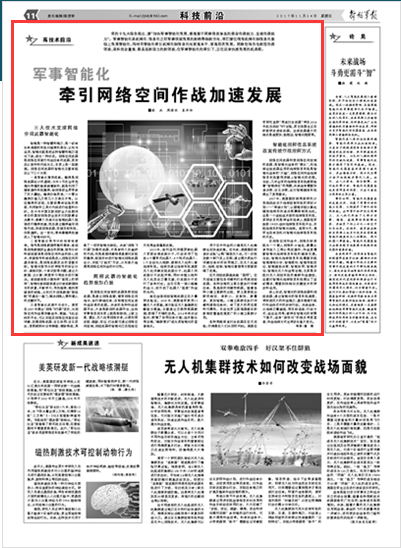
The report to the 19th National Congress of the Communist Party of China pointed out that it is necessary to “accelerate the development of military intelligence and improve joint operational capabilities and all-domain operational capabilities based on network information systems.” Today’s *PLA Daily* published an article stating that military intelligence is a new trend and direction in the development of the military field after mechanization and informatization. We must develop intelligence on the basis of existing mechanization and informatization, while using intelligence to drive mechanization and informatization to a higher level and a higher standard. Cyberspace, as a new operational domain, is a new field with high technological content and the greatest innovative vitality. Under the impetus of military intelligence, it is ushering in a period of rapid development opportunities.Illustration: Lei Yu

Military intelligence is driving the accelerated development of cyberspace operations.

■ Respected soldiers Zhou Dewang Huang Anwei

Three key technologies support the intelligentization of cyberspace weapons.

Intelligence is a kind of wisdom and capability; it is the perception, cognition, and application of laws by all systems with life cycles. Intelligentization is the solidification of this wisdom and capability into a state. Cyberspace weapons are weapons used to carry out combat missions in cyberspace. Their form is primarily software and code, essentially a piece of data. The intelligence of cyberspace weapons is mainly reflected in the following three aspects:

First, there’s intelligent vulnerability discovery. Vulnerabilities are the foundation of cyber weapon design. The ransomware that spread globally this May exploited a vulnerability in the Microsoft operating system, causing a huge shock in the cybersecurity community. Vulnerabilities are expensive, with a single zero-day vulnerability costing tens to hundreds of thousands of dollars. Previously, vulnerability discovery relied mainly on experienced hackers using software tools to inspect and analyze code. However, at the International Cybersecurity Technology Competition finals held during this year’s China Internet Security Conference, participants demonstrated how intelligent robots could discover vulnerabilities on-site, then use these vulnerabilities to write network code, creating cyber weapons to breach target systems and capture the flag. This change signifies that vulnerability discovery has entered the era of intelligent technology.

Second, intelligent signal analysis and cryptography. Signals are the carriers of network data transmission, and cryptography is the last line of defense for network data security. Signal analysis and cryptography are core technologies for cyberspace warfare. Breaking through signals and cryptography is the fundamental path to entering cyberspace and a primary target of cyber weapons attacks. Intelligent signal analysis solves problems such as signal protocol analysis, modulation identification, and individual identification through technologies such as big data, cloud computing, and deep learning. Cryptography is the “crown jewel” of computational science. Intelligent cryptography, through the accumulation of cryptographic data samples, continuously learns and searches for patterns to find the key to decryption, thereby opening the last door of the network data “safe” and solving the critical links of network intrusion and access.

Thirdly, there is the design of intelligent weapon platforms. In 2009, the U.S. military proposed the “Cyber ​​Aircraft” project, providing platforms similar to armored vehicles, ships, and aircraft for cyberspace operations. These platforms can automatically conduct reconnaissance, load cyber weapons, autonomously coordinate, and autonomously attack in cyberspace. When threatened, they can self-destruct and erase traces, exhibiting a certain degree of intelligence. In the future, the weapons loaded onto “Cyber ​​Aircraft” will not be pre-written code by software engineers, but rather intelligent cyber weapons will be designed in real-time based on discovered vulnerabilities, enabling “order-based” development and significantly improving the targeting of cyberspace operations.

The trend of intelligentization in network-controlled weapons is becoming increasingly prominent.

Weapons controlled by cyberspace, or cyber-controlled weapons, are weapons that connect to a network, receive commands from cyberspace, execute cross-domain missions, and achieve combat effects in physical space. Most future combat weapon platforms will be networked, making military information networks essentially the Internet of Things (IoT). These networks connect to satellites, radars, drones, and other network entities, enabling control from perception and detection to tracking, positioning, and strike. The intelligence of cyber-controlled weapons is rapidly developing across land, sea, air, space, and cyber domains.

In 2015, Syria used a Russian robotic force to defeat militants. The operation employed six tracked robots, four wheeled robots, an automated artillery corps, several drones, and a command system. Commanders used the command system to direct drones to locate militants, and the robots then charged, supported by artillery and drone fire, inflicting heavy casualties. This small-scale battle marked the beginning of robotic “team” operations.

Network-controlled intelligent weapons for naval and air battlefields are under extensive research and development and verification. In 2014, the U.S. Navy used 13 unmanned surface vessels to demonstrate and verify the interception of enemy ships by unmanned surface vessel swarms, mainly by exchanging sensor data, and achieved good results. When tested again in 2016, functions such as collaborative task allocation and tactical coordination were added, and “swarm awareness” became its prominent feature of intelligence.

The development of swarms of small, micro-sized drones for aerial combat is also rapid. In recent years, the U.S. Department of Defense has conducted multiple tests of the Partridge micro-drone, capable of deploying dozens or even hundreds at a time. By enhancing its coordination capabilities during reconnaissance missions, progress has been made in drone formation, command, control, and intelligent management.

Space-based cyber-control weapons are becoming increasingly “intelligent.” The space-based cyber-control domain primarily comprises two categories of weapons: reconnaissance and strike weapons. Satellites of various functions mainly perform reconnaissance missions and are typical reconnaissance sensors. With the emergence of various microsatellite constellations, satellites are exhibiting new characteristics: small size, rapid launch, large numbers, and greater intelligence. Microsatellite constellations offer greater flexibility and reliability in performing reconnaissance and communication missions, and currently, the world’s leading satellite powers are actively developing microsatellite constellation plans with broader coverage.

Various hypersonic strike weapons are cruising in the air, like a sword of Damocles hanging over people’s heads. The U.S. Air Force Research Laboratory stated that the “hypersonic strike weapon” will begin flight testing around 2018, and other countries are also actively developing similar weapons. The most prominent features of these weapons are their high speed, long range, and high level of intelligence.

Intelligent command information systems are changing traditional combat command methods.

Cyber ​​weapons and weapons controlled by cyberspace constitute the “fist” of intelligent warfare, while the command information systems that direct the use of these weapons are the “brain” of intelligent warfare. Cyberspace operational command information systems must keep pace with the process of intelligentization. Currently, almost all global command information systems face the challenge of “intelligent lag.” Future warfare requires rapid and autonomous decision-making, which places higher demands on intelligent support systems.

In 2007, the U.S. Defense Advanced Research Projects Agency (DARPA) launched the “Deep Green Program,” a research and development program for command and control systems, aiming to enable computer-aided commanders to make rapid decisions and gain a decisive advantage. This is a campaign-level command information system, developed to be embedded into the U.S. Army’s brigade-level C4ISR wartime command information system, enabling intelligent command by commanders. Even today, the U.S. military has not relaxed its development of intelligent command information systems.

In cyberspace warfare, network targets are represented by a single IP address accessing the network. Their sheer number makes efficient manual operation difficult, necessitating the support of intelligent command and information systems. Currently, intelligent command and information systems need to achieve functions such as intelligent intelligence analysis, intelligent sensing, intelligent navigation and positioning, intelligent decision support, intelligent collaboration, intelligent assessment, and intelligent unmanned combat. In particular, they must enable swarm operational control of unmanned network control systems. All of these requirements urgently demand intelligent command and information systems, necessitating accelerated research and development and application of relevant key technologies.

In conclusion, intelligent cyber weapons and network control weapons, coordinated through intelligent information systems, will form enormous combat capabilities, essentially enabling them to carry out all actions in current combat scenarios. Future warfare, from command force organization to target selection, action methods, and tactical applications, will all unfold within an intelligent context. The “gamification” of warfare will become more pronounced, and operational command methods will undergo significant changes.

In future battlefields, combat will require not only courage but also intelligence.

■ Yang Jian, Zhao Lu

Currently, artificial intelligence is entering a new stage of development and is rapidly penetrating various fields. Influenced by this process, military competition among nations surrounding intelligent technologies has begun. Our army has always been a brave and tenacious people’s army, determined to fight and win. On the future battlefield, we should continue to carry forward our glorious traditions while more broadly mastering and utilizing the latest technological achievements to develop more intelligent weapons and equipment, thereby gaining a decisive advantage on the future battlefield.

Intelligentization is a trend in human societal development, and intelligent warfare is rapidly approaching. The development of military intelligence has a solid foundation thanks to successful innovations that transcend existing computational models, the gradual popularization of nanotechnology, and breakthroughs in research on the mechanisms of the human brain. Consequently, intelligent weaponry is increasingly prominent, surpassing and even replacing human capabilities in areas such as intelligence analysis and combat response. Furthermore, intelligent weaponry offers significant advantages in terms of manpower requirements, comprehensive support, and operating costs, and is increasingly becoming the dominant force in warfare.

The development and application of intelligent weaponry have proven to expand the scope of military operations and significantly enhance the combat effectiveness of troops. In the battlefields of Afghanistan and Iraq, drones have undertaken most of the reconnaissance, intelligence, and surveillance support missions, and have been responsible for approximately one-third of the air strike missions. In the past two years, Russia has also repeatedly used highly intelligent unmanned reconnaissance aircraft and combat robots in the Syrian theater. Intelligent weaponry is increasingly demonstrating its significant value, surpassing that of traditional weapons.

In future wars, the contest of intelligent combat systems will be the key to victory in high-level competition and ultimate showdowns. As the development of technology-supported military means becomes increasingly uneven, whoever first acquires the capability to conduct intelligent warfare will be better positioned to seize the initiative on the battlefield. Those with a technological advantage will minimize the costs of war, while the weaker will inevitably suffer enormous losses and pay a heavy price. We must not only accelerate innovation in core technologies and the development of weaponry, but also research and explore organizational structures, command methods, and operational models adapted to the development of intelligent military operations. Furthermore, we must cultivate a talent pool capable of promoting intelligent military development and forging intelligent combat capabilities, fully leveraging the overall effectiveness of our military’s combat system, and winning wars in a more “intelligent” manner against our adversaries.

現代國語:

党的十九大报告指出,要“加快军事智能化发展,提高基于网络信息体系的联合作战能力、全域作战能力”。今天的《解放军报》刊发文章指出,军事智能化是机械化、信息化之后军事领域发展的新趋势和新方向,我们要在现有机械化和信息化基础上发展智能化,同时用智能化牵引机械化和信息化向更高水平、更高层次发展。网络空间作为新型作战领域,是科技含量高、最具创新活力的新领域,在军事智能化的牵引下,正在迎来快速发展的机遇期。制图:雷 煜

军事智能化牵引网络空间作战加速发展

■敬兵 周德旺 皇安伟

三大技术支撑网络空间武器智能化

智能是一种智慧和能力,是一切有生命周期的系统对规律的感应、认知与运用,智能化就是把这种智慧和能力固化下来,成为一种状态。网络空间武器是网络空间遂行作战任务的武器,其形态以软件和代码为主,本质上是一段数据。网络空间武器的智能化主要体现在以下三个方面:

一是智能化漏洞挖掘。漏洞是网络武器设计的基础,今年5月在全球范围内传播的勒索病毒软件,就是利用了微软操作系统漏洞,给网络安全界带来了巨大震动。漏洞价格昂贵,一个零日漏洞价值几万到几十万美元不等。以往漏洞的发现,主要依靠有经验的黑客,利用软件工具对代码进行检查和分析。在今年中国互联网安全大会期间举办的国际网络安全技术对抗联赛总决赛中,参赛人员演示由智能机器人现场进行漏洞挖掘,然后通过漏洞编写网络代码,形成网络武器,攻破目标系统,夺取旗帜。这一变化,意味着漏洞挖掘进入了智能化时代。

二是智能化信号分析和密码破译。信号是网络数据传输的载体,密码是网络数据安全最后的屏障,信号分析和密码破译是网络空间作战的核心技术,突破信号和密码是进入网络空间的基本路径,是网络武器攻击的首要目标。智能化信号分析将信号的协议分析、调制识别、个体识别等问题,通过大数据、云计算、深度学习等技术进行解决。密码破译是计算科学“皇冠上的明珠”,智能化密码破译通过对密码数据样本的积累,不断学习、寻找规律,能找到破译的钥匙,从而打开网络数据“保险柜”的最后一道门,解决网络入侵和接入的关键环节。

三是智能化武器平台设计。美军在2009年提出“网络飞行器”项目,为网络空间作战提供像战车、舰艇、飞机这样的平台,可以实现在网络空间里自动侦察、加载网络武器、自主协同、自主攻击,受到威胁时自我销毁、清除痕迹,具备了一定的智能化特征。未来“网络飞行器”加载的武器,不是软件人员编好的代码,而是根据侦察结果直接对发现的漏洞,现场实时进行智能化网络武器设计,实现“订购式”开发,从而极大地提高网络空间作战的针对性。

网控武器的智能化趋势愈加凸显

受网络空间控制的武器简称网控武器,是通过网络连接,接受网络空间指令,执行跨域任务,在物理空间达成作战效果的武器。未来的各种作战武器平台,大多是联网的武器平台,这样军事信息网本质上就是物联网,上联卫星、雷达、无人机等网络实体,从感知到发现、跟踪、定位、打击都可通过网络空间控制,网控武器的智能化已在陆海空天电等战场蓬勃发展。

2015年,叙利亚利用俄罗斯机器人军团击溃武装分子,行动采用了包括6个履带式机器人、4个轮式机器人、1个自动化火炮群、数架无人机和1套指挥系统。指挥员通过指挥系统调度无人机侦察发现武装分子,机器人向武装分子发起冲锋,同时伴随火炮和无人机攻击力量支援,对武装分子进行了致命打击。这仅仅是一场小规模的战斗,却开启了机器人“组团”作战的先河。

海空战场网控智能武器正在大量研发验证。2014年,美国海军使用13艘无人水面艇,演示验证无人艇集群拦截敌方舰艇,主要通过交换传感器数据,取得了不错的效果。2016年再次试验时,新增了协同任务分配、战术配合等功能,“蜂群意识”成为其智能化的显著特点。

用于空中作战的小微型无人机蜂群也在快速发展。近年来,美国国防部多次试验“山鹑”微型无人机,可一次投放数十架乃至上百架,通过提升其执行侦察任务时的协同能力,在无人机编队、指挥、控制、智能化管理等方面都取得了进展。

空天网控武器越来越“聪明”。空天领域主要包含侦察和打击两类网控武器,各种功能的卫星主要执行侦察任务,是典型的侦察传感器。随着各种小微卫星群的出现,使卫星表现出新的特征:体积小、发射快、数量多、更加智能。小微卫星群在执行侦察和通信任务时,有了更大的灵活度和可靠性,目前世界卫星强国都在积极制定覆盖范围更广的小微卫星群计划。

各种高超音速打击武器在空天巡航,仿佛悬在人们头顶的利剑。美国空军研究室称“高速打击武器”将在2018年前后启动飞行试验,其它各国也正在积极研发类似武器。这类武器最大的特点是速度快、航程远、智能化程度高。

智能化指挥信息系统改变传统作战指挥方式

网络空间武器和受网络空间控制的武器,是智能化战争的“拳头”,而指挥这些武器运用的指挥信息系统是智能化战争的“大脑”,网络空间作战指挥信息系统要同步跟上智能化的进程。当前,几乎全球的指挥信息系统都面临着“智能滞后”的难题,未来战争需要快速决策、自主决策,这对智能辅助系统提出了更高要求。

2007年,美国国防部高级研究计划局启动关于指挥控制系统的研发计划——“深绿计划”,以期能实现计算机辅助指挥员快速决策赢得制胜先机。这是一个战役战术级的指挥信息系统,其研发目的是将该系统嵌入美国陆军旅级C4ISR战时指挥信息系统中去,实现指挥员的智能化指挥。直到今天,美军也没有放松对智能化指挥信息系统的开发。

在网络空间作战中,网络目标表现为一个接入网络的IP地址,数量众多导致人工难以高效操作,作战更需要智能化指挥信息系统的辅助支撑。当前,智能化指挥信息系统需要实现智能情报分析、智能感知、智能导航定位、智能辅助决策、智能协同、智能评估、智能化无人作战等功能,尤其是实现对无人网控系统的集群作战操控,这都对智能化指挥信息系统提出了迫切需求,需要加快相应关键技术的研发和运用。

综上所述,智能化的网络武器和网控武器,通过智能化的信息系统调度,将形成巨大的作战能力,基本能遂行现行作战样式中的所有行动。未来战争,从指挥力量编组、到目标选择、行动方式、战法运用等,都将在智能化的背景下展开,战争“游戏化”的特点将更显著,作战指挥方式也将发生重大变化。

未来战场 斗勇更需斗“智”

■杨建 赵璐

当前,人工智能发展进入崭新阶段,并开始向各个领域加速渗透。受这一进程的影响,各国围绕智能化的军事竞争已拉开帷幕。我军历来是一支英勇顽强、敢打必胜的人民军队,未来战场上应继续发扬光荣传统,同时要更加广泛地掌握和利用最新的科技成果,研制出更多智能化的武器装备,在未来战场上掌握制胜先机。

智能化是人类社会发展的趋势,智能化战争正在加速到来。正是由于超越原有体系结构计算模型的成功创新、纳米制造技术的逐步普及,以及对人脑机理研究的突破性进展,军事智能化发展才拥有了坚实的基础。因此,智能化武器装备的表现日益突出,并在情报分析、战斗反应等方面开始超越并替代人类。此外,在人力需求、综合保障、运行成本等方面,智能化武器装备也具有明显的优势,正在日益成为战争的主导力量。

事实证明,智能化武器装备的发展应用,拓展了军事行动的能力范围,大幅提升了部队的作战效能。在阿富汗和伊拉克战场上,无人机已承担了大部分侦察、情报、监视等作战保障任务,并担负了约三分之一的空中打击任务。近两年,俄罗斯在叙利亚战场上也多次使用具有较高智能化程度的无人侦察机、战斗机器人等装备。智能化武器装备正在愈来愈多地展现出超越传统武器的重要价值。

未来战争中,作战体系智能化的较量将是高手过招、巅峰对决的制胜关键。随着以科技为支撑的军事手段发展的不平衡性越来越大,谁先具备实施智能化作战的能力,谁就更能掌握战场的主动权,拥有技术代差优势的强者会尽可能将战争成本降到最低,而弱者必然遭受巨大损失,付出惨重代价。我们不仅要加紧核心技术创新、武器装备研制,还要研究探索适应军事智能化发展的组织结构、指挥方式和运用模式,更要培养一支能够担起推进军事智能化发展、锻造智能化作战能力的人才队伍,充分发挥我军作战体系的整体效能,在与对手的较量中,以更加“智慧”的方式赢得战争。

中國原創軍事資源:http://www.81.cn/jwzl/2017-11/24/content_7841898885.htm

Chinese Military Operational Transition “Cyber Warfare” to “Mosaic Warfare”

中國軍事行動從「網路戰」轉型為「馬賽克戰」

現代英語:

Theory is the precursor of action. Strengthening innovation in combat concepts and promoting innovation in combat guidance have always been important ways for militaries around the world to develop military advantages. In recent years, the U.S. military has successively proposed cutting-edge combat theories such as “cyber warfare”“ and mosaic warfare”, in order to realize that the combat model “production relationship” can be more adapted to the development of combat capabilities “productivity”. Through comparative analysis of these two combat theories, the world can get a glimpse of the changes in the thinking of building the US military’s combat capabilities, especially the understanding of the winning mechanism “mosaic warfare”, so as to find targeted and effective checks and balances.

● From threat response to war design——

Active shaping and improvement of traction combat capability

“Threat-based ”or “capability-based” are two basic ways to build military combat capabilities.“ Threat-based ”reflecting demand traction and focusing on solving real-life problems in the near and medium term are the basic rules that the military should follow in building combat capabilities; “based on capabilities” embodying goal traction, aiming at future strategic missions, and supporting strategic concepts with new combat theories are the key to military combat capabilities. The only way to innovate and surpass. The development from “cyber warfare” to “mosaic warfare” reflects the differences and evolution of the internal laws of the above two approaches, and also reflects the changes in the thinking and concepts of the US military in promoting combat capability construction in recent years.

New changes in concept origin. Cyberspace was originally born to solve human communication needs. Later, it gradually evolved into a new combat domain independent of land, sea, air, and space. From this, a “cyber war” with the struggle for cyberspace control as the core was derived. In comparison, “mosaic warfare” is a new combat concept actively developed and designed by the US military in order to continue to maintain its strategic advantage and directly target competitors. Its formation process reflects the integration of demand traction and capability traction, and its strategy, initiative, and traction Sex is more prominent.

New ideas for the use of technology.“ Cyber warfare ”emphasis on supporting the transformation and implementation of combat concepts through the development of new generation technologies.“ Mosaic Warfare” breaks out of this model and does not place too much emphasis on the development of a new generation of equipment technology. It pays more attention to the rapid transformation of general military and civilian technologies and the incremental iteration of mature technologies. The basic idea is to build on existing equipment and follow the application concepts of service platforms such as online ride-hailing and crowdfunding development. Through module upgrades and intelligent transformation, various combat system units “mosaicization” will be transformed into single-function, flexible Assemble and replaceable “building blocks” or “pixels” to build a dynamically coordinated, highly autonomous, and seamlessly integrated combat system Embodied new technology-driven ideas.

Path Development New Design.“ Cyber warfare ”as a companion concept to the network space, wherever the network space develops, “cyber warfare” will follow suit. Generally speaking, “objective” material conditions will be considered first, and then “subjective” conceptual design will be carried out. It has strong dependence on path development.“ Mosaic warfare ”first from “subjective” to “objective”, by developing a force design model that can dynamically adjust the functional structure, it can adapt to different combat needs and changes in the battlefield environment.

It can be seen that “mosaic warfare” has clearer goals, more mature technology, and more reliable paths than previous combat concepts such as “cyber warfare”, reflecting the change in thinking actively shaped by the US military.

● From network center to decision center——

Group intelligence to achieve optimal system energy release

AI technology is a key variable in the information age and a core increment in the development of the “mosaic warfare” system.“ Cyber warfare ”emphasis on “network center”, “mosaic warfare” closely focuses on the core of artificial intelligence technology, adjusts the key to victory from “network center” to “decision-making center”, and changes the combat system structure from system level and platform level Joint transformation to functional level and factor level integration, seeking to fully gather energy in the network The “group intelligence technology” realizes the optimal release of the system and gives new connotation to the war winning mechanism in the intelligent era.

Use “fast” to control “slow” to seize the cognitive lead. In future wars, the battlefield situation will change rapidly, and the weight of time factors will continue to increase. “Fast” versus “Slow” can form a combat strike effect that is approximately dimensionally reduced.“ Mosaic War ” By using data information technology and artificial intelligence technology, we can improve the single-ring decision-making speed of our own “OODA” ring, expand the breadth of parallel decision-making, reduce the granularity of group decision-making, accelerate the progress of system operations, and create an overall one-step faster “First move” situation, aiming to firmly control the dominance of cognitive decision-making on the battlefield.

With “low” system “high”, we accumulate cost advantages. Different from the traditional combat concept of pursuing high-end weapon platforms, “mosaic warfare” focuses on using artificial intelligence technology to tap the potential and increase efficiency of existing weapon platforms and combat resources. By loading and operating intelligent algorithms and specific functional modules on many mid-to-low-end weapon platforms, it can achieve combat performance comparable to high-end weapon platforms, overall improving the cost-effectiveness ratio of the input and output of the weapon platform, thereby accumulating cost advantages.

To “disperse” control “gather” and seek sustainable survival. “ Mosaic Warfare ” emphasizes the adoption of decentralized ideas and asymmetric checks and balances, using an open system architecture, and decentralized configuration of various functions such as reconnaissance, positioning, communication, and strike on various manned/unmanned platforms to achieve power. Distributed deployment. At the same time, relying on intelligent algorithms to improve the self-organization, self-coordination, and independent attack capabilities of each platform to achieve dispersion and concentration of firepower. When some combat platforms are eliminated, interfered with or stripped away, the entire combat system can still operate normally, thereby enhancing the continued viability of the battlefield of the force cluster.

Use “movement” to control “stillness” to improve system flexibility. “ Mosaic warfare ” emphasizes further breaking through the barriers of various combat areas. By turning the fixed “kill chain” in different combat domains into a dynamically reconfigurable “kill net”, the “OODA” large ring is disassembled into small rings, and the single ring is differentiated into multiple rings. According to changes in combat processes and combat requirements, intelligent networking is relied on to realize the split-in-movement, call-in-movement and combination of combat forces. In this way, on the one hand, it can enhance the flexibility and adaptability of the combat system; on the other hand, it can also hedge and offset the node aggregation effect of complex networks, making it difficult for opponents to find key nodes to defeat their own systems.

“Mosaic warfare” provides a reference prototype for intelligent operations. But at the same time, as an idealized force design and application framework, “mosaic warfare” still needs closely related technical, doctrinal, policy and other supporting support. There is still a long way to go before it is fully realized, and it is consistent with traditional combat systems. The coexistence situation will exist for a long time.

● From factor integration to system restructuring——

Dynamic structure to enhance combat system flexibility

Structure and relationships often determine function and nature.“ Cyber warfare ”and “mosaic warfare” are built on the common material foundation of the information age and follow the same evolutionary paradigm, but the principles and effects of system construction are different.“ The system structure formed by cyber warfare” is statically deconstructable, while “mosaic warfare” dynamically combines functional units according to certain construction rules to form a flexible system structure with self-organizing and adaptive characteristics, similar to a “dynamic black box”, which is difficult to follow with conventional means. predict. And this flexible structure often “emerges” new capabilities to empower and increase effectiveness in the combat system.

The integrated development of network and cloud makes combat time and space more dynamic and malleable. The Internet and the cloud are the basic environment for the operation of the information combat system. They reshape the process elements of intelligence, accusation, strike, and support in traditional operations, and at the same time derive new combat time and space.“ Cyber warfare ”mainly focusing on network space, its combat time and space are relatively static.“ Mosaic warfare ” is not limited to a single combat space. Under the development trend of information infrastructure network following cloud movement and cloud network integration, tangible and intangible spaces can be further deep-linked. The boundaries between combat time and space are more flexible, and the allocation of combat resources is more flexible, the combat system structure is more dynamic.

Data flows across domains, making operational control more seamlessly coordinated. In the “Command and Control” link, “cyber warfare” focuses on the command and control of combat units by joint combat command agencies. Cross-domain exchange and flow of data is mainly concentrated on the theater battlefield.“ Mosaic warfare ”further sinks the level of joint operations to the tactical end. Through the autonomous cross-domain exchange and seamless flow of data at the tactical level, various data islands can be clustered into data clusters on demand, thereby producing a significant “spillover” effect, making the dynamic, discrete, agile, and parallel characteristics of the combat command control loop more obvious, and more conducive to achieving agile connection of each combat unit on demand Efficiently act in concert.

Algorithm full-dimensional penetration makes system operation more autonomous and efficient. Algorithms are the mapping of human consciousness in cyberspace, forming two basic forms: compilation codes transformed by intention and neural networks transformed by knowledge. In “cyber warfare”, compiled code is widely used, and neural networks are only used locally. In “Mosaic Warfare”, the algorithm expands the two key functions of shaping rules and providing engines, and the breadth and depth of application are more prominent. Shaping rules is mainly based on compilation code, supplemented by neural networks, to construct the process framework and operating logic of the “mosaic warfare” system, laying a structural foundation for its uncertainty, adaptability and ability “emergence”; the provision engine mainly integrates intelligent algorithms The model is distributed to the edge elements to operate, forming a knowledge diffusion effect, thereby comprehensively improving the intelligent autonomous combat capabilities of the “mosaic warfare” system.

The side end releases energy independently, making the combat style more flexible and polymorphic. The edge is an abstract model of various manned/unmanned combat functional units and a direct source of systemic capabilities “emergence”.“ Cyber warfare ”in a system where edge elements are closely coupled with superior and subordinate accusation processes and are in a state of precise control.“ In the mosaic warfare” system, the perception, interaction, reasoning, and decision-making capabilities of edge-end elements are greatly improved. Its “OODA” ring does not need to be linked back to the superior command structure, which is conducive to supporting the formation of a decentralized combat cluster with high and low matching and manned/unmanned combination. form, which can give edge-end elements more self-organizing authority and significantly enhance the battlefield confrontation advantage.

It can be seen that if “cyber warfare” is called a sophisticated war machine, “mosaic warfare” can be regarded as a complex “ecology” that can stimulate the dynamic growth of combat capabilities. New changes in network clouds, data, algorithms, and edges have contributed to The formation of a dynamically complex “system structure”. This structure in turn reversely regulates elements, platforms and systems, and new capabilities continue to emerge, playing an important role in enhancing and evolving the combat system.

● From “system breaking to compound confrontation——”

To analyse the advantages and disadvantages and seek effective checks and balances

“Mosaic warfare” represents to a certain extent the possible direction of the future development of joint operations. It is necessary to fully analyze and grasp the winning mechanism of “mosaic warfare”, shape the field of information and communication as a new quality and new domain that breaks the traditional boundaries of war time and space, create a new concept of network cloud-enabled combat, build and strengthen the support and support capabilities of national defense information infrastructure, and highlight military information network security defense capabilities, enhance the minimum support capabilities for the operation of strategic campaign command organizations, and continuously improve the network information system.

On the other hand, the emergence of the “mosaic warfare” theory makes it difficult for traditional combat methods to attack target nodes with limited capture and control to achieve the system-breaking effect of breaking points and breaking chains. But it should be noted that any system has its inherent contradictions, and the seemingly “impeccable” decentralized structure of “mosaic warfare” can still find ways to effectively crack it. For example, grasp its system complexity characteristics, use its correlation dependence, highlight the functional suppression of communication networks, construct network-electrical composite attack paths, and achieve disassembly and isolation of various units of the combat system; grasp its structural dissipation characteristics, and use Its external information dependence highlights the disguise and misleading of information data, prompting the combat system to transform into abnormal states such as information closure and information overload; Grasp its group autonomy characteristics, use its key technology dependence, highlight the confrontation and efficiency reduction of intelligent algorithms, and suppress the intelligent internal drive of each combat unit; grasp its functional non-linear characteristics, use its unknown vulnerabilities, and highlight battlefield differentiation Strike assessment, test and discover operational system imbalances with higher efficiency and faster speed, and find key weaknesses in system attack.

(Author’s unit: Unit 61001)

現代國語:

編者按

理論是行動的先導。加強作戰概念創新、推動作戰指導革新,歷來是世界各國軍隊培塑軍事優勢的重要途徑。近年來,美軍先後提出「賽博戰」「馬賽克戰」等前線作戰理論,以期實現作戰模式這一「生產關系」能夠更加適應作戰能力這一「生產力」的發展。透過對比分析這兩種作戰理論,世人可以一窺美軍作戰能力建設思路的變化,特別是認清「馬賽克戰」的製勝機理,從而有的放矢,找到有效制衡之策。

●從威脅應對到戰爭設計——

主動塑造,牽引作戰能力提升

「基於威脅」或「基於能力」是軍隊作戰能力建設的兩條基本途徑。 「基於威脅」體現需求牽引,聚焦解決近中期現實問題,是軍隊作戰能力建設應遵循的基本規律;「基於能力」體現目標牽引,瞄準未來戰略使命,以新作戰理論支撐戰略構想,是軍隊作戰能力創新超越的必由之路。從「賽博戰」向「馬賽克戰」的發展,體現了上述兩種途徑內在規律的差異與演進,也反映出美軍近年來推進作戰能力建設思維理念的變化。

概念發端新變化。網絡空間,最初為解決人類的通訊需求而生,後來逐漸演變為一個獨立於陸、海、空、天之外的新作戰域,由此衍生出以爭奪網絡空間制權為核心的「賽博戰」。與之相比,「馬賽克戰」是美軍為繼續保持戰略優勢地位,直接瞄準競爭對手而主動開發設計的新作戰概念,其形成過程體現了需求牽引與能力牽引的融合,戰略性、主動性、牽引性更加突顯。

技術運用新思路。 「賽博戰」強調,透過研發新世代技術支撐作戰概念轉化落地。 「馬賽克戰」則跳出這個模式,不過分強調研發新一代裝備技術,更加關注對軍民通用技術的快速轉化,對成熟技術的漸進迭代。其基本想法是立足現有裝備,按照類似網約車、眾籌開發等服務類平台的運用理念,通過模塊升級和智能化改造,將各類作戰系統單元“馬賽克化”為功能單一、靈活拼裝、便於替換的“積木”或“像素”,構建形成動態協調、高度自主、無縫融合的作戰體系,體現了新的技術驅動。

路徑發展新設計。 「賽博戰」作為網電空間的伴生概念,網電空間發展到哪裡,「賽博戰」就跟進到哪裡,總體上先考慮「客觀」的物質條件,再進行「主觀」的概念設計,在路徑發展上具有較強的依附性。 「馬賽克戰」則先由「主觀」再到「客觀」,透過開發可動態調整功能結構的兵力設計模型,使其能夠適應不同作戰需求及戰場環境變化。

由此可見,「馬賽克戰」相比「賽博戰」等過去作戰概念,其目標更加明確、技術更加成熟、路徑更加可靠,體現出美軍主動塑造的思路轉變。

●從網絡中心到決策中心—

群體智能,實現體系最優釋能

人工智慧技術是資訊時代的關鍵變量,也是「馬賽克戰」體系發展的核心增量。 《賽博戰》強調“網絡中心”,“馬賽克戰”則緊緊扭住人工智能技術這一核心,將製勝關鍵從“網絡中心”調整為“決策中心”,將作戰體系架構由系統級、平台級聯合轉變為功能級、要素級融合,謀求在網絡充分聚能的前提下,以群體性智能技術實現體系最優釋能,為勝理的戰爭賦予新涵機時代。

以“快”制“慢”,奪取認知先手。未來戰爭,戰場形勢瞬息萬變,時間要素的權重不斷上升,「快」對「慢」可以形成近似降維的作戰打擊效果。 「馬賽克戰」透過運用數據資訊技術與人工智慧技術,提升己方「OODA」環的單環決策速度,拓展並行決策廣度,降低組環決策粒度,加快體係作戰進度,在整體上塑造始終快人一步的「先手棋」態勢,旨在牢牢控制戰場認知決策的主導權。

以“低”制“高”,積累成本優勢。與追求高端武器平台的傳統作戰概念不同,「馬賽克戰」著重於利用人工智慧技術對現有武器平台及作戰資源的挖潛增效。透過在眾多中低階武器平台上加載運行智慧演算法和特定功能模塊,使其達到媲美高端武器平台的作戰性能,整體上提高了武器平台投入產出的效費比,進而積累形成成本優勢。

以“散”制“聚”,謀求持續生存。 「馬賽克戰」強調採用化整為零的去中心化思路和非對稱制衡理念,使用開放系統架構,在各類有人/無人平台上分散配置偵察、定位、通信、打擊等各類功能,實現力量的分佈式部署。同時,依托智能演算法提升各平台的自組織、自協同、自主攻擊能力,實現形散神聚、火力集中。當部分作戰平台被消滅、幹擾或剝離後,整個作戰體系仍能正常運轉,從而增強兵力集群的戰場持續生存能力。

以“動”制“靜”,提升體系彈性。 「馬賽克戰」強調進一步突破各作戰域壁壘。通過把不同作戰域中固定的“殺傷鏈”變成可動態重構的“殺傷網”,將“OODA”大環拆解為小環,單環分化為多環。根據作戰進程和作戰需求的變化,依托智能組網實現作戰力量的動中拆分、動中調用、動中組合。如此,一方面可增強作戰體系的靈活性、適應性;另一方面還可對沖抵消複雜網絡的節點聚集效應,使對手難以找到破擊己方體系的關鍵節點。

「馬賽克戰」為智慧化作戰提供了一種可藉鑑的參考原型。但同時,作為一種理想化的兵力設計和運用框架,「馬賽克戰」還需要與之緊密相關的技術、條令、政策等配套支持,距離完全實現還有很長的路要走,與傳統作戰體系共存的局面將長期存在。

●從要素整合到體系重組—

動態結構,增強作戰體係彈性

結構和關系往往決定功能和性質。 「賽博戰」與「馬賽克戰」建構於資訊時代共同的物質基礎,遵循相同的演進範式,但體系建構的原理和效果有所不同。 「賽博戰」形成的體系結構靜態可解構,而「馬賽克戰」則按照一定構建規則動態組合功能單元,形成具有自組織、自適應特徵的彈性體系結構,類似一種“動態黑箱”,常規手段難以跟踪預測。而這一彈性結構常會「湧現」出新的能力,為作戰體系賦能增效。

網雲融合發展,使作戰時空更動態可塑。網和雲是資訊化作戰體系運作的基礎環境,重塑了傳統作戰中情報、指控、打擊、保障的流程要素,同時衍生出新的作戰時空。 「賽博戰」主要聚焦網電空間,其作戰時空相對靜態。 「馬賽克戰」則不限於單一作戰空間,在資訊基礎設施網隨雲動、雲網一體的發展趨勢下,可進一步深度鉸鏈有形無形空間,作戰時空邊界更有彈性,作戰資源配置更加靈活,作戰體系結構更具動態。

數據跨域流轉,使作戰控制更加無縫協同。在指揮控制環節,「賽博戰」關注的重點是聯合作戰指揮機構對作戰單元的指揮控制,數據跨域交換流轉主要集中在戰區戰場。 「馬賽克戰」則進一步將聯合作戰的層級下沉至戰術末端,通過數據在戰術層面的自主跨域交換和無縫流轉,實現各類數據孤島按需集聚為數據集群,進而產生顯著的「溢出」效應,讓作戰指揮控制環路動態、離散、敏捷、並行的特徵更為明顯,更加有利於實現各作戰單元按需銜接、高效協同行動。

演算法全維滲透,使體系運作更加自主高效。演算法是人的意識在網絡空間的映射,形成了由意圖轉化的編譯代碼和由知識轉化的神經網絡兩種基本形態。在「賽博戰」中,編譯代碼大量應用,神經網絡只在局部應用。在「馬賽克戰」中,演算法擴展出塑造規則、提供引擎兩項關鍵職能,運用的廣度深度更加突出。塑造規則以編譯代碼為主,輔以神經網絡,構造「馬賽克戰」體系的流程框架和運行邏輯,為其不確定性、適應性和能力「湧現」性奠定結構基礎;提供引擎則主要將智能演算法模型分發至邊端要素運行,形成知識擴散效應,從而全面提升「馬賽克戰」體系的智能自主作戰能力。

邊端自主釋能,使作戰樣式更靈活多態。邊端是各類有人/無人作戰功能單元的抽像模型,也是體系能力「湧現」的直接來源。 「賽博戰」體系中,邊端要素與上下級指控流程緊密耦合,處於精確受控狀態。 「馬賽克戰」體系中,邊端要素的感知、交互、推理、決策能力大大提升,其「OODA」環不必回鏈至上級指揮機構,有利於支撐形成高低搭配、有人/無人結合的去中心化作戰集群形態,可以賦予邊端要素更多自組織權限,明顯增強了戰場對抗優勢。

可見,如果稱“賽博戰”為精密的戰爭機器,“馬賽克戰”則可以視為一種能夠激發作戰能力動態生長的復雜“生態”,網雲、數據、算法、邊端所產生的新變化,促進形成了動態復雜的“體系結構”。這一結構又反向調控要素、平台和系統,不斷湧現新的能力,為作戰體系增能、演變發揮重要作用。

●從體系破擊到復合對抗——

辨析優劣,尋求有效制衡之策

「馬賽克戰」某種程度上代表著未來聯合作戰形態發展的可能方向。應當充分研析把握「馬賽克戰」的製勝機理,將資訊通信領域作為打破傳統戰爭時空界限的新質新域加以塑造,打造網雲賦能作戰新概念,建強國防資訊基礎設施支撐保障能力,突顯軍事資訊網安全防禦能力,增強戰略戰役指揮機構運行的保底支撐能力,不斷完善網絡資訊體系。

另一方面,「馬賽克戰」理論的出現,使得打擊奪控有限目標節點的傳統作戰手段,難以達成毀點斷鏈的體系破擊效果。但應當看到,任何體係都有其固有矛盾,「馬賽克戰」看似「無懈可擊」的去中心化結構,仍可以找到有效破解的方法路徑。例如,掌握其體系複雜性特徵,利用其關聯關係依賴性,突出針對通信網絡的功能抑制,構建網電復合攻擊路徑,實現對作戰體系各單元的拆解孤立;把握其結構耗散性特徵,利用其外部信息依賴性,突出針對信息數據的偽裝誤導,促使作戰體係向信息封閉、信息過載等非正常狀態轉化;掌握其群體自主性特徵,利用其關鍵技術依賴性,突出針對智能算法的對抗降效,抑制各作戰單元的智能內驅力;把握其功能非線性特徵,利用其未知脆弱性,突出戰場差異化打擊評估,以更高的效率和更快的速度失衡、發現作戰體系擊點,尋找體系破擊的關鍵弱點。

(作者單位:61001部隊

中國原創軍事資源:http://www.mod.gov.cn/gfbw/jmsd/4894734888.html?big=fan